Best Data Science Degree Programs
Compare 220+ accredited Data Science programs at 210+ colleges, with net price after aid, graduation rates, earnings and debt from IPEDS and the U.S. College Scorecard.

The Bureau of Labor Statistics projects data scientist employment to grow 35% from 2025 to 2035, with roughly 24,800 openings each year. The standard entry credential is the Bachelor of Science (B.S.) in Data Science, a degree built on calculus, linear algebra, statistics and programming.
Price is where comparable programs split. Net cost after aid and earnings a few years out diverge sharply, and regional accreditation matters more than whether the degree is delivered online or on campus.
Every program considered here is undergraduate; master's degrees are out of scope. Judgments rest on federal College Scorecard cost and earnings figures rather than reputation alone.
Key Points
- BLS projects data scientist jobs to grow 35% from 2025 to 2035.
- Florida Atlantic University has the lowest average net price here: $8,752.
- Plan for calculus, linear algebra, programming and statistics before declaring the major.
Best Data Science Schools for a Bachelor's Degree: Our Top 10
Cost after aid is one of the quickest ways to tell these programs apart, with net prices across the ten running from roughly $11,655 to $29,167. All ten are campus-based, so readers weighing online options should look at the online versus campus comparison further down. Beyond price, the strongest entries pair a deep quantitative core with early chances to do real data work through capstones, research, and co-ops.
Stanford University
#1Stanford, CA · $10,000 – $15,000/yr (est.)
Best for: Future quantitative researchers wanting four subplans
Stanford's data science bachelor's degree is unusually interdisciplinary even by the standards of the field, sponsored jointly by Statistics, Mathematics, Computer Science, and Management Science and Engineering. Undergraduates choose one of four subplans, from Mathematics and Computation to Computational Neuroscience, and finish with a senior capstone. A 6-to-1 student-faculty ratio and a graduation rate above 90 percent make it the most selective and best-resourced entry on this list.
- 65 units in the major within 180 university units
- Four subplans, including Computational Neuroscience and Quantitative Finance
- Senior capstone plus a writing-in-the-major requirement
- Honors track requires a 3.5 major GPA and a portfolio
- Sponsored by Statistics, Mathematics, Computer Science, and Management Science
University of Wisconsin-Madison
#2Madison, WI · ~$17,000/yr (est.)
Best for: Budget-minded Wisconsin residents
Wisconsin's flagship offers data science as a Bachelor of Arts through the Department of Statistics in the College of Letters and Science, which lets students pair heavy quantitative work with a broad liberal arts base. Declaration is deliberately accessible: students need fewer than 86 credits, a 2.000 GPA in major coursework, and attendance at a declaration event. Net price after aid sits in the middle of this group, and the university supports study abroad in more than 80 countries.
- 120 credits, housed in the Department of Statistics
- 9 credits of foundational math through MATH 221 and 222
- Data modeling via STAT 240 and STAT 340
- Programming through COMP SCI 220 or 300 plus COMP SCI 320
- 18 credits of upper-level electives, including machine learning
- Declare below 86 credits with a 2.000 major GPA
- At least 15 major credits must be taken on campus
University of Michigan
#3Ann Arbor, MI · $18,000 – $61,000/yr (est.)
Best for: Engineering students wanting a joint CSE-statistics degree
Michigan runs its data science bachelor's degree as a joint venture between the Computer Science and Engineering division and the Department of Statistics, and it is open to students enrolled in the College of Engineering. The curriculum leans toward machine learning, artificial intelligence, and statistical learning rather than general analytics. A senior thesis can stand in for the capstone, and an accelerated pathway lets strong students finish a bachelor's and master's in about five years.
- Joint program of the EECS Computer Science division and Statistics
- Open to students in the College of Engineering
- Coursework in machine learning, AI, pattern recognition, statistical learning
- Capstone required; a senior thesis can satisfy it
- Accelerated bachelor's and master's path in five to five and a half years
- 100 award-winning faculty in the CSE division
University of North Carolina at Chapel Hill
#4Chapel Hill, NC · ~$12,000/yr (est.)
UNC-Chapel Hill is the only school here offering both a Bachelor of Arts and a Bachelor of Science in data science, giving applicants two distinct on-ramps. The B.A. is built around a 44-credit core plus one of seven concentrations, while the B.S. is a cohort-based program with 12 concentration options and a 3.0 GPA threshold. Both route through the School of Data and Information Sciences, and the in-state net price is the lowest on this list.
- 44 to 45 credit hours in the major
- Seven concentrations, including Data Journalism and Urban Data Analytics
- Each concentration adds four courses, about 12 credit hours
- 2.000 GPA required overall and in the major core
- 45 credit hours must be earned in UNC-Chapel Hill courses
- Core covers responsible data science and computational thinking
- 12 concentration options
- Cohort-based structure with fall and spring start terms
- 3.0 GPA minimum plus prerequisite courses
- Four-course concentration option
- Mentored research and internship opportunities
- Admission through the School of Data and Information Sciences
University of California-Davis
#5Davis, CA · $10,000 – $15,000/yr (est.)
UC Davis awards a Bachelor of Science in Data Science from the Department of Statistics in the College of Letters and Science, with a 92-unit structure split between preparation and depth. The single Foundations Track is designed with graduate study in mind, and three domain electives push students into an application field such as agriculture, biology, or health. Admission to the major is capped, so continuing students change into it through the statistics department.
- 92 units: 40 preparatory and 52 depth units
- Depth work in databases, algorithms, data pipelines, and optimization
- Three elective courses in a related application discipline
- Single Foundations Track aimed at graduate study
- Capped admission; change of major through the Statistics department
- 2.000 GPA required in major and upper-division major courses
Columbia University in the City of New York
#6New York, NY · ~$22,000/yr (est.)
Columbia's data science major is a joint program of the Computer Science and Statistics departments in Columbia College, built around the interface between the two fields. The 18-course sequence includes a full mathematics prerequisite chain and serious work in probability, inference, and statistical machine learning. Advising comes from faculty in both departments, and the university also runs statistics-linked interdisciplinary majors for students who want a different balance.
- 18 courses jointly run by Computer Science and Statistics
- Four mathematics prerequisites; Honors Math A and B accepted
- Probability, statistical inference, and linear regression required
- Two statistics electives and three computer science electives
- 124 points of credit for the B.A.
- Courses graded Pass/D/Fail or with a D do not count toward the major
University of Illinois Urbana-Champaign
#7Champaign, IL · ~$14,000/yr (est.)
Illinois blends data science with information science rather than housing it in statistics or engineering, so the degree carries a strong information, ethics, and policy flavor alongside the technical core. The STEM-designated program requires 120 credits and six hours of research or discovery experience, which students can satisfy through a capstone, a co-op, study abroad, or a summer REU. The top 10 percent of the graduating class earn departmental distinction.
- 120 credits over four years, STEM-designated
- 28 to 31 hour data science core
- 61-hour information sciences core with 43 elective hours
- Six hours of research or discovery experience required
- Capstone, co-op, study abroad, or summer REU can fulfill it
- Top 10% of the graduating class earn departmental distinction
Northwestern University
#8Evanston, IL · $29,000/yr (est. net price)
Northwestern's data science major lives in Weinberg College of Arts and Sciences and is run by the statistics department, which keeps required departmental coursework tight at 11 units. Students choose an R or Python sequence, add technical and domain electives plus an ethics course, and finish with a capstone. Strong students can pursue honors through two quarters of independent study.
- 11 units of department courses, including a capstone
- Four foundational courses plus six core courses
- Choose the R or Python sequence; credit granted for one only
- Two technical and domain science electives
- One ethics elective required
- No more than three required courses outside the statistics department
- Honors option: two quarters of independent study
William & Mary
#9Williamsburg, VA · $15,000 – $20,000/yr (est.)
William & Mary keeps its data science bachelor's degree compact at 36 credit hours, which leaves room for a second major or a substantial minor. Coursework reaches into generative AI, applied machine learning, databases, and visualization, and students choose one of four tracks when they declare. A single 400-level DATA course serves as the capstone, and an honors project can fulfill it.
- 36 total credit hours
- Four tracks: Artificial Intelligence, Algorithms, Data Application, Spatial Data Analytics
- Each track adds three methods courses, 9 credit hours
- Coursework includes generative AI, applied machine learning, and databases
- Capstone satisfied by one 400-level DATA course
- Honors project can fulfill the capstone
San Jose State University
#10San Jose, CA · ~$14,000/yr (est.)
San Jose State's data science degree is deliberately computing-based, emphasizing data management, machine learning, and the ethics of how data is collected and used. Students apply those skills in a field of their choice, whether that means economic data, climate data, or pharmaceutical data. Its Silicon Valley location and its far more accessible admissions profile make it a different kind of bet from the private universities above, and the institution-wide graduation rate still clears two-thirds.
- Computing-based curriculum in data management and machine learning
- Ethics of data collection, analysis, and use built into the coursework
- Students apply skills in an application field of their choice
- Change-of-major policy and steps published for current students
Cost & outcomes by school
Federal data for the highest-earning Data Science programs, independent of the ranking above. Earnings are this field's bachelor's graduates four years after completing where the Scorecard reports them, else the school's undergraduate median.
| School | Net price / yr | Grad rate | Earnings | Debt | Grads/yr | Format |
|---|---|---|---|---|---|---|
| University of Health Sciences and Pharmacy in St. Louis MO | $31,817 | 62% | $137,047 | $17,755 | 2 | Campus |
| Stanford University CA | $13,807 | 92% | $124,080 | $12,000 | 23 | Campus |
| Worcester Polytechnic Institute MA | $43,071 | 90% | $103,470 | $27,000 | 59 | Campus |
| Columbia University in the City of New York NY | $21,590 | 96% | $102,491 | $21,500 | 8 | Campus |
| Rose-Hulman Institute of Technology IN | $42,513 | 78% | $101,253 | $25,000 | 7 | Campus |
| Dartmouth College NH | $29,519 | 96% | $97,434 | $17,500 | 10 | Campus |
| SUNY Maritime College NY | $22,367 | 64% | $95,951 | $23,250 | — | Campus |
| George Washington University DC | $36,586 | 84% | $90,873 | $20,449 | 35 | Campus |
| Clarkson University NY | $30,305 | 75% | $89,696 | $26,000 | 6 | Campus |
| Northwestern University IL | $29,167 | 95% | $89,363 | $15,000 | 99 | Campus |
| Case Western Reserve University OH | $41,190 | 87% | $87,989 | $24,000 | 28 | Campus |
| Saint Joseph's University - Philadelphia PA | $29,689 | 79% | $86,881 | $25,500 | 2 | Campus |
Sources: U.S. Department of Education. Net price, graduation rate, earnings and debt: College Scorecard (earnings and debt for this field's bachelor's graduates where reported, else school-wide); graduates: IPEDS. A dash means no figure is reported.
Cost, debt & payoff
Median earnings of this field's bachelor's graduates (4 yrs after completing, else the school's undergraduate median) vs. their median federal loan debt · U.S. College Scorecard
Across these programs the median graduate earns about $59,679 and finishes with roughly $23,250 in debt — a ratio that clears a common rule of thumb (keep debt below first-year salary). Net price and debt vary widely school to school, so check the per-school figures in the table above before you shortlist.
How We Ranked Bachelor's Degree in Data Science Programs
What actually separates the schools at the top of this list from the ones further down? Federal data, not reputation surveys or editor opinion.
Bachelor's-only, built on federal numbers
Every program here is an undergraduate bachelor's degree in data science or a closely related data analytics major. Master's and certificate programs were excluded outright. The underlying figures come from the U.S. Department of Education's College Scorecard and IPEDS, the federal collections accredited institutions report into. Most competing lists never say where their numbers come from. Ours are public records you can check yourself.
The factors that moved a school up or down
- Net price after aid: what students actually pay once grants and scholarships are subtracted, not the sticker tuition.
- Earnings and debt at the program level: median pay for graduates of the data science major specifically, weighed against the debt they left with.
- Graduation and retention: whether students finish, and whether first-year students come back for a second year.
- Admissions selectivity: acceptance rate and incoming test scores, used as a signal of classroom peer group rather than prestige.
- Program completions: how many data science degrees the school actually awards each year, which separates a staffed department from a thin elective track.
How to read these figures
Two caveats matter. Graduation rate and net price are reported for the whole institution, not for the data science department alone, so treat them as a picture of general student support and affordability rather than a verdict on the major. And the numbers reflect the most recent Scorecard release; smaller or newly launched data science majors sometimes have no published earnings yet, which is a sign of program age, not weakness.
Data Science Degree Cost: The Lowest Net Prices on Our List
The most affordable schools on our list are all public universities, with average net prices after aid ranging from $8,752 at Florida Atlantic University to $11,655 at UNC Chapel Hill, according to 2024 IPEDS and College Scorecard data. Out-of-state sticker tuition is far higher, roughly $12,400 more per year at Florida Atlantic and more than $32,000 more at UNC Chapel Hill. Net price is an average after grants and scholarships, not a personal quote, so run each school's net price calculator. Monthly loan payments for these specific majors are not reported, but schoolwide median debt stays under $19,000 at each school, a balance that is easier to manage in the first years after graduation than the larger loans that come with higher-cost programs.
| School | Credential | Average Net Price After Aid | In-State Tuition and Fees | Out-of-State Tuition and Fees | Median Debt at Graduation (Schoolwide) |
|---|---|---|---|---|---|
| Florida Atlantic University (Boca Raton, FL) | B.S. with Major in Data Science and Analytics | $8,752 | $4,879 | $17,324 | $17,236 |
| University of Central Florida (Orlando, FL) | B.S. in Data Science | $10,411 | $6,368 | $22,467 | $18,190 |
| University of North Carolina at Chapel Hill (Chapel Hill, NC) | Data Science Major, B.A. | $11,655 | $8,994 | $41,203 | $14,000 |
Related Articles
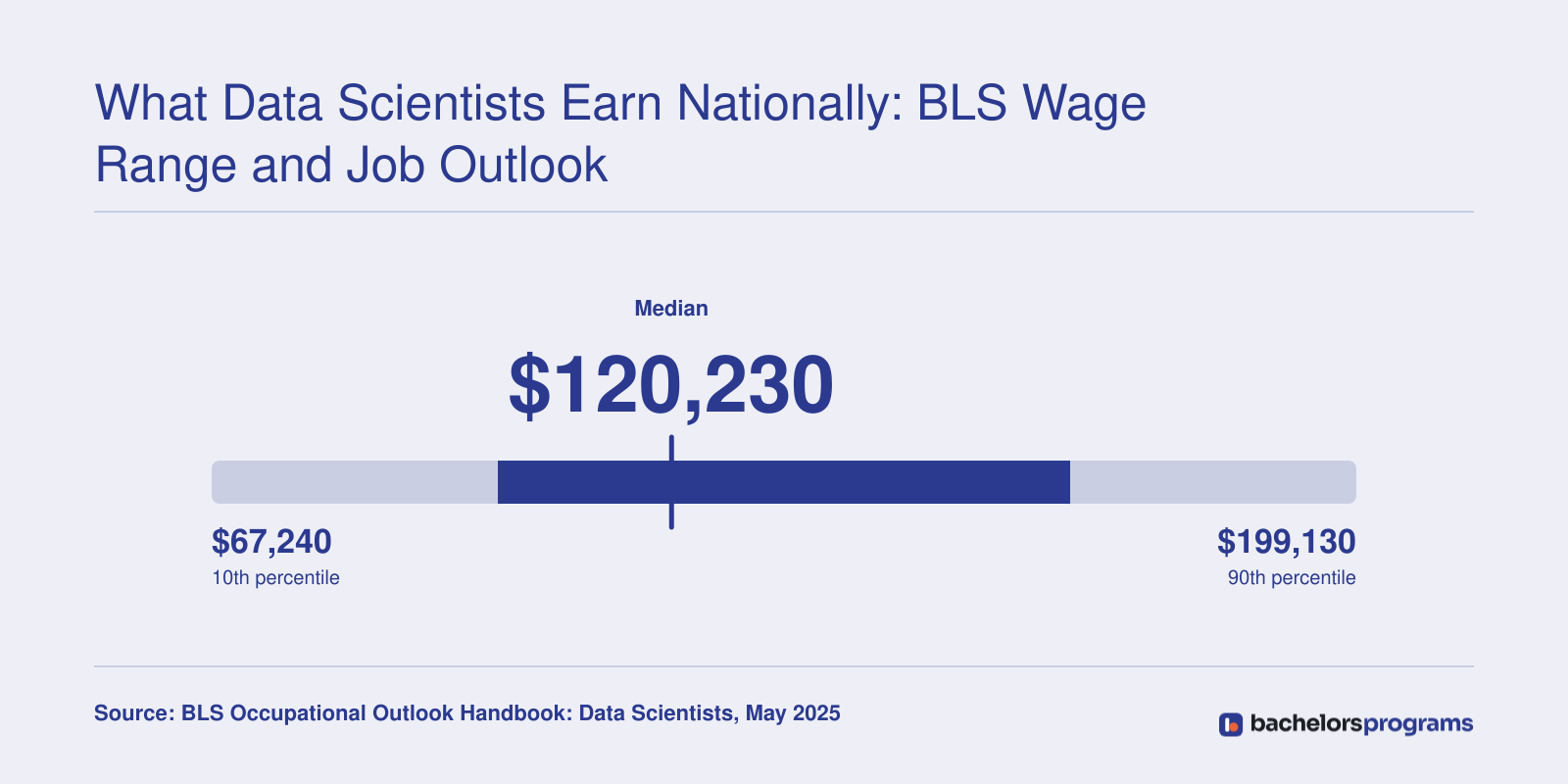
What Data Scientists Earn Nationally: BLS Wage Range and Job Outlook
The Bureau of Labor Statistics projects data scientist employment to grow 35% from 2025 to 2035, far faster than the 3% average for all occupations, with about 24,800 openings each year. These May 2025 wages cover the entire occupation, including experienced professionals, so they run higher than the first-year graduate earnings shown earlier on this page. A bachelor's degree in data science can also lead to related roles such as operations research analyst, where the BLS median annual wage was $88,940 in May 2025.
Online vs. Campus Data Science Degrees
Yes, you can earn a bachelor's degree in data science fully online, and several schools here offer online or hybrid formats. Online degrees from regionally accredited schools generally carry the same diploma as campus degrees. The real differences are cost structure, transfer rules, and how much hands-on access you get. The figures below come from Old Dominion University's online B.S. and one campus B.S. program.
| Factor | Online B.S. in Data Science | Campus B.S. in Data Science |
|---|---|---|
| Schedule flexibility | 100% online at Old Dominion University, so you can study around work and family | Fixed class times in most cases; one campus program lets part-time students choose on-campus, online, or independent-study courses |
| Cost structure | $443 per credit hour for Virginia residents and $453 for out-of-state students | $875 per credit part-time; full-time tuition of $13,635 per semester covers 12 to 18 credits |
| Total credits required | 120 credit hours | 122 credits |
| Transfer credit cap | Up to 90 credits can transfer, with at least 30 completed at the school | Caps vary by school; confirm the limit and residency minimum before you apply |
| Community college math and statistics | A qualifying associate degree may satisfy lower-level general education; the school evaluates how prior coursework applies. Calculus and statistics usually transfer when they match a required course, so request an equivalency check | Evaluated course by course. Calculus and statistics from a community college usually transfer when they match the program's requirements |
| Labs and research access | Mostly virtual tools and cloud computing; in-person research is limited | Direct access to computing labs, faculty research groups, and student projects |
| Internships and recruiting | You arrange your own placements, and career services are delivered remotely | On-campus career fairs, employer visits, and local internship pipelines |
| Fit for working adults | Strong fit for career changers and degree completers with prior credits | Better for full-time students who want a traditional campus experience |
Choosing a Specialization: AI, Machine Learning, Analytics, or Data Engineering
What actually changes between an AI concentration and a business analytics one? Mostly the math load, the tools you learn, and the kind of problem you are asked to solve in your senior project.
What each track emphasizes
- AI and machine learning: The heaviest math. Cal Poly's data science B.S., for example, requires linear algebra, two calculus courses built for data science, and an introduction to mathematical optimization alongside a fundamentals of machine learning course.3 Expect programming in several languages, data mining, and predictive modeling. UT Arlington's mathematics-oriented data science B.S. pairs two Python courses with two statistical methods courses and machine learning.4
- Analytics: More applied statistics and business framing. The University of New Haven's analytics coursework covers forecasting methods such as smoothing, moving averages, regression, time-series decomposition, and ARIMA, plus relational database design, entity-relationship diagrams, and SQL.5 Long Island University's business analytics program runs through consumer behavior, pricing, marketing, and social-media analytics.7
- Data engineering: Storage, movement, and scale. Texas A&M's data engineering B.S. centers on data handling, manipulation, mining, visualization, and storage, with required coursework in quantitative models for statistical and machine learning.1
B.S. versus B.A.
Some schools offer both. Nevada State University's data science program awards a B.A. or B.S. and teaches Python, R, and SQL in either; the B.S. is the one that requires higher-level calculus and linear algebra.6 In general, the B.S. carries the deeper math and computing sequence, while the B.A. frees up credits for a domain minor or liberal arts work. The labels are not standardized, so read the catalog rather than the letters.
Where each track leads, and the project that proves it
AI and machine learning coursework points toward machine learning engineer roles or research assistant work. Analytics maps to data analyst and business analyst titles. Engineering coursework leads to data engineer jobs.
Employers will ask about your capstone. Cal Poly's senior project capstone runs 2 credits, Oregon's capstone project is 4 credits, LIU's is 3, and Texas A&M's spans two semesters. Albany requires a practicum or capstone in its data science B.S.2 Check the concentrations listed in our ranking before you apply.
Questions to Ask Yourself
Do you enjoy proofs and linear algebra enough to handle a machine-learning-heavy B.S., or would applied statistics in a B.A. suit you better?
Would you rather build the pipelines that move data or interpret data for decision-makers?
Is there a domain, such as health, finance, or sports, you want to pair with data science?
Are you planning to pursue a master's degree later?
Math and Programming Prerequisites for a Data Science Bachelor's
No single national prerequisite list exists. Most programs share a core of calculus, linear algebra, programming and statistics, often completed before you can declare the major. Use this checklist to plan ahead.
- High school mathAim for precalculus at minimum. Calculus helps, and Berkeley accepts approved high school exam credit for Calculus I and II.
- Math placementSome schools measure readiness by placement. UW–Madison expects you to place above MATH 96 or complete it.
- Calculus I and IIThis is the most consistent gateway requirement. Michigan requires a C or better, and Northwestern continues through multivariable calculus.
- Linear algebraIt is common, but timing varies. Berkeley requires it before declaring, while Michigan may allow it afterward.
- Intro programmingUsually taken early. Examples include Berkeley's Program Structures and Data Structures and UNC's COMP 110.
- Intro statistics or data scienceExamples include Berkeley's Foundations of Data Science, UNC's STOR 120 and Northwestern's STAT 202.
- Grade and GPA thresholdsThere is no common standard. Berkeley requires a C- or better and a 2.0 average in specified courses, and UNC requires a 3.0 cumulative GPA.
- Test-optional policiesThese vary by school, so confirm each university's current 2026 policy directly.
- Transfer and later declarersUW–Madison generally requires declaring before 86 credits. UNC accepts applications with prerequisites still in progress.
Questions to Ask Yourself
Is the data science major housed in computer science, statistics, or its own school, and does that fit the track you want?
Does the school publish earnings for the data science program itself, or only figures for the whole institution?
How many of your community college or AP math credits will count toward the major?
Does the curriculum require a capstone or internship that uses real industry data?
Data Science programs by state
Data Science Bachelor's Degree FAQs
These answers cover the questions prospective students ask most about a bachelor's degree in data science. Details such as delivery format, accreditation and transfer rules vary by school, so confirm specifics in each program's catalog.
What is the best degree for data science?
Can you get a bachelor's degree in data science online?
Is a bachelor's degree in data science accredited and worth it?
Should I choose a B.S. in Data Science or a computer science or statistics degree with a data science minor?
Can a data science bachelor's lead directly to a job, or do most graduates need a master's?
Compare Data Science programs on the data that matters
Explore more Science & Engineering majors or browse every field of study.
All Science & Engineering programs Browse every field of study