Best Computer Science Schools in Hawaii
Compare 5 accredited Computer Science programs in Hawaii, with net price after aid, graduation rates, earnings and debt from IPEDS and the U.S. College Scorecard.

Hawaii's bachelor's programs in this field lead to a Bachelor of Science in Computer Science, with the University of Hawaiʻi at Mānoa also offering a Bachelor of Arts in Information and Computer Sciences, but the choice is rarely just about the curriculum. The islands limit how many campuses a student can realistically attend, and the cost of living in Honolulu and Hilo can outweigh a tuition gap.
The programs here are bachelor's degrees only, taught on campus at Hawaii-based schools, with no confirmed fully online computer science option among them. They differ in accreditation, admit rates and local employer ties, and those differences matter more than names on a ranking.
The state's tech sector is small next to the mainland's, so many graduates weigh staying put against relocating for the largest software employers.
Key Points
- BYU-Hawaii admits about 47% of applicants, the most selective option here.
- UH Mānoa's B.S. offers Data Science and Security Science concentrations.
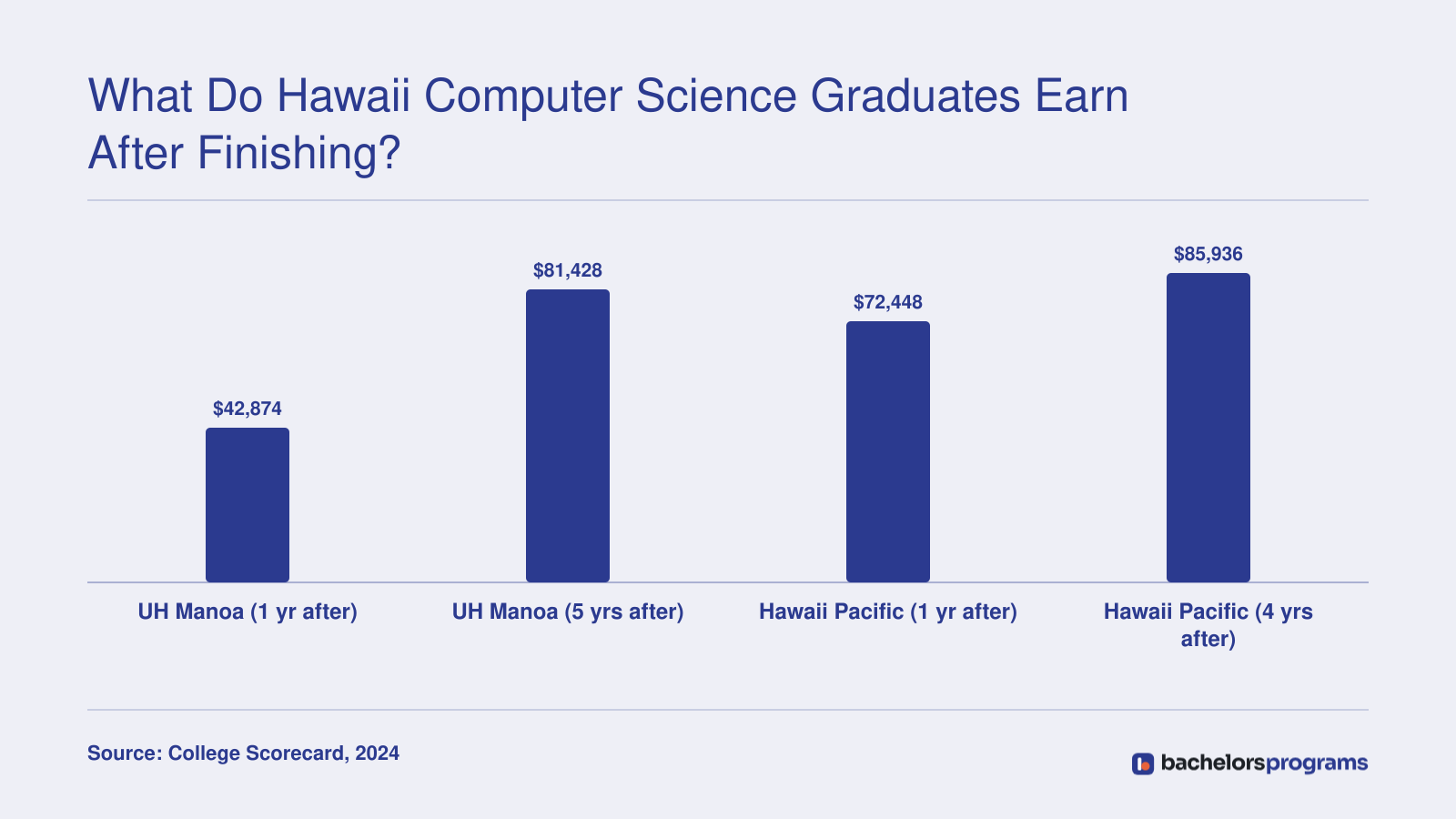
- UH Mānoa computer science graduates' median earnings rise from $42,874 to $81,428.
Best Bachelor's in Computer Science Schools in Hawaii, Ranked
Five accredited institutions in Hawaii award a bachelor's degree in computer science, and they split cleanly into two University of Hawaii campuses, two private Honolulu universities and one church-affiliated college on the North Shore of Oahu. The order below weighs how quickly students finish, what they pay after aid and how much of the curriculum is hands-on, then layers in program depth, concentration options and the local employer and mentorship connections each school has built. Every program listed is a Bachelor of Science in Computer Science.
University of Hawaii at Manoa
#1Honolulu, HI · $15,000 – $20,000/yr (est.)
Best for: Honolulu students wanting a large research campus
The flagship University of Hawaii campus in Honolulu carries the widest set of upper-division electives in the state and pairs a broad core in algorithms, operating systems, databases and security with declared concentrations in data science, security science and creative computational media. Students get unusual access to real clients: recent capstone teams worked with state agencies, MITRE, the Waikiki Aquarium and local technology firms, and the Kekuhaupi'o Tech Mentorship Program matches majors with industry mentors across the islands. It is also the only campus here that belongs to a multi-state semiconductor workforce network, which opens internships and training pathways beyond Hawaii.
- 120 credit hours over four years; 57 credits must be in the major
- Concentrations in Data Science, Security Science and Creative Computational Media
- Capstone project required in the final year
- Required security course plus AI and networking elective tracks
- 2.0 GPA minimum and a C or better in every major course
- 45 upper-division credits minimum to graduate
Brigham Young University-Hawaii
#2Laie, HI · ~$17,000/yr (est.)
Best for: Latter-day Saint students seeking a faith-based campus
A private church-affiliated university in Laie on Oahu's North Shore, small enough that computer science majors know their professors and structured enough that every student leaves with two minors alongside the major. The degree is deliberately broad, built on a CS and IT foundation, a 33-credit core and required religious education woven into general education. A single tuition rate applies to all students regardless of residency, which is unusual among the state's private colleges and simplifies planning for students coming from the mainland.
- 120 credit hours total, with 66 in the major
- Two minors required alongside the computer science major
- CS and IT foundation of 21 credits plus a 33-credit CS core
- 8 credits of mathematics and 4 credits of science
- Religious education required within the general education core
- Prerequisite coursework in CS 101 and calculus-level math
University of Hawaii at Hilo
#3Hilo, HI · ~$12,000/yr (est.)
Best for: Big Island students eyeing an AI concentration
The University of Hawaii's Big Island campus, where the computer science major is small, upper-division heavy and organized around a choice between a general track and an artificial intelligence concentration. Students take a professional seminar and three writing-intensive courses alongside the technical core, and can lean the degree toward physics or mathematics if graduate study is the goal. Class sizes are among the smallest of the five schools here, and advisors plan each semester with students rather than leaving sequencing to chance.
- 120 credit hours, including 45 upper-division credits
- Choose the general computer science option or the AI concentration
- 2.0 GPA minimum with a C or better in every CS course
- Professional seminar plus three writing-intensive courses
- Physics or mathematics track available
- Core includes database internals, computer architecture and theory of computing
Chaminade University of Honolulu
#4Honolulu, HI · $25,000 – $30,000/yr (est.)
A private Catholic university in Honolulu with a small, advising-heavy computer science major that lets students shape seven upper-division electives and add a certificate in cybersecurity and policy, computational mathematics, or data science and analytics. The program is tied tightly to Pacific-region data work: Chaminade leads an NSF-backed data science alliance and has placed students in internships and applied projects with defense contractors, the U.S. Space Force, the Texas Advanced Computing Center and local conservation groups. A four-year graduation guarantee backs the timeline for students who follow their plan.
- Four-year Bachelor of Science with a matching minor option
- Pre-major work in SQL, Python, visualization and data ethics
- Seven upper-division CS or data science electives chosen with an advisor
- Discrete mathematics, probability and statistics, and linear algebra required
- Computer Science Directed Research course
- Certificate options in computational math, cybersecurity and policy, or data science
- Four-Year Graduation Guarantee
Hawaii Pacific University
#5Honolulu, HI · $30,000/yr (est. net price)
A private university in downtown Honolulu whose computer science curriculum is built to ACM and IEEE standards and carries one of the heaviest major loads in this ranking, between 68 and 77 credits on top of general education. Students finish with a senior capstone built around a real software problem and can stack a cybersecurity concentration with four upper-level electives on top of assembly, architecture, operating systems, data communications and database coursework. The trade-off is cost, since published tuition and net price both run above the public campuses, and its graduation rate trails the public options here.
- 68 to 77 major credits, with 120 total credits to graduate
- Curriculum built to ACM and IEEE standards
- Senior capstone addressing a real software problem
- Cybersecurity concentration adds four upper-level electives
- Core covers assembly, computer architecture, operating systems and databases
- 2.0 cumulative GPA minimum across the degree
Cost & outcomes by school
Federal data for the highest-earning Computer Science programs, independent of the ranking above. Earnings are this field's bachelor's graduates four years after completing where the Scorecard reports them, else the school's undergraduate median.
| School | Net price / yr | Grad rate | Earnings | Debt | Grads/yr | Format |
|---|---|---|---|---|---|---|
| Hawaii Pacific University HI | $29,657 | 35% | $85,936 | $22,000 | 24 | Campus |
| University of Hawaii at Manoa HI | $15,664 | 64% | $77,502 | $15,468 | 133 | Campus |
| Chaminade University of Honolulu HI | $28,856 | 55% | $52,343 | $23,250 | — | Campus |
| Brigham Young University-Hawaii HI | $16,774 | 53% | $52,064 | $9,413 | 20 | Campus |
| University of Hawaii at Hilo HI | $11,856 | 48% | $47,856 | $20,500 | 8 | Campus |
Sources: U.S. Department of Education. Net price, graduation rate, earnings and debt: College Scorecard (earnings and debt for this field's bachelor's graduates where reported, else school-wide); graduates: IPEDS. A dash means no figure is reported.
Cost, debt & payoff
Median earnings of this field's bachelor's graduates (4 yrs after completing, else the school's undergraduate median) vs. their median federal loan debt · U.S. College Scorecard
Across these programs the median graduate earns about $52,343 and finishes with roughly $20,500 in debt — a ratio that clears a common rule of thumb (keep debt below first-year salary). Net price and debt vary widely school to school, so check the per-school figures in the table above before you shortlist.
How We Ranked Hawaii Computer Science Schools
What the Ranking Draws On
The ranking uses College Scorecard data, the federal dataset that reports outcomes for individual programs as well as whole schools. Where other rankings leave their sources unstated, the figures here come from that federal dataset rather than from school marketing.
Four measures matter most for a bachelor's degree in computer science:
- Program earnings: what graduates of the computer science program earn after finishing.
- Median debt: what students in the program typically owe when they leave.
- Completions: how many students finish the degree, a sign of how established the program is.
- School-level net price and graduation rate: what students pay after aid, and how many finish at the school overall.
What the Numbers Can and Cannot Tell You
Graduation rate and net price are school-wide averages. They describe the whole institution, not computer science students specifically, so treat them as context rather than a verdict on the major. Earnings, debt, and completions are the program-level figures.
Hawaii also has a small pool of bachelor's programs in this field. That keeps the ranking short, and it means the differences between schools are meaningful. A gap in cost, debt, or outcomes between two schools here reflects a real choice you would be making, not statistical noise among dozens of near-identical options.
So, What Is the Best Computer Science School in Hawaii?
The school at the top of the ranking above is our answer. Read its entry alongside the others, though. A student who needs the lowest net price or wants a particular campus setting may reasonably prefer a school lower on the list.
Bachelor's Degree in Computer Science: Curriculum, Concentrations and ABET Accreditation
The University of Hawaiʻi at Mānoa organizes its Bachelor of Science in Computer Science around a standard track plus three named concentrations: Creative Computational Media, Data Science and Security Science.1 That makes it the clearest example in Hawaii of a program that lets you specialize inside the major. Every school ranked here awards a B.S. in Computer Science, but how much structure each one builds into the upper division varies.
What the Core Curriculum Covers
Most bachelor's programs in computer science share a common foundation: programming sequences, data structures, algorithms, computer organization, operating systems and software development, backed by calculus and discrete mathematics. The schools in Hawaii follow that pattern, with different emphases:
- UH Hilo: Its B.S. requirements pair computer science courses with mathematics, science and liberal arts coursework, which suits students who want a broad, rigorous degree.2
- Chaminade University of Honolulu: The program describes its goal as preparing students to solve complex problems, build software and create technology.3 Upper-division flexibility comes through CS or DSAV electives.
- BYU, Hawaii and Hawaii Pacific University: Both offer a B.S. in Computer Science. Review each department's current course catalog for the core sequence and electives.
Concentrations and Electives
If you already know you want to work in cybersecurity, data science or digital media, UH Mānoa's concentrations offer the most defined paths among these schools. Security Science and Data Science line up with two of the fastest-moving areas in the field, and Creative Computational Media blends computing with design and media work.
UH Hilo and Chaminade do not list named tracks in artificial intelligence, cybersecurity, data science or software engineering on their program pages. That does not mean those topics are absent. Electives often cover them, so ask an advisor which upper-division courses run regularly and how often they are offered.
ABET Accreditation: What to Check
ABET accredits computing programs through its Computing Accreditation Commission (CAC), and engineering-oriented programs through a separate commission. ABET accreditation is program-specific, so a university's regional accreditation does not tell you whether its computer science degree carries ABET approval.
Accreditation status changes over time, so verify it directly before you apply:
- Search the ABET directory: Look up each school by name and confirm the exact degree title and commission listed.
- Check the department page: Accredited programs usually state it and publish their educational objectives.
- Weigh your goals: ABET status matters most for some government, defense and graduate-school pathways. Many software employers focus more on skills, internships and portfolio work.
Online and Hybrid Computer Science Bachelor's Options at Hawaii Schools
Remote delivery is routine across U.S. higher education; in Hawaii, computer science is still a campus degree. Every school here is classified as campus-based, and none of them could be confirmed to offer a fully online bachelor's degree in computer science.
What the Research Shows
Chaminade's program page lists its Bachelor of Science in Computer Science as "On Campus" and four years long.2 The university also advertises a separate Flex Online undergraduate program that is 100% online, but nothing we found says the computer science degree is part of it.
UH Online recognizes more than 40 fully online and hybrid programs across the University of Hawaii System. It defines fully online as no in-person requirements. It defines hybrid as at least 80% online, with some required in-person activity at a UH campus or designated location. Neither the UH Manoa BS in Computer Science (120 credits, 57 or more in the major)1 nor the BA in Information and Computer Sciences (120 credits, 30 of them at UH Manoa) is confirmed as listed there. The same is true of UH Hilo's computer science bachelor's. BYU-Hawaii and Hawaii Pacific University are not UH campuses, so UH Online does not apply to them, and we found no confirmed online or hybrid format for either.
Who Should Pay Attention
If you live on a neighbor island, move often with a military family, work full time, or are studying from the mainland, delivery format may matter as much as the curriculum. Labs, capstones and exams are the parts most likely to stay in person, but the pages we reviewed do not break those out by school.
Before you apply:
- Ask directly: Find out whether any required computer science courses are offered online or in the evening.
- Check residency rules: Confirm how many credits you must complete on campus.
- Check transfer credit: Ask whether online coursework from elsewhere counts toward the major.
For now, plan on attending in person unless a school confirms otherwise.
Related Articles
Admissions Requirements: GPA, Test Policy and Transfer Credit
BYU-Hawaii admits about 47% of applicants, the lowest admit rate among these five schools. UH Hilo sits near 61%. UH Mānoa (about 87%), Hawaii Pacific University (about 86%) and Chaminade (about 91%) admit most applicants who apply. Even so, a high admit rate does not mean every applicant gets into the CS major.
Schools With Published Standards
- UH Mānoa: Hawaiʻi residents with at least a 3.2 cumulative GPA who finish the required coursework are offered admission.1 Entering students typically fall between 3.49 (25th percentile) and 4.04 (75th percentile).1 Testing is optional. Required coursework is 4 years of English, 3 of math (Algebra I, Algebra II, Geometry), 3 of science and 5 electives. Computer science can count as an elective.
- UH Hilo: The standard is a 2.7 cumulative GPA with college-preparatory coursework: 4 English, 3 math, 3 natural sciences and 7 electives.2 Applicants below 2.7 may be considered on a sliding scale with official SAT or ACT scores. The admissions page does not state a test policy for those who meet 2.7.
Schools With No Published Policy We Could Confirm
For BYU-Hawaii, Hawaii Pacific University and Chaminade, we found no stated first-year GPA expectation and no SAT or ACT policy. Treat all three as unconfirmed and check their admissions pages before you apply. We also could not confirm transfer-credit rules for any school here, so ask each admissions office how your prior computer science and math courses would count.
CS-Specific Requirements
Neither UH campus publishes a separate CS admission GPA. At Mānoa, placement guidance for the B.S. lists CHEM 161/L and MATH 215 or 241, but these are course-placement requirements, not a first-year admission bar.3 UH Hilo lists a math placement requirement for its computer science B.S. without naming the course or minimum score. We found no CS-specific math prerequisite for the other three schools.
The Most Useful Tip
Finish Algebra II and Geometry before you enroll, and take additional math if your school offers it. Both UH campuses require three years of math, and UH Hilo strongly recommends extra math and science for science majors. Strong math preparation also keeps you out of remedial placement and on track for the CS sequence.
What Do Hawaii Computer Science Graduates Earn After Finishing?
Program-level median earnings for computer science bachelor's graduates are published for the University of Hawaii at Manoa and Hawaii Pacific University. The biggest jump is at UH Manoa, where the median rises from $42,874 one year after finishing to $81,428 five years out, a gain of about 90%. That growth comes with in-state tuition of $12,186 and an average net price of $15,664. Hawaii Pacific charges $34,392 in tuition with a $29,657 net price, and its graduates start higher at $72,448 and reach $85,936 four years out, the latest window it reports.
Questions to Ask Yourself
Do you need to stay on one island, or can you relocate for your degree?
Would starting at a UH community college and transferring save you more than a private aid package?
Do you want an ABET-accredited program for federal or engineering-adjacent roles?
Do you plan to work in Hawaii after graduating, or move to a larger tech market?
Compare Computer Science programs on the data that matters
Explore more Computers & IT majors or browse every field of study.
All Computers & IT programs Browse every field of study