Best Information Technology Schools in West Virginia
Compare 7 accredited Information Technology programs in West Virginia at 5 colleges, with net price after aid, graduation rates, earnings and debt from IPEDS and the U.S. College Scorecard.

Two kinds of West Virginia schools teach this field: campus and hybrid programs with in-state tuition, and online providers built around working adults. Which West Virginia schools offer a bachelor's degree in information technology? Marshall University, Concord University, and the University of Charleston teach it in person or in a hybrid format. American Public University System and Strayer University-West Virginia deliver a Bachelor of Science (B.S.) in Information Technology online.
The tension is practical. Program names vary (Computer Information Systems, Applied Computer Science), and sticker prices range from roughly $8,400 to $33,800 a year. ABET accreditation, admissions rules, and local pay deserve a close look before you apply, because a title that sounds identical can mean a different curriculum.
Key Points
- Marshall University's average net price, $7,502, undercuts University of Charleston's $22,107.
- PROMISE Scholarship pays eligible West Virginia residents up to $5,500 a year.
- American Public University System offers a fully online B.S. in Information Technology.
Best Schools for a Bachelor's Degree in Information Technology in West Virginia
These five programs are ordered by our own scoring, which puts on-time completion and net price after aid ahead of other factors, and the methodology section below spells out the full approach. Graduation rates here describe whole institutions rather than individual IT programs, and they run from about 39 percent to 57 percent across the schools on this list. Each card below covers the credential, the city, the delivery format, the listed concentration, and the published cost picture so you can compare like with like.
American Public University System
#1Charles Town, WV · $5,000 – $10,000/yr (est.)
Best for: Working adults seeking fully online study
American Public University System is a fully online institution based in Charles Town, and its information technology degree is built for adults who need to keep working while they study. Students pick one of five 15-credit concentrations and finish with a capstone, and courses start monthly in sessions that run 8 to 16 weeks. Transfer credit is generous, with up to 90 credits accepted, and many courses use zero-cost textbooks. About 57 percent of students complete their programs institution-wide.
- 120-credit degree with five 15-credit concentration options
- Concentrations include Programming, Project Management and Blockchain
- Ends with a 3-credit Information Technology capstone
- Courses start monthly in 8- to 16-week sessions
- Transfer up to 90 credits toward the degree
- $0 application fee; high school diploma or GED required
- Military rate of $250 per credit versus $360 standard
- Zero-cost textbooks and ebooks in many courses
Marshall University
#2Huntington, WV · $5,000 – $10,000/yr (est.)
Best for: West Virginia students targeting cybersecurity careers
Marshall University is a public research university in Huntington and the largest four-year institution on this list. Its computer and information technology degree offers two emphases, one in game and simulation development and one in computer and web application development, and seniors can take internships as part of a capstone. The Institute for Cyber Security has partnered with the offensive-security firm TWENTY to build internships, mentorship and applied research in cyber operations, artificial intelligence and national defense, which gives students a direct line into the state's security workforce. About 51 percent of students finish their degrees institution-wide.
- Two emphases: Game and Simulation Development, Computer and Web Application Development
- Dedicated computer labs with modern hardware
- Seniors can intern as part of a capstone project
- Internship hosts include Intellipoint Systems and State Electric Supply
- Team-based mobile game development coursework
- Recent survey: graduates employed in the field within six weeks
- Starting salaries averaged $44,100 in that survey
Strayer University-West Virginia
#3Scott Depot, WV · ~$14,000/yr (est.)
Best for: Transfer students with prior college credit
Strayer University's West Virginia location sits in Scott Depot, and the institution runs on a schedule built for working adults, with 11-week courses and several start dates a year. The information technology degree carries eight concentration options, including Artificial Intelligence, Cybersecurity and Data Analytics, and students can transfer up to 28 classes. Instruction is available online or on campus, and employer tuition reimbursement is accepted. Strayer is accredited by the Middle States Commission on Higher Education.
- 18 additional credit hours for the concentration
- Concentration offered in an online-only format
- 40 courses total, with winter classes starting January 4
- Each course runs 11 weeks
Strayer University-West Virginia
#4Scott Depot, WV · ~$14,000/yr (est.)
Strayer University's West Virginia location sits in Scott Depot, and the institution runs on a schedule built for working adults, with 11-week courses and several start dates a year. The information technology degree carries eight concentration options, including Artificial Intelligence, Cybersecurity and Data Analytics, and students can transfer up to 28 classes. Instruction is available online or on campus, and employer tuition reimbursement is accepted. Strayer is accredited by the Middle States Commission on Higher Education.
- 58.5 credit hours in major coursework
- Employer tuition reimbursement supported
- Transfer up to 28 classes toward the degree
- 40 total courses, including 67.5 credits of general education
Strayer University-West Virginia
#5Scott Depot, WV · ~$14,000/yr (est.)
Strayer University's West Virginia location sits in Scott Depot, and the institution runs on a schedule built for working adults, with 11-week courses and several start dates a year. The information technology degree carries eight concentration options, including Artificial Intelligence, Cybersecurity and Data Analytics, and students can transfer up to 28 classes. Instruction is available online or on campus, and employer tuition reimbursement is accepted. Strayer is accredited by the Middle States Commission on Higher Education.
- Emphasizes networking, security and programming
- No-cost general education courses through Sophia Learning
- One free course for every three passed
- $65 technology fee each term and a $100 resource kit per course
Concord University
#6Athens, WV · $10,000/yr (est. net price)
Concord University is a small public university in Athens, in the southern part of the state. Its computer information systems degree carries an Information Technology concentration and is designed around Association for Computing Machinery and IEEE curriculum recommendations, with tracks pointed at data analytics and computer security. Alumni have been hired by Intel, IBM, Red Hat, Lockheed Martin, Northrop Grumman and the FBI, and others have gone on to graduate programs at Georgia Tech, Virginia Tech, Marshall and West Virginia University. Roughly 39 percent of students complete a degree institution-wide.
- Five concentrations, including an Information Technology track
- IT concentration targets data analytics or computer security roles
- Curriculum follows ACM and IEEE recommendations
- Graduates hired by Intel, IBM, Red Hat, Lockheed Martin and Northrop Grumman
- Alumni have entered graduate programs at Georgia Tech and Virginia Tech
- Scholarships can cover tuition, room and board
University of Charleston
#7Charleston, WV · $20,000 – $25,000/yr (est.)
The University of Charleston sits in the state capital and runs its applied computer science degree in a hybrid format, mixing campus classes with online courses delivered through a national consortium. The Information Technology major prepares students for computer support, systems analysis, technician and help desk roles, and internships with technology companies, government agencies and nonprofits supply hands-on experience. Admission requires a 2.5 high school GPA or a 2.0 transfer GPA along with a qualifying math score, and students must earn at least a C in every program course. About 46 percent of students graduate institution-wide.
- Hybrid format: Charleston classes plus online courses via a national consortium
- Prepares students for support specialist, systems analyst and help desk roles
- Admission needs a 2.5 high school GPA or 2.0 transfer GPA
- ACT math score of 27 or completion of MATH 123 required
- Minimum grade of C required in every program course
- Capstone project plus internships with tech companies and agencies
- STEM OPT extension of 24 months for international students
Cost & outcomes by school
Federal data for the highest-earning Information Technology programs, independent of the ranking above. Earnings are this field's bachelor's graduates four years after completing where the Scorecard reports them, else the school's undergraduate median.
| School | Net price / yr | Grad rate | Earnings | Debt | Grads/yr | Format |
|---|---|---|---|---|---|---|
| Strayer University-West Virginia WV | — | — | $82,304 | $37,500 | 5 | Online |
| American Public University System WV | $9,597 | 57% | $80,417 | $25,852 | 210 | Online |
| Marshall University WV | $7,502 | 51% | $69,565 | $28,375 | 25 | Campus |
| University of Charleston WV | $22,107 | 46% | $55,774 | $19,500 | — | Hybrid |
| Concord University WV | $9,966 | 39% | $42,703 | $18,900 | — | Campus |
Sources: U.S. Department of Education. Net price, graduation rate, earnings and debt: College Scorecard (earnings and debt for this field's bachelor's graduates where reported, else school-wide); graduates: IPEDS. A dash means no figure is reported.
Cost, debt & payoff
Median earnings of this field's bachelor's graduates (4 yrs after completing, else the school's undergraduate median) vs. their median federal loan debt · U.S. College Scorecard
Across these programs the median graduate earns about $80,417 and finishes with roughly $28,375 in debt — a ratio that clears a common rule of thumb (keep debt below first-year salary). Net price and debt vary widely school to school, so check the per-school figures in the table above before you shortlist.
How We Ranked West Virginia IT Schools
Colleges label closely related degrees very differently, and employers hire across all those titles.
This ranking covers bachelor's programs only, on campus and online, at schools based in West Virginia. Graduate study is not part of it. We drew on College Scorecard, the U.S. Department of Education's public dataset, and looked at the following:
- Completion: how many students actually finish a bachelor's degree.
- Cost: net price after grants and scholarships, not just sticker tuition.
- Debt: typical borrowing among graduates.
- Earnings: what graduates make after leaving school, where program-level figures exist.
We did not assign published weights to these factors, and we avoid implying more precision than the data supports.
Why Program Titles Matter
We counted programs in information technology, information systems, and computer science, but we kept their names as each school uses them. American Public University System and Strayer University-West Virginia offer a Bachelor of Science in Information Technology. Marshall University lists Computer and Information Technology, Concord University offers Computer Information Systems, and the University of Charleston offers Applied Computer Science. These titles can differ in how much they emphasize networks and support versus programming and theory, so check the curriculum before you compare.
Limits to Keep in Mind
The completion and net price figures describe the whole institution, not the IT program alone. Some programs also lack published program-level earnings, so those figures are best treated as a starting point.
Online and Hybrid Bachelor's Degree Options at West Virginia Schools
A fully online bachelor's degree in information technology is available from West Virginia schools, but the format depends on which one you choose.
Fully Online Programs
American Public University System, based in Charles Town, delivers its Bachelor of Science in Information Technology online. It offers rolling start dates, courses that run 8 to 16 weeks, and transfer of up to 90 credits. That structure suits working adults and students finishing a degree they started elsewhere.
Strayer University-West Virginia, with a location in Scott Depot, offers its B.S. in Information Technology with a fully online option. Courses run 11 weeks, and its artificial intelligence concentration is available online only.
Hybrid and Campus-Based Programs
University of Charleston runs its Applied Computer Science degree, which includes an information technology concentration, as a hybrid. Students combine on-campus classes with online courses delivered through a national consortium, so plan to spend part of the program in Charleston.
Marshall University's Computer and Information Technology degree in Huntington and Concord University's Computer Information Systems degree in Athens are campus programs. Marshall highlights dedicated computer labs and senior internships, both of which assume regular in-person attendance.
Out-of-State Students and In-Person Requirements
The online programs here do not publish enrollment limits for students living outside West Virginia. Online schools still need authorization to enroll students in each state, so confirm your state is covered before you apply.
Read the program's catalog and capstone description, then ask an admissions counselor whether any proctored exams, orientations, labs, or residencies require travel. One required on-site session can reshape your schedule and budget.
Admission Requirements for West Virginia IT Bachelor's Programs
Admission standards for information technology bachelor's programs vary from one West Virginia school to the next. Some schools publish firm cutoffs for GPA and test scores; others review the whole application and leave the numbers unstated. Here is what each school actually says.
GPA and Test Policy, School by School
- American Public University System: No entrance exam for the B.S. in Information Technology. Applications are free, starts are rolling, and a test score never gates admission.
- University of Charleston: The most explicit of the group. A 2.5 GPA minimum, the ACT as its required entrance exam, and prerequisite courses completed before upper-level major work.
- Marshall University, Strayer University-West Virginia, Concord University: Their published admissions material does not state a first-year GPA floor or an SAT/ACT rule. Treat that as "ask," not "anything goes." Email admissions and get the answer in writing before you apply; a program can weigh math preparation and prior coursework even when no number is printed.
Transfer Credit and Community College Pathways
- American Public University System: Accepts up to 90 transfer credits, the most generous ceiling here for students arriving with an associate degree or military training.
- Strayer University-West Virginia: Accepts up to 28 classes, and its no-cost general education courses through Sophia Learning can clear lower-division requirements before you enroll.
- University of Charleston: Sets a 2.0 transfer GPA, separate from its 2.5 freshman standard.
- Concord University: Admits first-time freshmen and transfer students into Computer Information Systems, with scholarships open to both.
West Virginia's two-year colleges maintain articulation pathways into four-year IT programs. Ask each admissions office for the program-to-program agreement that matches your associate degree, then confirm which technical courses count toward the IT major rather than toward general electives. Getting that map before you register saves semesters later.
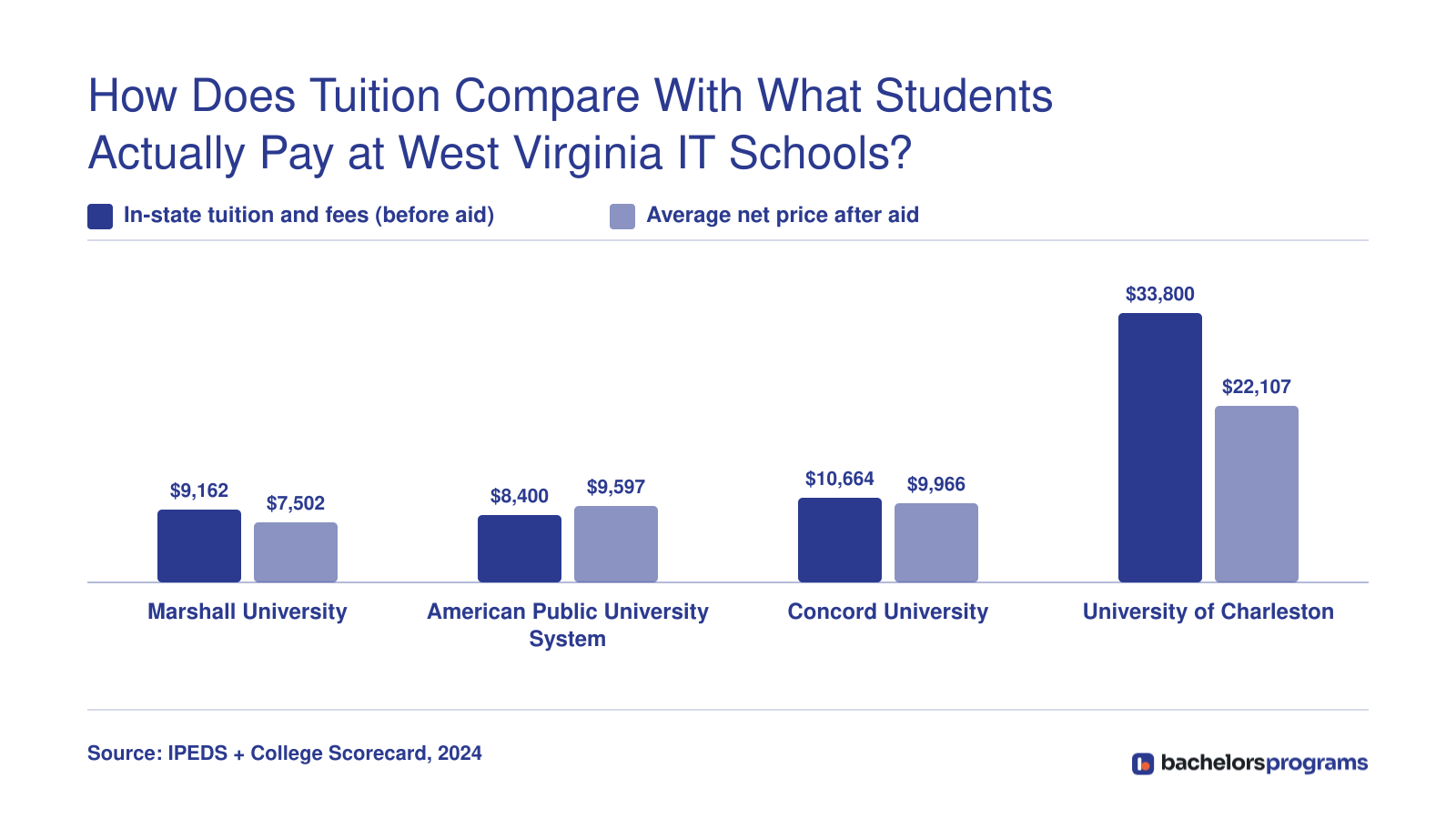
How Does Tuition Compare With What Students Actually Pay at West Virginia IT Schools?
Sticker price and what students actually pay can differ sharply. Marshall University posts in-state tuition and fees of $9,162 and an average net price of $7,502, while the University of Charleston lists $33,800 but averages $22,107 after aid. Tuition is the published rate before aid. Net price is an approximate institution-wide average that also counts books and living costs, so it can exceed tuition, as it does at American Public University System.
Paying for It: PROMISE, the Higher Education Grant, and In-State Tuition Rules
Two state programs do most of the work of cutting the cost of an IT bachelor's degree for West Virginia residents who plan early.
PROMISE Scholarship
PROMISE currently pays up to $5,500 a year, or tuition and required fees if those cost less, at eligible West Virginia public and private schools.1 The state's statutory text still lists $4,750, so confirm the current amount with the school's aid office.3 Core requirements:
- GPA: 3.0 in both core and overall graduation coursework.2
- Test scores: a qualifying ACT or SAT result, including an ACT science subscore of 19, even though the science section became optional in 2025.4
- Residency: 12 consecutive months of West Virginia residence before the final application, plus U.S. citizenship, permanent residency, or eligible noncitizen status.5
- Timing: enrollment generally within two years of finishing high school, with exceptions for military service.
Higher Education Grant
This is need-based aid, estimated at $3,400 for 2026-27.2 It is not a guaranteed amount for every recipient. Applicants must be U.S. citizens, West Virginia residents for 12 months, and full-time undergraduates who file the FAFSA and show financial need.
Residency and Tuition
Residency drives price. Public schools here, such as Marshall University and Concord University, charge nonresidents noticeably more than residents, which is the gap the cost comparison above shows. The 12-month rule above applies to these two aid programs. Tuition classification has its own tests, so ask each school's registrar how it determines resident status before assuming you qualify. PROMISE also requires an eligible institution, so confirm that Marshall, Concord, University of Charleston, and the others qualify before counting on the award.
Action List
- File the FAFSA as soon as it opens each October. The 2026-27 cycle closed March 1, 2026 for both programs.2
- Confirm the state aid deadline for your enrollment year on the College for West Virginia site, and plan around an early-spring cutoff.
- Send ACT or SAT scores and your high school transcript to the state well before that date.
- Ask each school's aid office how PROMISE and the grant combine with its own awards.
Median Debt, Monthly Payments, and Graduate Earnings by School
This table uses the U.S. Department of Education's IPEDS and College Scorecard data (2024) to compare what IT bachelor's graduates borrowed, what that debt costs per month on a standard 10-year plan, and what graduates earned one year after finishing. The last column is a return-on-investment proxy: each school's median earnings 10 years after entry divided by its median graduate debt, across all programs. American Public University System has the strongest debt-to-earnings balance in the table, with median debt of $25,852 (about $274 a month), first-year earnings of $68,210, and a ratio of 2.04. Marshall University is close behind at $28,375 in debt and a 1.99 ratio. Strayer University-West Virginia graduates report early earnings similar to APUS, but they carry the heaviest debt, and the school's 0.99 ratio is about half that of its peers. Among the other schools ranked here, University of Charleston (2.86) and Concord University (2.26) post the highest school-wide earnings-to-debt ratios.
| School | Median Debt at Completion (IT Bachelor's) | Estimated Monthly Payment (10-Year Plan) | Median Earnings 1 Year After Completion (IT Bachelor's) | School-Wide Earnings-to-Debt Ratio |
|---|---|---|---|---|
| American Public University System | $25,852 | $274 | $68,210 | 2.04 |
| Marshall University | $28,375 | $301 | $52,047 | 1.99 |
| Strayer University-West Virginia | $37,500 | $398 | $67,315 | 0.99 |
Related Articles
What IT Professionals Earn in West Virginia
Network and computer systems administration is one of the most common career paths for graduates with a bachelor's degree in information technology, and it gives a useful benchmark for in-state pay.
Questions to Ask Yourself
Do you need a fully online program, or can you commute to a campus?
Does your target employer screen on ABET accreditation, or value a cybersecurity concentration more?
Could starting at a two-year college and transferring lower your total cost?
West Virginia IT Degree FAQs
Which colleges in West Virginia offer information technology degrees?
Are there ABET-accredited information technology programs in West Virginia?
What is the difference between information technology and information systems degrees?
How much does an IT degree earn in West Virginia?
Compare Information Technology programs on the data that matters
Explore more Computers & IT majors or browse every field of study.
All Computers & IT programs Browse every field of study