Best Information Technology Schools in Florida
Compare 35 accredited Information Technology programs in Florida at 30 colleges, with net price after aid, graduation rates, earnings and debt from IPEDS and the U.S. College Scorecard.
Which Florida school offers the best bachelor's degree in information technology for the money? Most schools award a Bachelor of Science (B.S.) in Information Technology, though some state colleges confer applied science or information systems degrees.
Resident tuition at the public universities runs about $5,656 to $6,565 a year, while Strayer University-Florida charges $13,920. Florida's IT programs run from state colleges to large public universities to private institutions, and they differ most on price, entry requirements and career outcomes.
Price and entry requirements vary far more than the core curriculum does, so start there.
Key Points
- ABET accredits the University of West Florida's B.S. in Information Technology.
- Florida International University charges residents $235.57 per online IT credit.
- In-state tuition at Florida public universities runs about $5,656 to $6,565.
Top Schools for a Bachelor's Degree in Information Technology in Florida
These ten programs lead our review of bachelor's degrees in information technology in Florida, spanning public universities, state colleges and one career-focused online provider. Each card carries in-state tuition, average net price after aid and six-year graduation rate as school-wide, approximate figures rather than numbers for the IT program alone. The criteria behind the order are set out in the methodology section further down the page.
Florida State University
#1Tallahassee, FL · ~$11,000/yr (est.)
Best for: Campus-first students who want a capstone
Florida State runs its IT degree through the College of Communication and Information as an in-person Tallahassee program, with a required capstone sequence and a minor strongly recommended alongside the major. Admission to the upper division is a checkpoint at 52 credit hours, so prerequisite planning starts early. School-wide figures put in-state tuition near $5,656, average net price after aid around $11,300, and the six-year graduation rate near 86%.
- 120 total credit hours, including 24 prerequisite hours
- 42 major hours plus 30 elective hours inside the major
- 2.0 GPA and 52 credit hours required for upper division
- Capstone courses required, 6 credit hours
- Face-to-face instruction in Tallahassee, no online option
- Minor strongly recommended alongside the major
- Students provide their own laptop
University of Central Florida
#2Orlando, FL · ~$10,000/yr (est.)
Best for: Students targeting aerospace and defense employers
UCF's IT degree sits in the College of Engineering and Computer Science and leans toward networking, security and system administration rather than a capstone project. The Orlando location puts students close to the region's aerospace and defense employers, and the Hack@UCF team has taken three national cyber defense titles. School-wide figures put in-state tuition near $6,368, average net price after aid around $10,411, and the six-year graduation rate near 78%.
- 120 credits in the College of Engineering and Computer Science
- 42 major credits plus 49 advanced core credits
- No capstone required
- Coursework in network concepts, computing security and system administration
- Hack@UCF has won three national cyber defense championships
- Employers include L3Harris Technologies, Siemens and HD Supply
Florida International University
#3Miami, FL · ~$9,000/yr (est.)
Best for: Students who need a fully online option
FIU offers its IT bachelor's on campus in Miami and fully online through FIU Online, with DevOps and Software tracks plus junior and senior capstones. An accelerated route into the M.S. in Engineering Management lets strong students begin graduate work early. School-wide figures put in-state tuition near $6,565, average net price after aid around $9,288, and the six-year graduation rate near 74%.
- Two tracks: DevOps and Software
- Fully online option through FIU Online
- Junior and senior capstones; senior teams of up to five
- Accelerated pathway to the M.S. in Engineering Management
- Core covers programming, operating systems, web and cloud computing
- SAT, ACT or CLT scores required with the application
University of South Florida
#4Tampa, FL · ~$10,000/yr (est.)
USF's Tampa program builds from programming, databases and networking into cybersecurity, cloud computing and data management, with paid co-op and internships that can start in sophomore year. Through its Fuse Program, eligible Florida College System associate graduates get guaranteed admission into the IT program at USF. School-wide figures put in-state tuition near $6,410, average net price after aid around $9,812, and the six-year graduation rate near 77%.
- Coursework in cybersecurity, cloud computing and data management
- Paid co-op, part time or full time, combined with study
- Internships can begin in sophomore year
- Faculty-led undergraduate research from AI to cybersecurity
- Electives and projects let students shape the degree
- Prepares students for roles from security analyst to cloud architect
Strayer University-Florida
#5Tampa, FL · ~$16,000/yr (est.)
Strayer's Florida IT bachelor's is built for working adults: 11-week courses, eight concentration options and up to 28 transfer classes, delivered online or at select Tampa-area campuses. Employer tuition assistance and a free course after every three passed help students keep momentum. Average net price after aid is roughly $40,100 on a school-wide basis.
- 40 courses, each running 11 weeks
- $1,555 per course plus a $65 technology fee each term
- Eight concentrations, including AI, cybersecurity and cloud computing
- Transfer up to 28 classes
- Fully online and at select Florida campuses
- No-cost general education courses through Sophia Learning
University of North Florida
#6Jacksonville, FL · $10,000 – $15,000/yr (est.)
UNF's Jacksonville program requires 120 credits with a computing common core and selective admission to the major, then adds a network operations center for hands-on experience that opened in spring 2026. An accelerated BS-MS track lets up to 6 graduate credits count toward the bachelor's. School-wide figures put in-state tuition near $6,389, average net price after aid around $10,154, and the six-year graduation rate near 69%.
- 120 credits, including 15 prerequisite credits
- 18-credit computing common core plus 30 credits of major requirements
- Selective admission to the major; C or better in all courses
- One repeat allowed for prerequisite and core courses
- Accelerated BS-MS option applies up to 6 graduate credits
- Prerequisites include Programming I and Calculus for Business
University of West Florida
#7Pensacola, FL · $5,000 – $10,000/yr (est.)
UWF in Pensacola pairs its IT degree with an internship, a co-op and a research capstone, and grants credit for professional certifications such as CompTIA Security+. The Center for Cybersecurity and AI connects students to Florida state agencies, military installations and defense contractors. School-wide figures put in-state tuition near $6,360, average net price after aid around $9,364, and the six-year graduation rate near 59%.
- Internship, co-op and research capstone required
- CompTIA Security+ earns three credit hours toward a required course
- Partners with Red Hat Academy and Cisco Networking Academy
- Classes delivered face to face, hybrid and online
- Linux course includes Red Hat System Administration I and II training
- Networking courses prepare students for entry-level Cisco exams
Miami Dade College
#8Miami, FL · $2,800 – $10,000/yr (est.)
Miami Dade College is the transfer-friendly route: its Information Systems Technology bachelor's takes A.A. or A.S. graduates, or students with 60 credits and a 2.5 GPA, into Software Engineering or Networking concentrations. Articulation agreements with FIU, FAU and Northeastern support a master's pathway after graduation. School-wide figures put in-state tuition near $2,838, average net price after aid around $5,463, and the six-year graduation rate near 46%.
- Two concentrations: Software Engineering and Networking
- Open to A.A. or A.S. graduates, or 60 credits with a 2.5 GPA
- Prerequisites include College Algebra, statistics and C++
- Transfer pathways to FIU, FAU and Northeastern
- Prepares students for IT management, network and security roles
Indian River State College
#9Fort Pierce, FL · ~$3,800/yr (est.)
Indian River State College runs a 120-credit IT Management and Cyber Security bachelor's on the Treasure Coast, with a capstone semester spent on real business security problems, virtual hackathons and training at its Cyber Center of Excellence. The A.S. in Computer Information Technology is designed to transfer into the bachelor's. School-wide figures put in-state tuition near $2,764, average net price after aid around $3,815, and the six-year graduation rate near 45%.
- 120-credit B.S. in Information Technology Management and Cyber Security
- Capstone semester solving cyber security problems for real businesses
- Virtual hackathon competition built into the capstone
- Training at the college's Cyber Center of Excellence
- A.S. in Computer Information Technology transfers into the degree
- Employers include AT&T, Boeing, Northrop Grumman and Comcast
Eastern Florida State College
#10Melbourne, FL · $5,000 – $10,000/yr (est.)
Eastern Florida State College offers a Bachelor of Applied Science in Computer Information Systems Technology with five specialization tracks, from cybersecurity to AI-enhanced data science, taught across four Brevard County campuses and online for one track. An A.S. or A.A. is required for entry, and the specializations qualify for the state's $10,000 bachelor's pricing. School-wide figures put in-state tuition near $2,496, average net price after aid around $6,440, and the six-year graduation rate near 52%.
- Five specialization tracks, from cybersecurity to software development
- One track available fully online
- Classes at Cocoa, Melbourne, Palm Bay and Titusville
- Requires an A.S. or A.A.; an A.A.S. does not qualify
- C or higher in C++ programming and statistics before 3000-level work
- Specializations eligible for the $10,000 Bachelor Degree Program
Cost & outcomes by school
Federal data for the highest-earning Information Technology programs, independent of the ranking above. Earnings are this field's bachelor's graduates four years after completing where the Scorecard reports them, else the school's undergraduate median.
| School | Net price / yr | Grad rate | Earnings | Debt | Grads/yr | Format |
|---|---|---|---|---|---|---|
| University of Central Florida FL | $10,411 | 78% | $98,526 | $20,160 | 981 | Campus |
| Florida State University FL | $11,297 | 86% | $93,727 | $19,182 | 476 | Campus |
| University of South Florida FL | $9,812 | 77% | $90,953 | $22,500 | 321 | Online or campus |
| Florida International University FL | $9,288 | 74% | $90,397 | $18,896 | 953 | Online or campus |
| University of North Florida FL | $10,154 | 69% | $84,034 | $17,187 | 108 | Campus |
| Florida Agricultural and Mechanical University FL | $13,739 | 53% | $83,041 | $23,125 | 65 | Online or campus |
| Strayer University-Florida FL | $16,064 | 100% | $82,304 | $37,500 | 19 | Online or campus |
| Saint Leo University FL | $21,293 | 45% | $81,025 | $33,626 | 32 | Online or campus |
| Full Sail University FL | $38,875 | 44% | $80,909 | $22,757 | 25 | Online or campus |
| University of West Florida FL | $9,364 | 59% | $79,520 | $18,000 | 45 | Online or campus |
| Seminole State College of Florida FL | $8,970 | 41% | $76,080 | $13,618 | 123 | Online or campus |
| Indian River State College FL | $3,815 | 45% | $71,761 | $7,000 | 76 | Online or campus |
Sources: U.S. Department of Education. Net price, graduation rate, earnings and debt: College Scorecard (earnings and debt for this field's bachelor's graduates where reported, else school-wide); graduates: IPEDS. A dash means no figure is reported.
Cost, debt & payoff
Median earnings of this field's bachelor's graduates (4 yrs after completing, else the school's undergraduate median) vs. their median federal loan debt · U.S. College Scorecard
Across these programs the median graduate earns about $61,777 and finishes with roughly $21,500 in debt — a ratio that clears a common rule of thumb (keep debt below first-year salary). Net price and debt vary widely school to school, so check the per-school figures in the table above before you shortlist.
How We Ranked Florida's Bachelor's in IT Schools
ABET accredits the University of West Florida's B.S. in Information Technology under its Computing Accreditation Commission, using the computing criteria written specifically for IT degrees.1 That detail is why no ranking should be the last word: accreditation status and certification alignment differ from school to school, and sometimes between programs at the same school. Verify each item yourself before you apply.
Check institutional accreditation first
Start with SACSCOC, the regional accreditor for Florida colleges and universities. Its institution directory lists member schools and their current status, including any sanctions. Institutional accreditation is what makes a degree transferable and a student eligible for federal aid, so confirm it in the directory rather than trusting a school's marketing page.
Then check program accreditation separately
ABET accredits computing programs individually, and it accredits only some IT degrees. Use ABET's accredited program search and read the exact degree title and commission that appear in the listing. The University of South Florida, for example, holds ABET accreditation for its Computer Engineering B.S. through the Engineering Accreditation Commission and its Computer Science B.S. through the Computing Accreditation Commission; those listings do not cover an Information Technology degree.2 Finish by opening the school's official program page or catalog for the current curriculum, since catalogs update more often than third-party listings.
Confirm certification preparation in writing
Look for named courses and outcomes, not vague claims about being "industry aligned." A short checklist:
- Named credentials: CompTIA A+, Network+ or Security+; Cisco CCNA; AWS Cloud Practitioner or an Associate-level exam.
- Credit and vouchers: At UWF, CompTIA Security+ can earn 3 credit hours toward CTS 4121, Information Technology Applications.3 Ask whether exam vouchers are included and whether any certification is required to graduate.
- Advisor confirmation: Certification partnerships change between catalog years, so verify current offerings with an academic advisor.
Where to look next
Use BLS.gov for occupational outlook and typical entry requirements, the official CompTIA, Cisco and AWS sites for exam objectives and costs, and professional associations for field-specific guidance. Then put your accreditation and certification questions to an admissions or program advisor in writing before you enroll.
Cheapest Bachelor's in IT Programs in Florida
These Florida state colleges have the lowest average net price for a bachelor's in IT in our data, sorted from lowest to highest. Net price is what students typically pay per year after grants and scholarships. Indian River State College is the most affordable option here at $3,815 a year, and in-state tuition and fees at these schools run from $2,496 to $3,106. Florida State College at Jacksonville and Daytona State College appear in our directory. All figures come from the U.S. Department of Education's IPEDS and College Scorecard data (2024).
| School | City | Program | Format | In-State Tuition and Fees | Out-of-State Tuition and Fees | Average Net Price |
|---|---|---|---|---|---|---|
| Indian River State College | Fort Pierce | Bachelor of Science in Information Technology Management and Cyber Security | Campus and online | $2,764 | $10,201 | $3,815 |
| Florida State College at Jacksonville | Jacksonville | Information Systems Technology (B.A.S.) | Online | $2,878 | $9,992 | $4,128 |
| Miami Dade College | Miami | Information Systems Technology Bachelor of Science | Campus | $2,838 | $9,661 | $5,463 |
| Eastern Florida State College | Melbourne | Computer Information Systems Technology Bachelor of Applied Science | Campus and online | $2,496 | $9,739 | $6,440 |
| Daytona State College | Daytona Beach | Information Technology, Bachelor of Science Degree | Campus and online | $3,106 | $11,994 | $7,177 |
What a Bachelor's in IT Costs in Florida
In Florida, published resident tuition at the schools ranked here spans roughly $2,500 to $6,600 a year, and the gap between resident and nonresident pricing is wider than that entire range.
All figures are published tuition and fees for one full-time undergraduate year, before aid.
Published Tuition at Florida IT Schools
- Lowest resident tuition: Eastern Florida State College at about $2,500 a year, with Indian River State College and Miami Dade College near $2,800.
- Highest among the ranked universities: Florida International University at about $6,600, with the University of South Florida and the University of West Florida near $6,400.
- Nonresident tuition: about $9,700 at Miami Dade College up to roughly $19,200 at the University of West Florida, close to three times the resident rate.
Strayer University-Florida is private and sets its own tuition, so the public figures above do not apply to it. No single statewide per-credit rate applies across Florida public institutions either; each university sets its rate within state limits and adjusts it most years, so a four-year total depends on the school and the credit load.
Net Price After Aid
Net price is what first-time, full-time students at a school pay on average once grants and scholarships are applied. It is a school-wide average that blends every major and income band, so it is approximate for any one student. Among the schools ranked here it runs from about $3,800 at Indian River State College to about $9,800 at the University of South Florida.
Florida Aid That Reduces the Bill
- Bright Futures Academic Scholars: 3.50 weighted GPA in 16 college-preparatory courses, ACT 29, SAT 1330 or CLT 95, plus 100 service hours, covering 100% of tuition and applicable fees at public institutions.1
- Bright Futures Medallion Scholars: 3.00 weighted GPA, ACT 24, SAT 1190 or CLT 82, plus 75 service hours, covering 75%.2
- Florida Student Assistance Grant: need-based, at least 6 credit hours per term, a $200 minimum award, and a maximum reset by the Legislature each year.3
- Florida Resident Access Grant: for Florida residents at eligible private colleges, with the award also reset annually.
File the Florida Financial Aid Application by August 31 after graduation and keep at least 6 non-remedial credit hours per term.1
A Practical Way to Lower the Cost
The biggest savings come from finishing the degree at a state college. Miami Dade College, Indian River State College and Eastern Florida State College award the IT bachelor's themselves at a resident rate below $3,000 a year.
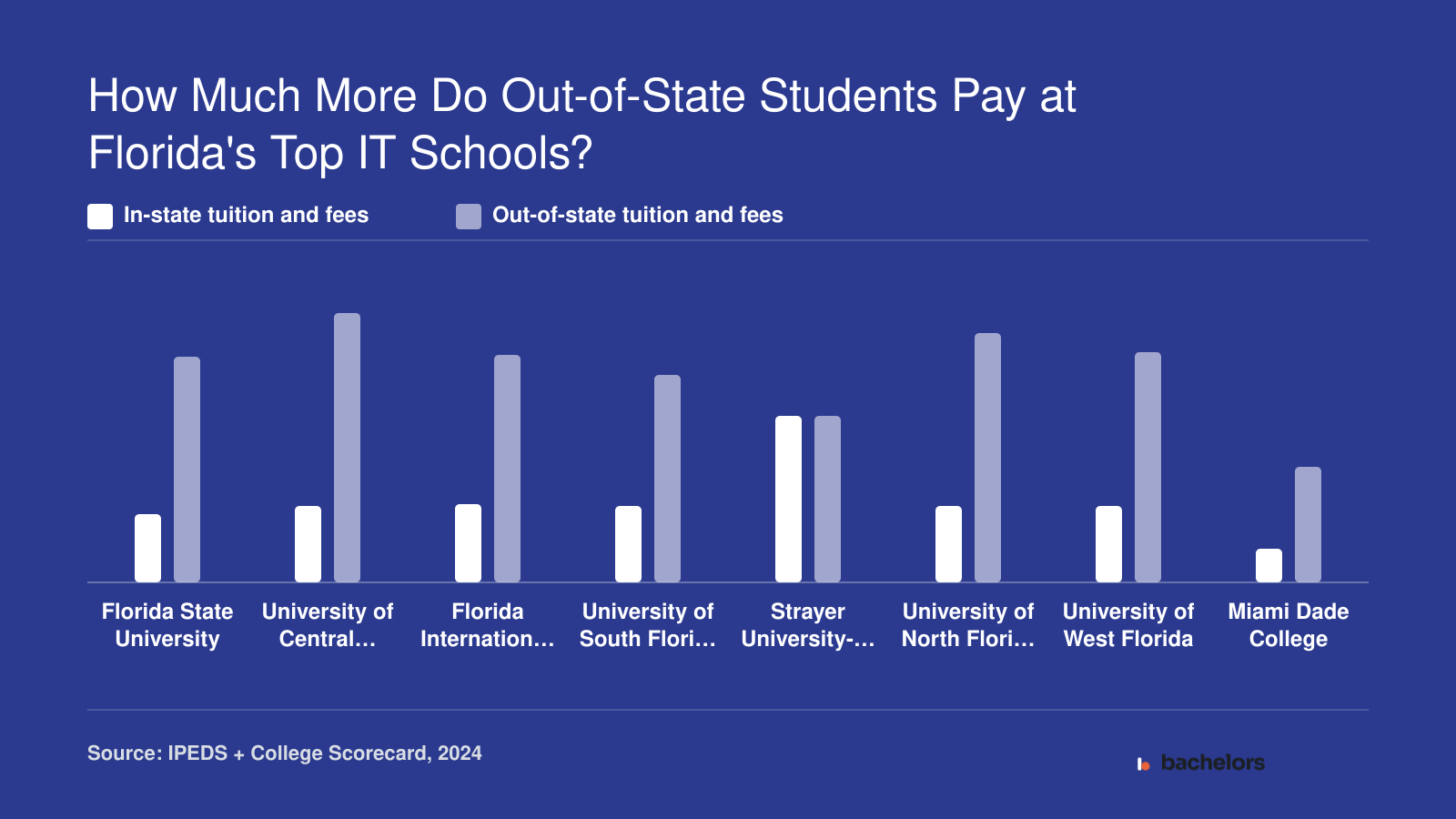
How Much More Do Out-of-State Students Pay at Florida's Top IT Schools?
Florida's public universities charge in-state undergraduates about $5,656 to $6,565 a year in tuition and fees, while out-of-state students pay roughly three times as much. These are published annual tuition and fee figures before financial aid, so many students pay less after grants and scholarships. Private schools such as Strayer University-Florida usually charge one rate regardless of residency, and Miami Dade College posts the lowest in-state figure in this chart at $2,838.
Careers and Salaries for IT Graduates in Florida
Salary data for IT roles changes with every Occupational Employment and Wage Statistics release, and Florida numbers vary widely from one metro to the next. Treat any single wage figure as a snapshot with an expiration date, and pull the current tables rather than trusting a summary that may be a release or two behind.
Pull the Latest Florida and Metro Medians
Start at BLS.gov/OEWS and open the most recent year available. Select Florida, then the Miami, Orlando, Tampa, and Jacksonville metro areas, and look up computer user support specialists, network and computer systems administrators, and information security analysts. The national medians for May 2025 were $61,860, $99,130, and $129,180 respectively, but the state and metro tables are where the local picture sits.2 Read the label on every table before you compare: a May 2023 mean for network administrators in Florida ($95,460) is not the same measure as a May 2025 median, and the Miami area mean that year was $99,750.3 Mixing years and measures distorts the comparison, so note the year, the area, and whether the figure is a median or a mean.
Verify Licensure, Do Not Assume It
Use CareerOneStop's license finder, Florida's official licensing and regulatory sites, and the BLS occupational profiles for each title. IT roles are rarely licensed at the state level, but requirements can change and job titles are not uniform across employers. Confirm the rule before you enroll in a program that markets a licensure outcome, and confirm again before accepting an offer. An advisor should be able to point you to the state rule rather than simply say "no license needed."
Cross-Check With Employers and Advisors
Compare the published ranges against three local signals: career-services pages at the Florida schools on this list, current employer job postings in your target metro, and professional associations such as CompTIA, ISACA, and (ISC)². Job postings show which certifications and clearances employers actually request, and many include pay ranges. Ask program advisors for current placement and salary data for recent graduates, and ask for the year and the number of graduates behind each figure. A placement rate without that context is marketing, not evidence.
Related Articles
Online and Hybrid Bachelor's in IT Options at Florida Schools
Florida International University charges $235.57 per credit for Florida residents in its online B.S. in Information Technology and $758.38 per credit for out-of-state students, a gap of more than $500 per credit. Check that split first when you compare online and campus options; not every Florida school prices distance study the same way.
Where Each Format Is Offered
FIU, USF, Strayer University-Florida, the University of West Florida, Indian River State College and Eastern Florida State College list both online and campus formats. Florida State University, UCF, the University of North Florida and Miami Dade College list their bachelor's degree in information technology as campus-based. At UWF, the program uses face-to-face, hybrid and online classes, so you can mix formats within the same degree.
What Online Study Costs
FIU publishes separate resident and nonresident online rates, so an out-of-state student pays roughly three times the Florida rate per credit.1 Strayer University-Florida, as a private institution, lists one tuition rate regardless of residency. For the public universities and colleges here, ask the distance-learning office whether online students pay the resident rate or a separate distance-learning fee, and whether that fee changes if you take a hybrid course.
Residency Rules and Campus Time
UCF's program carries explicit residency requirements: at least 24 credit hours in scheduled 3000- to 5000-level computer science courses at UCF, 12 of them at the 4000-5000 level, eight upper-division courses in the College of Engineering and Computer Science, and 30 of your last 39 credit hours in residence. Those rules apply to its campus program. For any online option, confirm whether exams are proctored on campus, whether an internship or capstone requires a site visit, and whether transfer credit counts toward residency.
Choosing a Format
- Working adults and career changers: a fully online option at FIU, USF, Strayer, UWF, Indian River State College or Eastern Florida State College keeps a full-time job viable.
- Students who want labs and local contacts: hybrid formats at USF, UWF, Indian River State College and Eastern Florida State College blend online coursework with hands-on time.
- Students who want internships and a campus cohort: FSU, UCF, UNF and Miami Dade suit you better if you can attend in person.
Before you apply, get the online rate and any residency rule in writing from the school.
Admissions for Florida Bachelor's in IT Programs: GPA and Test Policy
Florida's IT bachelor's programs do not share one admissions standard. Grouped by how hard they are to enter, they fall into three rough tiers.
Open-access colleges with an upper-division gate
Miami Dade College, Indian River State College and Eastern Florida State College admit at the college level without a selective first-year review. The filter sits at the upper division instead. Miami Dade asks for an A.A. or A.S. degree, or 60 credit hours, plus a 2.5 GPA. Eastern Florida requires an A.S. or A.A. and states plainly that an A.A.S. does not qualify. An A.S. in computer information technology at Indian River transfers directly into its bachelor's.
Moderately selective: UWF, FIU and UNF
University of West Florida admits roughly 58 percent of applicants, Florida International University about 55 percent and the University of North Florida about 53 percent. FIU lists the SAT and ACT among its entrance requirements and publishes no minimum GPA for the program. UNF runs selective admission to the IT major and expects a C or better in every major course.
Selective: FSU, UCF and USF
Florida State University admits about 24 percent, UCF about 40 percent and USF about 43 percent. FSU's program guide sets a 2.0 GPA minimum for the degree itself, but a first-year minimum GPA and a test-optional statement are not published on its admissions pages, and the same holds at UNF. Read those gaps as unknown, not as waived.
What to have ready before you apply
Prerequisites appear in every tier. FSU's program lists 24 prerequisite credit hours before major coursework starts, UNF pairs prerequisites with its C-or-better rule, and both Miami Dade and Eastern Florida flag prerequisite courses alongside the degree requirement. Confirm those courses before you apply, not after. Federal Pell Grant data also hints at how open each campus is: at Miami Dade and Indian River roughly nine in ten students receive one, compared with about six in ten at FSU and UNF.
Transfer Credit and the State College Route to a Bachelor's in IT
Many Florida students start at a state college and finish a bachelor's degree in information technology at a university or at the same college. Work through these steps before you apply.
- Know what the A.A. guaranteesFlorida's 2+2 articulation agreement guarantees Florida College System A.A. graduates admission to the State University System's 12 public universities. It does not guarantee a specific university, campus, major or program. State law also requires each institution to offer at least one targeted 2+2 pathway that guarantees qualifying A.A. graduates access to a participating university and degree program.
- Finish the 36-credit general education core firstFlorida public institutions must accept the full 36-credit general education block, and core courses satisfy matching core requirements. Transferring before you finish it can mean extra general education coursework, so the state advises completing the block first.
- Expect at least 60 credits toward the bachelor'sAn A.A. carries at least 60 credits toward a bachelor's degree. The state sets no single transfer maximum for IT programs. Residency rules, course equivalencies, excess-credit rules and major prerequisites still decide how much of that work counts toward the IT major.
- Check A.S. coverage separatelyStatewide articulation covers only certain A.S. degrees, and an A.S. in IT does not carry the A.A.'s admission guarantee. Look for local or targeted agreements, which can spell out the program, prerequisites and GPA. For example, USF has a 2026 targeted pathway with a Florida College System partner that includes IT for qualifying A.A. graduates. A.S. students can also earn guaranteed credit for qualifying industry certifications, though the amount varies.
- Get advising and a degree auditMeet transfer advisors at both schools. Request a degree audit that maps each course to the IT major, and confirm prerequisites and deadlines. You can also stay local: Miami Dade College, Seminole State College of Florida and Daytona State College each offer their own IT-focused bachelor's programs.
Frequently Asked Questions About Florida IT Schools
These answers draw on the school profiles, cost, admissions and career sections above. Program details change, so confirm current requirements with each school before you apply.
What is the difference between information technology and computer science degrees?
Can you earn a bachelor's degree in information technology online from a Florida school?
Are there accredited IT schools in Florida that accept transfer credits?
How much do information technology graduates earn in Florida?
Compare Information Technology programs on the data that matters
Explore more Computers & IT majors or browse every field of study.
All Computers & IT programs Browse every field of study