Best Online Information Technology Degree Programs
Compare 260+ accredited online Information Technology programs, with net price after aid, graduation rates, earnings and debt from IPEDS and the U.S. College Scorecard.

For network, systems and support roles, the bachelor's degree in information technology is the standard entry credential, usually a Bachelor of Science (B.S.) in Information Technology. Online price tags vary more than the curriculum does: average net price across the ranked programs runs from $1,300 to $21,565 a year, and published per-credit rates run from $360 to $545.
Delivery is fully online across the board, with no hybrid term or campus visit required. What actually separates the schools is transfer credit policy, term length, and whether graduates of that specific program earn enough to justify the debt they carry.
Key Points
- Texas A&M University-Central Texas has the lowest net price here: $1,300 yearly.
- Competency-based formats let experienced IT workers finish faster by proving existing skills.
- College Scorecard earnings and debt data beat sticker price for judging value.
Top 10 Fully Online Schools for a Bachelor's Degree in Information Technology
Every program below is delivered fully online, with no hybrid or in-person residency standing between a student and the degree. The ten schools are ordered by a mixed quality composite rather than by price or earnings alone, so a low sticker price by itself will not move a school up this list.
Texas A&M University-Central Texas
#1Killeen, TX · under $5,000/yr (est.)
Best for: Transfer students with technical credits
Part of the Texas A&M University system, this public university was built around transfer and nontraditional students, and its information technology degree reflects that mission. The Bachelor of Applied Arts and Sciences in Information Technology accepts an associate of applied science or comparable technical training and can apply up to 36 semester credit hours of occupational coursework toward the major. Four concentrations let students specialize in data analytics, cybersecurity, management and networking, or software and database design, or skip a concentration entirely. Military training evaluated by ACE is accepted, which makes the program unusually friendly to service members and veterans.
- Concentrations: data analytics, cybersecurity, management and networking, software and database design
- Up to 36 semester credit hours for technical, vocational, military or industry training
- A minimum of 12 credits in the occupational specialization is required for admission
- Accepts ACE-evaluated military credit at 15 contact hours per semester credit hour
- 120 total credit hours; zero-credit Computer Information Systems capstone assessment
- Option to finish the degree without declaring a concentration
Florida International University
#2Miami, FL · ~$9,000/yr (est.)
Best for: Career changers drawn to software or DevOps tracks
FIU is a large public research university whose online division delivers the same coursework as its campus programs. The information technology major splits into DevOps and Software tracks that share a core in programming, operating systems, web development and cloud computing, and an accelerated pathway leads into the master's in engineering management. Students complete a junior capstone and a faculty-supervised senior capstone in teams of up to five. The school's graduation rate is about 74 percent.
- Two tracks: DevOps and Software
- 120 total credit hours
- Accelerated pathway to the MS in Engineering Management
- Junior capstone plus faculty-supervised senior capstone with teams of up to five
- Core covers programming, human-computer interaction, operating systems, web and cloud
- Applicants submit a high school diploma plus SAT, ACT or CLT scores
- DevOps track covers continuous integration, configuration management and monitoring
University of South Florida
#3Tampa, FL · ~$10,000/yr (est.)
Best for: Students who want a paid co-op
The University of South Florida is a public research university with one of the strongest internship pipelines among the schools on this list. Internships can begin in the sophomore year, a paid co-op lets students alternate work and study, and undergraduates can join faculty-led research running from artificial intelligence to cybersecurity. Graduates target roles such as information security analyst, database administrator, software developer and cloud architect. The school's graduation rate is about 77 percent.
- Internships can start in the sophomore year
- Paid co-op, part-time or full-time, combined with study
- Faculty-led undergraduate research from artificial intelligence to cybersecurity
- Foundation in programming, databases, networking and system administration
- Advanced topics include cybersecurity, cloud computing and data management
- Target roles: information security analyst, database administrator, software developer
University of Virginia
#4Charlottesville, VA · $22,000/yr (est. net price)
The University of Virginia awards a Bachelor of Interdisciplinary Studies through its School of Continuing and Professional Studies, with an 18-credit information technology concentration built from five required IT courses and one elective. It is a bachelor's completion degree, so students arrive with prior college credit and finish at least 60 of the 120 credits at UVA. Most take two courses per term, finishing in three to four years, with up to seven years allowed. The school's graduation rate is about 96 percent, the highest among the schools on this list.
- 18-credit IT concentration: five required IT courses plus one elective
- Required coursework covers enterprise architecture, database management and business intelligence
- IT electives include Java programming, agile project management and cybersecurity
- 120 total credits, at least 60 completed at UVA; 24 elective credits outside IT
- Two-semester capstone plus Liberal Studies and Conduct of Inquiry seminars
- Typical pace is two courses per term; finish in three to four years, seven allowed
Strayer University-Florida
#5Tampa, FL · ~$16,000/yr (est.)
Strayer University is a for-profit institution built for working adults, with 11-week courses and eight technology concentrations that run from artificial intelligence and cybersecurity to cloud computing and IT project management. Students can transfer up to 28 classes, take general education courses at no cost through Sophia Learning, and draw on employer tuition assistance from a large network of partner organizations. Admission is open to applicants with a high school diploma or equivalent, and the same program runs online or at select campuses.
- Eight concentrations, including artificial intelligence, cybersecurity and cloud computing
- 40 courses total; each course runs 11 weeks
- Major requires 58.5 credit hours, the concentration 18 and general education 67.5
- Transfer up to 28 classes
- No-cost general education courses through Sophia Learning
- Employer tuition assistance with more than 500 partner organizations
- Financial aid and scholarships available; winter start dates
University of Oklahoma
#6Norman, OK · $15,000 – $20,000/yr (est.)
The University of Oklahoma awards its information technology degree through the School of Library and Information Studies, and every student completes an internship before graduating. A fully online track is designed for transfer students and working professionals, and students meet an advisor each semester before enrolling, which keeps the online experience from feeling anonymous. Coursework leans applied, using PHP, MySQL, HTML5, JavaScript, Python and R alongside coverage of AI, data science and cybersecurity. The school's graduation rate is about 75 percent.
- Fully online track designed for transfer students and working professionals
- Internship required for all BSIST students
- Coursework uses PHP, MySQL, HTML5, JavaScript, Python, R and CSS
- Covers information architecture, user-centered design, data analytics and cybersecurity
- Includes AI, data science, machine learning and human-AI interaction topics
- Advisor meeting required each semester before enrolling
- Graduates work as data analysts, UX researchers, IT project managers and systems analysts
Thomas Edison State University
#7Trenton, NJ · $5,000 – $10,000/yr (est.)
Thomas Edison State University is a public institution created for adults who already hold college credit and work experience. Its information technology degree accepts professional IT certifications, credit by exam and prior learning assessment toward the 120 credits, and at least 18 credits must be upper level so the degree does not turn into a patchwork of introductory courses. The program is fully online and aimed at people already working in the field who need the credential rather than an entry point.
- 120 total credit hours, fully online
- At least 18 area-of-study credits must be at the 3000 or 4000 level
- Professional IT certifications may satisfy some or all elective requirements
- Credit by testing and Prior Learning Assessment accepted
- Coursework covers network technology, Windows servers, Linux and cloud computing
- Required math above College Algebra plus a two-semester lab science sequence
University of West Florida
#8Pensacola, FL · $5,000 – $10,000/yr (est.)
The University of West Florida pairs its information technology major with required experiential components: an internship, a co-op and a research capstone. Department partnerships with Red Hat Academy and Cisco Networking Academy thread vendor training into the networking and Linux courses, and professional certification exams can earn credit toward the degree. The school's graduation rate is about 59 percent, and the department also offers minors in IT, data processing and network administration for students who want a smaller commitment first.
- Coursework in cybersecurity, databases, networks, operating systems and programming
- Internship, co-op and research capstone are part of the degree
- Partners with Red Hat Academy and Cisco Networking Academy
- Linux System Administration course includes Red Hat certification training
- Professional certification exams can earn credit toward the degree
- Minors offered in IT, data processing, information systems and network administration
California State University-San Marcos
#9San Marcos, CA · $10,000/yr (est. net price)
California State University San Marcos runs its computer information systems degree as a cohort-based completion program for students who arrive with at least 60 transferable semester units. The 60-unit curriculum finishes in four semesters, mixes computing with business and economics, and is delivered entirely online, with a diploma that does not distinguish it from the campus version. Credit for prior learning can shorten the path, and the school's graduation rate is about 55 percent.
- Degree-completion format for students entering with 60 transferable semester units
- 60-unit program completed in four semesters as a cohort
- 100% online coursework; the diploma does not state that it was online
- Coursework blends computing, business, economics and the social sciences
- Classes include Introduction to Computer Security and Project Management and Practice
- Credit for Prior Learning can reduce the number of courses needed
- Rolling admissions with a priority deadline for the Fall 2027 start
American Public University System
#10Charles Town, WV · $5,000 – $10,000/yr (est.)
American Public University System is an online institution that serves military members, veterans and working adults, with courses starting monthly in 8- to 16-week sessions. The information technology major offers five 15-credit concentrations, including programming, project management, full stack development and blockchain, and ends with a three-credit capstone. Transfer students can bring up to 90 credits, there is no application fee or entrance exam, and textbooks are provided at no cost. The school's graduation rate is about 57 percent.
- Five 15-credit concentrations, including programming, project management and blockchain
- 120 total credit hours; a 3-credit information technology capstone to finish
- Courses start monthly in 8- to 16-week sessions
- Transfer up to 90 credits
- No application fee and no entrance exam required
- Military and veteran benefits accepted, with a preferred military tuition rate
- Zero-cost textbooks and ebooks
Cost & outcomes by school
Federal data for the highest-earning Information Technology programs, independent of the ranking above. Earnings are this field's bachelor's graduates four years after completing where the Scorecard reports them, else the school's undergraduate median.
| School | Net price / yr | Grad rate | Earnings | Debt | Grads/yr | Format |
|---|---|---|---|---|---|---|
| Northeastern University MA | $30,915 | 91% | $163,708 | $22,583 | 748 | Online or campus |
| New York University NY | $37,050 | 88% | $142,495 | $19,500 | 698 | Online |
| University of Virginia VA | $21,565 | 96% | $142,041 | $16,547 | 656 | Online |
| Villanova University PA | $43,756 | 92% | $130,585 | $26,000 | 27 | Online or campus |
| George Mason University VA | $17,915 | 68% | $110,754 | $21,000 | 892 | Online or campus |
| Western Governors University UT | $12,548 | 46% | $108,836 | $16,625 | 1,341 | Online |
| Boston College MA | $41,704 | 91% | $103,937 | $19,000 | — | Online or campus |
| Arizona State University AZ | $14,967 | 68% | $101,170 | $15,000 | 170 | Online or campus |
| University of Cincinnati OH | $25,648 | 75% | $100,975 | $22,400 | 278 | Online or campus |
| University of Kentucky KY | $18,851 | 71% | $99,535 | $21,453 | 137 | Online or campus |
| Illinois Institute of Technology IL | $18,425 | 75% | $97,153 | $21,491 | 56 | Online |
| New Mexico State University NM | $8,889 | 55% | $94,024 | $19,508 | 173 | Online or campus |
Sources: U.S. Department of Education. Net price, graduation rate, earnings and debt: College Scorecard (earnings and debt for this field's bachelor's graduates where reported, else school-wide); graduates: IPEDS. A dash means no figure is reported.
Cost, debt & payoff
Median earnings of this field's bachelor's graduates (4 yrs after completing, else the school's undergraduate median) vs. their median federal loan debt · U.S. College Scorecard
Across these programs the median graduate earns about $64,343 and finishes with roughly $23,750 in debt — a ratio that clears a common rule of thumb (keep debt below first-year salary). Net price and debt vary widely school to school, so check the per-school figures in the table above before you shortlist.
How We Ranked Fully Online IT Programs
Flexibility is easy to advertise and hard to verify: a program can be 100 percent online and still leave you guessing whether its graduates land IT jobs and pay down their loans. That tradeoff, convenience against proof of outcomes, is what this ranking measures.
The fully online filter
Only programs you can complete entirely at a distance qualify. Hybrid formats, required campus visits and residencies are excluded, because they defeat the reason most readers search for an online IT degree.
What carries the most weight
Affordability comes first, measured by net price rather than sticker tuition, since aid and fees change what you actually pay. Next are institutional graduation and retention rates, which signal whether students who start actually finish. College Scorecard outcomes follow where they exist, including earnings after graduation and typical debt for graduates.
Institution-wide versus program-level data
Graduation rates, net price and 10-year earnings describe the whole institution, not the IT department alone. College Scorecard reports earnings and debt for that specific IT program and credential, shown separately so you can see how IT graduates fare on their own.
When outcomes are not published
Some programs do not report program-level earnings or debt. Those schools are still ranked on the measures they do report, rather than being pushed aside for a gap in reporting. Because federal data lags and curricula change, confirm tuition, transfer credit and outcome figures directly with each school before you apply.
Most Affordable Online IT Degree Programs: Net Price vs. Per-Credit Tuition
If you want the cheapest accredited online IT degree on an after-aid basis, Texas A&M University-Central Texas posts the lowest average net price here at $1,300 a year, followed by Indian River State College ($3,815) and Eastern Florida State College ($6,440). Net price is the federal College Scorecard average annual cost after grants and scholarships for all undergraduates at the school, not a sticker quote or a program-specific bill, so your cost will shift with residency, aid and transfer credit. On a standard 120-credit degree, starting with 0 transfer credits means paying for the full course load, while bringing 60 credits from an associate degree leaves roughly half to pay for, a pathway each of these public schools builds in. WGU appears for comparison because its flat-rate pricing rewards fast finishers and bundles certification exam vouchers into tuition, which WGU says are worth $150 to $400 per exam. Exam voucher coverage is not listed for the public schools, so budget for exams such as CompTIA certifications out of pocket unless the school confirms otherwise.
| School | Program | Average Net Price After Aid (Undergraduates) | Published Tuition and Fees | Transfer and Pricing Notes | Certification Exam Costs |
|---|---|---|---|---|---|
| Texas A&M University-Central Texas | Bachelor of Applied Arts and Sciences in Information Technology | $1,300 per year | $7,363 in-state / $17,154 out-of-state per year | 120 credits; transfer pathway for associate degree holders; up to 36 credits for occupational specialization; credit for certifications and industry training | Not listed |
| Indian River State College | Bachelor of Science in Information Technology Management and Cyber Security | $3,815 per year | $2,764 in-state / $10,201 out-of-state per year | 120 credits; A.S. in Computer Information Technology transfers in; offered online and on campus | Not listed |
| Eastern Florida State College | Computer Information Systems Technology Bachelor of Applied Science | $6,440 per year | $2,496 in-state / $9,739 out-of-state per year | Requires an A.S. or A.A. for entry (A.A.S. does not qualify); fully online option; eligible for the college's $10,000 Bachelor Degree Program | Not listed |
| Western Governors University (WGU) | Bachelor of Science in Information Technology | N/A | $3,925 per six-month term (2026 flat rate) plus $200 e-books and resources fee per term; one WGU page lists $4,175, so confirm the current rate | Flat rate covers as many courses as you complete each term; no separate online or technology fee listed beyond the $200 resource fee | Vouchers included in tuition, two attempts each; covers CompTIA A+, Network+, Security+, AWS Certified Cloud Practitioner, ITIL 4 Foundation and others; membership or other certification costs may still apply |
Related Articles
Graduate Earnings, Debt and ROI at Online IT Schools
Earnings and debt figures show what graduates of a specific IT bachelor's program were paid and what they owed, a better gauge of value than sticker price alone. The federal College Scorecard publishes these numbers by program, though not every school reports them.
Earnings and Debt by Program
University of Virginia graduates in this field had median earnings of $98,067 one year after completion and $142,041 four years after completion. Median debt was $16,547, with a monthly payment of $175 on a 10-year plan. George Mason University shows $78,800 at one year and $110,754 at four years, against $21,000 in debt. At Florida International University, the figures are $62,562 and $90,397, with $18,896 in debt.
Lower-priced public options sit at a different point. Indian River State College graduates earned $49,049 one year out and $71,761 four years out, with just $7,000 in median debt. University at Albany shows $49,759 and $80,285, with $20,000 in debt. Illinois Tech lands at $61,313 and $97,153, with $21,491 in debt. Some schools, including Thomas Edison State University and California State University-San Marcos, have no program-level figures, so they are left out here. Small graduating classes, such as Santa Fe College's, can also make a single year's numbers jumpy.
Payment as a Share of Early Pay
Divide the 10-year monthly payment by first-year monthly earnings and the picture sharpens:
- Indian River State College: $74 a month against roughly $4,087 in monthly pay, about 1.8 percent.
- University of Virginia: $175 against roughly $8,172, about 2.1 percent.
- University at Albany: $212 against roughly $4,147, about 5.1 percent.
None of these is onerous, but the spread between them is real. Indian River pairs modest early pay with very low debt, and Virginia pairs high pay with moderate debt.
What the ROI Ratio Does and Does Not Tell You
The return-on-investment ratio compares school-wide earnings ten years after enrollment to median graduate debt. Thomas Edison State University scores about 5.5 and Virginia about 5.0. Treat it as context for the whole institution, not as the result of the IT program itself. It also cannot stand in for a program-level figure that a school hasn't published.
Three Takeaways
- Low debt with solid early earnings usually beats high early earnings carried alongside heavy debt.
- Check the payment as a share of first-year pay. Under about 3 percent is comfortable, and above 5 percent deserves a second look.
- Use school-wide ratios to compare institutions, then lean on program-level earnings and debt before you commit.
Competency-Based vs. Term-Based Online IT Programs
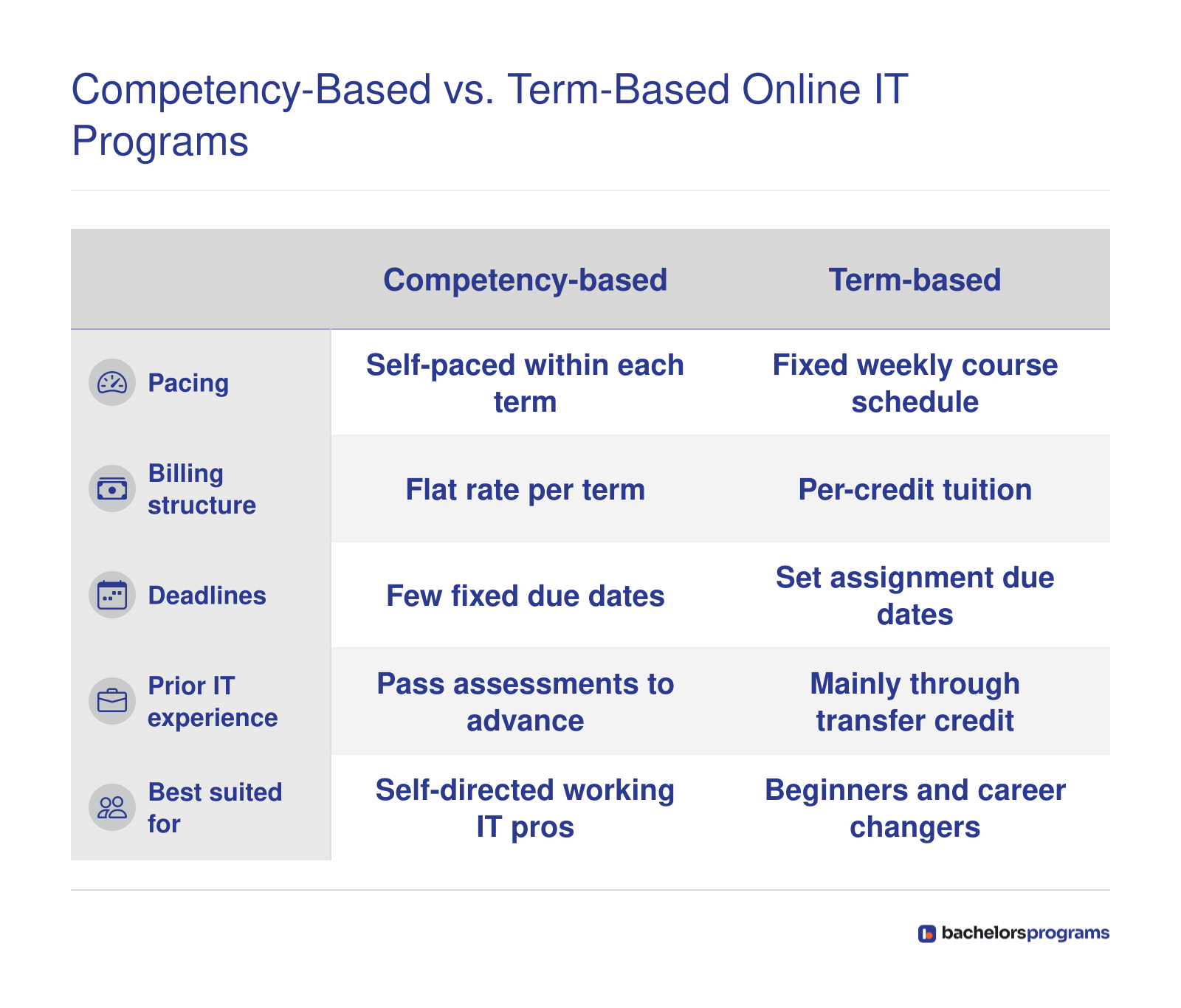
Online IT bachelor's programs usually follow one of two formats, and the choice shapes your schedule, cost and time to graduation. Experienced IT workers often finish faster in competency-based models because they can prove what they already know and move on. Beginners may benefit from the structure, set deadlines and steady pacing of term-based courses.
Accreditation and Online Format: What to Check Before You Apply
Before you apply, confirm that an online IT program's accreditation and delivery format match what it advertises. Work through these checks for every school on your shortlist.
- Confirm ABET program accreditationSearch ABET's accredited program search at abet.org by school and program name. ABET accredits individual programs, not whole schools, so make sure the B.S. in Information Technology itself appears under the Computing Accreditation Commission (CAC). Note any online-campus designation. ABET evaluates online programs under the same criteria as on-site programs.
- Verify institutional accreditationLook up the school in the U.S. Department of Education's accreditation database. This check covers the institution as a whole and is separate from program-level ABET review.
- Read the delivery detailsOn the official program page, find out whether courses are asynchronous or include required live sessions, whether exams use remote proctoring or testing centers, and whether there are residency, on-site or state authorization requirements. ABET's 100% online label means all course content is delivered online. It does not rule out these other requirements. If the page leaves anything out, ask admissions or the program director.
- Compare career expectationsUse the BLS Occupational Outlook Handbook and groups such as ACM, IEEE Computer Society and ISACA to learn what employers expect. Then compare those expectations with what the program page says.
- Get vague claims in writingTreat fuzzy answers as a warning sign. Ask for written confirmation of accreditation status, proctoring rules, live-session requirements and residency obligations before you apply.
Questions to Ask Yourself
Do you already hold IT certifications or work experience that could shorten your degree?
Will you transfer in an associate degree, and does your shortlisted school accept all of it?
Will your target employer or future master's program care about ABET accreditation?
Can your work schedule handle required live sessions?
What IT Managers Earn Nationally
A bachelor's degree in information technology is often the first step toward IT leadership roles, which rank among the field's highest-paying positions.
Information Technology programs by state
Online IT Degree FAQ
These answers cover the questions prospective students ask most about cost, timing, transfer credit and prior experience. Policies vary by school, so confirm details with an admissions office before you apply.
Can you get an IT degree online for free?
How long does it take to earn an online bachelor's degree in information technology?
Do online IT degrees accept transfer credits?
Can I earn an online IT degree with no prior IT experience?
Compare Information Technology programs on the data that matters
Explore more Computers & IT majors or browse every field of study.
All Computers & IT programs Browse every field of study