Best Web Development Degree Programs
Compare 30+ accredited Web Development programs, with net price after aid, graduation rates, earnings and debt from IPEDS and the U.S. College Scorecard.

Purdue graduates of its web programming and design major report median earnings of $72,424, a figure most program brochures leave out. Earnings, net price and debt separate one program from another, and they decide whether a bachelor's degree in web development pays off.
The Bachelor of Science (B.S.) in Web Development is the common credential, but the field is crowded with look-alikes. Plenty of so-called web development degrees are really concentrations inside information technology, graphic technology, or software development majors. The title on the diploma tells you little. The coursework behind it tells you almost everything.
Key Points
- 40.3% of 2026 Stack Overflow respondents named a bachelor's their highest degree.
- Web developers earn a national median wage above the overall U.S. median.
- Net price after aid, not sticker price, drives the real degree cost.
Best Web Development Schools Ranked for 2027
The ten programs below cover public and private universities and a mix of campus, online and hybrid delivery, so readers can weigh very different formats side by side. Each entry gives the institution's net price after aid, its graduation rate, its location and any concentration that sits inside a broader major rather than standing alone. Where the web program reports earnings for its graduates, the figure and its time window appear with it.
Purdue University
#1West Lafayette, IN · ~$15,000/yr (est.)
Best for: Designers who want serious coding depth
Purdue's West Lafayette campus pairs a large engineering and technology portfolio with a web major that lives inside Computer Graphics Technology, so students get design studio work and server-side programming in the same degree. The major requires the Cornerstone Certificate and runs a full fourth-year sequence of web development courses. Net price after aid is about $14,600, the school graduates 83% of students, and graduates of this program earned a median of $38,234 one year after finishing.
- Sits within the ABET-accredited Computer Graphics Technology program
- 33 required major credits plus 61 credits of other program requirements
- Front-end design in HTML5, JavaScript and CSS; back-end in PHP/MySQL or .NET
- Cornerstone Certificate required for the major
- Senior courses in advanced web programming and data integration
Brigham Young University-Idaho
#2Rexburg, ID · ~$8,000/yr (est.)
Best for: Cost-conscious students seeking full-stack training
BYU-Idaho runs a large, low-cost campus operation in Rexburg with a web major that puts full-stack work in the first year rather than saving it for upper division. Students move from Web Fundamentals into full-stack development and a web business course, and the department publishes a four-year class plan. Net price after aid is about $8,200, the school graduates 55% of students, and graduates report averaging $53,421 one year after graduation and $80,863 after five years.
- Starts with Web Fundamentals (WDD 130) and introduction to programming
- Progresses to Full Stack Foundations (WDD 360) and Web Full-Stack Development (WDD 430)
- Web Business Creation (MKT 353) and cloud technology courses included
- Four-year class plan published
- Program cites 23% projected ten-year growth for web developers and designers
- Graduates average $53,421 one year out and $80,863 after five years
Santa Clara University
#3Santa Clara, CA · ~$50,000/yr (est.)
Best for: Engineering-minded students focused on web systems
Santa Clara's engineering school treats the web as an engineering discipline, and the major carries a 175-unit load that includes the full University Core plus a three-course senior design sequence. Small cohorts work through web programming, infrastructure, usability and information management alongside computer networks and software engineering. Net price after aid is about $50,100, and the school graduates 88% of students.
- 175 total units including the University Core Curriculum
- Coursework in web programming, web infrastructure and web usability
- Web information management, computer networks and software engineering
- Three-course senior design sequence (Design Project I, II, III)
- CSEN 10 waived with AP credit or a department programming diagnostic
- Four calculus courses plus probability and statistics required
SUNY College of Technology at Alfred
#4Alfred, NY · ~$15,000/yr (est.)
Alfred State's four-year Bachelor of Technology takes a hands-on IT approach, and students work in more than 200 labs across the Alfred campus. The web program covers server administration, JavaScript and server-side scripting, ending in a capstone where students build web applications for outside organizations. Net price after aid is about $15,000, and the school graduates 55% of students.
- Four-year Bachelor of Technology on the Alfred campus
- Covers web server administration and JavaScript with server-side scripting
- Capstone builds web-based multimedia applications for real organizations
- More than 200 labs available across campus
- Students who do not place into College Algebra take MATH 1014 first
Illinois State University
#5Normal, IL · ~$19,000/yr (est.)
Illinois State houses web work inside an Information Systems degree accredited by ABET's computing commission, which puts databases, testing and mobile development alongside front-end design. Students complete a required professional practice internship and build projects for real clients. Net price after aid is about $19,400, and the school graduates 65% of students.
- Major sequence inside the ABET-accredited Information Systems BS
- Client- and server-side scripting plus web interface design
- Web frameworks, mobile application development and web database processing
- Required professional practice internship
- Students build projects for real clients
Utah Valley University
#6Orem, UT · $5,000 – $10,000/yr (est.)
Utah Valley runs one of the larger digital media operations in the state, and its web degree splits into an interaction and user experience track or a web and app development track, with shared classes for the first half. Seniors spend their final year on a capstone product team alongside designers and project managers. Net price after aid is about $6,400, the school graduates 45% of students, and graduates earned a median of $32,743 one year after finishing.
- 120 credits with two emphases: Interaction & User Experience Design, Web & App Development
- Both emphases share the same classes for the first half of the degree
- Web and App Development emphasis prepares junior-level front-end developers
- Final year is a capstone on a product team with designers and project managers
- Department also offers a 63-credit Associate in Applied Science
Weber State University
#7Ogden, UT · ~$10,000/yr (est.)
Weber State's full stack emphasis builds the front end first, then adds databases and API services, with internships at community nonprofits where students build, test and maintain live applications. The degree is accredited by ABET's computing commission, and the department also offers a user experience emphasis for students who lean toward design. Net price after aid is about $10,300, and the school graduates 46% of students.
- Accredited by the Computing Accreditation Commission of ABET
- First two years cover the front-end stack and core coding languages
- Later coursework adds back-end development with databases and API services
- Internships with community partners, including nonprofit organizations
- Second emphasis available in User Experience Design
Union University
#8Jackson, TN · ~$27,000/yr (est.)
Union University is a private Christian liberal arts school where web development is a concentration inside the computer science major rather than a standalone degree. The concentration trains front-end and back-end development, and students can take the BS or the BA while choosing among four concentration options. Net price after aid is about $27,200, and the school graduates 66% of students.
- Concentration inside the computer science major, not a standalone web degree
- Offered as a Bachelor of Science or a Bachelor of Arts
- Four concentrations, including AI & Machine Learning and Game Development
- 2026-27 catalogue curriculum guide published for the BS concentration
- Separate minor in Web Development available
DePaul University
#9Chicago, IL · ~$31,000/yr (est.)
DePaul's Chicago campus runs a large computing and digital media college, and the web development concentration sits inside the Information Technology BS, which students can take on campus or online. The 2026-27 curriculum requires 192 credit hours across roughly 48 courses and finishes with experiential learning and a capstone. Net price after aid is about $30,900, the school graduates 68% of students, and graduates earned a median of $54,859 one year after finishing.
- Concentration inside the Information Technology BS
- 192 credit hours, generally 48 courses, with a 2.0 GPA minimum
- Major electives drawn from 200- and 300-level CDM courses
- Fourth year includes IT 394 experiential learning and IT 395 capstone
- Ethics course required; C- minimum in major courses
- Students cannot double major in Computer Science
Simmons University
#10Boston, MA · $25,000 – $30,000/yr (est.)
Simmons, a private Boston university with a women-centered undergraduate college, teaches this degree jointly through its communications and computer science departments. Students pick a BA in Interaction Design or a BS in Technology centered on full-stack development, then close with a capstone internship or independent study. The Boston location is pitched for internship access, net price after aid is about $25,300, and the school graduates 72% of students.
- Taught jointly by Communications and Computer Science departments
- Two tracks: Interaction Design (BA) or Technology (BS) with full-stack focus
- Covers HTML5, CSS, JavaScript with jQuery and AJAX, plus server-side Perl and Python
- Capstone internship or independent study to finish
- Boston location cited for internship access
- Minor requires 16 credits
Cost & outcomes by school
Federal data for the highest-earning Web Development programs, independent of the ranking above. Earnings are this field's bachelor's graduates four years after completing where the Scorecard reports them, else the school's undergraduate median.
| School | Net price / yr | Grad rate | Earnings | Debt | Grads/yr | Format |
|---|---|---|---|---|---|---|
| Santa Clara University CA | $50,062 | 88% | $109,183 | $19,162 | 12 | Campus |
| DePaul University IL | $30,902 | 68% | $96,616 | $24,999 | 75 | Online or campus |
| Rochester Institute of Technology NY | $34,906 | 70% | $88,096 | $27,000 | 211 | Campus |
| University of Wisconsin-Stevens Point WI | $14,559 | 51% | $84,809 | $22,939 | 1 | Campus |
| Champlain College VT | $35,860 | 65% | $67,795 | $27,000 | 9 | Online |
| Gwynedd Mercy University PA | $27,483 | 57% | $67,145 | $25,000 | 1 | Campus |
| Brigham Young University-Idaho ID | $8,221 | 56% | $65,397 | $9,312 | 82 | Campus |
| Simmons University MA | $25,265 | 72% | $63,494 | $24,840 | 2 | Campus |
| Illinois State University IL | $19,398 | 65% | $62,117 | $20,482 | 58 | Campus |
| Utah Valley University UT | $6,376 | 45% | $61,451 | $14,750 | — | Campus |
| Duquesne University PA | $37,730 | 78% | $60,310 | $26,950 | 16 | Campus |
| Purdue University IN | $14,600 | 83% | $59,766 | $20,101 | 246 | Campus |
Sources: U.S. Department of Education. Net price, graduation rate, earnings and debt: College Scorecard (earnings and debt for this field's bachelor's graduates where reported, else school-wide); graduates: IPEDS. A dash means no figure is reported.
Cost, debt & payoff
Median earnings of this field's bachelor's graduates (4 yrs after completing, else the school's undergraduate median) vs. their median federal loan debt · U.S. College Scorecard
Across these programs the median graduate earns about $52,074 and finishes with roughly $24,670 in debt — a ratio that clears a common rule of thumb (keep debt below first-year salary). Net price and debt vary widely school to school, so check the per-school figures in the table above before you shortlist.
How We Ranked Web Development Bachelor's Programs
What makes one web development bachelor's program rank above another? We focused on what happens to students after they enroll and after they graduate, using public federal data rather than school marketing claims.
What Went Into the Ranking
- Graduate earnings and debt: The U.S. Department of Education's College Scorecard reports typical earnings and federal loan debt for graduates of a specific field at a specific school.
- Net price: The average yearly cost after grants and scholarships, which is closer to what families pay than sticker tuition.
- Graduation and retention: How many students finish, and how many return after their first year.
- Delivery format: Whether the degree is offered online, on campus, or both.
Where earnings and debt were published for web development graduates at a given school, we used those field-specific figures instead of school-wide averages. A computing degree can pay off very differently than a college's overall numbers suggest.
Major or Concentration?
Some schools offer a standalone web development major. Others offer web development as a concentration inside an information technology or graphic technology degree. Both can prepare you for the work, but the coursework and diploma title differ, so each school card labels which type it is.
Limits to Keep in Mind
That net price averages students who receive aid, so it is not a quote for your household. Use each school's net price calculator for that. Graduation and retention rates cover the entire institution, not only web development students.
What a Bachelor's Degree in Web Development Covers
The tradeoff at the heart of a bachelor's degree in web development is breadth against proof: you spend years learning the entire stack, then get hired on the slice of it you can demonstrate in a portfolio.
The Core Coursework Buckets
Most programs divide coursework into the same few recognizable areas. Front-end work covers HTML, CSS, JavaScript, and at least one modern framework such as React. Back-end work introduces a server language and API design. Databases mean SQL and, increasingly, a nonrelational option. Around that core are cloud deployment, version control with Git, and usability or accessibility coursework, areas hiring teams tend to expect.
How Named Programs Build the Stack
Full Sail University's B.S. in Web Development is unusually explicit about the stack: named courses include web architecture, interface programming, database systems, server-side languages, deployment, cloud application development, and integration and security. Bellevue University's online B.S. in Web Development lists 127 total credits, with WEB 200 Fundamentals of Web Development as a 3-credit requirement. Champlain College's B.S. in Web Design and Development totals 120 credits, split into 48 professional, 42 general education, and 30 elective credits.
Capstone, Portfolio, and the GPA Question
Portfolio work is where the degree proves itself. Full Sail runs a six-course Project and Portfolio sequence plus two professional development seminars; the final course requires students to deploy a product to a working, scaled test environment, measure load performance, document security testing, and present the finished system. That is closer to a job sample than a term paper. Hiring managers in this field generally weigh a live portfolio more heavily than a GPA, because it shows whether you can ship.
How Long It Takes
Plan on roughly 120 credit hours and about four years of full-time study, which is the pattern at Bellevue and Champlain. Some online schools offer accelerated or competency-based paths that shorten the calendar, particularly for transfer students.
Web Development vs. Web Design vs. Computer Science Degrees
All three bachelor's degrees can lead into tech work, but they train you for different jobs. Computer science keeps the most career doors open, web development is the most job-ready path for building sites and apps, and web design suits visual and UX-focused students. Pay and growth figures below come from U.S. Bureau of Labor Statistics data for the closest matching occupations (May 2025 wages, 2025 to 2035 projections).
| Factor | Web Development | Web Design | Computer Science |
|---|---|---|---|
| Core focus | Building and maintaining websites and web applications | Planning and testing site or interface layout, functions, and navigation for usability | Designing computer applications, programs, and the systems behind them |
| Typical courses | HTML, CSS, JavaScript, databases and SQL, back-end programming, web frameworks | Visual design, UX and usability, interface layout, graphic arts, front-end basics | Data structures, algorithms, operating systems, software engineering, theory |
| Math intensity | Light to moderate | Light | Highest: discrete math, calculus, and algorithm analysis are common |
| Related jobs and median pay | Web developer: $92,650 | Web and digital interface designer: $104,000 | Software developer: $135,980 |
| Projected job growth, 2025 to 2035 | 3.8% for web developers | 6.0% for web and digital interface designers | 10.2% for software developers |
| Degree and hiring picture | Bachelor's degree is typical, though entry can range from a high school diploma up; some employers prefer computer science or programming | Bachelor's degree is typical; employers may prefer web design, digital design, or graphic arts, and a strong portfolio can substitute for credentials | Bachelor's degree is typical, usually in computer and information technology or a related field; some employers prefer a master's |
| Best fit | Students who want to build working sites and apps quickly | Students drawn to visuals, layout, and user experience | Students who want the widest range of tech careers and can handle heavier math |
Most Affordable Web Development Degree Programs
These are the lowest-cost web development bachelor's programs on this page, ranked by average net price after aid, based on IPEDS and College Scorecard (2024) data from the U.S. Department of Education. Net price is the average amount students actually pay per year after grants and scholarships, not the sticker price. Because it also reflects living costs, it can run higher than tuition alone, as it does at Brigham Young University-Idaho, which charges the same $4,800 in tuition and fees regardless of residency.
| School | Program | Location | Average Net Price (After Aid) | In-State Tuition and Fees | Out-of-State Tuition and Fees | Format |
|---|---|---|---|---|---|---|
| Utah Valley University | Web Design and Development (Web and Application Development) | Orem, UT | $6,376 | $6,507 | $18,489 | On campus |
| Brigham Young University-Idaho | Web Design & Development (B.S.) | Rexburg, ID | $8,221 | $4,800 | $4,800 | On campus |
| Weber State University | Web and User Experience (BS), Full Stack Web Development | Ogden, UT | $10,258 | $6,557 | $17,545 | On campus |
Web Development Degree Cost, Debt, and Return on Investment
The sticker price on a web development program rarely matches what students actually pay, and that gap should drive your decision.
What the degree actually costs
Average net price (tuition and living costs after grants and scholarships) runs from about $8,221 a year at Brigham Young University-Idaho to roughly $37,730 at Duquesne University. Published tuition tells a very different story: Rochester Institute of Technology lists $59,274 but averages $34,906 after aid, and Champlain College drops from $47,850 to about $35,860. Public options stay close to list price, with Purdue University at $14,600 and University of Wisconsin-Stevens Point at $14,559 net.
Debt and the monthly payment
Median federal debt among graduates of these web development programs varies widely. Brigham Young University-Idaho is the clear low mark at $9,312 borrowed, or roughly $99 a month on a standard 10-year plan. Purdue graduates carry $20,101 ($213 a month), Wisconsin-Stevens Point $22,939 ($243), and Northwest Missouri State $23,250 ($246). DePaul, Duquesne, RIT, and Champlain cluster between $24,999 and $27,000, or $265 to $286 monthly. DeVry University's programs sit highest at $41,879, about $444 a month.
Weighing debt against earnings
Median earnings one year after completing these programs range from $32,159 at DeVry to $69,052 at RIT, with Northwest Missouri State at $51,790 and DePaul at $54,859. Four years out, Brigham Young University-Idaho graduates reach a median of $65,397 and RIT graduates $88,096.
A workable rule: keep total borrowing under your expected first-year salary. Brigham Young University-Idaho and Purdue clear that bar comfortably. Where debt approaches or exceeds year-one pay, the payment becomes the deciding factor, not the diploma.
Related Articles
Median Pay for Web Developers Nationwide
Graduates from a bachelor's degree in web development enter an occupation with a national median wage well above the overall U.S. median.
Web Developer Degree Requirements: Admission and Transfer Checklist
Admission to an online web development bachelor's program is usually straightforward. Transfer rules often matter more, because they decide how fast you finish and what you pay. Use this checklist to compare schools.
- High school diploma or equivalentWGU and Bellevue University require one. Bellevue also asks for a readiness survey and an application.
- Minimum GPAChamplain College Online recommends a 2.5 but reviews exceptions case by case. WGU asks for a 2.25 on college transcripts or a 2.75 on high school transcripts.
- Admission testsWGU does not require the ACT or SAT.
- Maximum transfer creditsSNHU and Champlain each accept up to 90 transfer credits. SNHU requires at least 30 of its 120 credits to be earned at SNHU.
- Minimum transfer gradeSNHU accepts a C- or higher for online undergraduates. Champlain requires a C or higher.
- IT certificationsAt WGU, an approved IT certification can serve as an admission pathway and may transfer as course credit, generally if you earned it within five years.
- Credit for prior learningChamplain weighs work experience, training and military service. WGU evaluates coursework from Sophia Learning and Study.com.
- Associate degree transferWGU says credits from an accredited associate degree almost always transfer and may cover some or all lower-division requirements.
- Accreditation of prior courseworkBellevue accepts transfer credit only from regionally accredited colleges and universities.
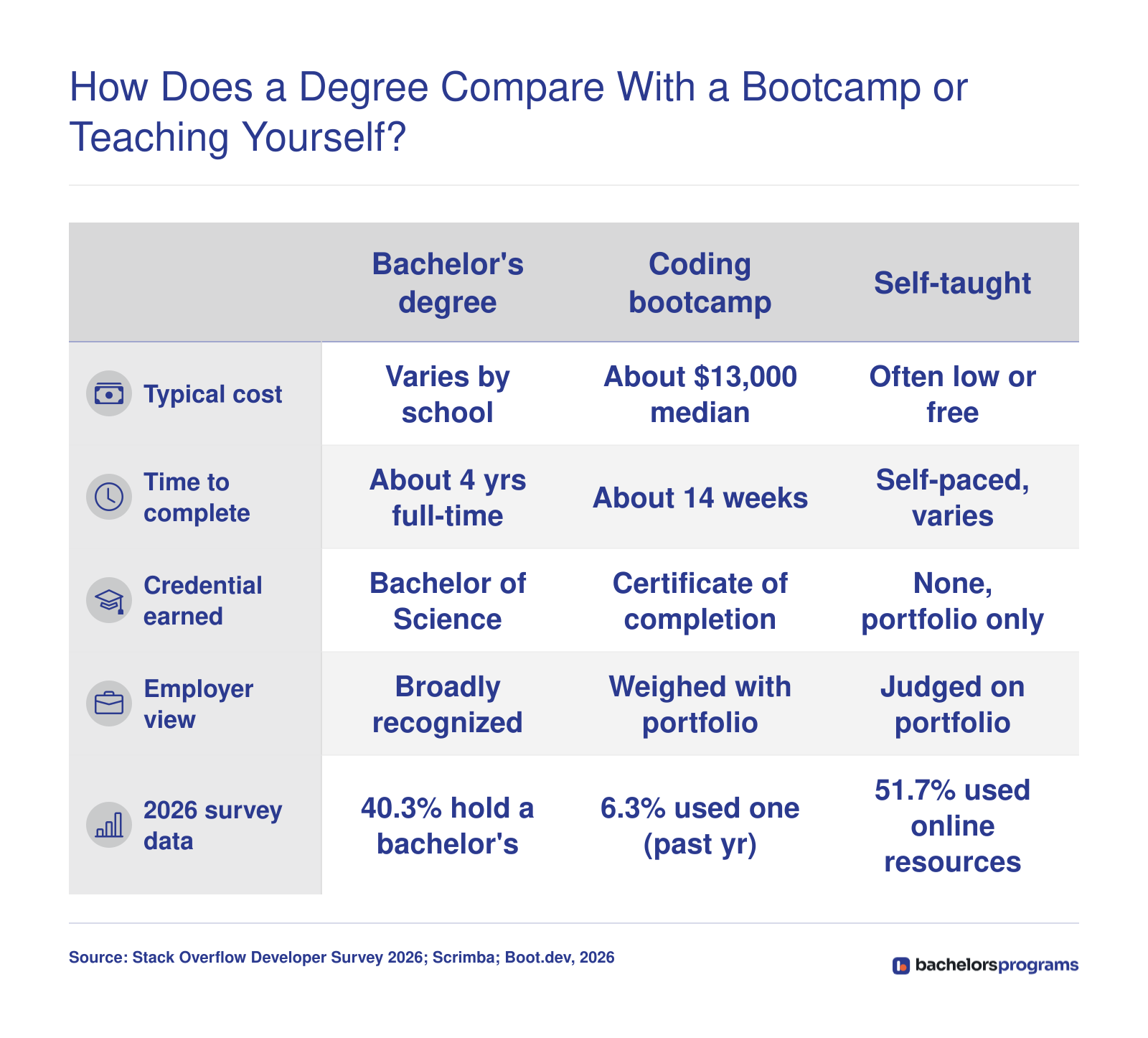
How Does a Degree Compare With a Bootcamp or Teaching Yourself?
In the 2026 Stack Overflow Developer Survey, 40.3% of respondents listed a bachelor's as their highest completed education. Separately, 6.3% said they used a coding bootcamp to learn in the past year, and respondents could pick more than one learning method. Bootcamp prices vary widely, from under $500 to over $20,000. One worldwide sample averaged $14,142 for about 14 weeks.
Web Development programs by state
Compare Web Development programs on the data that matters
Explore more Computers & IT majors or browse every field of study.
All Computers & IT programs Browse every field of study