Best Web Design Degree Programs
Compare 30+ accredited Web Design programs, with net price after aid, graduation rates, earnings and debt from IPEDS and the U.S. College Scorecard.

AI tools have moved into the studio curriculum. BYU-Idaho and Utah Valley now teach AI tools alongside HTML, CSS, and JavaScript, and Purdue's program requires 48 credits of major coursework plus a 15-credit certificate.
The practical question is which bachelor's degree in web design produces a usable portfolio and a job without excessive debt. The ranked list includes both online and on-campus programs, with net price after aid and College Scorecard earnings data shown beside each.
No license gates this field, so time and cost decide more than prestige: four years against a two-year associate option or a bootcamp, measured in tuition and starting salary.
Key Points
- Monthly loan payments run $99 at BYU-Idaho to $444 at DeVry University-Illinois.
- Web developers earn a national median of $92,650, according to BLS data.
- Many employers hire web designers on portfolio strength rather than degree alone.
Top 10 Web Design Schools for 2027, Ranked and Reviewed
Every school below awards a bachelor's degree in web design or a closely related major, and each card gives the format, the location, the average net price after aid, and the school's overall graduation rate so you can compare them side by side. Where a program has its own published earnings figure, that number appears with the timeframe attached. Read straight through, or skip to the entry that matches your budget, your state, and how you want to attend class.
Purdue University
#1West Lafayette, IN · ~$15,000/yr (est.)
Best for: Students who want front-end coding depth
Purdue University is a large public research university in West Lafayette, Indiana, and its web design pathway sits inside the Computer Graphics Technology program rather than a standalone art department. The bachelor's degree in web design leans technical, pairing front-end work in HTML5, JavaScript and CSS with back-end coursework in PHP/MySQL or .NET and SQL Server. Students who completed the program had median earnings of $38,234 one year after finishing. The average net price after aid is about $14,600, and the school's overall graduation rate is 83%.
- ABET-accredited B.S. inside the Computer Graphics Technology program
- 120 credits, including 48 in program major courses
- Front-end work in HTML5, JavaScript and CSS
- Back-end options in PHP/MySQL or .NET/SQL Server
- Three major selectives (12 credits) shape the focus
- 15-credit Cornerstone Certificate required
- C- or better required in every CGT course
- Two semesters of resident study at West Lafayette
Brigham Young University-Idaho
#2Rexburg, ID · ~$8,000/yr (est.)
Best for: Budget-conscious students seeking a religious campus
BYU-Idaho is a private university in Rexburg, Idaho, with a four-year Bachelor of Science in Web Design and Development that sequences courses from web fundamentals through full-stack development. The curriculum folds AI tools into coding and design workflows and adds business coursework such as web business creation, so graduates can both build a site and reason about why it exists. Program graduates had median earnings of $49,581 one year after finishing. The average net price after aid is about $8,200, and the school's overall graduation rate is 55%.
- Four-year B.S. in Web Design and Development
- Sequence runs from Web Fundamentals to Full-Stack Development
- Intro to Cloud Technologies and programming among entry courses
- AI tools built into coding and design coursework
- Web Business Creation links design work to marketing
- Graduates work as web developers, administrators and programmers
Touro University
#3New York, NY · $30,000/yr (est. net price)
Best for: Career changers wanting New York internships
Touro University's Lander College of Arts and Sciences sits in Manhattan, which puts agencies, studios and internship sponsors within reach of the classroom. Web design here is a concentration inside a Bachelor of Arts in Digital Multimedia Design, and most design courses meet on campus so students get studio-style feedback rather than working alone online. Faculty include working professionals who mentor students, and the final semester pairs an internship with portfolio preparation. The average net price after aid is about $29,600, and the school's overall graduation rate is 72%.
- Web and multimedia design concentration inside the B.A.
- Six concentration options across the design program
- Three levels of web design coursework
- Final-semester internship plus portfolio preparation
- Faculty include working professionals who mentor students
- Most design courses meet on campus
- Design Society student club
Santa Clara University
#4Santa Clara, CA · ~$50,000/yr (est.)
Santa Clara University is a private Jesuit university in the heart of Silicon Valley, and its Bachelor of Science in Web Design and Engineering is housed in the Department of Computer Science and Engineering. The degree is unusually engineering-heavy for a web design major: 175 units, calculus through Calculus IV, and a three-course design project sequence, balanced by studio arts courses in website graphic design and digital storytelling. That structure suits students who want to build the systems behind a site, not only its layout. The average net price after aid is about $50,100, and the school's overall graduation rate is 88%.
- B.S. in Web Design and Engineering, 175 units total
- University Core Curriculum plus engineering requirements
- Coursework in web usability, web infrastructure and information management
- Three-course Design Project sequence closes the major
- Calculus I through IV plus probability and statistics
- Arts options include website graphic design and digital storytelling
- Intro programming can be waived by AP credit or a diagnostic exam
Sullivan University
#5Louisville, KY · ~$26,000/yr (est.)
Sullivan University is a private institution based in Louisville, Kentucky, and it runs its web design concentration inside a Bachelor of Science in Information Technology that can be completed on campus or fully online. Classes meet days, nights and weekends, which suits working adults finishing a degree around a job. The curriculum spans programming, databases, networking and web design rather than design alone, so graduates can support the sites they build. The average net price after aid is about $25,500, and the school's overall graduation rate is 71%.
- Web Design and Application Development concentration
- Complete in 36 to 48 months
- Fully online option plus Louisville and Lexington campuses
- Day, night and weekend class formats
- Coursework spans programming, databases, networking and web design
- Other concentrations include cybersecurity and network support
- Federal aid, scholarships and military benefits accepted
Utah Valley University
#6Orem, UT · $5,000 – $10,000/yr (est.)
Utah Valley University is a public university in Orem, Utah, and its Bachelor of Science in Web Design and Development splits into two emphases: interaction and user experience design, and web and app development. Both tracks share coursework in the first half of the degree, then diverge, and the capstone puts students on a product team alongside developers and project managers. Program graduates had median earnings of $32,743 one year after finishing. The average net price after aid is about $6,400, and the school's overall graduation rate is 45%.
- Interaction and user experience design emphasis
- Shared core with the development track in the first half
- User research, prototyping and AI literacy coursework
- Capstone puts students on a product team with developers
- Prepares digital product designers and UX designers
- ProdUX student club and conference travel to five U.S. cities
- Web and app development emphasis, 120 credits
- Prepares junior-level front-end web developers
- Capstone with real product teams and industry advisors
- Bryce Canyon field capture trip
- Industry advisors and partners help shape the curriculum
Duquesne University
#7Pittsburgh, PA · $35,000 – $40,000/yr (est.)
Duquesne University is a private Catholic university in Pittsburgh, and its web design offering is a concentration inside a Bachelor of Arts in Digital Media Arts. Students choose a design and usability path or a more technical programming path, then apply both in coursework on dynamic, database-driven sites and interactive client-side interfaces. Internships with Pittsburgh corporate and nonprofit sponsors are built in, with placements reaching as far as New York and Los Angeles. Program graduates had median earnings of $41,394 one year after finishing, the average net price after aid is about $37,700, and the school's overall graduation rate is 77%.
- B.A. in Digital Media Arts with a web development concentration
- 36-credit major, at least 120 credits to graduate
- Design and usability path or a technical programming path
- Coursework in website usability and web design standards
- Covers database-driven sites and interactive client-side interfaces
- Internships with Pittsburgh corporate and nonprofit sponsors
Southwest Baptist University
#8Bolivar, MO · ~$22,000/yr (est.)
Southwest Baptist University is a private Christian university in Bolivar, Missouri, and its Bachelor of Science in Web Systems and Design is a 120-credit degree built on a 48-credit major core. Coursework runs from graphic design and UI/UX through full stack web development and mobile apps, with digital and social media marketing added for students who want the business side of the job. A 2.25 GPA is required in both the computing core and the major core, so the bar stays consistent across the technical half of the degree. The average net price after aid is about $21,700, and the school's overall graduation rate is 55%.
- B.S. in Web Systems and Design, 120 credits
- 48-credit major core plus a 30-credit computing core
- 40-credit DISCOVER core curriculum
- UI/UX design and full stack web development coursework
- Graphic design, mobile apps and database management included
- 2.25 GPA required in both the computing and major cores
- No more than two D grades count in computing core courses
Bellevue College
#9Bellevue, WA · $11,000/yr (est. net price)
Bellevue College is a public college outside Seattle, and its web design path is a track inside a Bachelor of Applied Science in Digital Marketing, so design coursework sits beside analytics, search and ecommerce strategy. The degree is built for transfer students: applicants enter with an associate degree or 90 credits and finish a 180-credit bachelor's, 45 of which must be taken in residence. That makes it a practical route for someone who already holds a two-year credential and wants a four-year title without starting over. The average net price after aid is about $11,400, and the school's overall graduation rate is 36%.
- Bachelor of Applied Science in Digital Marketing, 180 credits
- Web Design and User Experience is one of five tracks
- 30-credit track covers webpage authoring and ecommerce strategy
- User experience and usability coursework
- Selective admission; associate degree or 90 credits to enter
- 45 credits in residence, 30 of them upper division
- Capstone I and II close the degree
Fairleigh Dickinson University-Metropolitan Campus
#10Teaneck, NJ · $15,000/yr (est. net price)
Fairleigh Dickinson University's Metropolitan Campus sits in Teaneck, New Jersey, close enough to New York to make the city's design market part of the plan. Web design here is a concentration inside a Bachelor of Arts in Graphic Design, so students build typography and visual skills first, then move into interface design, coding and site production. The concentration includes a thesis and portfolio preparation, which matters when applying for studio and agency work. The average net price after aid is about $15,400, and the school's overall graduation rate is 53%.
- B.A. in Graphic Design with a Web Design concentration
- Concentration requires 33 credits, including Web Design I and II
- Coursework in WordPress, dynamic design and interface coding
- Thesis and portfolio preparation built into the concentration
- Three electives (9 credits) plus 9 credits of cognates
- 2.00 grade point ratio required after admission
Cost & outcomes by school
Federal data for the highest-earning Web Design programs, independent of the ranking above. Earnings are this field's bachelor's graduates four years after completing where the Scorecard reports them, else the school's undergraduate median.
| School | Net price / yr | Grad rate | Earnings | Debt | Grads/yr | Format |
|---|---|---|---|---|---|---|
| Santa Clara University CA | $50,062 | 88% | $109,183 | $19,162 | 12 | Campus |
| Champlain College VT | $35,860 | 65% | $67,795 | $27,000 | 9 | Online |
| Gwynedd Mercy University PA | $27,483 | 57% | $67,145 | $25,000 | 1 | Campus |
| Brigham Young University-Idaho ID | $8,221 | 56% | $65,397 | $9,312 | 82 | Campus |
| University of Maryland Global Campus MD | $22,063 | 33% | $65,287 | $21,000 | 94 | Online |
| Utah Valley University UT | $6,376 | 45% | $61,451 | $14,750 | — | Campus |
| Duquesne University PA | $37,730 | 78% | $60,310 | $26,950 | 16 | Campus |
| Purdue University IN | $14,600 | 83% | $59,766 | $20,101 | 246 | Campus |
| Walsh University OH | $20,493 | 59% | $59,764 | $27,000 | — | Hybrid |
| Edgewood University WI | $26,113 | 60% | $59,728 | $24,424 | 1 | Campus |
| William Jewell College MO | $17,562 | 68% | $59,268 | $24,498 | — | Campus |
| Fairleigh Dickinson University-Metropolitan Campus NJ | $15,404 | 53% | $57,273 | $25,000 | 4 | Campus |
Sources: U.S. Department of Education. Net price, graduation rate, earnings and debt: College Scorecard (earnings and debt for this field's bachelor's graduates where reported, else school-wide); graduates: IPEDS. A dash means no figure is reported.
Cost, debt & payoff
Median earnings of this field's bachelor's graduates (4 yrs after completing, else the school's undergraduate median) vs. their median federal loan debt · U.S. College Scorecard
Across these programs the median graduate earns about $53,758 and finishes with roughly $22,057 in debt — a ratio that clears a common rule of thumb (keep debt below first-year salary). Net price and debt vary widely school to school, so check the per-school figures in the table above before you shortlist.
How We Ranked Each Bachelor's Degree in Web Design
Some numbers describe your web design program. Others describe the whole school around it. Knowing which is which keeps you from misreading a ranking.
Program-Level vs. School-Wide Numbers
The rankings draw on the federal College Scorecard and IPEDS, the Department of Education's public data systems. Two kinds of figures come from them.
- Program-specific: Median earnings after graduation, median debt, and completions are reported by field of study. They reflect graduates of the web design or closely related program itself.
- School-wide: Graduation rate, retention rate, and average net price cover the entire institution. They tell you about the campus experience and cost, not the web design major alone.
Net price is what students pay after grant aid, not the sticker price, and it shifts with family income.
Online and Campus Programs Both Counted
Both online and campus formats were eligible. Format neither earned nor cost a school a spot, and the same measures applied to every program.
When a Figure Is Missing
If a program shows no earnings figure, the program is too small for the Scorecard to publish without identifying individual graduates. It does not mean the program performed poorly. Small programs are common in design fields, so read a blank as a reporting gap, not a verdict.
Check the Math Yourself
Most web design rankings never show where their numbers come from. You don't have to take ours on faith. Every figure can be looked up on the College Scorecard website by searching the school and opening its field-of-study data. Do that before you build your shortlist, since the federal numbers are updated periodically.
Best-Value Web Design Degrees: Strongest Earnings Relative to Debt
This table ranks schools by a simple value measure: median earnings of former students 10 years after entering the school, divided by the median debt graduates leave with. The figures come from the U.S. Department of Education's 2024 College Scorecard and IPEDS data. Because the ratio covers every graduate at the institution, not only web design majors, treat it as a school-level signal of payoff rather than a promise of what you will earn with this degree. Earnings for these web design programs on their own are not yet reported. Santa Clara University leads on the ratio because of high school-wide earnings, while CUNY New York City College of Technology has the lowest net price and lowest median debt here, which makes it the strongest fit for budget-focused students.
| School | Program | Format | Average Net Price (Per Year) | Median Graduate Debt | School-Wide Median Earnings (10 Years After Entry) | Earnings-to-Debt Ratio |
|---|---|---|---|---|---|---|
| Santa Clara University (Santa Clara, CA) | Web Design and Engineering | On-campus | $50,062 | $19,162 | $109,183 | 5.70 |
| CUNY New York City College of Technology (Brooklyn, NY) | Communication Design BFA, Web Design concentration | On-campus | $5,127 | $10,533 | $49,365 | 4.69 |
| Bellevue College (Bellevue, WA) | Digital Marketing BAS, Web Design and User Experience concentration | On-campus | $11,430 | $12,375 | $56,310 | 4.55 |
Online vs. On-Campus Web Design Bachelor's Degrees
Choosing a format trades flexibility against face-to-face support. Web design is one of the few creative fields where format matters less than you might expect: the work product is digital either way. A site, a prototype or a style guide looks the same whether it was built in a campus lab or at a kitchen table. What changes is how you get feedback and how you land your first internship.
What the Ranked Schools Offer
Most of the schools here deliver the degree on campus, including Purdue University, Santa Clara University, Duquesne University and Utah Valley University. Sullivan University is the one that lists both formats, with campus locations in Louisville and Lexington, day, night and weekend classes, and a fully online option for its information technology degree with a web design concentration. If a fully online path is a priority, choices are few, so confirm each program's current delivery format before you apply.
Who Online Suits
Online study fits working adults and career changers. Coursework is typically asynchronous, so you can build projects around a job or family schedule. The toolchain is fully digital: code editors, design software, version control and prototyping apps all run on your own computer. Portfolio reviews happen by screen share, which mirrors how many remote design teams present work anyway.
Who On-Campus Suits
Campus programs tend to work better for recent high school graduates who want structure. You get studio critiques where classmates and instructors react to your work in real time, plus lab access to hardware and software you may not own yet. In-person internship networks also matter. Touro University builds an internship into the final semester, and Utah Valley University pairs students with developers and project managers on capstone teams.
The Two Questions That Decide It
Before choosing, ask two things of any program:
- Live critique: Will instructors and peers review your work in real time, or only through written comments?
- Internship support: Does the school place students with employers, or leave you to find your own?
An online program with strong live reviews and career services can outperform a campus program with neither.
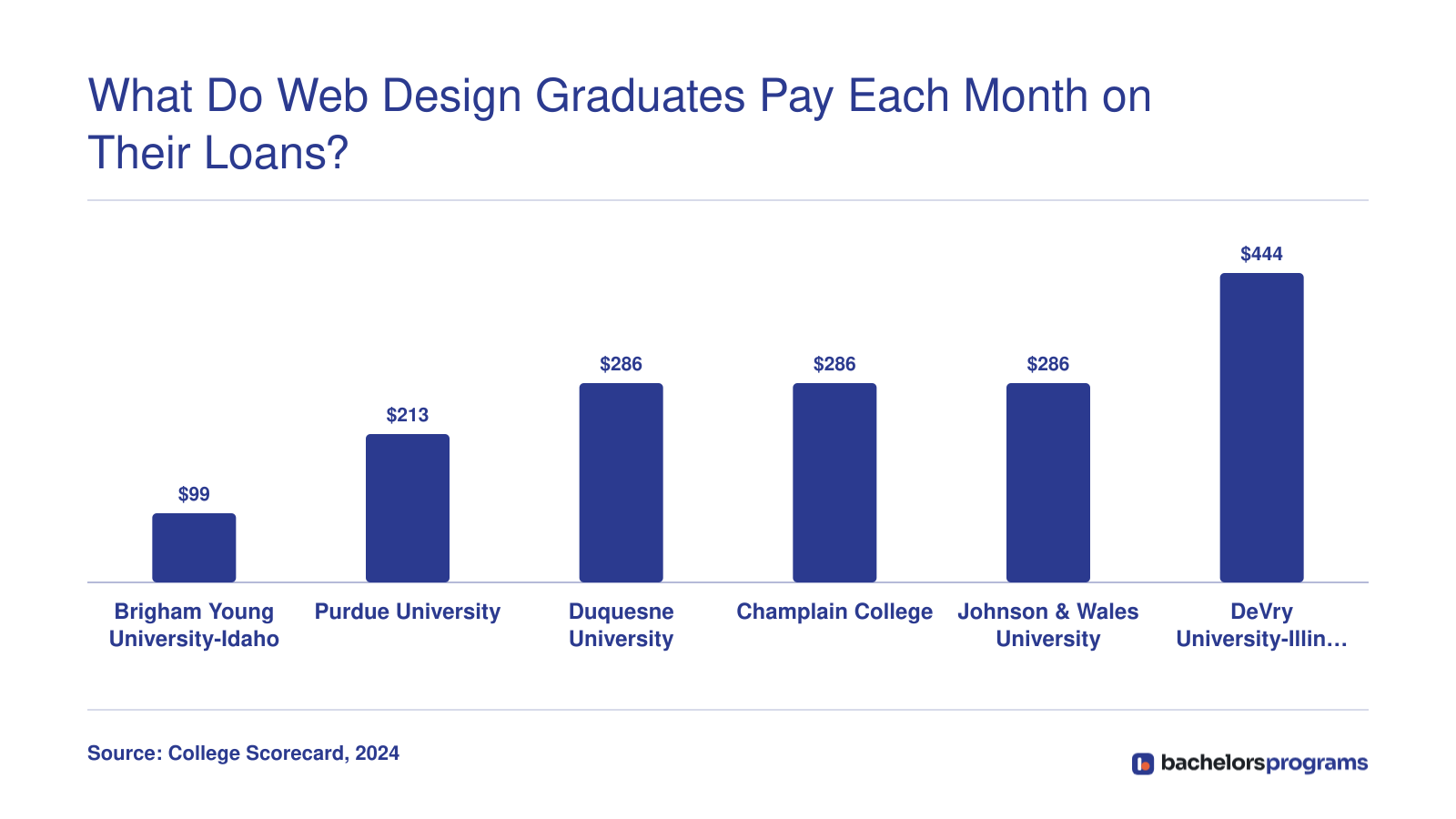
What Do Web Design Graduates Pay Each Month on Their Loans?
On a standard 10-year repayment plan, median monthly payments for web design graduates range from $99 at Brigham Young University-Idaho to $444 at DeVry University-Illinois. These figures use each program's own graduate debt. Measured against the first-year median earnings covered earlier, BYU-Idaho's payment takes about 2.4% of a $49,581 salary, while DeVry's takes about 16.6% of $32,159, before taxes. Programs without a published program-level debt figure are left out rather than filled in with campus-wide averages.
Related Articles
How to Verify Accredited Web Design Degree Programs
Before you apply to any bachelor's program in web design, run these checks. Each one takes only a few minutes.
- Confirm institutional accreditationSearch the U.S. Department of Education's DAPIP database using the college's exact legal name, then check the campus, accreditor and status. Cross-check the result in the CHEA directory. The Department recognizes accreditors but does not accredit colleges itself, and DAPIP data is not audited, so confirm with the accreditor if anything looks off.
- Check programmatic accreditation where it fitsArt and design-focused programs may fall under NASAD. Computing-heavy programs may fall under ABET. Most web design degrees have no dedicated accreditor, so search each directory for the exact degree rather than assuming coverage.
- Tie credits and aid to accreditationFederal student aid depends on accreditation from a Department of Education-recognized agency. Transfer credit decisions also generally hinge on institutional accreditation.
- Ask about an internship and portfolio reviewAsk whether the program requires an internship or practicum and a portfolio review before graduation. Employers will judge you largely on your work samples.
- Watch for red flagsWalk away from schools accredited by agencies that neither CHEA nor the Department of Education recognizes. Also avoid programs promising degrees for life experience alone.
Questions to Ask Yourself
Do you light up more when choosing typefaces and layouts, or when making a page actually work in JavaScript?
Will you graduate with four to six polished portfolio pieces, or just class assignments?
Does the program build in an internship, or are you on your own to find client work?
If you already hold an associate degree, how many credits will transfer?
How Much Web Designers Make Nationally
Federal wage data shows strong earning potential for graduates of a bachelor's degree in web design. Web developers, a separate BLS category, earned a national median of $92,650.
Bachelor's Degree vs. Associate Degree vs. Bootcamp for Web Design
Do you need a degree to be a web designer? Not strictly, because many employers hire on the strength of a portfolio. Still, no nationally representative 2026 dataset shows how often postings require a bachelor's degree. An Indeed employer guide says most companies expect a bachelor's, associate's, or certificate in a technology-related subject, so a credential still helps. A bootcamp usually works best as an add-on to a degree, not a replacement for one.
| Factor | Bachelor's Degree | Associate Degree | Coding Bootcamp |
|---|---|---|---|
| Typical cost | Varies widely by public or private school and in-state or online rates | Usually lower than a bachelor's; varies by community college or online provider | Roughly $4,000 to $8,500 for the programs surveyed in 2026; some providers charge more |
| Time to complete | About four years full-time; transfer credits can shorten it | About 24 months (60 credits) at Champlain College Online | About 6 months (20 to 32 weeks) for a typical full-time program |
| Design theory depth | Deepest: typography, color, UX, visual communication, plus general education | Solid foundations in design principles and layout | Light; focused on applied tools and workflow |
| Coding depth | Broad, often HTML, CSS, JavaScript, plus databases or interaction design | Introductory to intermediate front-end skills | Intensive and narrow, built around one job-ready stack |
| Portfolio output | Multiple projects across years, often including capstones | Several foundational projects | A few concentrated projects built in a short window |
| Federal aid eligibility | Eligible at accredited institutions via the FAFSA | Eligible at accredited institutions via the FAFSA | Generally not eligible; most use provider payment plans or private financing |
| Employer perception | Most widely recognized credential; often preferred for design-lead and larger-company roles | Accepted for entry-level roles; strongest when paired with a portfolio | Judged mainly on portfolio. One survey reports 79% found full-time work in 1 to 6 months, though definitions vary |
| Transfer pathway | Accepts associate credits, but the number is set by each school | Can feed a bachelor's; Champlain's associate program accepts up to 45 transfer credits in, so confirm articulation agreements | Credits rarely transfer; best used to add skills after a degree |
Web Design programs by state
Compare Web Design programs on the data that matters
Explore more Arts & Design majors or browse every field of study.
All Arts & Design programs Browse every field of study