Best Online Bachelor's Degrees in Criminal Justice Administration
Compare 180+ accredited online Criminal Justice Administration programs, with net price after aid, graduation rates, earnings and debt from IPEDS and the U.S. College Scorecard.

Can a sergeant, corrections officer, or security supervisor complete a criminal justice administration bachelor's degree without giving up shifts? Yes, if the program is fully online. The degree is usually a Bachelor of Science (B.S.) in Criminal Justice Administration.
The programs ranked here are all 100% online, with no hybrid requirements or campus visits. Cost, completion speed, accreditation, and salary follow the rankings.
Supervisory ranks in many agencies depend on a four-year degree, though requirements vary by department.
Key Points
- Texas A&M University-Central Texas averages about $1,300 a year after aid.
- Some online universities accept up to 90 of the 120 required credits.
- Graduates' median earnings one year out span $43,405 to $68,956.
Top 10 Fully Online Criminal Justice Administration Bachelor's Programs
Every program on this list can be completed at a distance, with no requirement to relocate or attend regular campus classes. The formats differ: some run 8-week terms with frequent start dates, others keep a traditional 16-week semester, and several are cohort-based completion tracks designed for people already working in law enforcement, courts or corrections.
Texas A&M University-Central Texas
#1Killeen, TX · under $5,000/yr (est.)
Best for: Associate degree holders transferring technical credits
A public upper-division campus in Killeen, Texas, built around students who arrive with an associate degree or technical training already in hand. Its criminal justice offering is a Bachelor of Applied Arts and Sciences rather than a B.S., and it accepts up to 33 credit hours for certifications, academy instruction and other non-academic training. Upper-level coursework balances law enforcement, courts, corrections and victim services with supervision and management material.
- 120 total credit hours
- Up to 33 hours from certifications and field training
- Built for students holding an Associate of Applied Science
- Upper-level coursework in courts, corrections and victim services
- Also covers supervision, policing and forensic investigations
- Student group: Criminal Justice Association
- Honor society chapter: Alpha Phi Sigma
- Offered on campus and online
Amridge University
#2Montgomery, AL · $5,000 – $10,000/yr (est.)
Best for: Part-time adults balancing work and coursework
A small private university in Montgomery, Alabama, with a long record of serving working adults on a part-time basis. The B.S. in Criminal Justice runs 128 semester hours split between general education, a required criminal justice core and open electives, so students shape roughly a third of the degree themselves. Required courses cover criminal investigation, evidence, procedure and constitutional law, with electives for internship work and white collar crime.
- 128 semester hours: 40 general education, 40 criminal justice
- 48 elective hours let students shape the degree
- $395 per semester hour at the full-time rate
- At least 40 semester hours must be taken at Amridge
- 2.0 cumulative GPA required to graduate
- Core includes criminal investigation, evidence and procedure
- Electives include an internship and white collar crime
Florida State University
#3Tallahassee, FL · ~$11,000/yr (est.)
Best for: Criminology-focused students wanting a research core
A large public research university whose criminology major carries a genuine research methods core rather than a narrow patrol-training focus. Majors complete 36 credit hours in criminology on top of general education, including four core courses, and add a minor of 12 to 15 hours. An optional one-semester, 15-credit internship lets students earn three hours toward the major while placed in an agency. Coursework is available through distance learning for enrolled FSU students.
University of Washington-Tacoma Campus
#4Tacoma, WA · $13,000 – $43,000/yr (est.)
The Tacoma campus of the University of Washington treats crime and justice as a multidisciplinary field, pairing coursework with community partnerships and restorative justice. Its online major is a sequenced, cohort-based completion track for working professionals rather than a self-paced option, and applicants need 90 college-level quarter credits, a 2.0 GPA and the English composition prerequisite before the autumn start. Internship placements can land in police agencies, courts, probation and parole offices or advocacy nonprofits.
- Cohort-based online major for working professionals
- Requires 90 college-level quarter credits before entry
- English composition prerequisite and 2.0 GPA required
- Autumn start with a March 15 priority deadline
- Internships with police, courts, probation and advocacy groups
- Multidisciplinary look at crime, justice and community partnerships
University of West Florida
#5Pensacola, FL · $5,000 – $10,000/yr (est.)
A public university in Pensacola whose criminal justice degree is delivered online and designed for distance students, with nine concentration options spanning juvenile justice, cybercrime, gangs, drugs, forensic science and homeland security. The 120-credit program runs on 16-week courses and can be finished in 24 to 48 months. An internship can serve as the senior capstone, and strong students can bank up to 12 graduate credits through an accelerated path.
- 120 credits, finishable in 24 to 48 months
- 16-week courses
- Nine concentration options
- Optional internship as the senior capstone
- Up to 12 graduate credits through an accelerated path
- Core covers policing, courts, corrections and research design
- Electives include cybercrime, gangs, terrorism and forensic science
California State University-San Bernardino
#6San Bernardino, CA · $4,600/yr (est. net price)
A public university in Southern California's Inland Empire that runs its criminal justice bachelor's fully online through the College of Extended and Global Education. The 120-unit degree divides each semester into two accelerated sessions of about seven weeks and requires six elective courses from topics such as gangs, terrorism, victimology, white collar crime and correctional counseling. Every student works with an advisor to build a personalized program plan.
- 120 units delivered 100% online
- Semester split into two seven-week accelerated sessions
- Six elective courses required
- Electives include gangs, terrorism, victimology and white collar crime
- Personalized program plan built with an advisor
- Spring entry points in January and March
Southern Utah University
#7Cedar City, UT · $7,000 – $21,000/yr (est.)
A public university in Cedar City, Utah, that has turned its criminal justice major into a fully online, transfer-friendly degree. Students can bring in up to 90 credits and finish in as few as three years, with tuition set at $315 per credit and a Finish Line Scholarship worth up to $6,000. The curriculum covers criminal law, research methods and criminal justice management, and a Graduate Bridge program lets undergraduates bank up to 12 credits toward a Master of Public Administration.
- Transfer up to 90 credits
- Finish in as few as three years
- $315 per credit
- Finish Line Scholarship worth up to $6,000
- Coursework in criminal law, research methods and justice management
- Graduate Bridge: up to 12 credits toward an MPA
- Spring and summer start dates
Strayer University-Florida
#8Tampa, FL · ~$16,000/yr (est.)
A private, Middle States accredited university with Florida campuses and a long-running online operation aimed at working adults. Its B.S. in Criminal Justice includes a Criminal Justice Administration concentration with courses in law enforcement operations and management, crime prevention strategies and comparative criminal justice. The degree is 40 courses at $1,555 each, each course runs 11 weeks, and up to 28 classes can transfer in. Employer tuition reimbursement is supported, and students earn a free course after every three passed.
- 40 courses, each 11 weeks, at $1,555 per course
- Transfer up to 28 classes
- Concentration in criminal justice administration
- Concentration courses include law enforcement operations and management
- Also covers crime prevention strategies and comparative justice
- Employer tuition reimbursement supported
- Accredited by the Middle States Commission on Higher Education
Humphreys University
#9Stockton, CA · $6,000/yr (est. net price)
A small private university in Stockton, California, accredited by WASC and geared toward people already working rotating shifts in the field. Its criminal justice bachelor's runs on 11-week quarters with four start dates a year, charges $375 per unit, and can be finished in about two years by students who transfer in an associate degree. Credit can be awarded for officers' field experience, and classes stay small with faculty drawn from law enforcement, courts and corrections.
- 11-week quarters with four start dates a year
- $375 per unit
- About two years for students transferring an associate degree
- Credit available for officers' field experience
- Built around rotating shift schedules
- Small classes taught by law enforcement, courts and corrections faculty
- Institutionally accredited by WASC
Florida Gulf Coast University
#10Fort Myers, FL · ~$13,000/yr (est.)
A public university in Fort Myers with a criminal justice major that lets students pick a specialty rather than follow one general track. Undergraduates choose from law enforcement, corrections, legal studies, juvenile justice, international justice or management in criminal justice, and complete 120 credits with an internship worth up to six credits. The degree is taught on campus and is also available through internet distance learning.
- 120 credits, including 36 in required major courses
- 9 credits of restricted electives
- Six specialization options, including juvenile and international justice
- Internship course counts for up to 6 credits
- 2.0 GPA and a C or better in each major course
- Available on campus and through internet distance learning
Cost & outcomes by school
Federal data for the highest-earning Criminal Justice Administration programs, independent of the ranking above. Earnings are this field's bachelor's graduates four years after completing where the Scorecard reports them, else the school's undergraduate median.
| School | Net price / yr | Grad rate | Earnings | Debt | Grads/yr | Format |
|---|---|---|---|---|---|---|
| University of New Hampshire NH | $23,805 | 76% | $81,768 | $26,814 | — | Online |
| National University CA | $22,878 | 43% | $81,299 | $25,000 | 131 | Online or campus |
| Mercer University GA | $23,847 | 70% | $71,602 | $25,000 | 12 | Online or campus |
| Columbia Southern University AL | $14,580 | 33% | $70,354 | $20,209 | 332 | Online |
| Herzing University-Kenosha WI | $23,066 | 72% | $69,601 | $19,310 | 2 | Online |
| Utah Valley University UT | $6,376 | 45% | $68,296 | $19,586 | 83 | Online or campus |
| Charter Oak State College CT | $15,815 | 67% | $64,209 | $18,750 | 43 | Online |
| University of Washington-Tacoma Campus WA | $10,163 | 63% | $63,311 | $11,628 | 50 | Online or campus |
| University of Kansas KS | $18,059 | 69% | $61,945 | $21,000 | 3 | Online |
| University of Nevada-Reno NV | $15,927 | 61% | $60,614 | $18,922 | 140 | Online |
| Humphreys University CA | $5,524 | 62% | $60,478 | $35,500 | 1 | Online or campus |
| Southern Utah University UT | $10,462 | 61% | $60,008 | $16,701 | 72 | Online |
Sources: U.S. Department of Education. Net price, graduation rate, earnings and debt: College Scorecard (earnings and debt for this field's bachelor's graduates where reported, else school-wide); graduates: IPEDS. A dash means no figure is reported.
Cost, debt & payoff
Median earnings of this field's bachelor's graduates (4 yrs after completing, else the school's undergraduate median) vs. their median federal loan debt · U.S. College Scorecard
Across these programs the median graduate earns about $52,847 and finishes with roughly $24,750 in debt — a ratio that clears a common rule of thumb (keep debt below first-year salary). Net price and debt vary widely school to school, so check the per-school figures in the table above before you shortlist.
Inside a Bachelor's Degree in Criminal Justice Administration: Courses and Credentials
Most programs require 120 credits, split into three layers. General education covers writing, math, and social science. The criminal justice core adds criminology, courts, corrections, ethics, and constitutional law. The administration layer brings budgeting, personnel management, leadership, and policy.
That last layer separates this major from a general criminal justice degree. A general track centers on how the system works. The administration track adds management and supervision coursework aimed at sergeants, shift supervisors, and agency administrators.
B.S. vs. B.A.
The Bachelor of Science tends toward research methods and statistics. The Bachelor of Arts leans toward humanities and, often, a foreign language. Hiring agencies rarely distinguish between them, so pick the one whose coursework fits your strengths.
Concentrations
Many of the ranked programs let you specialize. Common options include homeland security, corrections, and law enforcement leadership. Choose one that matches the role you want to hold in five years, not just the one that sounds most appealing today.
Cheapest Fully Online Criminal Justice Administration Degrees by Net Price
The cheapest online criminal justice degree among these options is at Texas A&M University-Central Texas, where the approximate average net price after aid is about $1,300 per year, based on 2024 U.S. Department of Education IPEDS and College Scorecard data. No accredited bachelor's degree is free outright, but Pell Grants, GI Bill benefits and employer or agency tuition assistance can push your out-of-pocket cost close to zero. More than 80 percent of undergraduates at each school below receive Pell Grants, which helps explain the low averages.
| School | Location | Sector | Approx. Average Net Price per Year | In-State Tuition and Fees | Undergraduates Receiving Pell Grants | Graduation Rate |
|---|---|---|---|---|---|---|
| Texas A&M University-Central Texas | Killeen, TX | Public | $1,300 | $7,363 | 82% | N/A |
| California State University-San Bernardino | San Bernardino, CA | Public | $4,564 | $8,093 | 87% | 55% |
| Humphreys University | Stockton, CA | Private nonprofit | $5,524 | $13,500 | 84% | 62% |
Fastest Ways to Finish: Transfer Credit, Police Academy Hours and Military Training
Transfer credit, not accelerated coursework, is what actually shortens a criminal justice administration degree. Several large online universities accept up to 90 credits of the typical 120, so a student who transfers in with an associate degree can finish the remainder in roughly two years. Campbellsville University, American Military University and UMGC all cap transfer at 90 credits1; Liberty University frames its ceiling as 75 percent of the degree.
Credit for training you already completed
Sworn experience often converts directly. Franklin University awards 28 credits for police academy training, plus 4 for corrections or bailiff training and 4 for the FBI National Academy. Purdue Global grants 25 credits for POST academy work to currently certified officers. Campbellsville offers up to 16 academy credits and up to 16 for state law enforcement training, and National University maps California POST and CHP coursework within a 30-credit professional-training limit. Military and self-study routes run through ACE evaluation and CLEP or DSST exams, accepted at schools including American Military University, Saint Mary's University of Minnesota and Old Dominion.3
Residency rules set the floor
Franklin and Old Dominion each require at least 30 credits earned through the university itself2, so prior learning can only carry you so far. Do the arithmetic: 120 credits minus 60 transferred minus 12 in academy credit leaves about 48, or roughly 16 months of full-time study in 8-week terms.
Accreditation and Online Format: What to Confirm Before You Enroll
Online delivery makes it easy for unaccredited operators to look like real colleges, so verify before you apply. Institutional accreditation from an agency recognized by the U.S. Department of Education affects federal aid, credit transfer, and hiring by many agencies. Criminal justice has no required programmatic accreditor, and programmatic approval never substitutes for institutional accreditation.5
Two-Step Check
- Step 1: Search the school's exact legal name in the Department's DAPIP database. Confirm the status is Active2, the accreditor has institutional scope, and no adverse or probation actions appear. DAPIP is agency-reported and not audited, so recent changes may lag.3
- Step 2: Look up the same name in CHEA's directory and confirm the accreditor matches.
You may recognize older regional names such as HLC, MSCHE, NECHE, NWCCU, SACSCOC, WSCUC and ACCJC, but what counts is the agency's current recognition.4
Ask Admissions
- Is coursework fully asynchronous, or are live sessions required?
- How long are terms?
- Are exams proctored, and is a testing center an option?
- Does the internship or capstone need a local placement, background check, or fingerprinting?
Avoid national-only or unaccredited "criminal justice certificate" mills, whose credits rarely transfer.
Questions to Ask Yourself
Do you already hold academy, military, or associate credits that a generous transfer policy would turn into saved months?
Is your target job a promotion inside your current agency or a federal role that only requires an accredited bachelor's?
Would a homeland security or corrections concentration help more than a general administration track for the job you want?
Can your shift schedule handle required live sessions, or do you need fully asynchronous courses?
What Do Common Criminal Justice Administration Career Targets Pay?
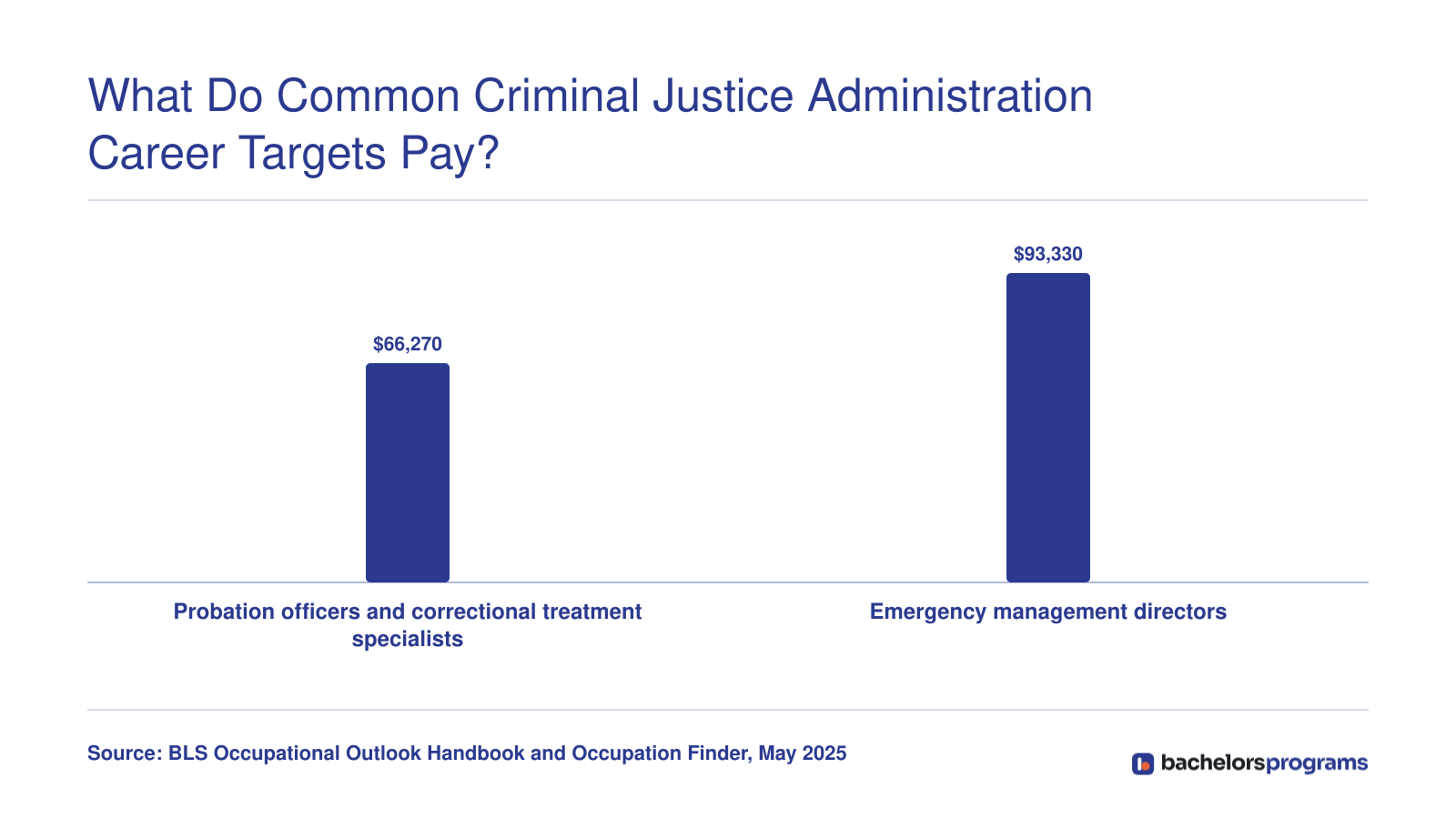
These are BLS median annual wages for each occupation as a whole, not earnings of graduates from the programs on this page. Probation officers and correctional treatment specialists earned a median of $66,270 in May 2025 with 3% projected growth for 2025-2035 (about as fast as average), and emergency management directors earned $93,330 with 4% growth. BLS places first-line supervisors of police and detectives in its $100,000-or-more median band and first-line supervisors of correctional officers in the $75,000-$99,999 band, with correctional supervisor jobs projected to decline.
Is an Online Criminal Justice Administration Degree Worth It? Careers and Salary
Does an online criminal justice administration degree pay off? The numbers say it can, with caveats. One year after completion, median earnings run from $43,405 at Strayer University-Florida to $68,956 at Charter Oak State College. Median debt runs from $18,750 at Charter Oak (roughly $199 a month) to $41,562 at Strayer (roughly $441 a month). Texas A&M-Central Texas, Portland State and Utah Valley fall in between on both measures.
- Certification still applies: Police officers often need only a high school diploma or GED to apply, but they must complete an academy and pass state POST certification.1 The degree does not replace either step.
- Federal doors: The FBI requires an accredited bachelor's for special agents.2 Since July 6, 2026, a bachelor's plus one year of sworn law enforcement experience can qualify, down from two years. Federal GS-5 roles may accept a bachelor's with related coursework, but each vacancy announcement sets the terms.3
- Best payoff: The administration focus helps most if you already work in the field and want a supervisory promotion.
- Bottom line: Compare a program's debt against your realistic starting pay before you enroll.
Related Articles
Criminal Justice Administration programs by state
Compare Criminal Justice Administration programs on the data that matters
Explore more Criminal Justice & Law majors or browse every field of study.
All Criminal Justice & Law programs Browse every field of study