Best Online Criminal Justice Degree Programs
Compare 480+ accredited online Criminal Justice programs, with net price after aid, graduation rates, earnings and debt from IPEDS and the U.S. College Scorecard.

Two questions decide most of the comparison: what a credit costs online, and how much of the coursework actually happens online. The answers vary more than most applicants expect. Per-credit rates here run from $212 at UCF to $425 at Cal State Long Beach. The Bachelor of Science in Criminal Justice is the common credential, and it can mean 120 credits or far fewer depending on how generously a school accepts transfer credit.
Some programs also tuck internships or in-person field work behind an "online" label. Only fully online programs qualify. Hybrid formats are excluded.
Many agencies still run their own academy training after hire, so the degree works as an entry credential rather than the whole path into the field.
Key Points
- Florida State ranks first, with $68,225 median earnings a decade after enrollment.
- CUNY John Jay's average net price after aid is just $3,203.
- Transfer credit and experience can shorten a 120-credit B.S. substantially.
Best Fully Online Criminal Justice Degree Programs for 2027
Every program below can be completed fully online, from the first course to the final capstone, and no hybrid or campus-based format was allowed onto the list. The order reflects a mixed composite of institutional quality measures rather than one headline number, so a strong showing in a single area does not carry a school to the top.
Florida State University
#1Tallahassee, FL · ~$11,000/yr (est.)
Best for: Criminology-focused degree seekers
Florida State houses its criminal justice track inside a dedicated College of Criminology and Criminal Justice, so majors study crime and the justice system as a research discipline rather than a sidebar of a general social science department. Undergraduates complete 120 credits, 36 of them in criminology, and can add an optional full-time internship semester that doubles as field experience before graduation. Distance students follow the same curriculum as campus majors, and a bachelor's-to-master's pathway lets strong seniors bank up to 12 graduate credits.
- 120 total credit hours, including 36 in criminology
- Four core courses must be completed with a C or higher
- 2.0 GPA and 52 credit hours to enter upper division
- Optional one-semester, 15-credit internship
- Bachelor's-to-master's pathway with up to 12 graduate credits
- Required minor of 12 to 15 hours
- Careers in local, state and federal agencies
Florida International University
#2Miami, FL · ~$9,000/yr (est.)
Best for: Working adults in South Florida
Florida International runs its criminal justice degree through a standalone department, with the Bachelor of Science built around police, courts and corrections plus the causes and prevention of crime. The curriculum pairs 18 credits of core coursework with 18 credits of criminal justice electives, leaving room for a minor or a second area of study. A senior capstone and a professional development course round out the degree, and an internship is encouraged for students who want documented field hours.
- 18 credits of core criminal justice courses
- 18 credits of criminal justice electives plus 24 general electives
- Senior capstone required
- Professional Development in Criminal Justice course
- Internship encouraged but not required
- Two Global Learning courses required
- Second-semester foreign language sequence required
- Three years of justice work may replace one core course by petition
University of Central Florida
#3Orlando, FL · ~$10,000/yr (est.)
Best for: Transfer students with prior college credit
UCF splits its criminal justice major into two tracks, so students choose between an academy-style professional route and a research-oriented scholar's route. The professional track embeds academy training, certifications and a required internship, while the scholar's track adds graduate-level seminars for students aiming at law school or a master's. A capstone in criminal justice ethics anchors the senior year, and the department offers several undergraduate certificates that stack onto the major.
- 120 total credit hours, with a 30-credit core
- 30 credits of restricted electives
- Professional Track embeds academy training and a required internship
- Scholar's Track requires a 3.2 GPA and nine hours of graduate work
- Capstone in criminal justice ethics
- $212 per credit for in-state students
- Six undergraduate certificate options
- Foreign language proficiency required for the BA
CUNY John Jay College of Criminal Justice
#4New York, NY · ~$3,200/yr (est.)
John Jay is a college whose identity is built around criminal justice, and its bachelor's program treats crime as a social problem rather than a purely procedural one. Students spend much of the major learning to analyze the system's structure and ethics, then argue for changes to how it functions. The Department of Criminal Justice also runs a combined bachelor's-to-master's option, which shortens the path for students who already know they want graduate study.
- Crime treated as a social problem, not only a procedure
- Focus on analytical skills and ethical reasoning
- Students assess how the criminal justice system functions
- Housed in the Department of Criminal Justice
- Combined criminal justice BA/MA option
- One of 31 undergraduate majors at the college
Amridge University
#5Montgomery, AL · $5,000 – $10,000/yr (est.)
Amridge is a small private university in Montgomery organized around distance study for working adults, and its criminal justice bachelor's follows that model closely. Required coursework in criminal investigation, criminal law, evidence and constitutional law gives the degree a legal-procedure spine, with electives reaching into corrections, terrorism and white collar crime. A 48-credit elective block is unusually generous for a criminal justice major, which makes the program forgiving for transfer students bringing in prior coursework.
- 128 semester credit hours in total
- 40 hours in program courses and 48 hours of electives
- Required courses in criminal investigation, law, evidence and procedure
- Electives in corrections, terrorism and white collar crime
- Criminal justice internship available as an elective
- $395 per semester hour full-time; $455 part-time
- At least 40 of the 128 hours must be taken at Amridge
- 2.0 cumulative GPA required to graduate
San Diego State University
#6San Diego, CA · $15,000/yr (est. net price)
San Diego State's criminal justice degree takes a social justice and policy angle, asking how the system delivers or fails to deliver justice rather than only how it operates. The School of Public Affairs houses the major, and students can add internships plus coursework through the university's Imperial Valley location and its global campus. Graduates move into law enforcement, probation and parole, corrections and social services, and the degree is a common launch point for law school.
- Bachelor of Science in Criminal Justice
- Sample courses include Crime, Law, and Justice and Juvenile Justice
- Offered through the School of Public Affairs
- Internships available for major credit
- Prepares students for law school or graduate study
- Graduates work in law enforcement, probation, corrections and social services
California State University-Long Beach
#7Long Beach, CA · $7,000 – $20,000/yr (est.)
Cal State Long Beach runs its criminology and criminal justice degree as an upper-division completion program, so students arrive with general education and lower-division major courses already finished. The cohort model moves everyone through 61 units together over 21 months, which builds a professional network but leaves little room for part-time pacing. Faculty sit in a school that also covers emergency management, and a senior integrative experience asks students to pull the whole curriculum together before they finish.
- 61 units completed over 21 months
- Cohort-based and full-time, with asynchronous classes
- Admission requires 60 transferable units and a 3.0 GPA
- 25 units of core courses and 15 units of upper-division electives
- Senior integrative experience required
- $425 per unit
- Fall start with an April 1 application deadline
- Military benefits accepted
Strayer University-Florida
#8Tampa, FL · ~$16,000/yr (est.)
Strayer is a national for-profit university with Florida locations, and its criminal justice bachelor's is built for adults who need to keep working while they study. The program is unusually modular: named concentrations, 11-week courses and a generous transfer policy let students shape the degree around a current job or a planned move into forensics, administration or national security. Pricing is set per course rather than per credit, which makes the total easier to budget once transfer credit is settled.
- Six concentrations, including digital forensics and cybersecurity
- Other options cover crime and criminal behavior and national security
- 40 courses, each running 11 weeks
- 67.5 credits of criminal justice courses plus 18 in a concentration
- $1,555 per course
- Transfer up to 28 classes
- Military benefits and employer tuition reimbursement accepted
Texas A&M University-Central Texas
#9Killeen, TX · under $5,000/yr (est.)
Texas A&M-Central Texas serves working adults and transfer students in the Killeen area, and its criminal justice bachelor's is organized for students who arrive with core coursework already done. The major sequences a criminal justice system course and a social science proseminar up front, then closes with a capstone in the final semester, so students bookend the degree with research and writing. Upper-level electives cover law enforcement, corrections, courts, victims and offenders, and the department runs an honor society chapter and a student criminal justice association.
- 120 total credit hours
- CRIJ 3303 and SOSC 3300 in the first semester
- CRIJ 4395 capstone in the final semester
- Upper-level work covers law enforcement, courts, corrections, victims
- Alpha Phi Sigma honor society chapter
- Criminal Justice Association for students
California State University-San Bernardino
#10San Bernardino, CA · $4,600/yr (est. net price)
Cal State San Bernardino concentrates 45 of its 120 units in the major, with required coursework in criminological theory, research methods and statistics sitting alongside corrections and policing courses. Electives reach into victimology, gangs, white collar crime and domestic violence, which gives students room to shape a specialty before graduation. Internship, independent study and senior honors options let strong students add field hours or a research project to the transcript.
- 120 units total, with 45 in the criminal justice major
- 21 upper-division units in theory, research methods and statistics
- Electives include victimology, gangs and white collar crime
- C or better required in core courses
- Internship and independent study options
- Senior honors project available
- Up to 9 transfer units may count toward electives
Cost & outcomes by school
Federal data for the highest-earning Criminal Justice programs, independent of the ranking above. Earnings are this field's bachelor's graduates four years after completing where the Scorecard reports them, else the school's undergraduate median.
| School | Net price / yr | Grad rate | Earnings | Debt | Grads/yr | Format |
|---|---|---|---|---|---|---|
| Boston College MA | $41,704 | 91% | $103,937 | $19,000 | 7 | Online or campus |
| University of New Hampshire NH | $23,805 | 76% | $81,768 | $26,814 | — | Online |
| Mount Saint Mary's University CA | $21,413 | 53% | $72,379 | $25,949 | — | Online or campus |
| University of Florida FL | $6,541 | 91% | $71,588 | $15,000 | — | Online or campus |
| University of Florida FL | $4,815 | 85% | $71,588 | $15,000 | — | Online or campus |
| Herzing University-Kenosha WI | $23,066 | 72% | $69,601 | $19,310 | 2 | Online |
| American Public University System WV | $9,597 | 57% | $69,546 | $20,888 | 550 | Online |
| University at Albany NY | $17,167 | 62% | $67,979 | $19,500 | 150 | Online or campus |
| University of New Hampshire at Manchester NH | $9,992 | 50% | $66,479 | $26,814 | — | Online |
| Charter Oak State College CT | $15,815 | 67% | $64,209 | $18,750 | 43 | Online |
| University of Washington-Tacoma Campus WA | $10,163 | 63% | $63,311 | $11,628 | 50 | Online or campus |
| California State University-San Marcos CA | $10,229 | 55% | $62,908 | $17,350 | — | Online |
Sources: U.S. Department of Education. Net price, graduation rate, earnings and debt: College Scorecard (earnings and debt for this field's bachelor's graduates where reported, else school-wide); graduates: IPEDS. A dash means no figure is reported.
Cost, debt & payoff
Median earnings of this field's bachelor's graduates (4 yrs after completing, else the school's undergraduate median) vs. their median federal loan debt · U.S. College Scorecard
Across these programs the median graduate earns about $53,916 and finishes with roughly $24,212 in debt — a ratio that clears a common rule of thumb (keep debt below first-year salary). Net price and debt vary widely school to school, so check the per-school figures in the table above before you shortlist.
How We Ranked Online Bachelor's Programs in Criminal Justice
Florida State University's 86 percent graduation rate and CUNY John Jay's $3,203 average net price after aid are the kinds of public figures that move a school up or down here, and both feed into how every bachelor's degree in criminal justice program on this page was scored.
Online Only, Before Anything Else
The first cut is delivery format. A program qualifies only if the bachelor's can be completed entirely at a distance, with no required campus residencies and no hybrid semesters. Campus-only and mostly in-person programs were removed before any scoring began, so a strong graduation rate on its own will not carry a school onto this list.
What the Composite Blends
Each program that clears the format filter is then weighed on three public measures:
- Affordability: average net price after grant and scholarship aid, which is closer to what a typical first-year student actually pays than the sticker tuition is.
- Institutional outcomes: graduation and first-year retention rates as reported to the federal government.
- Post-graduation results: median earnings and typical debt for graduates, but only where College Scorecard publishes them for that institution.
No single measure runs the table. A low net price does not fully offset a weak completion rate, and a strong earnings figure does not erase heavy typical borrowing.
Where the Numbers Stop
The federal government collects graduation rates, retention rates, and net price at the institution level, not the department level, so all three describe the whole school rather than its criminal justice program. Where the federal data does not publish earnings, the field stays blank rather than being estimated. Institutional figures come from the 2024 Scorecard snapshot, with earnings outcomes drawn from its 2022 data release.
Why the Inputs Are Shown
Plenty of "best" lists publish a rank and nothing else. Every figure printed beside a school traces back to a public federal dataset, so you can disagree with our placement and still use a program's net price, completion rate, and earnings to reach your own conclusion.
What a Bachelor's Degree in Criminal Justice Covers Online
Most online criminal justice degrees award the Bachelor of Science and require about 120 credits, roughly half of them in the major. The core curriculum is remarkably consistent from school to school.
The Courses You Will Take
- Foundations: introduction to criminal justice, criminology, and research methods
- Law and process: criminal law, criminal procedure, and constitutional issues
- The system: policing, courts, corrections, and juvenile justice
- Professional practice: ethics, policy, and administration or management courses
General education requirements in writing, math, and the sciences fill out the rest of the degree, and transfer credit frequently clears a large share of them.
Concentrations and What They Signal
Many programs let you specialize in policing and law enforcement, corrections, homeland security, cybersecurity, or criminology. The concentration field in the ranking above shows each program's track, so you can match a school to the career you want rather than discovering the mismatch after you enroll.
Do Online Programs Require an Internship?
Often not. Most fully online programs make the internship optional or accept a capstone in its place. Concordia University, St. Paul states plainly that an internship is not required1, letting students choose an internship, a portfolio, or a capstone project, and Appalachian State's 12-credit capstone offers three routes: a local internship, a practicum at a current criminal justice employer after a year of full-time service, or approved upper-level electives for eligible working adults.2
Some programs do require supervised field hours. Georgia State requires an approved agency internship in senior year through CRJU 4935 and 4940.3 Methodist requires a 10-week supervised practicum.4 Monroe requires 160 internship hours plus a capstone5, and William Paterson requires 120 hours inside a 7-week course.6 Online students generally arrange a site near home with a coordinator's approval in the semester before enrollment.
Check for In-Person Requirements
Ask about proctored exams, short residencies, and synchronous sessions before you commit. William Paterson's internship course includes several 75-minute in-person classes and three or four instructor meetings6, and some placements require background checks or health clearances by law.
Cheapest Online Criminal Justice Degrees: Net Price, Per-Credit Rates, and Military Pricing
Texas A&M University-Central Texas and CUNY John Jay College of Criminal Justice are ranked on this page. Texas A&M International University and every per-credit row come from our wider directory. Average net price after aid is an approximate, institution-wide yearly figure from federal data, not a tuition quote, so it will not match a published per-credit online rate multiplied across 120 credits. Our 120-credit estimates exclude fees and technology charges, and UMGC and the University of Colorado Denver charge out-of-state students more. If you serve or have served in the military, the discounted per-credit rates at AMU, UMGC and Purdue Global can cut a 120-credit total by thousands of dollars.
| School | Cost basis | Figure | 120-credit estimate | Military or veteran rate |
|---|---|---|---|---|
| Texas A&M University-Central Texas | Average net price after aid (institution-wide, approximate) | $1,300 per year | N/A | N/A |
| CUNY John Jay College of Criminal Justice | Average net price after aid (institution-wide, approximate) | $3,203 per year | N/A | N/A |
| Texas A&M International University | Average net price after aid (institution-wide, approximate) | $3,637 per year | N/A | N/A |
| Liberty University (B.S. in Criminal Justice) | Published online per-credit rate (2026-2027) | $250 per credit | About $30,000 | N/A |
| University of Maryland Global Campus (B.S. in Criminal Justice) | Published per-credit rate (in-state) | $337 per credit ($499 out-of-state) | About $40,440 in-state; about $59,880 out-of-state | Military: $250 per credit (about $30,000 for 120 credits) |
| American Military University (B.A. in Criminal Justice) | Published per-credit rate | $360 per credit | About $43,200 | Military: $250 per credit (about $30,000); Veteran: $324 per credit (about $38,880) |
| Purdue Global (Criminal Justice) | Published per-credit rate (as of September 2026) | $371 per credit | About $44,520 | Military: $165 per credit (about $19,800 for 120 credits) |
| Colorado State University Global (B.S. in Criminal Justice) | Published per-credit rate | $385 per credit | About $46,200 | N/A |
| Texas State University (B.S. in Criminal Justice) | Published per-credit rate | $407 per credit | About $48,840 | N/A |
| San Francisco State University (Degree-Completion Program) | Published per-credit rate | $415 per credit | N/A (degree-completion program; transfer credits reduce the total) | N/A |
| University of Colorado Denver (Online Bachelor's in Criminal Justice) | Published per-credit rate (resident) | $417 per credit ($640 out-of-state) | About $50,040 resident; about $76,800 out-of-state | N/A |
| Penn State World Campus (B.S. in Criminal Justice) | Published per-credit rate (Fall 2026 to Summer 2027) | $644 per credit | About $77,280 | N/A |
Related Articles
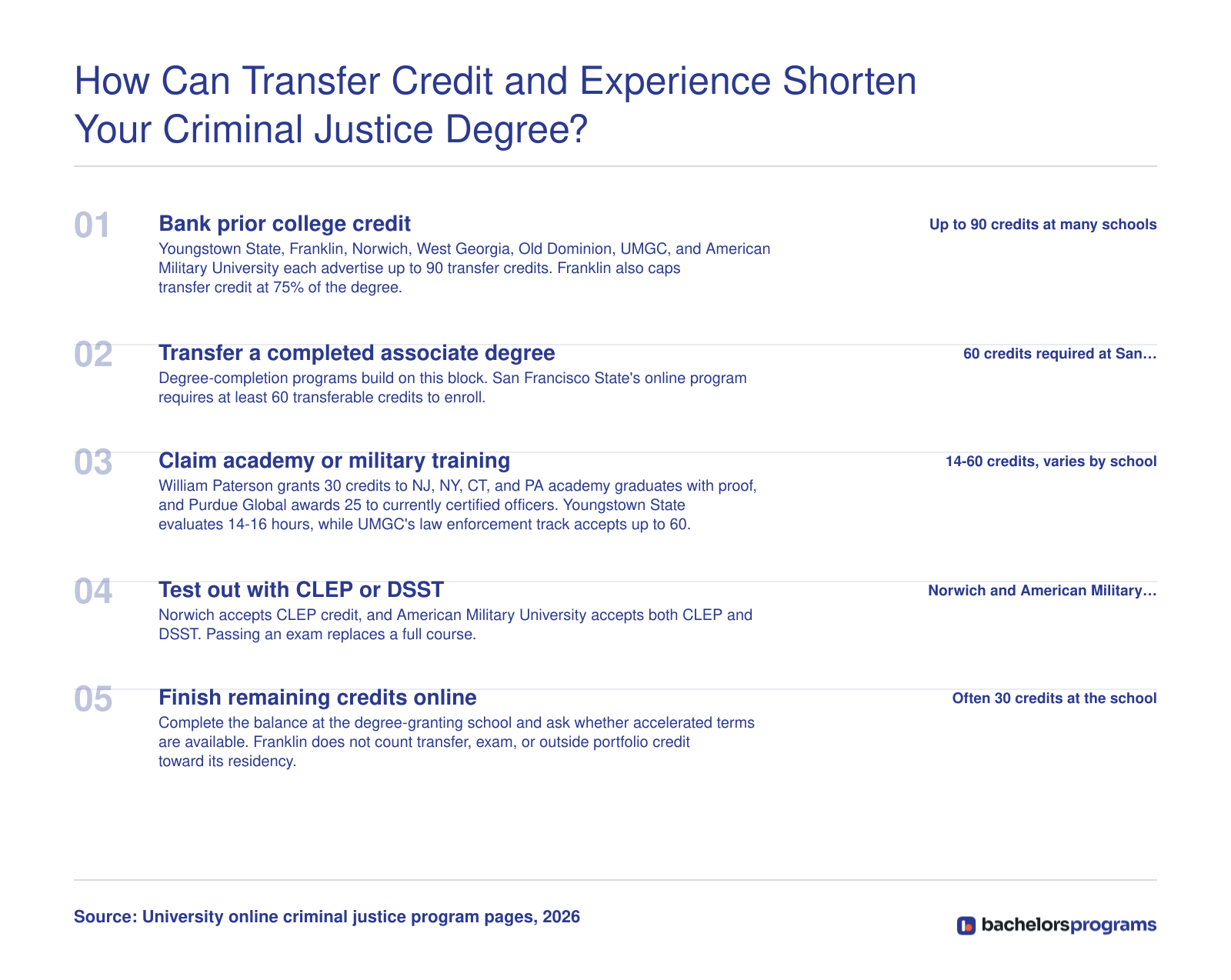
How Can Transfer Credit and Experience Shorten Your Criminal Justice Degree?
Transfer-friendly online schools can turn a 120-credit bachelor's degree in criminal justice into far less new coursework. Stack your credit sources in this order. Most schools still require a minimum number of credits earned at the school itself: Franklin, Old Dominion, and William Paterson each require at least 30.
Top Early-Career Earnings Among Ranked Online Programs
For a sense of earning potential, the strongest program-level figure for an online criminal justice bachelor's comes from a school in our wider bachelorsprograms.com directory, not from this ranking.
Questions to Ask Yourself
Are you aiming for local policing or a federal agency?
Might you pursue law school or a master's later?
Does your state authorize your chosen online program to enroll residents?
Criminal Justice programs by state
Compare Criminal Justice programs on the data that matters
Explore more Criminal Justice & Law majors or browse every field of study.
All Criminal Justice & Law programs Browse every field of study