Best Criminal Justice Schools in Minnesota
Compare 23 accredited Criminal Justice programs in Minnesota at 18 colleges, with net price after aid, graduation rates, earnings and debt from IPEDS and the U.S. College Scorecard.

Minnesota's POST Board will not license a peace officer on a degree alone: candidates also need certified professional peace officer education, an exam and an agency offer. That requirement shapes the choice between a campus program with skills training built in and a fully online bachelor's degree in criminal justice designed for working adults.
Cost cuts the other way. Saint Mary's University of Minnesota posts the highest tuition in the group but the lowest net price after aid, at $11,704, so sticker price tells you little. The B.S. in Criminal Justice is the common credential either way. Pay varies more by agency and county than by major.
Key Points
- Saint Mary's University of Minnesota posts the lowest average net price: $11,704.
- Rasmussen University-Minnesota offers its criminal justice bachelor's fully online, eight starts yearly.
- Licensed Minnesota officers need POST-certified education, an exam and a job offer.
Best Criminal Justice Schools in Minnesota: Our Top 10 Bachelor's Programs
Minnesota's criminal justice bachelor's programs run from fully online degrees built for working adults to POST-certified campus programs that fold police skills training into the curriculum. The programs below, ranked for 2026, span public universities, private colleges and career-focused online options, and each entry notes what the school does best for a criminal justice major.
Rasmussen University-Minnesota
#1St. Cloud, MN · ~$18,000/yr (est.)
Best for: Working adults needing fully online classes
Rasmussen University runs its criminal justice bachelor's entirely online from its Minnesota base, with eight start dates a year and up to 91 transfer credits accepted, which lets students who arrive with an associate degree finish in as few as 18 months. The 180-credit curriculum was reviewed by practitioners from the FBI, DEA, Secret Service and Homeland Security, and classes meet in live interactive sessions with faculty and peers. The degree is not designed as peace officer licensure preparation, so students aiming at that career should plan the skills training separately.
- 180 credit hours across 22 courses
- Finish in as few as 18 months with 91 transfer credits
- Eight start dates offered each year
- $332 per credit, about $35,505 with 90 transfer credits
- Self-directed assessments can save about $8,500
- Live interactive online sessions with faculty and peers
- Curriculum reviewed by FBI, DEA and Homeland Security experts
- Not designed to prepare students for state licensure
University of Minnesota-Crookston
#2Crookston, MN · ~$12,000/yr (est.)
Best for: Future police officers seeking licensure preparation
University of Minnesota Crookston offers the only POST-certified criminal justice program in the University of Minnesota system, with licensure and certification embedded in the curriculum rather than added afterward. Students pick a law enforcement or corrections emphasis and can complete the degree online or on campus. The law enforcement route, paired with approved skills training, leads to the state board exam and a licensed police officer career, while graduates also move into probation, federal agent and forensic science roles.
- Pairs with approved skills training for the state board exam
- Only POST-certified program in the University of Minnesota system
- Licensure and certification embedded in the curriculum
- Available fully online or on campus
- 2026-27 tuition and fees: $14,364 for 13-18 campus credits
- Second emphasis option, with elective credits in both tracks
- Coursework in law, psychology, sociology and public administration
- Prepares students for probation and correctional roles
- Combines statistics, technical writing and the humanities
Saint Mary's University of Minnesota
#3Winona, MN · $12,000/yr (est. net price)
Best for: Corrections-focused students preferring a private university
Saint Mary's University of Minnesota is a private university in Winona whose criminal justice bachelor's pairs a corrections track with a law enforcement track. Coursework examines how social and cultural institutions interact with the justice system and builds the awareness, respect, adaptability and inclusion needed for sociocultural diversity in the field. The program is campus based, which suits students who want a private-college setting in southeastern Minnesota.
- Two tracks: Corrections and Law Enforcement
- Corrections track studies social and cultural institutions
- Builds awareness, respect, adaptability and inclusion
- Covers leadership and management principles
- Examines how parts of the justice system influence each other
Southwest Minnesota State University
#4Marshall, MN · ~$15,000/yr (est.)
Southwest Minnesota State University awards a Bachelor of Science in Justice Administration, a degree that covers the same ground as criminal justice with a management slant. The 49-credit major builds from community policing and criminal procedure through advanced criminal law to a senior seminar, with 12 elective credits that include crisis intervention, restorative justice and an internship. It is a public regional university in Marshall, in southwestern Minnesota.
- 49 credits in the major
- Core includes Criminal Procedure and Advanced Criminal Law
- Senior Seminar in Justice Administration as the capstone
- 12 elective credits, at least 6 in justice administration
- Field experience and internship elective available
- Options include Crisis Intervention and Restorative Justice
Bethany Lutheran College
#5Mankato, MN · $20,000 – $25,000/yr (est.)
Bethany Lutheran College is a small private liberal arts college in Mankato with a criminal justice major grounded in ethical leadership and public service. Coursework runs from community policing and evidence to criminal law, the Supreme Court and business law, and graduates go on to law school, graduate study or straight into the workforce. The major is academic preparation only: Minnesota peace officer licensure requires skills training beyond the program, so students planning that route need to build it into their timeline early.
- Coursework in community policing, evidence and criminal law
- Covers the Supreme Court and business law
- Prepares students for law school, graduate school or direct entry
- Peace officer licensure requires skills training outside the program
- Career paths include corrections, juvenile justice and corporate security
Winona State University
#6Winona, MN · ~$18,000/yr (est.)
Winona State University offers a 60-credit criminal justice major with no minor requirement and two tracks, Police Science and Corrections & Justice Services. The corrections track adds required courses in community corrections and offender assessment plus a corrections internship, and students in either track need program admission before 400-level coursework. It is a mid-sized public university in the Mississippi River town of Winona with a clear, credit-by-credit path to completion.
- 60 credits in the major, no minor required
- Police Science or Corrections & Justice Services track
- 2.5 GPA minimum and a C or better in major courses
- Prerequisites: ENG 111, SOC 150 and CJS 210
- Corrections track includes a required internship
- Program admission required for 400-level courses
- Field courses carry an extra liability insurance fee
Minnesota State University Moorhead
#7Moorhead, MN · ~$18,000/yr (est.)
Minnesota State University Moorhead awards a Bachelor of Arts in Criminal Justice with five concentrations that let students pair the major with gerontology, political science, psychology, social work or sociology. The law enforcement program is certified by the Minnesota Board of Peace Officer Standards and Training, and becoming a licensed officer takes the degree plus a 15-credit skills program. Internships and a first-year learning community give students work experience and a cohort before graduation.
- Five concentrations, including psychology and social work
- Law enforcement program is POST certified
- 15-credit Law Enforcement SKILLS program after the degree
- 3+2 option completes bachelor's and master's in five years
- Internships provide work experience before graduation
- Juvenile Justice minor available
Minnesota State University-Mankato
#8Mankato, MN · $10,000 – $19,000/yr (est.)
Minnesota State University Mankato runs the largest criminal justice program in this group, built around a 120-credit Bachelor of Science and a Policing Studies emphasis designed for future peace officers. The curriculum covers Minnesota laws, rules and statutes, criminal investigation and peace officer communication techniques, and the degree satisfies the academic requirement for state licensure. Students then complete a clinical skills program before sitting for the POST Board examination.
- 120 credits total, 43 in the major
- Meets the academic requirement for peace officer licensure
- Clinical skills program before the POST licensure exam
- 2.6 GPA in the major, C or better in every CJ course
- 18 restricted elective credits, 6 at the 300-400 level
- Courses include Minnesota Laws, Rules, and Statutes
- 40-hour sexual assault advocate certification option
- Completed A.A. or A.S. waives general education
University of Northwestern-St Paul
#9Saint Paul, MN · ~$28,000/yr (est.)
University of Northwestern-St. Paul offers a criminal justice bachelor's as either a Bachelor of Arts or a Bachelor of Science, with a general track and a POST-certified law enforcement track. A required internship places students with federal, state, county and local agencies, including the Minneapolis and St. Paul police departments, and faculty are current or former practitioners. The Christian liberal arts setting adds an ethics component to the degree.
- 125 credits total
- Bachelor of Arts or Bachelor of Science option
- Required internship with federal, state and local agencies
- Faculty are current or former practitioners
- Ethics taught from a Christian perspective
- POST-certified law enforcement track
- Approved for the academic component of peace officer education
- Skills component completed with an outside agency
- Internships with Minneapolis and St. Paul police departments
- One of 29 POST-certified schools in Minnesota
Bemidji State University
#10Bemidji, MN · ~$15,000/yr (est.)
Bemidji State University awards a Bachelor of Science in Criminal Justice with four emphases: corrections, police science, tribal justice and victimology. The police science and tribal justice routes meet the academic requirements for Minnesota peace officer licensure, with the skills portion completed outside the university, and the corrections emphasis leans on evidence-based practice and reentry. Graduates work at county, state and federal levels, and the program also feeds into law school and graduate study.
- Emphasis on supervision, reentry and rehabilitation
- Covers motivational interviewing and core correctional practices
- Prepares for probation, parole and case manager roles
- Includes report writing and special populations coursework
- Meets Minnesota POST academic requirements
- Skills program completed outside the university
- Prepares for police officer, deputy sheriff and trooper careers
- Available online or on campus
- Examines American Indian justice practices
- Offered with the Indigenous Studies program
- Prepares students for justice roles serving tribal communities
- Focus on victims and victim services
- Prepares graduates for county, state and federal agency work
- Pathway into graduate study or law school
Cost & outcomes by school
Federal data for the highest-earning Criminal Justice programs, independent of the ranking above. Earnings are this field's bachelor's graduates four years after completing where the Scorecard reports them, else the school's undergraduate median.
| School | Net price / yr | Grad rate | Earnings | Debt | Grads/yr | Format |
|---|---|---|---|---|---|---|
| Saint Mary's University of Minnesota MN | $11,704 | 66% | $79,464 | $21,500 | 24 | Campus |
| Concordia University-Saint Paul MN | $18,462 | 46% | $73,060 | $23,112 | 18 | Online or campus |
| Herzing University-Minneapolis MN | $16,670 | 47% | $69,601 | $19,310 | 1 | Online |
| Southwest Minnesota State University MN | $15,291 | 45% | $64,654 | $26,000 | 15 | Campus |
| Minnesota State University-Mankato MN | $19,139 | 54% | $64,585 | $21,500 | 96 | Campus |
| Metropolitan State University MN | $16,863 | 44% | $64,481 | $16,146 | 58 | Hybrid |
| University of Northwestern-St Paul MN | $27,705 | 68% | $64,339 | $21,325 | 11 | Campus |
| Winona State University MN | $17,503 | 57% | $62,220 | $23,225 | 25 | Campus |
| Hamline University MN | $20,744 | 61% | $61,106 | $23,770 | — | Campus |
| Rasmussen University-Minnesota MN | $17,962 | 54% | $60,483 | $29,236 | 27 | Online |
| Capella University MN | $17,956 | 20% | $59,375 | $25,558 | 4 | Online |
| Bemidji State University MN | $15,261 | 48% | $58,519 | $16,375 | 32 | Online or campus |
Sources: U.S. Department of Education. Net price, graduation rate, earnings and debt: College Scorecard (earnings and debt for this field's bachelor's graduates where reported, else school-wide); graduates: IPEDS. A dash means no figure is reported.
Cost, debt & payoff
Median earnings of this field's bachelor's graduates (4 yrs after completing, else the school's undergraduate median) vs. their median federal loan debt · U.S. College Scorecard
Across these programs the median graduate earns about $59,375 and finishes with roughly $21,325 in debt — a ratio that clears a common rule of thumb (keep debt below first-year salary). Net price and debt vary widely school to school, so check the per-school figures in the table above before you shortlist.
How We Ranked Minnesota's Bachelor's Degree in Criminal Justice Programs
The ranking weighs the numbers that matter most to students: what a degree costs, whether they finish, what graduates earn and how much they borrow.
What We Compare
- Net price after aid: average yearly cost once grants and scholarships are applied.
- Graduation rate: the share of students who complete a degree.
- Program-level earnings: reported pay for criminal justice graduates, where a school publishes it.
- Student debt: typical borrowing among people who finish.
- Completions: how many students actually earn the credential.
Reading the Numbers Carefully
Both are institution-wide averages: graduation rate and net price describe the whole college, not the criminal justice major alone. Net price is also an estimate; your own aid offer can look different once the FAFSA is processed. Earnings reflect graduates a few years into their careers, so treat them as a realistic starting range, not a promise.
Only bachelor's programs at Minnesota-based schools are included, whether you study on campus or online. Certificate and associate options sit outside this comparison, as do graduate degrees. Where a school does not publish a figure, we leave it out rather than estimate.
Online and Hybrid Criminal Justice Bachelor's Options at Minnesota Schools
Rasmussen University-Minnesota delivers its criminal justice bachelor's fully online, with eight start dates a year and no on-campus requirement. Yes, a bachelor's degree in criminal justice can be earned entirely online at a Minnesota school, though most programs ranked here remain campus-based.
Which Schools Offer Each Format
- Fully online: Rasmussen University-Minnesota, with next listed starts of November 12, 2026 and January 4, 2027.
- Campus and online: University of Minnesota Crookston and Bemidji State University.
- Campus only: Saint Mary's University of Minnesota, Southwest Minnesota State University, Bethany Lutheran College, Winona State University, Minnesota State University Moorhead, Minnesota State University-Mankato and University of Northwestern-St Paul.
Metropolitan State University in Saint Paul also lists its Criminal Justice BA among its online programs.
How Delivery Differs
UMN Crookston's online option is 100% asynchronous with no on-campus component, so you study on your own schedule. UMN Online lists application deadlines of December 15, May 15 and August 1 for spring, summer and fall entry. Metro State's catalog shows HyFlex, blended, mostly online and completely online courses, so delivery can vary from course to course. Metro State also requires 30 credits earned in residence, and transfer credits do not count toward that total.
Bemidji State lists both campus and online delivery but publishes no details on in-person requirements or term starts for its online route. Confirm those with admissions before applying.
Who Each Format Suits
Fully online programs with frequent starts, like Rasmussen's, fit working adults, parents and anyone already employed in security or corrections. Asynchronous options such as Crookston's suit students in rural Minnesota who cannot relocate. Campus programs work best for traditional students who want agency internships, hands-on skills training and a fixed semester calendar.
Cost of a Criminal Justice Degree in Minnesota: The Most Affordable Programs
Saint Mary's University of Minnesota lists the highest tuition in the table below, yet its average net price after grants and scholarships is the lowest, at $11,704. Bemidji State University and Southwest Minnesota State University charge in-state tuition of about $10,200 to $10,400, and Minnesota State's 2026-27 schedule lists annual tuition and fees of $10,860 at Minnesota State University-Mankato and $11,679 at Minnesota State University Moorhead. The figures below come from the most recent federal data, so check each school's tuition page for current rates and aid.
| School | Sector | Program Format | Published Tuition and Fees (In-State) | Average Net Price After Aid | Median Debt at Graduation |
|---|---|---|---|---|---|
| Saint Mary's University of Minnesota | Private | Campus | $45,080 | $11,704 | $21,500 |
| University of Minnesota-Crookston | Public | Campus and online | $13,288 | $12,212 | $20,500 |
| Bemidji State University | Public | Campus and online | $10,237 | $15,261 | $19,750 |
| Southwest Minnesota State University | Public | Campus | $10,361 | $15,291 | $20,500 |
| Herzing University-Minneapolis | Private | Online | $13,450 | $16,670 | $21,500 |
Related Articles
How Do You Become a Licensed Peace Officer in Minnesota?
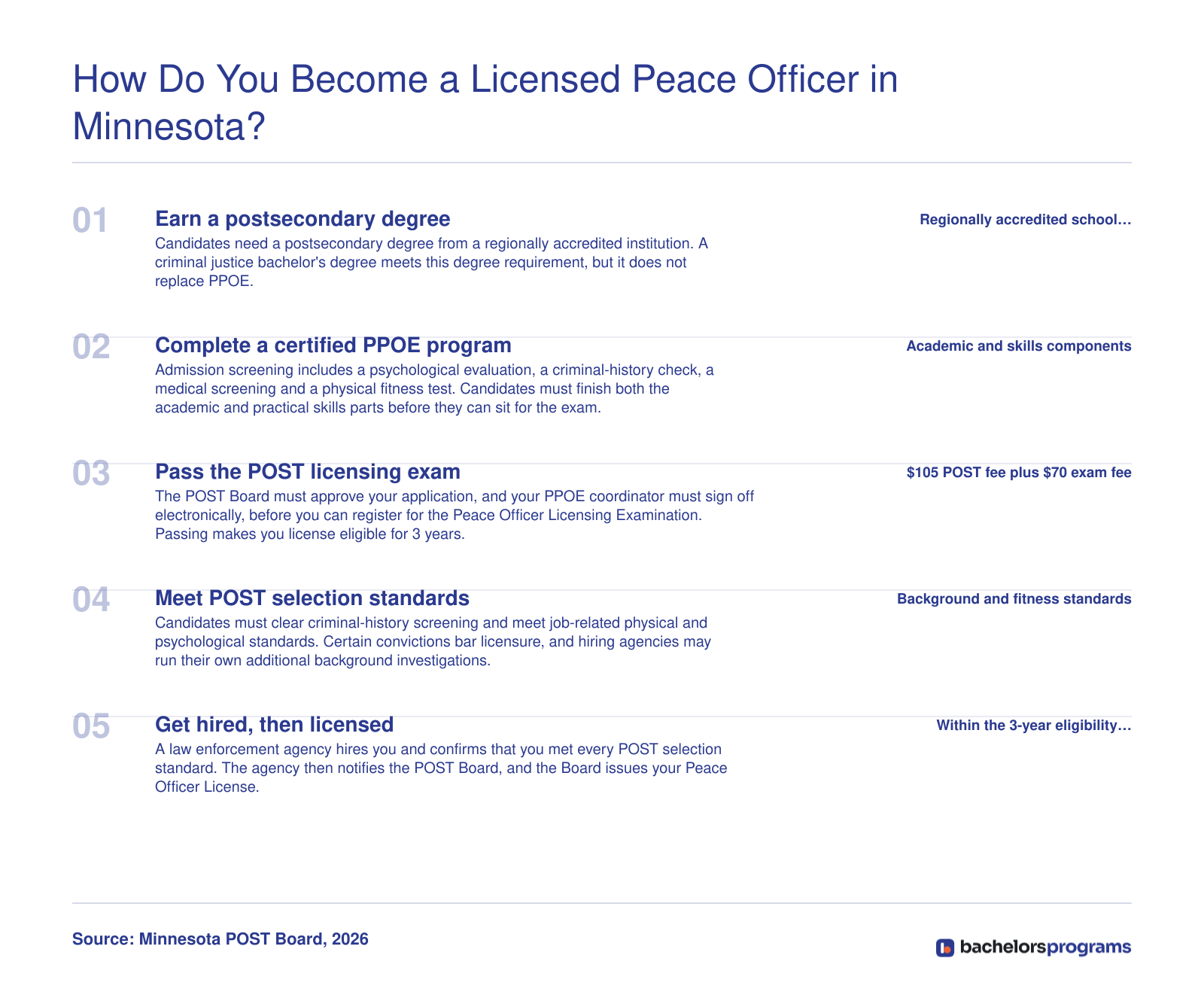
In Minnesota, a bachelor's degree in criminal justice is only the first step toward a peace officer license. The Minnesota POST Board also requires certified professional peace officer education (PPOE), a licensing exam, selection standards and a job offer from a law enforcement agency. Passing the exam does not by itself produce a license.
Criminal Justice Salaries in Minnesota: Police, Corrections, Probation and Detectives
Pay varies widely by agency, county and years of service; the figures below are reference points, not guarantees.
Police and sheriff's patrol officers
This is the largest sworn role in the state. Minnesota DEED counts roughly 9,160 police and sheriff's patrol officers working statewide as of early 2026, with a median wage of $41.10 an hour and a mean of $41.97.1 The reported spread runs from about $29.91 at the low end to $52.33 at the upper end.1 At a standard 2,080-hour year, the median converts to roughly $85,000, though DEED publishes these as hourly figures and overtime, shift differentials and union contracts move real take-home pay in both directions.
Corrections, probation and investigations
DEED counts about 5,350 correctional officers and jailers in Minnesota.2 No full Minnesota percentile breakdown for this occupation was available at the time of writing, so the closest reference is national: the Bureau of Labor Statistics reports a median of $58,940 a year for correctional officers and jailers in May 2025.3
For the other two roles, national BLS medians for 2025 are the most reliable benchmark available:
- Probation officers and correctional treatment specialists: $66,270 median annually4
- Detectives and criminal investigators: $93,790 median annually5
Detective and investigator roles almost always require prior sworn experience, so the higher figure reflects a mid-career destination rather than an entry point.
Outlook
BLS projects probation officer and correctional treatment specialist employment to grow about 3 percent nationally from 2025 to 2035, with roughly 7,900 openings a year, most from retirements and turnover.4 Minnesota-specific projections for these occupations were not published in the data reviewed here.
Minnesota Criminal Justice Degree FAQs
What is the best criminal justice school in Minnesota?
Can you get a bachelor's degree in criminal justice online in Minnesota?
Do I need a bachelor's degree to become a police officer in Minnesota?
Can I transfer community college credits into a Minnesota criminal justice bachelor's program?
Compare Criminal Justice programs on the data that matters
Explore more Criminal Justice & Law majors or browse every field of study.
All Criminal Justice & Law programs Browse every field of study