Best Criminal Justice Schools in Tennessee
Compare 31 accredited Criminal Justice programs in Tennessee at 26 colleges, with net price after aid, graduation rates, earnings and debt from IPEDS and the U.S. College Scorecard.

Cost and flexibility pull in opposite directions at Tennessee's criminal justice programs: average net price after aid spans roughly $10,700 to $24,700 a year, and the cheapest campuses are rarely the ones a working officer can attend online. A bachelor's degree in criminal justice, most often a Bachelor of Science (B.S.) in Criminal Justice, is the standard credential, though the state's POST Commission, not the degree, certifies officers.
The ranking weighs those tradeoffs against outcomes: net price, graduation rate, program completions, and federal earnings data.
The practical constraint is sequencing. Departments hire before graduation, but promotion and specialized units are where the degree starts to pay.
Key Points
- Le Moyne-Owen College posts the lowest net price here: $7,099 yearly.
- Tennessee patrol officers earned a $53,870 median wage in May 2023.
- For flexibility, look to UT Chattanooga, MTSU and University of Memphis.
Best Bachelor's Degree in Criminal Justice Schools in Tennessee: Our Top 10
These ten Tennessee schools split on two lines: average net price after aid runs from roughly $10,700 to $24,700 a year, and delivery ranges from programs that meet only in person to ones a working student can finish entirely online. Net price figures throughout are approximate averages after grant aid, not a quote for any individual student, since your own cost depends on residency, scholarships and transfer credits. Across the group, institution-wide graduation rates span about 46% to 72%.
The University of Tennessee-Martin
#1Martin, TN · $11,000/yr (est. net price)
Best for: Future crime scene investigators
The University of Tennessee at Martin awards a Bachelor of Science in Criminal Justice with four concentrations: Forensics, Justice Studies, Juvenile Justice and Law Enforcement. The forensics track is the most distinctive, with 18 credits in crime scene management, bloodstain pattern analysis, latent prints and forensic anthropology, and no minor required. Every concentration runs 120 credit hours with a C minimum in core courses, a 2.0 overall GPA and three credits of experiential learning. Its average net price after aid is the lowest in this group.
- Tracks: Forensics, Justice Studies, Juvenile Justice, Law Enforcement
- 120 total credit hours, including 30 in criminal justice core courses
- Forensics track: 18 credits, no minor required
- Bloodstain pattern analysis, latent prints, forensic anthropology, human remains
- 3 credits of experiential learning required in every track
- Minimum C in core and concentration courses; 2.0 overall GPA
- Justice Studies track requires an exit exam and 30 hours at UT Martin
- Law Enforcement track covers law, fitness, firearms and de-escalation
East Tennessee State University
#2Johnson City, TN · ~$16,000/yr (est.)
Best for: Students choosing between BA and BS tracks
East Tennessee State University awards both a Bachelor of Arts and a Bachelor of Science in Criminal Justice and Criminology, so students choose either a foreign-language path or a science-and-technology emphasis. Coursework covers criminal law, criminal statistics and criminological theory, and each student completes a field internship with a local, state or federal justice agency. Advisors in the Center for Advisement and Student Excellence handle academic and career planning, and scholarships run through the Phil and Martha Bachman College of Arts and Sciences.
- Bachelor of Arts or Bachelor of Science offered
- BA requires a foreign language; BS emphasizes science and technology
- Field internship with a local, state or federal justice agency
- Coursework: criminal law, criminal statistics, criminological theory
- Pathway to law school and to probation, parole and juvenile justice roles
- Assigned advisor through the Center for Advisement and Student Excellence
- Scholarships through the Phil and Martha Bachman College of Arts and Sciences
University of Memphis
#3Memphis, TN · $10,000 – $15,000/yr (est.)
Best for: Students who want campus and online options
The University of Memphis awards a Bachelor of Arts in Criminology and Criminal Justice built on 39 semester hours in the major, including research methods, criminology, ethical dilemmas and a senior capstone. Students add 18 more hours in the department, at least 15 of them upper division, plus a dedicated upper-division English course. Majors with 55 completed hours and a 3.25 GPA can apply to the honors program, which adds 15 honors hours and graduates with the "With Honors in Criminology and Criminal Justice" designation. Classes run on campus and online.
- Bachelor of Arts with 39 semester hours in the major
- Senior capstone and Research Methods both required
- 18 additional department hours, at least 15 at upper division
- Upper-division English course required
- Honors entry: 55 completed hours, 3.25 GPA, 15 honors hours
- "With Honors in Criminology and Criminal Justice" designation
- 41 hours of general education plus 6 to 9 hours of B.A. requirements
The University of Tennessee-Chattanooga
#4Chattanooga, TN · ~$14,000/yr (est.)
The University of Tennessee at Chattanooga awards a Bachelor of Science in Criminal Justice that can be completed in a traditional classroom or fully online. The degree requires 30 hours of core courses and 18 hours of criminal justice electives, covering criminological theory, the police, courts and corrections system, ethics and crime data analysis. Students can also earn three credit hours through the Senator Tommy Burks Victim Assistance Academy, a 40-hour victim advocacy training run with the Tennessee Coalition to End Domestic and Sexual Violence.
- 30 hours of core courses plus 18 hours of criminal justice electives
- Fully online option available alongside in-seat classes
- Covers police, courts and corrections as one system
- Ethics, crime data analysis, and race, class and gender in justice
- Victim Assistance Academy: 40 hours, up to 3 credit hours
- Criminal justice minor open to most majors; 2.0 minor average
Milligan University
#5Milligan, TN · ~$21,000/yr (est.)
Milligan University awards a Bachelor of Science in Criminology and Criminal Justice on its northeast Tennessee campus, with a suggested four-year schedule totaling at least 128 credits. First-year students take Introduction to Criminology and Criminal Justice, Juvenile Justice and Delinquency, and Criminal Investigation, then move into criminal law and procedure, leadership and ethics, and sociological research. An internship and a capstone seminar are both required, and some courses rotate by year. The university's overall graduation rate of about 63% is among the stronger figures here.
- 128 credits minimum on the suggested four-year schedule
- Internship (CRIM 491) and capstone seminar both required
- Juvenile Justice offered in odd-numbered spring terms only
- Criminal Investigation offered in even-numbered spring terms only
- Criminal law and procedure, leadership and ethics, sociological research
- First-year sequence includes Intro to Criminology/CJ and Criminal Investigation
Trevecca Nazarene University
#6Nashville, TN · $17,000/yr (est. net price)
Trevecca Nazarene University runs two routes to a criminal justice bachelor's degree in Nashville: a traditional on-campus Bachelor of Science in Criminal Justice Studies and a fully online degree-completion program for students who already hold college credit. The campus program covers criminal law and procedure, policing, courts, corrections, juvenile justice, emergency management and investigating terrorism, and includes a supervised three-credit senior practicum placed with a law enforcement, court or correctional agency.
- On-campus Bachelor of Science on the Nashville campus
- Supervised senior practicum, CJS 4400, worth 3 credits
- Covers criminal law and procedure, policing, corrections, juvenile justice
- Emergency management and investigating terrorism coursework
- 51 general education hours plus 6 criminal justice electives and 9 general electives
- Internships and jobs available in the Nashville market
- 36 credit hours over roughly 18 months, fully online
- Asynchronous, cohort-based classes with weekly discussion
- Transfer up to 90 credits; academy training may earn credit
- 2.0 GPA minimum and no application fee
- $419 per credit, about $15,084 total program tuition
- Degree-completion format for students with prior college credit
Lipscomb University
#7Nashville, TN · ~$25,000/yr (est.)
Lipscomb University offers criminal justice as either a Bachelor of Arts or a Bachelor of Science, with a 39-credit major and an 18-credit minor, all delivered in person in Nashville. The program takes a restorative justice approach, and students take classes alongside incarcerated students at the Tennessee Prison for Women through the Lipscomb Initiative for Education. The department reports a 98% job placement rate for graduates and a 100% graduate school acceptance rate, and points students toward law, social work and theology as well as criminal justice agencies. Its overall graduation rate of about 72% is the highest in this group.
- Bachelor of Arts or Bachelor of Science; 39-credit major
- 18-credit criminal justice minor available
- Restorative justice focus across the major
- Classes with incarcerated students at Tennessee Prison for Women (LIFE)
- Study abroad options in Italy, Austria and England
- Department reports 98% job placement and 100% graduate school acceptance
Middle Tennessee State University
#8Murfreesboro, TN · ~$13,000/yr (est.)
Middle Tennessee State University awards a Bachelor of Science in Criminal Justice with courses offered both in seat and fully online, making it one of the larger producers of criminal justice graduates in the state. Coursework runs from law enforcement and criminal investigation to courts, corrections, criminological theory and public policy. Graduates go to Customs and Border Protection, the Federal Bureau of Prisons, Immigration and Customs Enforcement and the Drug Enforcement Administration, and alumni employers include the FBI, the Secret Service and the Tennessee Bureau of Investigation.
- Courses offered in seat and fully online
- Covers investigations, courts, corrections, theory and public policy
- Employers: FBI, DEA, Secret Service, TBI, Nashville Metro Police
- Prepares students for law school
- Career Development Center and Handshake job and internship board
Lincoln Memorial University
#9Harrogate, TN · ~$20,000/yr (est.)
Lincoln Memorial University awards a Bachelor of Science in Criminology and Criminal Justice with a curriculum built by an advisory board of academics and criminal justice professionals to comply with Academy of Criminal Justice Sciences academic standards. Classes are capped at 30 students, and students are encouraged to complete a field internship; past placements include the FBI, the Tennessee Bureau of Investigation and the 8th Judicial District Attorney General's Office. The department offers early entry to LMU's law school and to its criminal justice master's program.
- Curriculum built to Academy of Criminal Justice Sciences academic standards
- Classes capped at 30 students
- Field internships: FBI, Tennessee Bureau of Investigation, district attorney
- First-year applicants need a 3.2 GPA; ACT or SAT scores optional
- Transfers need a 2.4 GPA and 15 semester credits
- Early entry to LMU law school and to the criminal justice master's
- Chapters of Alpha Phi Sigma and the American Criminal Justice Association
Cumberland University
#10Lebanon, TN · ~$19,000/yr (est.)
Cumberland University awards a Bachelor of Arts in Criminal Justice through the Millard and JJ Oakley School of Humanities, Education and the Arts. The degree comes in three routes: the standard major, the major with a declared minor, and the major with a Law Enforcement Academy option. Its overall graduation rate of about 46% is the lowest in this group, so ask about completion support and four-year course availability before you commit.
- Bachelor of Arts through the Millard and JJ Oakley School
- Three routes: standard major, declared minor, Law Enforcement Academy option
- Housed in the Humanities and Social Sciences department
- Law Enforcement Academy option sits alongside the standard major
Cost & outcomes by school
Federal data for the highest-earning Criminal Justice programs, independent of the ranking above. Earnings are this field's bachelor's graduates four years after completing where the Scorecard reports them, else the school's undergraduate median.
| School | Net price / yr | Grad rate | Earnings | Debt | Grads/yr | Format |
|---|---|---|---|---|---|---|
| Bethel University TN | $12,595 | 35% | $62,967 | $28,908 | 87 | Campus |
| Christian Brothers University TN | $9,854 | 55% | $57,478 | $27,000 | — | Campus |
| Lipscomb University TN | $24,739 | 72% | $55,541 | $19,500 | 1 | Campus |
| Middle Tennessee State University TN | $13,359 | 54% | $55,481 | $22,000 | 94 | Online or campus |
| Bryan College-Dayton TN | $20,614 | 50% | $54,434 | $23,000 | 12 | Campus |
| Union University TN | $27,171 | 66% | $53,990 | $20,714 | — | Campus |
| Strayer University-Tennessee TN | $11,645 | — | $53,916 | $41,562 | 20 | Online |
| The University of Tennessee-Chattanooga TN | $14,265 | 50% | $53,565 | $18,214 | 103 | Online or campus |
| University of Memphis TN | $12,397 | 51% | $53,399 | $25,941 | 71 | Online or campus |
| Austin Peay State University TN | $9,735 | 40% | $53,376 | $21,090 | 79 | Online or campus |
| Cumberland University TN | $18,759 | 46% | $51,032 | $17,952 | 16 | Campus |
| Lincoln Memorial University TN | $20,406 | 50% | $49,956 | $20,000 | 10 | Campus |
Sources: U.S. Department of Education. Net price, graduation rate, earnings and debt: College Scorecard (earnings and debt for this field's bachelor's graduates where reported, else school-wide); graduates: IPEDS. A dash means no figure is reported.
Cost, debt & payoff
Median earnings of this field's bachelor's graduates (4 yrs after completing, else the school's undergraduate median) vs. their median federal loan debt · U.S. College Scorecard
Across these programs the median graduate earns about $48,784 and finishes with roughly $21,443 in debt — a ratio that clears a common rule of thumb (keep debt below first-year salary). Net price and debt vary widely school to school, so check the per-school figures in the table above before you shortlist.
How We Ranked Tennessee Criminal Justice Schools
Four inputs drive the ranking: federal College Scorecard outcomes for graduates, the net price families pay after grants and scholarships, the graduation rate, and how many students complete a criminal justice bachelor's degree at each school. Together they show which Tennessee schools graduate students consistently and at a reasonable cost.
What We Looked At
Only Tennessee-based schools with a bachelor's degree in criminal justice were considered. Both campus and online programs qualify, as long as the school is based in the state.
Read These Numbers Carefully
Graduation rate and net price describe the whole institution, not the criminal justice program alone. A school with a strong overall graduation rate may still have a program that performs differently, and net price depends on your own aid package. Treat both figures as a starting point for comparison, not a promise about your own cost or outcome.
Key Takeaways
- Scope: Every school here is based in Tennessee and offers a bachelor's degree in criminal justice or a closely related field.
- Institution-wide figures: Graduation rate and net price reflect the full school, not one major.
- Program size: Completions show how established a program is, but not whether it fits your goals.
- Limits: A ranking cannot judge curriculum quality, faculty, internship access, or whether you would be admitted.
GPA expectations, test policies, and transfer credit are covered in the admissions section; confirm the details with each school's admissions office before you apply.
Most Affordable Bachelor's Programs in Criminal Justice in Tennessee
Le Moyne-Owen College in Memphis has the lowest average net price below at $7,099 a year, and UT Martin, also one of the schools ranked above, comes in at $10,701 with a median program debt of $21,443. Sticker price can mislead: Christian Brothers University, whose criminal justice option is a concentration within its Applied Psychology B.A., lists $38,420 in tuition and fees but averages $9,854 after aid, while net price at public Austin Peay and UT Martin runs slightly above tuition because it also counts housing, books and other costs. Figures come from federal IPEDS and College Scorecard data, and debt appears only where a program-level median is published.
| School | City | Program | Sector | In-State Tuition and Fees (per year) | Average Net Price (per year) | Median Program Debt |
|---|---|---|---|---|---|---|
| Le Moyne-Owen College | Memphis | Criminal Justice | Private nonprofit | $12,076 | $7,099 | N/A |
| Austin Peay State University | Clarksville | Criminal Justice (B.S.) | Public | $9,006 | $9,735 | $21,090 |
| Christian Brothers University | Memphis | Applied Psychology, B.A. (Criminal Justice concentration) | Private nonprofit | $38,420 | $9,854 | N/A |
| The University of Tennessee-Martin | Martin | Bachelor of Science in Criminal Justice | Public | $10,560 | $10,701 | $21,443 |
| Lane College | Jackson | Criminal Justice | Private nonprofit | $11,790 | $10,904 | $36,500 |
Related Articles
Online and Hybrid Criminal Justice Bachelor's Options at Tennessee Schools
If you need flexibility, the best options are at Tennessee's large public universities. The University of Tennessee-Chattanooga, Middle Tennessee State University and the University of Memphis each deliver their criminal justice bachelor's in more than one format. Most private schools here teach the degree on campus.
Online and Hybrid Programs
- UTC (Criminal Justice, B.S.): Offered on campus and fully online. The curriculum pairs 30 core hours with 18 hours of electives, covering police, courts, corrections and crime data analysis.
- MTSU (Criminal Justice, B.S.): Also offered both ways, with a fully online option. Coursework spans investigations, courts and corrections.
- University of Memphis (Criminology and Criminal Justice): Listed for both campus and online study. Students finish with a required capstone. Confirm with the department which courses run online.
Campus-Based Programs
UT Martin, ETSU, Milligan, Trevecca Nazarene, Lipscomb, Lincoln Memorial and Cumberland teach their programs in person. UT Martin is the clearest choice if you want a specialization. It offers four concentration options, including forensics coursework in crime scene management and bloodstain pattern analysis. That concentration is campus-based.
Check Accreditation First
ETSU states that it holds regional accreditation from the Southern Association of Colleges and Schools Commission on Colleges (SACSCOC) to award degrees from the baccalaureate through the doctorate. Before you enroll anywhere, find the SACSCOC statement on that school's website. Regional accreditation affects credit transfer, federal aid eligibility, and whether employers and graduate programs accept your degree. It matters just as much for online study as it does on campus.
Which Format Fits You
- Working adults: The fully online tracks at UTC and MTSU let you study around shift work or a full-time job.
- Transfer students: The flexible formats at UTC, MTSU and Memphis make it easier to finish a degree you already started. Lincoln Memorial accepts transfers with 15 semester credits for its campus program.
- Traditional-age students: Campus programs build in hands-on experience. Examples include ETSU's field internship with a justice agency, Trevecca's supervised senior practicum in Nashville and Milligan's required internship.
Tennessee Criminal Justice Careers and Wages
Police and sheriff's patrol officers in Tennessee earned a median annual wage of $53,870 in May 2023, according to the Bureau of Labor Statistics, across 12,730 positions statewide.1 That figure matters more than most brochures: the field's largest employer group pays a median in the mid-$50,000s, the clearest salary benchmark a new graduate can plan around.
Patrol and Investigations
Patrol work remains the entry point for most sworn careers, and those 12,730 jobs represent the deepest hiring pool in the state. Detectives and criminal investigators are counted separately, and their pay typically sits above patrol pay. Getting there usually takes several years of sworn service and a promotion, not a different degree.
Community Supervision and Corrections
Probation officers and correctional treatment specialists reported a Tennessee median of $48,840 across roughly 2,600 jobs in the same period.1 The work leans on case management, report writing, and courtroom documentation, which is why many employers prefer a bachelor's degree in criminal justice or a closely related field. Correctional officers and jailers are tracked separately and generally start below probation pay, though county and state facilities offer a dependable way into the field for graduates who want corrections experience early.
State Roles and Outlook
Troopers with the Tennessee Highway Patrol and officers with the Tennessee Wildlife Resources Agency are often grouped with patrol officers in wage reporting, and each agency recruits and trains through its own academy.
Demand across these occupations is steady rather than explosive. Retirement-driven turnover in patrol and corrections keeps openings coming, but hiring timelines, physical standards, and background checks shape who gets hired as much as the wider job market does.
One caution: these are occupational wages for everyone holding the job, not the earnings of recent graduates. Supervisors, detectives, and long-tenured officers pull the medians up, so read them as a career range rather than a starting salary.
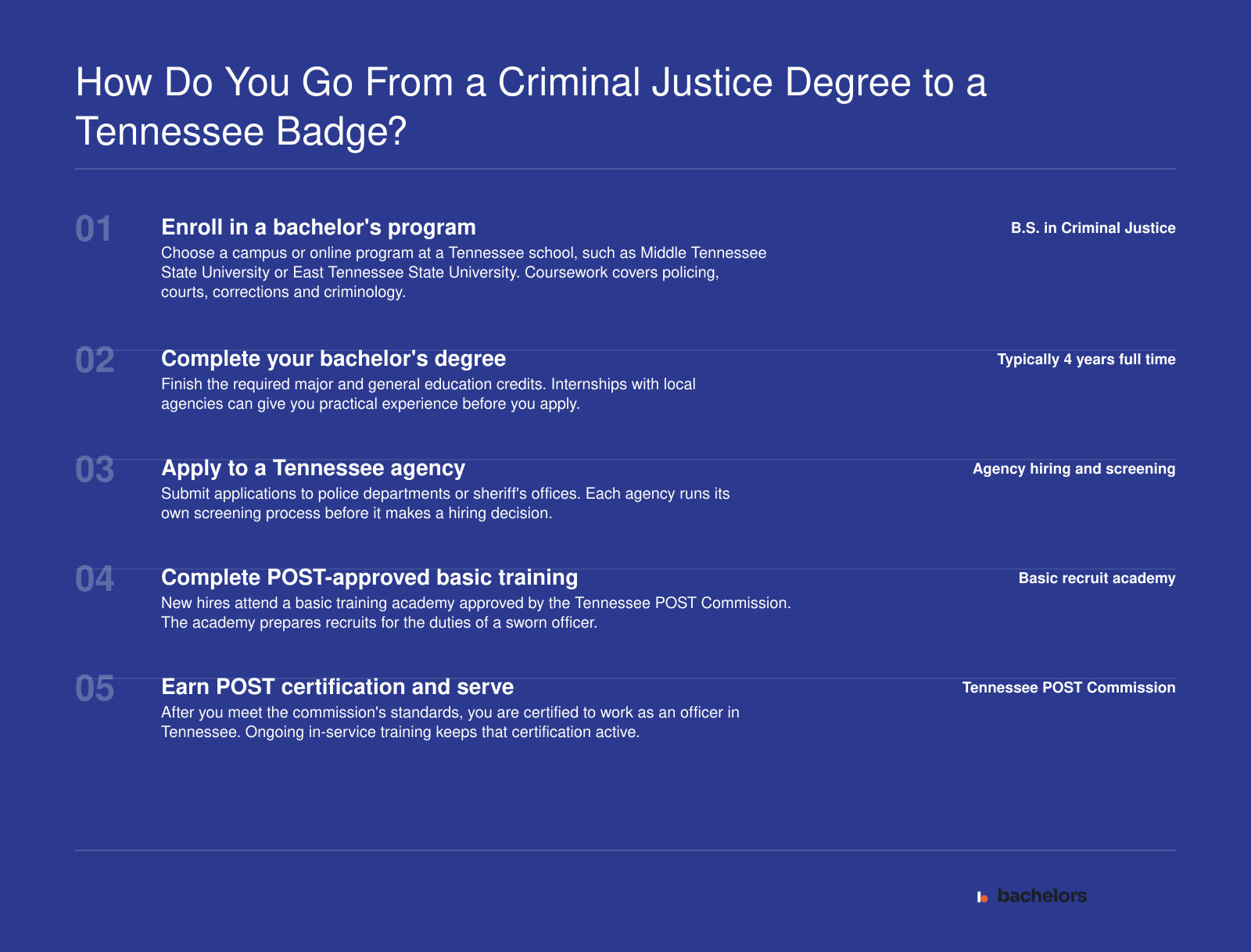
How Do You Go From a Criminal Justice Degree to a Tennessee Badge?
In Tennessee, the Peace Officer Standards and Training (POST) Commission sets the standards that law enforcement officers must meet, and a bachelor's degree works alongside those standards rather than replacing them. The path below shows the order most graduates follow, from the first semester of a Bachelor of Science in Criminal Justice to a certified role with a Tennessee agency.
Common Questions About Criminal Justice Degrees in Tennessee
What are the best criminal justice schools in Tennessee?
Which Tennessee colleges offer a bachelor's degree in criminal justice online?
How much does a criminal justice degree cost in Tennessee?
What are the ETSU criminal justice requirements?
What jobs can you get with a criminal justice degree in Tennessee?
Compare Criminal Justice programs on the data that matters
Explore more Criminal Justice & Law majors or browse every field of study.
All Criminal Justice & Law programs Browse every field of study