Best Criminology Schools in Massachusetts
Compare 15 accredited Criminology programs in Massachusetts, with net price after aid, graduation rates, earnings and debt from IPEDS and the U.S. College Scorecard.
Massachusetts schools award the criminology bachelor's as either a Bachelor of Science or a Bachelor of Arts, and this list divides between the two.
Cost and payoff rarely land in the same place. In-state tuition at the public universities runs under $20,000, while the small private colleges post the strongest four-year earnings medians, just under $68,000. Admissions adds a second filter: at some schools students enter the university first, then declare the major.
For police work, the state's Quinn Bill pays a 20% salary incentive to officers holding a bachelor's degree, so the credential keeps paying after hire.
Key Points
- Assumption and Emmanuel graduates earn medians near $68,000 four years out.
- The cheapest options are public universities, within about $1,700 yearly.
- The Quinn Bill sets a 20% pay incentive for bachelor's-holding officers.
Best Bachelor's Degree in Criminology Schools in Massachusetts: Our Top 10
Massachusetts offers criminology bachelor's degrees in almost every format a student could want, from small liberal arts colleges in Worcester and Easton to public universities in Boston, Lowell, Dartmouth and Amherst. The ten schools below mix B.A. and B.S. credentials, campus and fully online delivery, and price points that run from modest public tuition to private college sticker prices. Each entry highlights what the school does distinctively well for criminology undergraduates.
Assumption University
#1Worcester, MA · ~$29,000/yr (est.)
Best for: Students wanting professor-taught small seminar classes
Assumption University runs its criminology major through the Sociology and Criminology Department in Worcester, and the structure is deliberately lean: 13 courses, with three electives drawn from Deviance and Law and Society and three from Structural and Cultural Factors. A two-semester internship seminar is required, and a Police Academy Seminar can stand in for those courses. The department reports that 95% of its 2020 criminology graduates were employed or in graduate school within six months, and classes are taught by professors rather than teaching assistants.
- 13 courses total: seven required and six electives
- Three electives from Deviance/Law and Society; three from Structural and Cultural Factors
- Two-semester internship seminar required for all majors
- Police Academy Seminar can replace the two internship courses
- Integrated four-year double major in sociology and criminology
- 13:1 student-faculty ratio with no classes taught by teaching assistants
- Department reports 95% of 2020 graduates employed or in grad school in six months
- NACP Provisional Credential eligibility
Stonehill College
#2Easton, MA · ~$33,000/yr (est.)
Best for: Federal law enforcement career track
Stonehill College teaches its criminology major on a leafy campus in Easton and lets students choose among three concentrations: Federal Law Enforcement, Crime Victimization, and Law and Policy. Every major completes a capstone internship in the third or fourth year with a social service or criminal justice agency, and federal law courses are taught by former federal staff. The department has drawn national and regional recognition from College Factual and CourseAdvisor, and graduates move into law enforcement, the courts, corrections, law school and federal government.
- Three concentrations: Federal Law Enforcement, Crime Victimization, Law and Policy
- Capstone internship in year three or four with justice or social service agencies
- Federal law classes taught by former federal staff
- Required courses include Critical Introduction to Criminal Justice
- Undergraduate research with faculty through the SURE program
- Full-time students finish the major in four years
Emmanuel College
#3Boston, MA · ~$27,000/yr (est.)
Best for: Boston-based advocates for justice reform
Emmanuel College sits in Boston and awards a B.A. in Criminology and Criminal Justice with a required internship placed with agencies across the city. All majors complete a Capstone Experience, and the core sequence runs from Law and Criminal Procedure through Criminology and Professional Ethics. Coursework deliberately examines race, ethnicity and gender in criminal justice and the effects of reform on underserved communities, which suits students aiming at victim advocacy, probation or community-based work.
- Required internship placed with Boston-area justice agencies
- Capstone Experience required of all majors
- Core sequence includes Law and Criminal Procedure, Criminology, and Professional Ethics
- Electives include Forensic Chemistry, Juvenile Justice, Family Violence, Drugs and Society
- Coursework examines race, ethnicity and gender in criminal justice and reform
- Minor requires four core courses plus two additional courses
- Career paths include police officer, probation officer, crime scene investigator, victim advocate
University of Massachusetts-Dartmouth
#4North Dartmouth, MA · ~$21,000/yr (est.)
UMass Dartmouth's 120-credit Crime and Justice Studies B.A. is one of the few in the state offered both on campus and 100% online, and students can finish in three years through the UMassD in Three option. A senior-year internship course places students with the Bristol County Sheriff's Office, Fall River Police Department and the Massachusetts Parole Board victim services unit. The curriculum leans toward restorative and transformative justice, mediation and abolitionism, with a pre-law concentration and a 3+3 pathway into UMass Law for students heading to legal careers.
- 120-credit B.A. offered on campus and 100% online
- Senior-year internship course required for every major
- Placements include Bristol County Sheriff's Office and Fall River Police Department
- Pre-law concentration available within the major
- Alpha Phi Sigma national criminal justice honors society chapter
- 3+3 pathway with UMass Law; finish the bachelor's in three years
- Coursework covers restorative justice, mediation and abolitionism
- Inside-Out Prison Exchange program
Framingham State University
#5Framingham, MA · ~$16,000/yr (est.)
Framingham State University offers a criminology major and minor on a public campus west of Boston, with coursework pulled from sociology, psychology, anthropology, history and political science. A dedicated research sequence has students design and carry out their own empirical criminological study using quantitative or qualitative methods. Internships, thesis projects and faculty-led study tours have placed students with the Department of Children and Families, Massachusetts adult and juvenile courts, local and state police, the FBI and Homeland Security.
- Criminology major and minor offered on campus
- Research sequence: students design and carry out their own criminological study
- Internships with DCF, state and local police, the FBI and Homeland Security
- Thesis projects and faculty-led study tours available
- Interdisciplinary coursework in sociology, psychology, anthropology and history
- Graduates enter law, public policy, social services, advocacy and law enforcement
University of Massachusetts-Amherst
#6Amherst, MA · $20,000 – $25,000/yr (est.)
At UMass Amherst, criminology is studied as a Criminology, Law and Deviance concentration inside the sociology major, a structure that suits students who want strong social science and research training alongside crime coursework. A pre-approved internship or research assistantship can replace a 200-level elective.
- Concentration inside the sociology major for students entering Fall 2026 or later
- 13 courses: 7 required sociology, 2 distribution, 4 criminology and law courses
- SOCIOL 241 Criminology required, plus one of Conformity & Deviance or Sociology of Law
- Electives cover juvenile delinquency, corporate crime, hate crime and domestic violence
- A pre-approved internship or research assistantship can replace a 200-level elective
- Study abroad or a foreign language course meets the intercultural requirement
- No single course can satisfy two requirements
Boston College
#7Chestnut Hill, MA · ~$42,000/yr (est.)
Boston College's Woods College of Advancing Studies awards a B.A. in Criminal and Social Justice on a Chestnut Hill campus, combining a structured justice major with the full Boston College core curriculum in English, philosophy, theology, history, mathematics and natural science. Required coursework runs from Principles of Criminal Justice and Criminal Law and Procedure to Corrections: Policies and Practice, and students choose four electives split between social and systemic challenges and interdisciplinary topics. Rolling admissions with fall, spring and summer start dates give working students several entry points each year.
- Bachelor of Arts in Criminal and Social Justice at the Woods College of Advancing Studies
- Required courses include Principles of Criminal Justice, Criminal Law and Procedure, Corrections
- Four electives: two in social and systemic challenges, two interdisciplinary
- Full Boston College core curriculum also required
- Rolling admissions with fall, spring and summer start dates
- Careers span law, social work, corrections, victim advocacy, government and security
University of Massachusetts-Lowell
#8Lowell, MA · ~$17,000/yr (est.)
UMass Lowell awards a Bachelor of Science in Criminal Justice and Criminology with two options, General and Corrections, on a public campus north of Boston. The curriculum pairs the causes of crime with the workings of the justice system and pushes students to apply both to complex social problems while building critical thinking and communication skills. An accelerated bachelor's to master's pathway and a criminal justice minor give students room to move faster or broaden their studies.
- Bachelor of Science in Criminal Justice and Criminology
- Two options: General and Corrections
- Coursework covers the causes of crime and the workings of the justice system
- Emphasis on applied problem solving and communication skills
- Accelerated BS to MS pathway in criminal justice and criminology
- Minor in criminal justice available
Westfield State University
#9Westfield, MA · $15,000 – $20,000/yr (est.)
Westfield State University offers a Bachelor of Science in Criminal Justice with a Criminology concentration, a 42-credit major built on six core courses including Theories of Crime and Research Methods in Criminal Justice. Students choose 21 upper-division elective credits from topics such as Deviance and Culture, Organized and White Collar Crime, Victimology and Evidence-Based Crime Policy, and up to six practicum or independent study credits can count toward the major. The department advertises more than 700 internship opportunities and the largest criminal justice career fair in the Northeast.
- 42-credit major with 18 credits in six core courses
- Core includes Theories of Crime and Research Methods in Criminal Justice
- 21 upper-division elective credits, at least 18 in criminology topics
- Topics include Deviance and Culture, Organized and White Collar Crime, Victimology
- Up to 6 credits of field practicum or independent study can apply to the major
- Majors entering 2025-26 or later need a C- or better with a 2.3 core GPA
- 700+ internship opportunities and the largest criminal justice career fair in the Northeast
University of Massachusetts-Boston
#10Boston, MA · $18,000/yr (est. net price)
UMass Boston's B.A. in Criminology and Criminal Justice is a 36-credit major of at least eleven courses taught in the city where much of the state's justice system operates. The core covers sociology, criminal justice systems, criminology and research methods, then students add statistics, an advanced justice course, an advanced criminology course and electives such as Family Violence, Juvenile Delinquency and Victimology. The capstone is a three- or six-credit internship or senior seminar, and students declare after completing 12 UMass Boston credits with a 2.0 GPA.
- 36-credit major built from at least 11 courses
- Core: Introduction to Sociology, Criminal Justice Systems, Criminology, Research Methods
- Capstone is a 3- or 6-credit internship or senior seminar; only one internship counts
- Declare after 12 UMass Boston credits with a 2.0 GPA
- Electives include Family Violence, Juvenile Delinquency and Victimology
- No more than five transfer courses apply toward the major
- Only one pass/fail course may count in the major
Cost & outcomes by school
Federal data for the highest-earning Criminology programs, independent of the ranking above. Earnings are this field's bachelor's graduates four years after completing where the Scorecard reports them, else the school's undergraduate median.
| School | Net price / yr | Grad rate | Earnings | Debt | Grads/yr | Format |
|---|---|---|---|---|---|---|
| Boston College MA | $41,704 | 91% | $103,937 | $19,000 | — | Campus |
| Northeastern University MA | $30,915 | 91% | $92,538 | $24,250 | — | Campus |
| Northeastern University MA | — | — | $92,538 | $24,250 | — | Campus |
| Merrimack College MA | $37,927 | 70% | $75,584 | $27,000 | — | Campus |
| University of Massachusetts-Amherst MA | $22,383 | 83% | $71,631 | $22,763 | — | Campus |
| Assumption University MA | $29,498 | 75% | $67,883 | $27,000 | 9 | Campus |
| Emmanuel College MA | $26,706 | 68% | $67,814 | $26,000 | 16 | Campus |
| Wheaton College (Massachusetts) MA | $29,822 | 73% | $67,725 | $26,000 | — | Campus |
| University of Massachusetts-Boston MA | $17,707 | 49% | $65,865 | $21,974 | — | Campus |
| Stonehill College MA | $33,016 | 76% | $64,957 | $25,000 | 47 | Campus |
| University of Massachusetts-Lowell MA | $17,163 | 65% | $64,874 | $23,704 | — | Campus |
| Framingham State University MA | $16,114 | 48% | $59,857 | $25,000 | 42 | Campus |
Sources: U.S. Department of Education. Net price, graduation rate, earnings and debt: College Scorecard (earnings and debt for this field's bachelor's graduates where reported, else school-wide); graduates: IPEDS. A dash means no figure is reported.
Cost, debt & payoff
Median earnings of this field's bachelor's graduates (4 yrs after completing, else the school's undergraduate median) vs. their median federal loan debt · U.S. College Scorecard
Across these programs the median graduate earns about $67,725 and finishes with roughly $25,000 in debt — a ratio that clears a common rule of thumb (keep debt below first-year salary). Net price and debt vary widely school to school, so check the per-school figures in the table above before you shortlist.
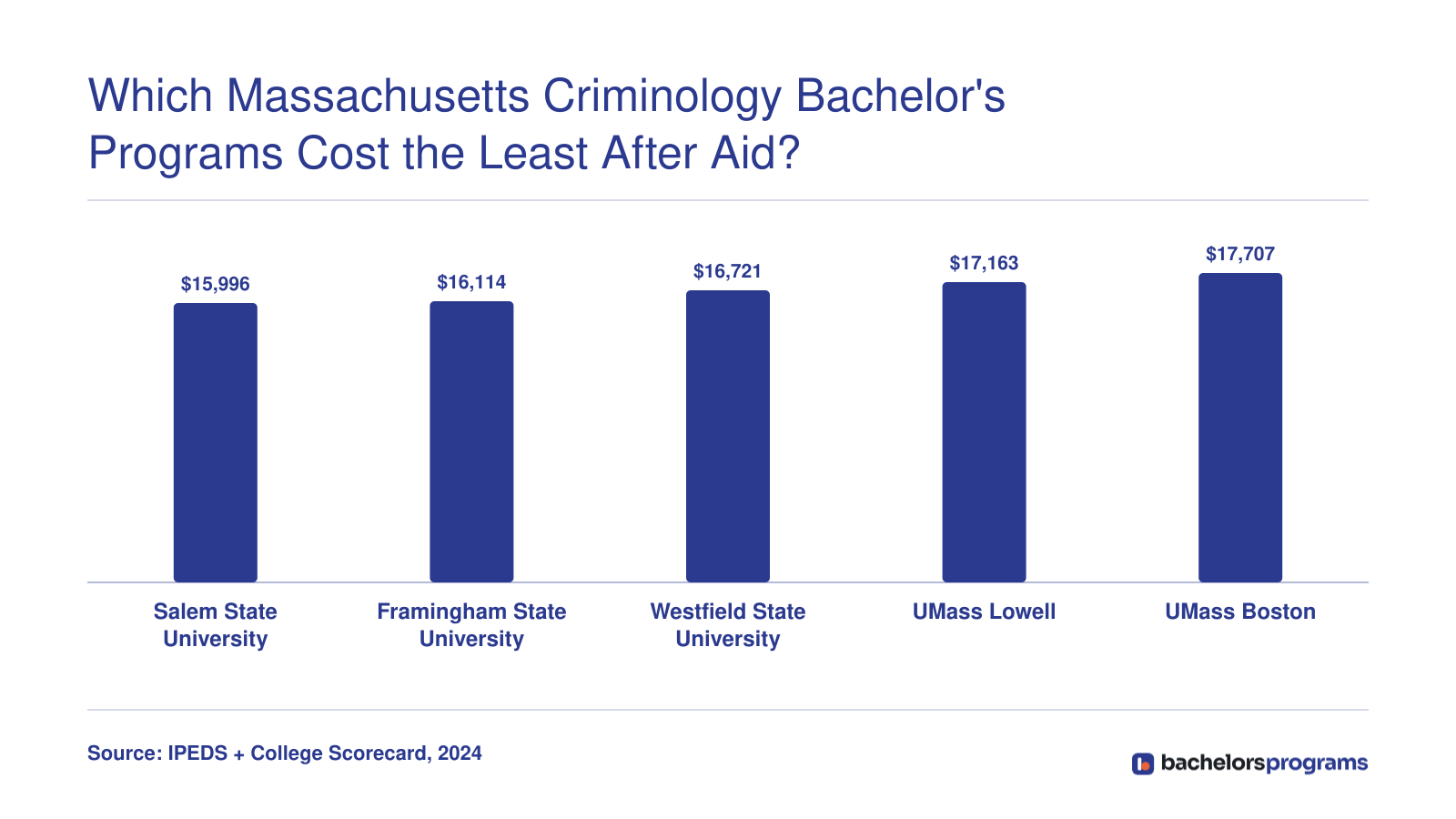
Which Massachusetts Criminology Bachelor's Programs Cost the Least After Aid?
The lowest-cost options for a criminology bachelor's in Massachusetts are all public universities, and the gap between them is small: about $1,700 a year separates the low end from the high end. Salem State University, in our directory, has the lowest average net price at $15,996 after grants and scholarships. Framingham State University is the lowest-priced ranked option at $16,114. These are federal averages for aided in-state students at public institutions, and private colleges are measured on a separate basis, so treat each figure as a benchmark rather than a quote. Your own price depends on your aid package.
Criminology Bachelor's Graduates With the Highest Earnings
Assumption University and Emmanuel College graduates post the highest medians four years after finishing, both just under $68,000. UMass Dartmouth shows the steepest climb, from about $37,500 in the first year to more than $65,000 by year five, at a public-university price.
| School | City | Sector | Median Earnings, 1 Year After Graduation | Median Earnings, 4 Years After Graduation | Median Earnings, 5 Years After Graduation | Median Program Debt | Est. Monthly Payment (10-Year Plan) |
|---|---|---|---|---|---|---|---|
| Assumption University | Worcester | Private nonprofit | $48,600 | $67,883 | N/A | $27,000 | $286 |
| Emmanuel College | Boston | Private nonprofit | $36,824 | $67,814 | N/A | $26,000 | $276 |
| University of Massachusetts-Dartmouth | North Dartmouth | Public | $37,535 | $54,174 | $65,646 | $25,204 | $267 |
| Stonehill College | Easton | Private nonprofit | $40,928 | $64,957 | $63,767 | $25,000 | $265 |
| Framingham State University | Framingham | Public | $41,431 | $59,857 | $60,589 | $25,000 | $265 |
Online and Hybrid Criminology Bachelor's Options at Massachusetts Schools
Campus study buys structure, online study buys flexibility, and the schools here divide cleanly along that line. Only one program in our data is listed with both formats, so the choice narrows quickly.
Online and Campus Delivery
University of Massachusetts-Dartmouth is the one school whose program type covers both campus and online delivery. Its Crime & Justice Studies BA requires 120 credit hours and a senior-year internship course, and the school also lists accelerated options, including finishing in three years instead of four. Confirm with the department which courses can be taken remotely before you commit.
Campus-Only Programs
The rest are campus programs: Assumption University, Stonehill College, Emmanuel College, Framingham State University, UMass Amherst, Boston College, UMass Lowell, Westfield State University and UMass Boston. Many build in required internships, which are easier to arrange when you live near the school. Emmanuel and UMass Boston, both in Boston, place students with city agencies, while Westfield State advertises 700+ internship opportunities.
Who Each Format Suits
- Working adults: UMass Dartmouth's online option gives the most flexibility around a job or family schedule.
- Transfer students: Credits are easier to line up at the public campuses, such as UMass Boston and Westfield State, which publish transfer limits and course rules.
- Traditional full-time students: The campus programs offer in-person internships, honors societies and faculty research.
Online study here means a Massachusetts-based school, so out-of-state online providers are not included.
Admissions: GPA, Test Policy and Transfer Credit for Criminology Bachelor's Programs
Getting into a criminology bachelor's program in Massachusetts usually means two steps: gaining admission to the university, then meeting any requirements to enter the major. Published detail varies widely by school, so the groups below separate what is documented from what is not.
Selective Admissions
Boston College admits about 16 percent of applicants, the most selective school here by a wide margin. UMass Amherst (about 60 percent) and Stonehill College (about 66 percent) admit a larger share but still expect a strong academic record. We did not find a stated minimum GPA or transfer-credit rule for these three programs, so confirm both with the admissions office before you apply.
Broadly Accessible Admissions
Emmanuel, Assumption, Framingham State, UMass Lowell, Westfield State, UMass Boston and UMass Dartmouth each admit roughly three-quarters or more of applicants, with UMass Dartmouth the highest at about 91 percent. Within this group, published policies differ:
- UMass Lowell: Applicants through its No Test Option should have a GPA of 3.000 or higher and evidence of outstanding academic success. SAT and ACT scores are optional for most applicants, but some home-schooled and international applicants may still need them. No average admitted-student GPA is published.
- Westfield State: The program page lists the university as test optional with no entrance exam required.
- UMass Boston: The major itself lists a 2.0 GPA minimum, and no more than five transfer courses can count toward it.
- Emmanuel, Assumption, Framingham State and UMass Dartmouth: We found no published GPA minimum, test policy or transfer rule for these programs. Ask the school directly instead of assuming.
Transfer Credit
UMass Lowell publishes the clearest transfer rules. Transfer applicants generally qualify in one of three ways:
- At least 12 transferable credits and a 2.500 college GPA.
- Up to 23 transferable credits and a 2.000 college GPA, plus a qualifying high school transcript.
- At least 24 transferable credits and a 2.000 college GPA.
Applicants with fewer than 12 transferable credits are held to first-year standards. Credits are evaluated from official transcripts after admission, and you must identify all prior credits when you apply. The department chair makes the final call on which credits apply to the criminal justice major, so ask for that review early.
UMass Lowell's program is titled criminal justice, and several other schools here use similar names or offer criminology as a concentration. Check which exact degree an admissions rule applies to before you plan around it.
Related Articles
Cost of a Criminology Degree in Massachusetts: Tuition, Net Price and State Aid
Sticker price and the bill after aid are two very different numbers in Massachusetts, and the gap between them decides whether a private criminology program is a stretch or a nonstarter.
Public and Private: What Each Actually Costs
In-state tuition at the public universities on this list runs from $11,920 a year at Framingham State to $17,772 at UMass Amherst. Tuition at the private colleges here is far higher: $48,550 at Emmanuel College and $51,356 at Assumption University. Average net price, an approximate average after grants and scholarships rather than a guaranteed figure, narrows the field: roughly $16,100 to $22,400 at the public campuses and about $26,700 to $29,500 at the two private ones. Out-of-state tuition at the publics ($18,000 to $40,449) can land above a private college's net price, so establishing residency early is worth real money.
Three State Programs That Lower the Bill
- MASSGrant: need-based aid for Massachusetts residents, with a FAFSA (or the state MASFA if FAFSA is not an option) showing a Student Aid Index of $14,790 or less, filed by June 30, 2026, at least 12 credits per term, and satisfactory academic progress.1
- MassTransfer Tuition Waiver: pays 100 percent of resident tuition at a state university or UMass campus for the two years immediately after community college. It covers tuition, not mandatory fees, and a 3.0 GPA also qualifies you for the MassTransfer credit at four-year campuses.2
- Commonwealth Commitment: a 10 percent rebate on tuition and applicable fees each semester, with your tuition and fees frozen from your first semester.3
Award amounts vary by student and campus. The Commonwealth Commitment figures published for the Fall 2022 through Spring 2026 cohort ($38,004 in locked tuition and fees, less $2,388 in MassTransfer credits and $3,562 in rebates, for $32,054) illustrate that window rather than guaranteeing a Fall 2026 price.4
The Money-Saving Move
Start at a community college, finish the associate degree, then transfer under MassTransfer and pay resident tuition for your final two years. Every one of these programs runs through the FAFSA, so file it in the fall of your senior year, even while you are still comparing campuses.
Criminology Careers in Massachusetts for Bachelor's Graduates
A bachelor's degree in criminology opens several public-safety and justice pathways in Massachusetts. Massachusetts does not license criminology as a profession, so no state exam or credential comes with the degree. Some jobs do carry their own hiring requirements, set by the employing agency.
Policing
Police and sheriff's patrol officers are the largest group here. The most recent Massachusetts figures from the Bureau of Labor Statistics (May 2023) show about 16,910 officers and a median annual wage of $78,770, or $36.40 an hour.1 Officers are hired through their department and attend a police academy. Check current civil service and academy rules with the hiring agency before you apply, since they change.
Probation and Corrections
Probation officers and correctional treatment specialists numbered about 1,350 in Massachusetts in May 2023, with a mean annual wage of $82,700.2 That is a mean, not a median, so treat it as a rough guide. Nationally, the median for this occupation was $61,800.3 A bachelor's degree in criminology fits this work well, and agencies set their own screening standards.
Correctional officers and jailers are a separate group. Massachusetts-specific wage figures were not available to me, but nationally the typical entry requirement is a high school diploma4, followed by academy and on-the-job training. A bachelor's degree can help with advancement into supervisory or treatment roles.
Crime Analysis
Crime analysts study patterns in incident data to help police departments and other agencies deploy resources. Federal wage data does not break this job out cleanly for Massachusetts. For context, detectives and criminal investigators nationally averaged $98,770 in May 2023.5 Analyst roles usually reward the research methods, statistics and data skills that criminology programs teach.
Read each posting closely, because education, testing and background requirements differ by employer.
Police Career Incentive Pay (Quinn Bill) and Criminology Bachelor's Programs
The Police Career Incentive Pay Program, known as the Quinn Bill, sets a 20% salary incentive for officers with a bachelor's degree, compared with 10% for an associate degree and 25% for a master's.1 Points follow the same ladder: one per semester hour, with 120 for a bachelor's degree.1
Who Qualifies
The incentive covers regular full-time officers in participating Massachusetts cities and towns, plus State Police and State Police detectives.1 Municipal adoption is required, so not every department pays it.2 Officers who enrolled after January 1, 2004 generally must graduate from a program the Board of Higher Education has approved.3 The Board's guidelines require at least 30 semester hours of criminal justice or cognate coursework in a bachelor's major.2
Which Programs Are Eligible
The state's approved listings use the title "criminal justice," and the program FAQ says only programs with that title qualify under current guidelines.3 Salem State University, the University of Massachusetts-Boston and the University of Massachusetts-Lowell appear on those lists with criminal justice bachelor's degrees. Their criminology-titled offerings are separate, so check which degree carries the approval.
Certification could not be confirmed for Assumption University, Stonehill College, Emmanuel College, University of Massachusetts-Dartmouth, Framingham State University, University of Massachusetts-Amherst, Boston College, Westfield State University or Wheaton College. No Massachusetts bachelor's program titled "criminology" was identified as separately certified.3 Approval lists also change, and an older listing does not guarantee a school is still certified in 2026.
Before You Enroll
Confirm three things before you commit: whether your employing department participates, what percentage it pays, and whether your exact degree title is approved. Then ask the program office to verify its current approval in writing.
Criminology vs. Criminal Justice Bachelor's Degrees: How to Choose
Criminology and criminal justice overlap heavily, and many Massachusetts schools blend the two in one major. The practical difference is emphasis: criminology leans toward why crime happens, while criminal justice leans toward how the system responds. Check the course list and any ACJS endorsement rather than relying on the major's name alone.
| Factor | Criminology | Criminal Justice |
|---|---|---|
| Central question | Why crime occurs and how it is patterned across people and places | How police, courts and corrections operate and respond to crime |
| Typical coursework | Criminological theory, research methods, deviance and victimization | Policing, criminal law, corrections and criminal procedure |
| Program names in Massachusetts | Assumption University, Stonehill College and Framingham State University offer a Criminology major; UMass Dartmouth offers a Crime & Justice Studies BA | Salem State University offers Criminal Justice; Westfield State University offers a Criminal Justice B.S. with a Criminology Concentration; Emmanuel College and UMass Boston combine both in Criminology & Criminal Justice |
| ACJS curriculum standard | A major should require one-third of its semester hours in the field and related cognates, with balanced coverage of the field's issues | The same ACJS baccalaureate standard applies, and diversity and equity must be addressed through required courses or integration |
| ACJS faculty standard | Two-thirds of full-time faculty must hold a qualifying PhD or specified JD-based credentials or experience | The same faculty standard applies |
| ACJS recognition | Endorsement requires meeting at least 85% of standards, including mandatory Standard C.4; 95% or more may earn the gold seal | The same thresholds apply. ACJS replaced its older Certification with Program Endorsement in 2018 |
Criminology Schools in Massachusetts: Common Questions
What is the best criminology school in Massachusetts?
What is the cheapest criminology school in Massachusetts?
Are there online criminology degree programs in Massachusetts?
Which Massachusetts criminology programs qualify for police career incentives?
Compare Criminology programs on the data that matters
Explore more Criminal Justice & Law majors or browse every field of study.
All Criminal Justice & Law programs Browse every field of study