Best Criminal Justice Schools in Massachusetts
Compare 32 accredited Criminal Justice programs in Massachusetts at 29 colleges, with net price after aid, graduation rates, earnings and debt from IPEDS and the U.S. College Scorecard.

Massachusetts certifies its police officers through the Municipal Police Training Committee's academy, so a bachelor's degree in criminal justice supports that credential rather than replacing it. The degree is usually a Bachelor of Science (B.S.) in Criminal Justice, and the schools diverge quickly: private universities in Boston publish tuition above $65,000, while public campuses bring net price after aid below $14,000.
Format adds another variable. Several Massachusetts-based programs can be finished online, and cost, median earnings four years out and delivery model separate schools that otherwise sound identical. In a field where the state academy, not the diploma, controls entry, cost is the figure to check first.
Key Points
- Worcester State University has the lowest net price here: $13,381 a year.
- Fisher College criminal justice graduates earn a median $80,136 four years out.
- Westfield State offers B.S. concentrations in criminology, law enforcement, and rehabilitation.
Best Criminal Justice Schools in Massachusetts: Our Top 10 Ranked
These ten Massachusetts schools are ordered by our overall score for their bachelor's degree programs in criminal justice. The list runs from large private universities in Boston to public institutions in Worcester, Lowell and Salem, and each entry notes format, net price after aid and the school's graduation rate.
Boston University
#1Boston, MA · $20,000 – $25,000/yr (est.)
Best for: Working adults finishing a degree part time
Boston University delivers its Bachelor of Science in Criminal Justice through Metropolitan College in Boston, with a 128-unit curriculum covering crime causation, policing, court procedure, corrections and crime-control policy. Required courses include Principles of Criminal Justice, Police and Society, Corrections, Criminal Law, and Courts and Criminal Procedure, and students may build related coursework in computer science, psychology or sociology. Schools offering this program have a graduation rate of 89%, and the net price after aid is about $24,402.
- 32 total courses (128 units)
- 16 major and related courses (64 units)
- Six required courses, including Police and Society and Corrections
- Seven additional criminal justice electives, four at the 300 level
- Three related courses (12 units) from any department
- Grade of C or higher required in major courses
- Full-time and part-time study available
- Specialize toward computer science, psychology or sociology
Northeastern University
#2Boston, MA · ~$31,000/yr (est.)
Best for: Experiential learners seeking co-op placements
Northeastern University offers a Bachelor of Science in Criminology and Criminal Justice in Boston, built on 128 semester hours with 64 in the major and co-op integration seminars tied to local justice institutions. Two experiential courses run in cooperation with criminal justice agencies, and the degree closes with a project-based capstone seminar. Schools offering this program have a graduation rate of 91% and a net price after aid of about $30,915. Graduates of the criminal justice program had median earnings of $77,477 four years after completing the credential.
- 128 semester hours, 64 in the major
- Experiential courses run with local justice institutions
- Two methods courses in research and crime data analysis
- Five CRIM electives, four numbered 3000 or above
- Project-based senior capstone seminar
- Co-op preparation plus two co-op integration seminars
- Minor or three courses from one department meets the sequence
- Optional junior or senior honors project
College of Our Lady of the Elms
#3Chicopee, MA · ~$18,000/yr (est.)
Best for: Western Massachusetts students wanting small cohorts
The College of Our Lady of the Elms is a small private college in Chicopee that awards a Bachelor of Arts in Criminal Justice with a 37-credit core and 9 credits of electives spanning forensic psychology, juvenile law, victimology and homeland security. A four-credit senior internship and a three-credit capstone are required, and faculty help place students with local police departments, courts and human services agencies. Schools offering this program have a graduation rate of 68%, the net price after aid is about $17,545, and graduates had median earnings of $56,168 four years after completing the credential.
- 37-credit criminal justice core
- 9 credits of electives, from forensic psychology to victimology
- Four-credit senior internship required
- Three-credit capstone
- 2.5 GPA minimum for admission
- 24 credits must be earned at Elms
- Interdisciplinary electives in psychology, sociology and social work
- Faculty place students with local police and courts
Boston College
#4Chestnut Hill, MA · ~$42,000/yr (est.)
Boston College teaches a Bachelor of Arts in Criminal and Social Justice through its Woods College of Advancing Studies in Chestnut Hill, with rolling admission and coursework spanning juvenile justice, corrections, criminal law and criminology. The major pairs eight required courses with four electives drawn from criminal justice, social and systemic challenges, and interdisciplinary categories, taught by attorneys, police chiefs and practitioners. Schools offering this program have a graduation rate of 91% and a net price after aid of about $41,704.
- Rolling admissions with fall, spring and summer entry
- $45 application fee and two recommendation letters
- 500 to 750 word application essay required
- Core includes Corrections and the Juvenile Justice System
- Four electives across criminal justice and social challenges
- Taught by attorneys, police chiefs and practitioners
- Required core curriculum for all B.A. students
- Non-native English speakers submit TOEFL or IELTS scores
Wheaton College (Massachusetts)
#5Norton, MA · $25,000 – $30,000/yr (est.)
Wheaton College in Norton offers a major and a matching minor in Criminal Justice, Restorative Justice and Criminology, taught through a liberal arts and social justice lens. Coursework examines wrongful arrests, mass incarceration, disproportionate minority contact and victim-offender reconciliation, combining classroom learning with research and field experience. Schools offering this program have a graduation rate of 73% and a net price after aid of about $29,822.
- Major and matching minor available
- Covers criminology, criminal justice and restorative justice
- Examines wrongful arrests and mass incarceration
- Studies disproportionate minority contact in the system
- Combines classroom learning with field experience
- Built on a liberal arts and social justice foundation
Worcester State University
#6Worcester, MA · ~$13,000/yr (est.)
Worcester State University awards a Bachelor of Science in Criminal Justice built on 120 credit hours, with 45 credits in the field and a 27-credit core running from Introduction to Corrections through Theories of Crime, Criminal Law and Criminal Justice Ethics to a capstone. Electives reach into cybercrime, information security and intelligence organizations, and majors can apply for a junior-year internship. Schools offering this program have a graduation rate of 61%, and net price after aid is about $13,381, among the lowest on this list. Graduates had median earnings of $65,588 four years after completing the credential.
- 120 credit hours, 45 of them in criminal justice
- 22 criminal justice credits must be taken at Worcester State
- 27-credit core plus 18 credits of electives
- Capstone required
- Electives in cybercrime, information security and intelligence
- Junior-year internship available
- Prepares students for graduate school or law school
University of Massachusetts-Lowell
#7Lowell, MA · ~$17,000/yr (est.)
UMass Lowell offers a 120-credit Bachelor of Science in Criminal Justice with general and corrections options, covering criminal law, policing, crime mapping, statistics and research methods and closing with a capstone seminar. Majors must hold a 2.500 criminal justice GPA and a 2.200 overall GPA, and internships with police departments, nonprofits and government agencies are available. Schools offering this program have a graduation rate of 65% and a net price after aid of about $17,163. Graduates had median earnings of $66,258 four years after completing the credential.
- 120 credits with general and corrections options
- 36 to 60 credits in criminal justice
- 2.500 criminal justice GPA and 2.200 overall GPA required
- Capstone seminar in criminology and criminal justice
- Coursework in crime mapping and research methods
- Internships with police, nonprofits and government agencies
- Full-time and part-time study available
- Faculty research on cybercrime, mass violence and human trafficking
Salem State University
#8Salem, MA · $15,000 – $20,000/yr (est.)
Salem State University's Bachelor of Science in Criminal Justice is offered fully online or part time in the evening, with a curriculum rooted in social justice and equity plus cybersecurity training tied to public safety. Graduates work in federal, state and local government, correctional facilities, education, healthcare and private-sector finance and insurance. Schools offering this program have a graduation rate of 50%, the lowest on this list, and net price after aid is about $15,996. Graduates had median earnings of $59,774 four years after completing the credential.
- Coursework rooted in social justice and equity
- Cybersecurity training tied to public safety
- Fully online option available
- Part-time evening hybrid format
- Pairs practical training with theoretical knowledge
- Graduates work in government, corrections, education and healthcare
Merrimack College
#9North Andover, MA · ~$38,000/yr (est.)
Merrimack College in North Andover awards a Bachelor of Arts in Criminology and Criminal Justice on a four-year plan with fall and spring start terms. Students take Introduction to Criminology, The Criminal Justice System, Society and Law, research methods and statistics, then choose five electives from topics such as cybercrime, terrorism, hate crimes and victimology, and every student completes a semester-long internship. Schools offering this program have a graduation rate of 70% and a net price after aid of about $37,927. Graduates had median earnings of $69,615 four years after completing the credential.
- Four-year program with fall and spring starts
- Core includes Introduction to Criminology and Society and Law
- Research methods and statistics in criminology required
- Five electives from cybercrime to victimology
- Semester-long internship for every student
- Internships with agencies such as Homeland Security Investigations
- Accredited by NECHE
Suffolk University
#10Boston, MA · ~$30,000/yr (est.)
Suffolk University, in downtown Boston, awards a bachelor's degree in criminal justice through its Sociology and Criminal Justice department, with a standard BA pathway and a Criminal Justice BS Accelerated Program. Coursework prepares students for adult and juvenile justice, youth development, community justice, victim advocacy and human services. Schools offering this program have a graduation rate of 61% and a net price after aid of about $29,618.
- BA pathway plus a Criminal Justice BS Accelerated Program
- Suggested course sequence across Years 1 through 3
- Upper-level CJU electives at the 300 level
- Prepares students for adult and juvenile justice work
- Tracks toward victim advocacy and human services
- Summer core or major courses available
Cost & outcomes by school
Federal data for the highest-earning Criminal Justice programs, independent of the ranking above. Earnings are this field's bachelor's graduates four years after completing where the Scorecard reports them, else the school's undergraduate median.
| School | Net price / yr | Grad rate | Earnings | Debt | Grads/yr | Format |
|---|---|---|---|---|---|---|
| Boston College MA | $41,704 | 91% | $103,937 | $19,000 | 7 | Online or campus |
| Boston University MA | $24,402 | 89% | $83,238 | $23,250 | 1 | Campus |
| Fisher College MA | $26,649 | 28% | $80,136 | $26,500 | 12 | Online or campus |
| Northeastern University MA | $30,915 | 91% | $77,477 | $20,889 | 104 | Campus |
| Anna Maria College MA | $28,333 | 46% | $76,013 | $25,500 | 25 | Online or campus |
| Nichols College MA | $33,036 | 63% | $75,321 | $27,000 | 25 | Campus |
| Merrimack College MA | $37,927 | 70% | $69,615 | $27,000 | 62 | Campus |
| Wheaton College (Massachusetts) MA | $29,822 | 73% | $67,725 | $26,000 | 2 | Campus |
| Suffolk University MA | $29,618 | 61% | $67,506 | $26,889 | 50 | Campus |
| Westfield State University MA | $16,721 | 54% | $67,363 | $21,500 | 116 | Online or campus |
| University of Massachusetts-Lowell MA | $17,163 | 65% | $66,258 | $21,502 | 160 | Online or campus |
| Worcester State University MA | $13,381 | 62% | $65,588 | $21,050 | 74 | Campus |
Sources: U.S. Department of Education. Net price, graduation rate, earnings and debt: College Scorecard (earnings and debt for this field's bachelor's graduates where reported, else school-wide); graduates: IPEDS. A dash means no figure is reported.
Cost, debt & payoff
Median earnings of this field's bachelor's graduates (4 yrs after completing, else the school's undergraduate median) vs. their median federal loan debt · U.S. College Scorecard
Across these programs the median graduate earns about $64,292 and finishes with roughly $24,586 in debt — a ratio that clears a common rule of thumb (keep debt below first-year salary). Net price and debt vary widely school to school, so check the per-school figures in the table above before you shortlist.
How We Ranked Massachusetts Bachelor's Programs in Criminal Justice
Two criminal justice bachelor's programs can carry the same degree title and sit on opposite sides of a state approval line. That distinction matters more than the degree title, and it is where any comparison should start.
What goes into the comparison
The comparison uses published cost after aid rather than sticker tuition, earnings and completion data for each school, and whether the program runs on campus, online, or in a hybrid format.
Accreditation is not state approval
The New England Commission of Higher Education accredits the institution, not the criminal justice department.1 The Massachusetts Board of Higher Education authorizes degree offerings but does not accredit colleges or programs.2 Criminal justice has no separate programmatic accreditor for most programs; the closest equivalent is Police Career Incentive Pay Program approval, a field-specific review with external readers, annual reporting, and a full review every five years.3
The Quinn Bill today
PCIPP, formerly the Quinn Bill, remains in effect in 2026, with a May 1 letter of intent and a September 30 application deadline.4 The state's current approved list includes criminal justice bachelor's programs at schools such as Anna Maria College, Bridgewater State University, Fisher College, Salem State University, UMass Lowell, Westfield State University, and Worcester State University.5 State materials describe the procedures and the approved list, not a guaranteed payment amount, so do not pick a program on assumed incentive pay. Confirm a program's approval before you enroll.
Reading the numbers
Net price in this ranking is a sector-average estimate, and graduation rates are institution-wide rather than criminal justice specific. Treat both as a starting filter, then verify the details with each school.
Most Affordable Bachelor's in Criminal Justice Programs in Massachusetts
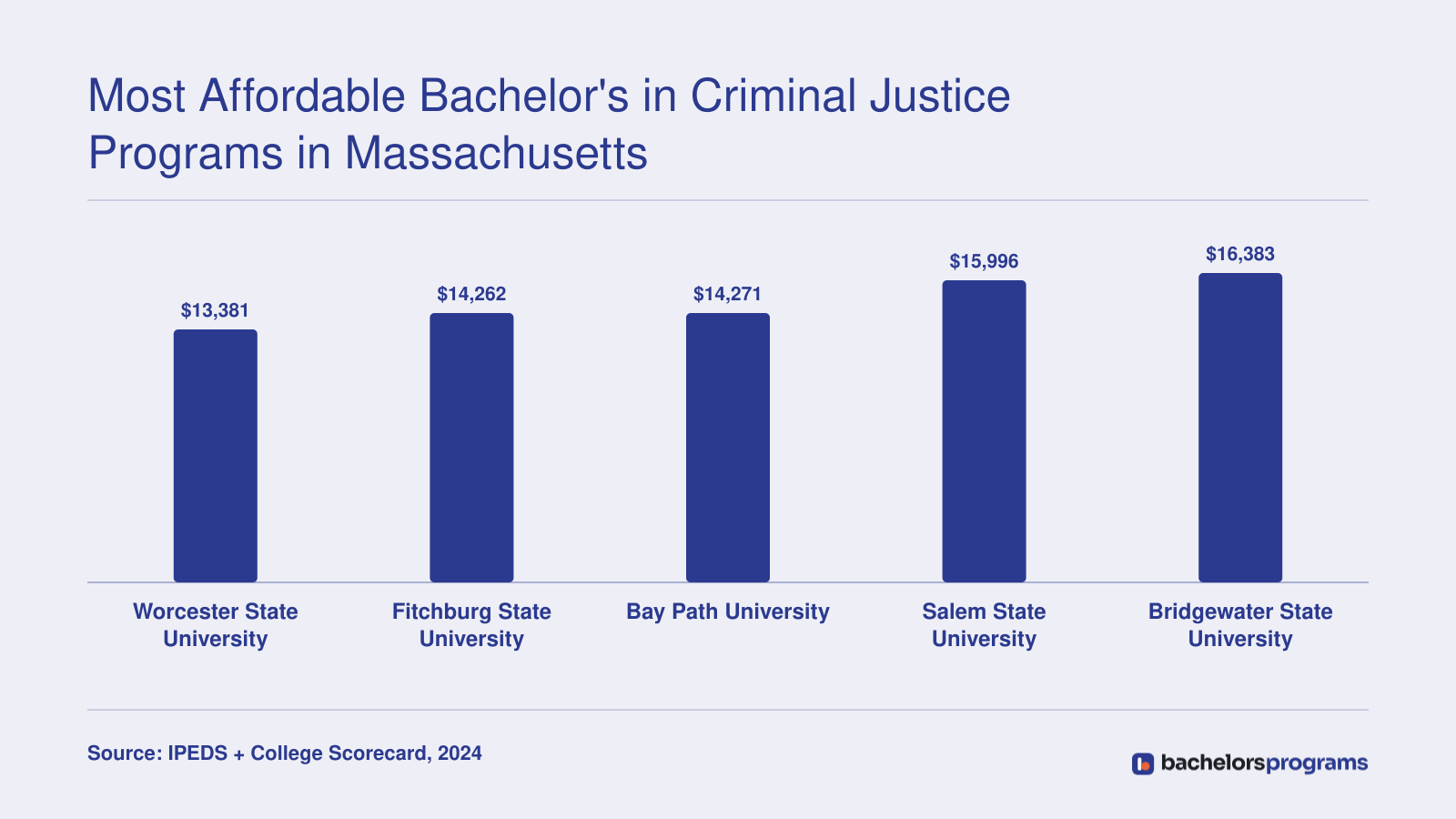
Worcester State University has the lowest average net price after aid here at $13,381 a year, followed by public Fitchburg State University at $14,262, with Salem State University ($15,996) and Bridgewater State University ($16,383) close behind. Private Bay Path University lists $38,302 in tuition and fees but averages $14,271 after grants and scholarships, within $900 of Worcester State. Net price is an approximate average across aided students, so your own cost depends on household income and aid; see the cost section below for Massachusetts state grant and scholarship programs.
Highest-Earning Graduates: Bachelor's in Criminal Justice Programs by Earnings
These figures come from the U.S. Department of Education's College Scorecard (2024) and reflect graduates of each school's criminal justice bachelor's program, not the school as a whole. Fisher College posts the highest median four years after finishing ($80,136), and Northeastern University, one of the schools ranked here, follows at $77,477 four years out and $75,101 five years out. Springfield College and Endicott College, both in our directory, show the steepest climbs, with medians rising from about $39,000 to $41,000 one year after graduation to roughly $68,000 to $74,000 five years out. Median debt runs from about $21,000 to $27,000 across these programs, with monthly payments of $221 to $286.
| School | Location | Median Earnings 1 Year After Graduation | Median Earnings 4 Years After Graduation | Median Earnings 5 Years After Graduation | Median Debt at Graduation | Estimated Monthly Payment |
|---|---|---|---|---|---|---|
| Fisher College | Boston, MA | $45,695 | $80,136 | Not reported | $26,500 | $281 |
| Northeastern University | Boston, MA | $51,363 | $77,477 | $75,101 | $20,889 | $221 |
| Springfield College | Springfield, MA | $41,441 | $60,494 | $73,997 | $24,250 | $257 |
| Endicott College | Beverly, MA | $38,900 | $58,605 | $68,314 | $27,000 | $286 |
Online and Hybrid Bachelor's in Criminal Justice Options at Massachusetts Schools
Can you complete a bachelor's degree in criminal justice at a Massachusetts school without commuting to campus?
Several of the programs ranked here are listed as offering both campus and online or hybrid formats. Boston College's Criminal and Social Justice program, the UMass-Lowell Bachelor of Science in Criminal Justice, and Salem State's Criminal Justice program each appear that way in their program information. The UMass-Lowell and Salem State pages also describe a fully online option and part-time study, which matters if you plan to work while you finish the degree.
Comparing the net prices
Net price after aid runs about $17,163 at UMass-Lowell for in-state students and $15,996 at Salem State, against $41,704 at Boston College. Those are school-wide averages rather than online-only rates, so ask the program directly whether distance students pay the same tuition and fees as campus students.
What to Confirm Before You Apply
- Delivery style: ask whether courses run asynchronously or meet at scheduled times, and whether the online track follows the same term calendar as the campus program.
- Pace: check that part-time enrollment is permitted in the online format and how long completion usually takes.
- Transfer credit: ask how each school evaluates previously earned credits and community college coursework.
Ask the program about format before you apply, since delivery details change from year to year.
Questions to Ask Yourself
Do you need to keep working or stay in your Massachusetts community while you study?
Could you start at a community college and use MassTransfer to lower your bachelor's cost?
Are you aiming for a police academy path, or a court, probation, or advocacy role?
What Massachusetts Criminal Justice Jobs Pay
Pay in Massachusetts criminal justice is set agency by agency, through municipal contracts and state budget cycles, so no single number describes the field. That is also why this section cannot give you current statewide wage and employment figures for the roles below; the Bureau of Labor Statistics is where the real numbers live.
Start with the federal tables
- OEWS state tables: Open BLS.gov and pull the Occupational Employment and Wage Statistics Massachusetts state page. Look up annual median wage and employment for police and sheriff's patrol officers, probation officers and correctional treatment specialists, correctional officers and jailers, and paralegals.
- OEWS caveats: Those wages are straight-time gross pay. Overtime, shift differentials, bonuses, and benefits sit outside the figure, and annual amounts assume a 2,080-hour year.
Then check the outlook
Use the Occupational Outlook Handbook entry for each occupation to see national growth projections for the 2025-2035 window. Read the outlook alongside the Massachusetts OEWS numbers rather than treating either source as the final word; one describes national direction, the other describes local pay.
Verify it locally
- School program pages: Criminal justice, paralegal, corrections, and police academy pages often post salary references, hiring notices, and program outcomes.
- Professional associations: The Massachusetts Police Chiefs Association, plus state and local paralegal and corrections associations, publish job listings and pay context.
- Employers and advisors: Ask a department recruiter or program advisor directly. Pay moves with agency, region, experience, and shift assignment, so a conversation beats waiting for a static table.
Related Articles
Massachusetts Criminal Justice School Questions, Answered
These answers draw on the program details and cost figures covered throughout this guide. Confirm current numbers with each school before you apply.
How much does a criminal justice degree cost in Massachusetts?
Which criminal justice programs in Massachusetts are accredited?
Which Massachusetts schools offer an online bachelor's degree in criminal justice?
What is the best college for criminal justice in Massachusetts?
What can you do with a bachelor's degree in criminal justice in Massachusetts?
Compare Criminal Justice programs on the data that matters
Explore more Criminal Justice & Law majors or browse every field of study.
All Criminal Justice & Law programs Browse every field of study