Best Criminology Schools in New York
Compare 18 accredited Criminology programs in New York, with net price after aid, graduation rates, earnings and debt from IPEDS and the U.S. College Scorecard.

A bachelor's degree in criminology at CUNY John Jay College of Criminal Justice is a Bachelor of Arts, while SUNY Old Westbury awards a Bachelor of Science (B.S.). Schools in New York use either a B.A. or a B.S. in Criminology, and some house the subject inside sociology or criminal justice titles.
The schools ranked here are New York-based and offer bachelor's programs only, on campus or online. Cost, earnings, admissions rules and program labels vary widely between public and private options. Several schools here fold criminology into a broader major.
In practice, public-sector hiring in New York turns on civil service exams and agency standards more than on the name printed on the diploma.
Key Points
- John Jay awards more criminology bachelor's degrees than any other school here.
- Some private schools here publish tuition above $40,000; compare net price instead.
- Criminology isn't licensed in New York; peace officers need formal appointment.
Best Criminology Schools in New York: Our Ranked List
Ten New York colleges award a bachelor's degree in criminology, and they range from a Manhattan justice college with one of the lowest net prices in the state to private universities with published tuition above $40,000. School-wide graduation rates across these ten run from about 45% to 75%, a reminder that the school and the major are two different things to evaluate. Each entry below covers what the program requires and the kind of student it fits.
CUNY John Jay College of Criminal Justice
#1New York, NY · ~$3,200/yr (est.)
Best for: New York City commuters targeting public-service careers
CUNY John Jay College of Criminal Justice is a public senior college in Manhattan built around criminal justice, forensic science and public service, which makes it the most direct route into New York City's justice agencies. The criminology major sits in the Department of Sociology and draws on other social sciences and the humanities to study crimes, offenders, victims and the policies aimed at them. The college also enrolls working NYPD, Department of Correction, FDNY and in-service students, so classmates often already hold jobs in the field. Its school-wide graduation rate is about 56%.
- Bachelor of Arts major in the Department of Sociology
- Covers crimes, criminals and crime victims
- Examines theories of illegal and deviant behavior
- Weighs the effectiveness of anti-crime policies
- One of 31 undergraduate majors at the college
- Prepares students for graduate and professional school
University at Buffalo
#2Buffalo, NY · $20,000 – $25,000/yr (est.)
Best for: Policy and justice-reform focused undergraduates
The University at Buffalo is the largest campus in the SUNY system and a major research university, so criminology majors study alongside faculty working at graduate level. The BA is housed in the Department of Sociology and Criminology and treats crime as a social problem shaped by power, inequality and institutional practice. Students who want a large-campus research environment and a path toward graduate study in sociology, law or policy fit well here. The school-wide graduation rate is about 75%.
- Major in the Department of Sociology and Criminology
- Critical look at criminal justice institutions
- Examines racism, sexism and classism in justice systems
- Evidence-based study of crime causes and behavior
- Prepares for law enforcement, policy analysis and reform work
- Also prepares students for graduate study across disciplines
Niagara University
#3Niagara University, NY · ~$17,000/yr (est.)
Best for: Western New Yorkers wanting a small private college
Niagara University is a private Catholic university just north of Niagara Falls, and its criminology and criminal justice program is built as a fixed sequence rather than a choose-your-own menu. The BS runs through Introduction to Criminal Justice, Criminology, Law Enforcement, Juvenile Justice, Principles of Justice, Corrections, Criminal Law and Victimology before a policy research seminar. Students who want predictability in what they take each term, rather than a wide elective menu, get that here. The school-wide graduation rate is about 75%.
- Bachelor of Science in Criminology and Criminal Justice
- Eight required 3-credit courses from introductory justice to victimology
- 3-credit Criminology Research course required
- 9 credits of 300-level criminal justice electives
- Closes with CRJ 490 Policy Research Seminar
State University of New York at Cortland
#4Cortland, NY · $20,000 – $25,000/yr (est.)
SUNY Cortland is a public university in central New York where criminology is one of the most popular majors on campus. The BA requires 120 credit hours and pairs a liberal arts core with options in forensics, computer crime investigation, law, counseling or social work. Internships with police, probation and child services agencies, plus an exchange program with Griffith University in Australia, give students applied and international options. The school-wide graduation rate is about 68%.
- 120 credit hours required
- Combines criminology with a broad liberal arts education
- Can pair with forensics, computer crime investigation or law
- Internships with police, probation and child services agencies
- Exchange program with Griffith University in Australia
- Hosts Alpha Phi Sigma criminology honor society
Le Moyne College
#5Syracuse, NY · ~$22,000/yr (est.)
Le Moyne College is a private Jesuit college in Syracuse, and its criminology program leans on multidisciplinary and intersectional approaches to crime, criminality and justice. Coursework reaches into criminal investigation, corrections, law, psychology, race and ethnic relations, family violence, gangs and deviance, with a minor available alongside the major. Internships and personalized career guidance are part of the package, and the college reports that 96% of its graduates are employed or in graduate school within six months. The school-wide graduation rate is about 73%.
- Bachelor of Arts in criminology plus a criminology minor
- Covers criminal investigation, corrections and criminal law
- Topics include gangs, family violence and race relations
- Multidisciplinary and intersectional approach to crime
- Internships and personalized career guidance
- Grounded in Jesuit values
SUNY Old Westbury
#6Old Westbury, NY · $11,000/yr (est. net price)
SUNY Old Westbury is a public liberal arts college on Long Island with a criminology BS that puts research methods and a thesis at the center of the degree. The major requires 40 credits inside a 120-credit degree, including 16 credits of theory and methods and a senior seminar built around an original primary research project. The college's school-wide graduation rate is about 45%, the lowest on this list, so students who thrive with self-direction and a close faculty advisor relationship do best. Its net price after aid is also among the lowest here.
- 120 credits total, including 40 in the major
- At least 60 credits of liberal arts required
- 16 credits of research methods and theory
- Electives include Juvenile Delinquency and Victimology
- 4-credit Senior Seminar built on an original research thesis
- 2.0 GPA in the major; C- minimum in each major course
St. John Fisher University
#7Rochester, NY · ~$29,000/yr (est.)
St. John Fisher University is a private university in Rochester with a compact 39-credit criminology and criminal justice major that leaves room for a second major or a minor. Required courses cover prison, contemporary policing, criminal law, criminological theory, race, class and crime, and social research design. A capstone can be met through an internship, and psychology, legal studies and political science are the suggested pairings. The school-wide graduation rate is about 74%.
- 39 credit hours in the major
- 21 credits of required courses
- 15 credits of advanced coursework, at least 9 of them in criminology
- Capstone met through an internship or the capstone course
- Suggested double majors: psychology, legal studies, political science
- Course substitutions need written approval from the division chair
St Bonaventure University
#8Saint Bonaventure, NY · $27,000/yr (est. net price)
St. Bonaventure University is a private Franciscan university in rural southwestern New York with a criminology BA that emphasizes theory, causation and rehabilitation. The program examines how family, peers, social structure and personality traits influence offenders, how victimization is studied through social and personal factors, and where the criminal justice system succeeds and falls short. A criminology minor is open to non-majors, and a published four-year plan makes the sequence easy to map. The school-wide graduation rate is about 67%.
- Bachelor of Arts through the Department of Sociology and Criminology
- Studies theoretical perspectives and the causes of crime
- Examines family, peers and social structure as influences on offenders
- Assesses strengths and weaknesses of the criminal justice system
- Criminology minor offered for non-majors
- Four-year degree plan published
Mount Saint Mary College
#9Newburgh, NY · ~$26,000/yr (est.)
Mount Saint Mary College is a private college in Newburgh, in the Hudson Valley, and its criminology BA is organized around five concentrations rather than a single track. Students choose from General Criminology, Criminal Justice System, Juvenile Justice, Restorative Justice, and Mental Health and Crime, begin major courses in freshman year and finish with a capstone. Internships are encouraged, with placements including the New York State Police and Orange County Probation and Parole. The school-wide graduation rate is about 65%.
- 45 credits across four years
- Five concentrations, including Juvenile Justice and Restorative Justice
- Major coursework begins in freshman year
- Senior capstone project required
- Internships encouraged, including with New York State Police
- Chi Rho Iota criminology honor society
Manhattan University
#10Riverdale, NY · $27,000/yr (est. net price)
Manhattan University is a private Catholic university in Riverdale, in the Bronx, close to New York City courts and justice agencies. The criminology BA draws on sociology, psychology, anthropology, economics, statistics and law, with named courses such as Crime Mapping, Mass Incarceration and Collateral Consequences, and Criminal Justice Ethics. Every major completes an original-research capstone, tuition is locked for all four years under the university's guarantee, and more than 90% of students receive financial aid. The school-wide graduation rate is about 64%.
- 120 credit hours over four years
- Draws on sociology, psychology, economics, statistics and law
- Courses include Crime Mapping and Mass Incarceration
- Original-research capstone required of every major
- Faculty-supervised internship at a local social service agency
- 15-credit criminology minor available
- Tuition locked for all four years
Cost & outcomes by school
Federal data for the highest-earning Criminology programs, independent of the ranking above. Earnings are this field's bachelor's graduates four years after completing where the Scorecard reports them, else the school's undergraduate median.
| School | Net price / yr | Grad rate | Earnings | Debt | Grads/yr | Format |
|---|---|---|---|---|---|---|
| Manhattan University NY | $27,256 | 64% | $86,316 | $26,000 | 13 | Campus |
| Marist University NY | $41,544 | 80% | $77,819 | $25,000 | — | Campus |
| University at Buffalo NY | $20,995 | 75% | $70,814 | $19,000 | 113 | Campus |
| Mount Saint Mary College NY | $25,522 | 66% | $67,705 | $26,007 | 14 | Campus |
| Le Moyne College NY | $22,277 | 73% | $65,956 | $27,000 | 20 | Campus |
| University of Mount Saint Vincent NY | $21,696 | 57% | $65,756 | $25,000 | — | Campus |
| Niagara University NY | $17,248 | 75% | $60,995 | $26,997 | 48 | Campus |
| Hofstra University NY | $34,176 | 69% | $60,697 | $25,250 | 39 | Campus |
| St. John Fisher University NY | $28,945 | 74% | $60,481 | $23,188 | 21 | Campus |
| SUNY Oneonta NY | $19,158 | 69% | $60,386 | $19,812 | — | Campus |
| State University of New York at New Paltz NY | $18,809 | 72% | $58,073 | $18,750 | — | Campus |
| CUNY John Jay College of Criminal Justice NY | $3,203 | 56% | $57,396 | $8,600 | 227 | Campus |
Sources: U.S. Department of Education. Net price, graduation rate, earnings and debt: College Scorecard (earnings and debt for this field's bachelor's graduates where reported, else school-wide); graduates: IPEDS. A dash means no figure is reported.
Cost, debt & payoff
Median earnings of this field's bachelor's graduates (4 yrs after completing, else the school's undergraduate median) vs. their median federal loan debt · U.S. College Scorecard
Across these programs the median graduate earns about $60,434 and finishes with roughly $21,594 in debt — a ratio that clears a common rule of thumb (keep debt below first-year salary). Net price and debt vary widely school to school, so check the per-school figures in the table above before you shortlist.
How We Ranked Bachelor's in Criminology Programs in New York
What does a ranking of criminology programs in New York actually measure? It covers bachelor's programs only, offered on campus or online, at schools based in New York. Graduate study is outside its scope.
The figures come from the federal College Scorecard and IPEDS, the U.S. Department of Education's postsecondary data system. Together they supply net price, graduation rate, earnings and debt for each school.
What the ranking weighs
- Net price: What students pay once grants and scholarships are subtracted, which usually matters more than sticker tuition.
- Graduation rate: The share of students who finish, a signal of how well a school supports its learners.
- Earnings: Typical pay for graduates a few years after they leave.
- Debt: Typical borrowing, which shows what a degree may cost over time.
Limits of the data
The graduation rate and net price describe each institution as a whole, not its criminology program. A school with a strong overall rate may see a different result inside one major. Several programs here also sit within sociology departments, so earnings and debt describe a school's graduates broadly rather than criminology majors alone.
Use the ranking to narrow your list, then confirm program details and current costs with each school's admissions office.
Most Affordable Bachelor's in Criminology Programs in New York
Sticker price is the published tuition and fees. Net price is what students actually paid on average after federal, state and institutional grants and scholarships were subtracted, so it is the better guide to your real cost. The figures below come from IPEDS and the College Scorecard (U.S. Department of Education, 2024 release). John Jay College of Criminal Justice posts the lowest average net price at $3,203 a year, and its criminology graduates also carry the lightest program-level debt shown.
| School | Location | Program | Format | In-State Tuition and Fees (per year) | Average Net Price After Aid (per year) | Median Debt, All Graduates | Median Debt, Criminology Program Graduates |
|---|---|---|---|---|---|---|---|
| CUNY John Jay College of Criminal Justice | New York, NY | Criminology (BA) | Campus | $7,470 | $3,203 | $11,000 | $8,600 |
| College of Staten Island CUNY | Staten Island, NY | Sociology/Anthropology BA (Critical Criminology and Social Justice concentration) | Campus | $7,490 | $5,579 | $14,350 | N/A |
| SUNY Old Westbury | Old Westbury, NY | Criminology, B.S. | Campus | $8,422 | $11,282 | $14,997 | $15,517 |
| Empire State University | Saratoga Springs, NY | B.A. or B.S. in Sociology (Criminology concentration) | Online | $7,648 | $11,676 | $18,730 | N/A |
| SUNY College of Technology at Canton | Canton, NY | Forensic Criminology | Campus and online | $8,742 | $15,268 | $20,000 | N/A |
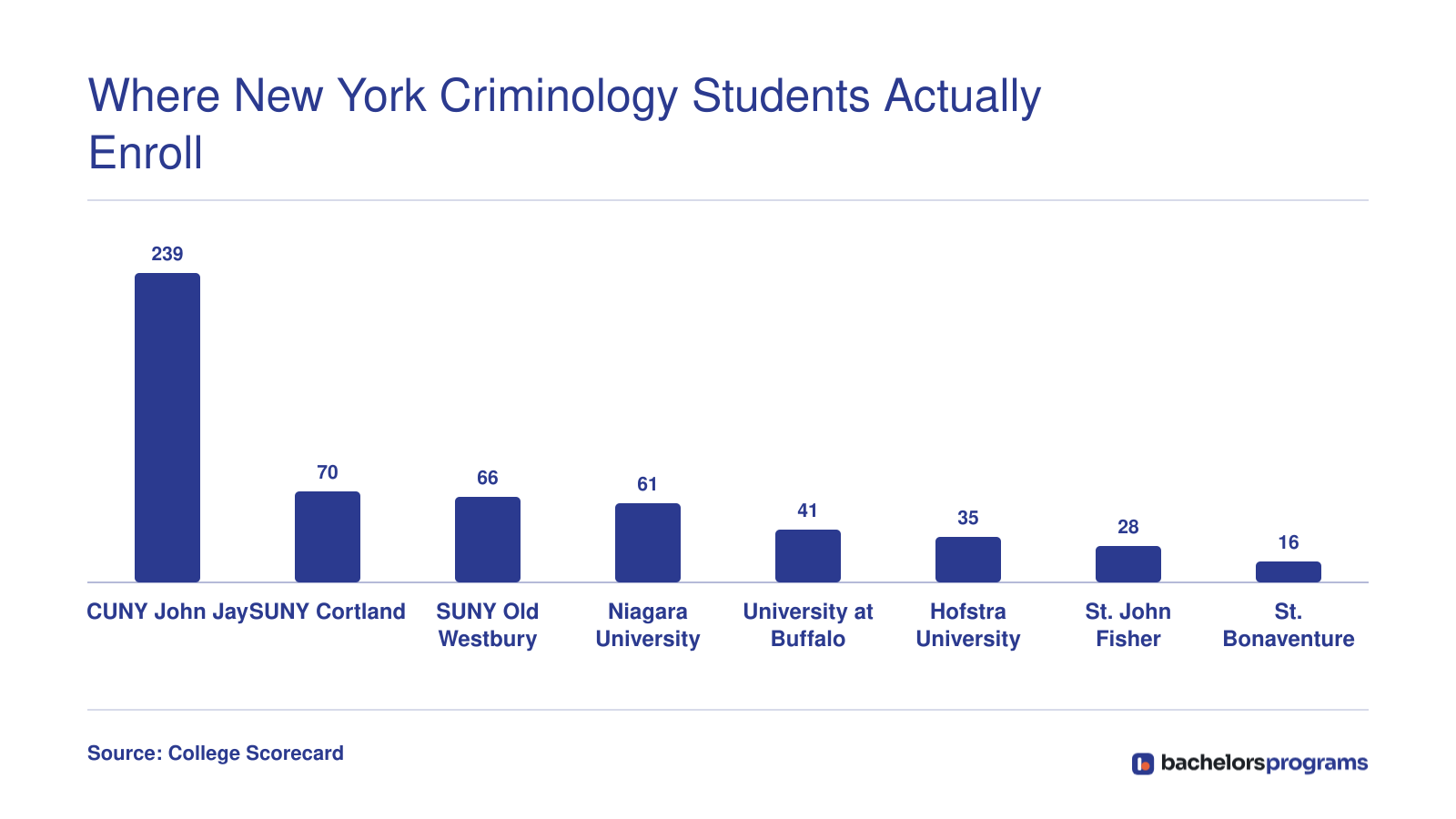
Where New York Criminology Students Actually Enroll
Program size shows how established a criminology major is. In the most recent federal reporting year, CUNY John Jay College of Criminal Justice awarded far more bachelor's degrees in criminology than any other school shown, while SUNY Cortland, SUNY Old Westbury and Niagara University form a mid-size group. Larger programs usually offer more elective variety and bigger alumni networks across New York agencies, but a smaller department can mean closer advising, so treat size as a sign of maturity, not of fit.
Bachelor's Degree in Criminology vs. Criminal Justice: Which Fits You?
A criminology degree and a criminal justice degree can lead to the same job posting, but they are built differently. Criminology tends to study crime as a social phenomenon: why it happens, who is affected, and how systems respond. Criminal justice tends to study the institutions themselves: policing, courts, and corrections, and how they operate day to day.
Compare the programs yourself
Start at the source. Search "[school name] criminology bachelor's degree" and "[school name] criminal justice bachelor's degree" for schools like John Jay College, Hofstra University, and Le Moyne College, then open the official program pages side by side. Compare three things: the degree title (B.A. or B.S.), the required core courses, and any listed concentrations or tracks.
Ask the department directly
A short email to admissions or a faculty contact gets answers a brochure will not. Ask how the school distinguishes criminology from criminal justice, whether the degree is a B.A. or B.S., which courses are required versus elective, and what concentrations exist. Request a sample four-year plan or program sheet so you can see the sequencing.
Build a decision checklist
- Degree title: Note whether the credential is a B.A. or B.S.
- Core requirements: Compare research and methods courses against justice-system practice courses.
- Concentration options: Check whether a track aligns with your interests.
- Fieldwork: Confirm internship or practicum requirements.
For outside context, read the U.S. Bureau of Labor Statistics Occupational Outlook Handbook entries for criminologists and law enforcement occupations, and see how the American Society of Criminology and the Academy of Criminal Justice Sciences describe the fields. Then match what you find to your career or graduate school goals.
A B.A. and a B.S. are not the same signal
At many New York schools, the B.A. leans toward social science breadth and the B.S. toward research methods and statistics. Neither is automatically stronger. The one that fits is the one whose required courses and fieldwork move you toward the job or graduate program you want.
Related Articles
Online and Hybrid Bachelor's in Criminology Options at New York Schools
Can you complete a [[LINK:1|criminology bachelor's degree fully online]] from a New York school? Yes, though most online options are criminal justice or criminology-adjacent programs rather than a degree titled Criminology. Check each program page before you apply, because titles and delivery formats differ.
## Fully online
- **SUNY College of Technology at Canton:** Its Bachelor of Science in Forensic Criminology is listed as 100% online.[[CITE:1]] - **Empire State University:** Its Bachelor of Science in Criminal Justice is listed as 100% online through SUNY Online.[[CITE:1]]
Other New York schools outside this ranking also advertise [[LINK:2|online criminal justice bachelor's degrees]].
## Online completion and campus formats
John Jay College offers an online completion route for its Bachelor of Science in Criminal Justice. It is a narrower route than a fully online degree: entry takes an associate degree or at least 55 credits plus the required prerequisites. The last two years can then be finished online, and almost all courses are asynchronous.
Manhattan University's Criminology B.A. is a 120-credit, four-year program on its Riverdale campus. The program page does not identify an online or hybrid version, so treat it as a campus program.
The other ranked schools (University at Buffalo, Niagara University, SUNY Cortland, Le Moyne College, SUNY Old Westbury, St. John Fisher University, St Bonaventure University and Mount Saint Mary College) deliver their criminology programs on campus.
## What we could not confirm
We could not confirm the delivery format for Hofstra University, SUNY New Paltz, SUNY Oneonta, College of Staten Island, Marist University or the University of Mount Saint Vincent. Ask admissions before assuming either way.
The program pages we reviewed do not establish a separate residency rule or required in-person credits for the online options. A page that is silent on the point does not prove no requirement exists, so confirm any internship, synchronous session or campus visit with the school.
Admission Requirements for New York Criminology Bachelor's Programs
Admissions rules in New York are shifting at the edges, with test requirements relaxed and transfer grade floors lowered. John Jay College of Criminal Justice (CUNY) shows both trends clearly.
GPA and Test Policy
John Jay is test-optional for Fall 2023 through Spring 2027. Decisions rest mainly on high-school GPA, course grades and the rigor of the courses taken. Its admissions FAQ sets no single minimum first-year GPA and points applicants to its published Freshman Admission Profile for the average admitted GPA. Applicants must also show CUNY college readiness in reading, writing and math.
For Hofstra and Le Moyne, we could not confirm a current minimum GPA, test policy or transfer-credit rule, so treat those as unverified and read their admissions pages before you apply.
Transfer Pathways
John Jay publishes detailed transfer rules. Applicants with fewer than 24 college credits must also meet high-school academic average and unit requirements, and every transfer student must meet CUNY readiness in English and math.
Credit grade floors have changed. Coursework from other CUNY colleges transfers with a D- or higher. For outside colleges, a D- or higher is accepted effective Fall 2026, replacing an earlier C-or-higher rule. One John Jay advanced-standing page still lists C or better for accredited outside institutions, so get the rule that applies to you confirmed in writing.
Transferred credits count toward the 120 needed to graduate, but residency rules apply:
- Residency: At least 30 credits must be earned at John Jay, including at least 50% of the major's credits.
- Non-college learning: Up to 45 credits can come from verified college-level learning outside college, such as law-enforcement or fire academies, military training and standardized tests.
That allowance matters for working officers and veterans who return for a criminology bachelor's degree.
Practical Tips
- Ask each school early whether criminology has its own prerequisites or a higher GPA expectation than general admission.
- Request a written credit evaluation before you commit, and check the residency and external-credit caps so no earned credits are lost.
- Confirm which catalog year and transfer date apply to you, since rules like John Jay's Fall 2026 grade change depend on when you transfer.
New York Licensing and Civil Service Rules for Criminology-Related Careers
Compare Criminology programs on the data that matters
Explore more Criminal Justice & Law majors or browse every field of study.
All Criminal Justice & Law programs Browse every field of study