Best Cybercrime Degree Programs
Compare 20+ accredited Cybercrime programs, with net price after aid, graduation rates, earnings and debt from IPEDS and the U.S. College Scorecard.

A bachelor's degree in cybercrime teaches students to investigate digital offenses: how intrusions happen, how evidence is preserved, and how cases reach court. Many programs sit between criminal justice and computing, so schools label similar coursework cyber criminology, fraud investigation, or digital forensics. Net price after aid at the schools ranked here ranges from $11,297 at Florida State University to $32,568 at the University of Scranton, a $21,000 gap for degrees leading to the same job titles.
Employers rarely check the label. They check tools, certifications, and internships.
Key Points
- Florida State's Cyber Criminology program reports the strongest program-level earnings here.
- Median debt: $12,000 at Vincennes, $24,500 at Kent State regional campuses.
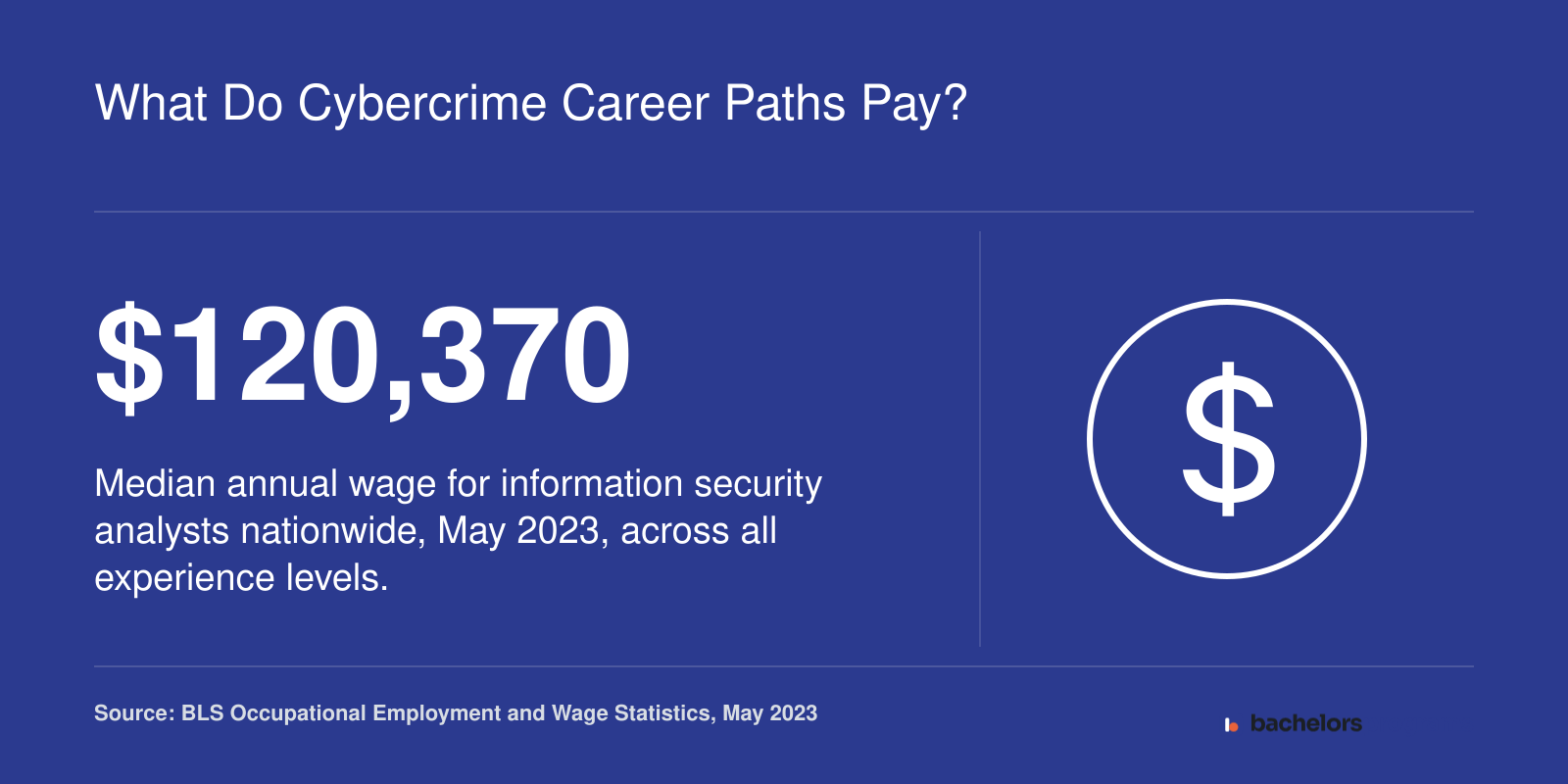
- Information security analysts earned a $120,370 median wage in May 2023.
Best Bachelor's Degree in Cybercrime Programs for 2027
These ten programs are ordered by our composite ranking, and the methodology section further down explains how those scores are built. Each card gives the average net price after aid, the share of students the school graduates, its admission rate, the format and the concentration, with program-level earnings and debt shown only where the data supports them.
Florida State University
#1Tallahassee, FL · ~$11,000/yr (est.)
Best for: Students pairing criminology with computer science
Florida State University is a large public research university in Tallahassee whose cyber criminology degree sits at the intersection of criminal justice and computing. The program adds a computer science concentration, two capstone courses and prerequisites in programming and calculus, so graduates leave with both investigative and technical footing. FSU also runs a cybersecurity partnership with ReliaQuest that brings hands-on labs, mentoring and research opportunities to students in the field. This is a campus-based option with a selective admission process.
- 120 total credit hours with a 2.0 GPA minimum
- Two capstone courses focused on cybercrime detection
- Interdisciplinary blend of criminology and computer science
- Computer programming and calculus prerequisites required
- Face-to-face instruction in Tallahassee only
- Foreign language proficiency may be required
- Prepares graduates for information crime and network security roles
Kennesaw State University
#2Kennesaw, GA · ~$15,000/yr (est.)
Best for: Georgia students wanting three security tracks
Kennesaw State University is a large public university in the Atlanta metro whose cybersecurity degree is housed in the Coles College of Business. Students choose among Systems Security, Network Security and a Cyber Crime track, and there is no separate entrance exam beyond admission to the university. Double Owl Pathways let undergraduates begin master's work in cybersecurity, information technology or software engineering, and a minor and certificate serve students in other majors.
- Three tracks: Systems Security, Network Security and Cyber Crime
- Housed in the Coles College of Business
- No entrance exam; university admission is the only requirement
- Two four-credit laboratory sciences required
- Double Owl Pathways to master's degrees in cybersecurity and IT
- Cybersecurity minor and certificate offered separately
- Four-year program map and recommended course sequence provided
Washburn University
#3Topeka, KS · ~$15,000/yr (est.)
Best for: Kansas learners drawn to forensic lab work
Washburn University is a public institution in Topeka that pairs computer information science with forensic science coursework. Its cybersecurity and digital forensics concentration requires Digital Forensics I and II plus a capstone, and the university partners with the Kansas Bureau of Investigations Forensic Science Center so students see how computer science fits into live criminal investigations. The major sits inside a 120-credit bachelor's degree with a comparatively small campus footprint.
- 43 hours of computer information science coursework
- Digital Forensics I and II plus Ethical Hacking or Security Governance
- Capstone project required for the concentration
- 21 to 23 outside hours include forensic science and legal issues in cybersecurity
- Partnership with the Kansas Bureau of Investigations Forensic Science Center
- Major totals 64 to 66 hours inside a 120-credit degree
- Statistics, calculus and symbolic logic required
York College of Pennsylvania
#4York, PA · $15,000 – $20,000/yr (est.)
York College of Pennsylvania is a private college in York with a criminology and criminal justice department that offers a cybercrime concentration. Every student completes an internship before graduating, and faculty-supervised research is available for those who want it. Graduates move into agencies such as Homeland Security and the FBI as well as private employers, and a Pre-Law Society supports students aiming at law school.
- Internship required before graduation
- Internship eligibility: 60 credit hours and a 2.5 GPA
- Faculty-supervised research projects available
- Pre-Law Society for students headed to law school
- Employers include Homeland Security, the FBI and Lockheed Martin
- Accredited by the Middle States Commission on Higher Education
- Four-year, on-campus program
Utica University
#5Utica, NY · $15,000 – $20,000/yr (est.)
Utica University is a private university in central New York whose cybersecurity bachelor's degree is delivered fully online. The cybercrime and fraud investigation specialization covers economic crime theory, white-collar criminology, payment systems and fraud detection technology, and students work in a cyber range with ransomware simulations. Utica holds a National Center of Academic Excellence in Cyber Defense designation and is a CompTIA academic partner, though the online program enrolls New York state residents only.
- Three specializations including Cybercrime and Fraud Investigation
- 120 credits across four years, with a part-time option
- Fully online delivery
- Cyber range with ransomware simulations
- CompTIA academic partner; preparation for A+, Security+ and Network+
- National Center of Academic Excellence in Cyber Defense
- Transfer up to 98 credits
- Open only to New York state residents
University of Scranton
#6Scranton, PA · $33,000/yr (est. net price)
The University of Scranton is a private Jesuit university in northeastern Pennsylvania with a dedicated cybercrime and homeland security major. Coursework blends digital forensics, cybersecurity management and threat analysis, and students finish with a senior internship or independent study. Small classes and two campus centers, the Center for Analysis and Prevention of Crime and the Cyber-Forensics and Cybersecurity Lab, give students research and hands-on access. The Jesuit foundation adds an emphasis on ethics and social justice.
- 123 total credit hours
- Senior-year internship or independent study
- Coursework in digital forensics and cybersecurity management
- Access to the Cyber-Forensics and Cybersecurity Lab
- Center for Analysis and Prevention of Crime research opportunities
- Small class sizes with a Jesuit ethics and social justice focus
- Prepares for national security analyst and forensic investigator roles
Thomas College
#7Waterville, ME · $19,000/yr (est. net price)
Thomas College is a small private college in Waterville, Maine, that approaches cybercrime through criminal justice rather than engineering. The cybersecurity concentration teaches students to investigate cybercrimes, gather admissible digital evidence and work with technology law, and the degree can be finished in three years. Internships and leadership development are built into the curriculum, and graduates move into law enforcement, homeland security and corporate safety roles.
- 121 total credit hours
- Three-year completion option available
- Coursework in Computer Forensics, Security Essentials and Data Communications
- Internships built into the curriculum
- Leadership development included
- Managerial Risk Analysis and Decision Making course
- Careers in law enforcement, homeland security and defense
Old Dominion University
#8Norfolk, VA · $13,000 – $34,000/yr (est.)
Old Dominion University is a public research university in Norfolk, Virginia, that built its cybercrime major as an interdisciplinary program drawing on criminology, cybersecurity and information technology. Students can double major in cybersecurity, IT or criminal justice and earn credit through internships, with classes offered online and on campus. The university has announced that the cybercrime program is no longer accepting new students, so prospective applicants should confirm current options before applying.
- Interdisciplinary blend of criminology, cybersecurity and IT
- Double major option in cybersecurity, IT or criminal justice
- For-credit internships available
- Courses in Java and C++ programming
- Online and on-campus delivery
- Military benefits accepted, with an active duty tuition rate
- Program is no longer accepting new students
Bay Path University
#9Longmeadow, MA · $14,000/yr (est. net price)
Bay Path University is a private university in Longmeadow, Massachusetts, offering its cybersecurity degree fully online in accelerated seven-week terms. The digital forensics and incident response concentration assumes no prior IT background and covers forensic acquisition, mobile forensics, network intrusion analysis and insider threat detection. Students can add a 15-credit certificate or a second major, and the university holds a National Center of Academic Excellence in Cyber Defense designation through 2027.
- 120 total credits, fully online and asynchronous
- Accelerated seven-week terms
- No IT or computer science background required
- 15-credit Digital Forensics and Incident Response certificate option
- Double major available
- National Center of Academic Excellence in Cyber Defense through 2027
- Labs in forensic acquisition, mobile forensics and intrusion analysis
- Accredited by NECHE
University of Colorado Colorado Springs
#10Colorado Springs, CO · $10,000 – $24,000/yr (est.)
The University of Colorado Colorado Springs is a public university whose criminal justice department offers a cybercrime and cybersecurity concentration within a liberal arts framework. The concentration covers cybercrime investigation, cybersecurity law, cybervictimization and high-tech forensics, with an internship option for students who lack prior work experience. Students may double major in psychology or sociology, and the degree requires a C or better in major courses.
- 12-credit concentration inside a 120-credit degree
- Coursework in cybercrime investigation, cybersecurity law and high-tech forensics
- Internship option for students without prior work experience
- Double majors with Psychology or Sociology available
- Grade of C or better required in major courses
- 45 upper-division credit hours required
- One of five concentration options in the Criminal Justice BA
Cost & outcomes by school
Federal data for the highest-earning Cybercrime programs, independent of the ranking above. Earnings are this field's bachelor's graduates four years after completing where the Scorecard reports them, else the school's undergraduate median.
| School | Net price / yr | Grad rate | Earnings | Debt | Grads/yr | Format |
|---|---|---|---|---|---|---|
| Florida State University FL | $11,297 | 86% | $93,841 | $18,750 | 45 | Campus |
| University of Scranton PA | $32,568 | 80% | $74,652 | $27,000 | 11 | Campus |
| Utica University NY | $19,108 | 56% | $63,277 | $22,500 | — | Online |
| University of Baltimore MD | $13,868 | 38% | $61,335 | $23,250 | 22 | Hybrid |
| York College of Pennsylvania PA | $18,556 | 64% | $61,012 | $26,000 | 3 | Campus |
| Kennesaw State University GA | $15,048 | 52% | $57,552 | $23,833 | 156 | Campus |
| Kean University NJ | $12,447 | 47% | $57,237 | $23,250 | — | Campus |
| Bay Path University MA | $14,271 | 44% | $56,262 | $27,000 | 10 | Online |
| Old Dominion University VA | $14,638 | 46% | $54,914 | $24,000 | — | Hybrid |
| University of Colorado Colorado Springs CO | $15,788 | 47% | $54,659 | $20,000 | — | Campus |
| Georgian Court University NJ | $19,285 | 54% | $53,096 | $21,816 | — | Hybrid |
| Minnesota State University Moorhead MN | $17,997 | 57% | $50,527 | $20,000 | — | Campus |
Sources: U.S. Department of Education. Net price, graduation rate, earnings and debt: College Scorecard (earnings and debt for this field's bachelor's graduates where reported, else school-wide); graduates: IPEDS. A dash means no figure is reported.
Cost, debt & payoff
Median earnings of this field's bachelor's graduates (4 yrs after completing, else the school's undergraduate median) vs. their median federal loan debt · U.S. College Scorecard
Across these programs the median graduate earns about $47,786 and finishes with roughly $24,000 in debt — a ratio that clears a common rule of thumb (keep debt below first-year salary). Net price and debt vary widely school to school, so check the per-school figures in the table above before you shortlist.
How We Ranked These Cybercrime Schools
Outcomes, not reputation, decide where a school lands on this list. Five inputs drive every placement: net price after aid, graduation rate, program-level earnings, median debt at completion, and whether the degree can be completed online.
The Data Behind the Rankings
Two federal datasets supply every figure: the U.S. Department of Education's College Scorecard and the IPEDS survey. Earnings and debt are program-level wherever those figures are published for a specific cybercrime or closely related major. Institution-wide numbers appear only as context, and they never substitute for a program's own results.
What the numbers can't tell you
Graduation rates are school-wide, so they describe the whole campus rather than the cybercrime major alone. Net price averages what aided students pay, so your own bill depends on household income, scholarships, transfer credits, and residency. Treat each figure as a starting point for comparison, then confirm costs with the school's net price calculator.
Why outcomes beat prestige
Most competing lists are unranked directories that sort schools by name recognition or alphabet. That tells you little about what a degree costs or what graduates earn. Weighing price, completion, pay, and debt favors programs that deliver for students, whether the school is a household name or a regional university with a strong online option.
Cybercrime vs. Cybersecurity vs. Digital Forensics Degrees
Cybercrime degrees emphasize investigation, cyber law, and criminology, while cybersecurity degrees focus on defending systems. Digital forensics sits between the two, pairing computer science with criminal justice to handle evidence. Many ranked programs offer a cybercrime concentration inside a criminal justice degree, and hybrid criminal justice and cybersecurity programs blend both sides. So what is the best degree for cybercrime? It depends on your goal: choose cybercrime or digital forensics if you want to investigate crimes, and cybersecurity if you want to prevent breaches.
| Factor | Cybercrime | Cybersecurity | Digital Forensics |
|---|---|---|---|
| Core focus | Investigative and legal responses to cybercrime, with homeland-security and policy issues | Protecting computing environments through detection, response, and risk management | Examining digital evidence and reconstructing incidents |
| Typical coursework | Cybercrime, Cyber Law and Policy, Cyber Intelligence, Terrorism and Homeland Security, internship | Programming, networking, cloud security, risk management, ethical hacking, Red Team/Blue Team capstone | Mobile-device and network forensics, multimedia evidence analysis, incident response, legal procedures, expert testimony |
| Technical depth | Moderate: network security, ethical hacking, and forensic tools alongside law and policy | Highest: computing, programming, and security technologies form the core | Moderate to high: data recovery, anti-forensics detection, and evidence preservation |
| Typical home department | Criminal justice or homeland security | Computing or information technology | Interdisciplinary: criminal justice and computer science |
| Common first jobs | Computer forensic investigator, cyber-threat-intelligence analyst, information security officer, law-enforcement agent | Cybersecurity analyst, network defender, incident responder, penetration tester, security engineer | Digital forensic analyst or examiner, cybercrime investigator, incident-response analyst |
| Typical work settings | Federal law enforcement, homeland security agencies, military, policy roles | Government, industry, or graduate study | Federal, state, and local law enforcement, businesses, nonprofits |
Cybercrime Degree Cost, Debt, and Return on Investment
Median federal debt among the programs here runs from $12,000 at Vincennes University to $24,500 at the Kent State regional campuses, a $12,500 spread that matters more to most families than a few hundred dollars of tuition difference.
What the Net Prices Show
Net prices after grant aid cluster tightly. Indiana State University comes in at $10,873, Kent State Stark at $10,897, Kent State Trumbull at $11,135, Vincennes at $11,225 and Florida State at $11,297. The high end of the group, Kent State East Liverpool, is $13,392. Every school in this set is public, so the roughly $2,500 gap between cheapest and priciest reflects campus-by-campus aid packaging rather than a public-versus-private split.
Sticker rates tell a different story. Kent State charges $8,211 in-state and $17,969 out-of-state per year, while Florida State's out-of-state rate is $21,683 against $6,517 in-state. Aid narrows those gaps, though not always to the same destination.
Debt and the Monthly Payment
At Florida State, graduates carry $18,000 in median federal debt at completion, with a median 10-year payment of $199 a month, a program-level figure. Kean University sits at $23,250 and Indiana State at $24,000.
Where Cost Meets Earnings
Florida State pairs its $11,297 net price with program-level earnings of $58,249 one year after graduation and $93,841 four years out. Set the $18,000 debt against the one-year figure and the degree pays back quickly; the four-year number shows the payoff widening as graduates move into analyst and investigative roles.
One practical test: price the out-of-state rate against an online in-state option before committing to a move. Kent State's out-of-state rate is more than double its in-state rate, and a fully online pathway billed at resident tuition can close that gap.
Top Program-Level Earnings Among Ranked Cybercrime Schools
Among the schools ranked here, Florida State University's Cyber Criminology program reports the strongest program-level earnings.
Related Articles
Questions to Ask Yourself
Will an online program give you real hands-on time with forensic tools, or only simulations?
Can you land a cybercrime internship with a local police department or agency while studying remotely?
How many of your existing community college or military credits will the program actually accept toward the bachelor's?
Forensic Tools and Certifications Cybercrime Programs Prepare You For
Coursework built around industry tools such as OpenText EnCase, Exterro FTK, and Cellebrite mobile forensics gives graduates hands-on, resume-ready skills that employers search for, and it also lays groundwork for credentials like GIAC's Certified Forensic Examiner (GCFE). The EnCE is open to both public- and private-sector professionals once you complete 64 hours of authorized computer-forensics training or 12 months of forensics work, so civilians can earn it, not just sworn officers. For the other credentials, confirm eligibility directly with the issuing body before building your plan around them.
| Certification or Tool | Issuing Body | What It Validates | Eligibility |
|---|---|---|---|
| EnCase Certified Examiner (EnCE) | OpenText | Use of OpenText EnCase Forensic | Open to public- and private-sector professionals with 64 CPE hours of authorized computer-forensics training or 12 months of computer-forensics work experience |
| Certified Forensic Computer Examiner (CFCE) | International Association of Computer Investigative Specialists (IACIS) | Computer-forensics examination competency | Confirm requirements with IACIS |
| CompTIA Security+ | CompTIA | Foundational cybersecurity knowledge | Confirm requirements with CompTIA |
What Do Cybercrime Career Paths Pay?
Information security analysts earned a national median annual wage of $120,370 in May 2023, according to the Bureau of Labor Statistics. This is an occupation-wide median, meaning half of all workers in the role earn more and half earn less. It is not starting pay, so new graduates should expect early offers below this figure. Investigative paths such as detective work, forensic science, patrol policing, and fraud investigation also draw cybercrime graduates, and pay in those roles varies by employer and region.
Cybercrime programs by state
Cybercrime Degree FAQs
These answers cover the questions prospective students ask most about entering a cybercrime program, from prerequisites to visa rules and California options.
Do you need a computer science background to study cybercrime?
What are the best cybercrime degree programs for international students?
What are the best cybercrime degree programs in California?
Can you get a bachelor's degree in cybercrime fully online?
Compare Cybercrime programs on the data that matters
Explore more Criminal Justice & Law majors or browse every field of study.
All Criminal Justice & Law programs Browse every field of study