Best Paralegal Degree Programs
Compare 60+ accredited Paralegal programs at 50+ colleges, with net price after aid, graduation rates, earnings and debt from IPEDS and the U.S. College Scorecard.

A two-year associate degree and a four-year bachelor's degree in paralegal studies both lead to the same job title, but rarely to the same employers or salary band. A bachelor's degree in paralegal studies carries more weight in corporate legal departments and at firms that bill clients for paralegal time.
The list covers bachelor's-level programs only, not graduate study. Costs run from about $250 to $860 per credit depending on the school, and a 120-credit degree at a private university such as Loyola University Chicago reaches $103,200. ABA approval is voluntary, so the credential behind the degree is not uniform.
Key Points
- Paralegals earned a $62,890 national median wage in May 2025 (BLS).
- ABA approval is voluntary, and no state requires it to work.
- Tulane's $68,678 sticker price falls to a $39,949 average net price.
Best Schools for a Bachelor's Degree in Paralegal Studies
This ranking covers ten bachelor's degree in paralegal studies programs drawn from the 29 schools in our pool that award the credential, spanning fully online, campus and hybrid formats. Completion and cost carried the most weight in the order, and the methodology section below lays out the full set of factors. Each entry below notes what the program does well and the kind of student it tends to suit.
Humphreys University
#1Stockton, CA · $6,000/yr (est. net price)
Best for: California paralegals eyeing a law school pathway
A small Stockton university whose legal studies degree is built around California's paralegal requirements, with coursework in torts, contracts, criminal and domestic law, litigation and trial procedure, and law office management. Nine courses from the bachelor's count toward the Drivon School of Law JD or the Master of Legal Studies, giving graduates a defined path into law school. Classes run in 11-week quarters, and faculty include practicing attorneys who also teach in the law school.
- $375 per unit; 12 to 16 units billed at the 12-unit rate
- 11-week quarter terms
- Meets California requirements for the paralegal profession
- Nine courses count toward the Drivon School of Law JD
- Faculty include practicing attorneys
- Transfer units accepted from accredited institutions
- Fully online and on-campus formats available
University of Cincinnati
#2Cincinnati, OH · ~$26,000/yr (est.)
Best for: Fully online learners juggling full-time jobs
Cincinnati's law and paralegal studies bachelor's is an ABA-approved program taught by licensed attorneys, with a curriculum spanning legal research and writing, civil litigation, real estate, corporate law, estate planning and probate, and e-discovery. Students complete at least nine legal specialty credits through synchronous instruction, and part-time and full-time schedules are both available. Program graduates reported median earnings of $45,549 one year after finishing and $67,713 four years after finishing.
- ABA-approved paralegal program
- 100% online with no campus visits
- At least nine legal specialty credits taught synchronously
- 2.5 cumulative GPA required for admission
- Part-time and full-time schedules available
- Application fee waived through Spring 2027
- Graduates are not eligible for the bar exam
Illinois State University
#3Normal, IL · ~$19,000/yr (est.)
Best for: Bilingual students pursuing language-focused legal studies
Illinois State's legal studies degree sits in the Politics and Government department and is an ABA-approved paralegal program that prepares students for law offices, corporate legal departments and government agencies. Students choose between a General Legal Studies sequence and a Language Integration sequence focused on the language, culture and legal issues of specific client communities. Program graduates reported median earnings of $59,943 four years after finishing.
- ABA-approved paralegal educational program
- Sequence in General Legal Studies
- Sequence in Legal Studies: Language Integration
- Language Integration covers language, culture and client communities
- On-campus instruction
- Degree housed in Politics and Government
Southern Illinois University-Carbondale
#4Carbondale, IL · $10,000 – $15,000/yr (est.)
SIU Carbondale's ABA-approved paralegal studies degree offers a Pre-Law specialization, a dual B.S./J.D. option and a capstone, so students can tilt the degree toward law school or toward day-one practice. The department also runs an undergraduate certificate and a minor in paralegal studies for students enrolled in other majors. Program graduates reported median earnings of $36,159 one year after finishing and $43,654 four years after finishing.
- ABA-approved paralegal program
- Pre-Law specialization available
- Dual B.S./J.D. degree option
- Capstone option
- Also offers an undergraduate certificate and a minor
- Offered on campus, online and off campus
Indiana University-Indianapolis
#5Indianapolis, IN · $11,000 – $35,000/yr (est.)
At IU Indianapolis, students who finish the law in liberal arts major also earn the paralegal certificate, an ABA-approved pairing the school describes as the only one of its kind in the city. Classes meet in person downtown with licensed, practicing attorneys, and advising, internships and career support come with the degree. Program graduates reported median earnings of $44,070 one year after finishing and $57,262 four years after finishing.
- Major and paralegal certificate earned together
- ABA-approved program
- At least nine semester hours of specialty courses synchronously
- Up to four legal specialty courses may transfer in
- Faculty are licensed, practicing attorneys
- Internships and career support included
- Downtown Indianapolis campus near the legal district
Liberty University
#6Lynchburg, VA · ~$29,000/yr (est.)
Liberty's paralegal studies bachelor's is built for online study, teaching legal research and writing, constitutional and court systems coursework, and civil and criminal process alongside legal ethics from a Christian worldview. The degree adds an E-Discovery concentration for students aiming at litigation support and electronic records work. Program graduates reported median earnings of $41,973 one year after finishing and $48,589 four years after finishing.
- Fully online bachelor's in paralegal studies
- Coursework in legal research, writing and court systems
- Civil and criminal legal processes covered
- Legal ethics taught from a Christian worldview
- Roles include paralegal, claims adjuster and law clerk
- E-Discovery concentration
- Eight-week asynchronous online sub-terms
- Eight start dates per year
- Transfer up to 75% of the degree
- $410 per credit; $250 per credit for military students
- No application fee and no standardized test required
University of Houston-Clear Lake
#7Houston, TX · $15,000 – $20,000/yr (est.)
UHCL's legal studies degree blends legal principles and research with practical exposure: an annual mock trial, the American Mock Trial Association competition, Constitutional Law Day and State Bar of Texas seminars accepted for credit. Every professor in the Legal Studies Department belongs to the State Bar of Texas, and the degree works either as preparation for paralegal work or as a springboard to law school. Program graduates reported median earnings of $42,723 one year after finishing and $52,230 four years after finishing.
- All Legal Studies professors belong to the State Bar of Texas
- Annual mock trial and American Mock Trial Association competition
- State Bar of Texas seminars accepted for credit
- Prepares students for paralegal work or law school
- Legal Studies Association membership
Tulane University of Louisiana
#8New Orleans, LA · ~$40,000/yr (est.)
Tulane's School of Professional Advancement runs the university's ABA-accredited paralegal studies bachelor's, a 120-credit degree with a 36-credit major and a final practicum built around a 100-hour law office internship. Written work is compiled into a Benchbook portfolio, and faculty are practicing attorneys and paralegals. Program graduates reported median earnings of $43,025 five years after finishing.
- ABA-accredited paralegal studies bachelor's
- 120 credits, including a 36-credit major
- Final practicum includes a 100-hour law office internship
- Nine credits must be in person or synchronous
- $600 per credit with a 20% discount for qualified students
- Transfer up to 60 credits from ABA-approved programs
- No test scores or recommendation letters required
- Rolling admissions with 8-week terms
St Petersburg College
#9St. Petersburg, FL · ~$1,500/yr (est.)
St. Petersburg College offers Florida's only ABA-approved public baccalaureate paralegal program, with an estimated total program cost of about $11,467 and evening classes on an annual rotation. Students complete 36 general education credits plus legal specialty coursework, at least nine credits of it delivered synchronously, and graduates can sit for the NALA Certified Paralegal exam. Program graduates reported median earnings of $43,499 one year after finishing and $52,657 four years after finishing.
- Only ABA-approved public baccalaureate program in Florida
- Estimated total program cost of $11,467.08
- Evening classes on an annual rotation
- Three start dates: January, May and August
- Prepares students for the NALA Certified Paralegal exam
- Taught by practicing attorneys and judges
Western Kentucky University
#10Bowling Green, KY · $12,000 – $27,000/yr (est.)
Western Kentucky's professional legal studies major puts 42 credit hours of law-related coursework inside a 120-credit degree, covering legal ethics, research and writing, property, criminal, family and civil procedure plus an internship. Students must add a second major or minor, which lets them pair legal training with fields such as business, criminal justice or political science. Graduates need a 2.0 GPA and a C or better in every paralegal course.
- 42 credit hours in the major within a 120-credit degree
- Second major or minor required
- Nine hours of legal specialty courses in synchronous format
- Internship in paralegal studies required
- Legal-specialty transfer credit only from ABA-approved programs
- Electives include Contract Law, Tort Law, Evidence and Corporate Law
Cost & outcomes by school
Federal data for the highest-earning Paralegal programs, independent of the ranking above. Earnings are this field's bachelor's graduates four years after completing where the Scorecard reports them, else the school's undergraduate median.
| School | Net price / yr | Grad rate | Earnings | Debt | Grads/yr | Format |
|---|---|---|---|---|---|---|
| Loyola University Chicago IL | $36,079 | 73% | $71,530 | $24,157 | 8 | Campus |
| Widener University PA | $25,759 | 68% | $70,920 | $27,000 | 5 | Online |
| University of Cincinnati OH | $25,648 | 75% | $67,713 | $23,376 | 37 | Online |
| National University CA | $22,878 | 43% | $67,548 | $25,000 | 12 | Online or campus |
| Suffolk University MA | $29,618 | 61% | $67,506 | $26,889 | 1 | Campus |
| University of Massachusetts Global CA | $32,654 | 43% | $65,703 | $24,276 | 4 | Online |
| University of La Verne CA | $20,161 | 63% | $65,464 | $23,500 | — | Campus |
| Stevenson University MD | $26,505 | 69% | $63,656 | $25,625 | 19 | Online or campus |
| Tulane University of Louisiana LA | $39,949 | 86% | $63,268 | $20,500 | — | Online |
| Eastern Michigan University MI | $15,407 | 46% | $60,196 | $25,000 | 6 | Hybrid |
| Illinois State University IL | $19,398 | 65% | $59,943 | $20,482 | 22 | Campus |
| Nova Southeastern University FL | $30,371 | 63% | $59,209 | $24,250 | 1 | Online or campus |
Sources: U.S. Department of Education. Net price, graduation rate, earnings and debt: College Scorecard (earnings and debt for this field's bachelor's graduates where reported, else school-wide); graduates: IPEDS. A dash means no figure is reported.
Cost, debt & payoff
Median earnings of this field's bachelor's graduates (4 yrs after completing, else the school's undergraduate median) vs. their median federal loan debt · U.S. College Scorecard
Across these programs the median graduate earns about $49,075 and finishes with roughly $22,500 in debt — a ratio that clears a common rule of thumb (keep debt below first-year salary). Net price and debt vary widely school to school, so check the per-school figures in the table above before you shortlist.
How We Ranked These Paralegal Schools
Paralegal rankings have drifted toward reputation surveys and opaque scoring, leaving students to guess what a degree will actually cost and return. This list rests on public federal data plus a separate approval check.
The factors, in plain language:
- Net price after aid: what students actually pay after grants and scholarships, not the sticker tuition.
- Graduation and retention: how many students finish, and how many come back after the first year.
- Earnings and debt: College Scorecard figures for students who completed a paralegal program.
- Online availability: whether the bachelor's can be completed remotely.
What the Numbers Cover
Graduation, retention and net price describe the whole school, not the paralegal program alone. Earnings and debt apply only to paralegal completers, and the federal government does not publish them for every school. Where those figures are missing, we leaned on what the data does show rather than estimating.
ABA Approval
The federal data does not track American Bar Association approval, so we checked it separately, school by school.
Why It Matters
Lists that never explain their scoring hand you a conclusion you cannot test. Every factor here traces to a public source or a stated check, so you can verify the results and weigh the measures that matter most to your budget.
Side-by-Side Comparison: Cost, Earnings, Debt and Graduation Rates
Sticker tuition and net price often differ sharply. Tulane University lists $68,678 in annual tuition and fees but an average net price of $39,949 after aid, while net price can exceed tuition at schools such as the University of Cincinnati because it also counts housing, books and living costs. Where schools publish per-credit rates, the math gives a rough program total: Liberty University's full-time online rate of $410 across 120 credits comes to about $49,200, and Tulane's $600 per credit over 120 credits comes to about $72,000. St. Petersburg College publishes $11,467 in total program tuition for its Bachelor of Applied Science, and Humphreys University lists $375 per credit. Fees, transfer credit and part-time rates will shift any of these totals. In the grid, debt and earnings are program-level figures for paralegal graduates, while tuition, net price and graduation rate are school-wide. "Not reported" means the program figure is unpublished.
| School | In-State Tuition and Fees | Out-of-State Tuition and Fees | Average Net Price | Graduation Rate | Program Median Debt | Median Earnings, 1 Year After Completion | Median Earnings, 4 Years After Completion |
|---|---|---|---|---|---|---|---|
| Humphreys University | $13,500 | $13,500 | $5,524 | 61.5% | Not reported | Not reported | Not reported |
| University of Cincinnati | $13,976 | $29,310 | $25,648 | 75.0% | $23,376 | $45,549 | $67,713 |
| Illinois State University | $16,144 | $28,210 | $19,398 | 64.5% | Not reported | Not reported | $59,943 |
| Southern Illinois University-Carbondale | $13,334 | $13,334 | $13,297 | 62.4% | $24,871 | $36,159 | $43,654 |
| Indiana University-Indianapolis | $10,762 | $34,891 | $11,668 | 54.4% | Not reported | $44,070 | $57,262 |
| Liberty University | $22,465 | $22,465 | $29,357 | 65.3% | $30,616 | $41,973 | $48,589 |
| University of Houston-Clear Lake | $7,770 | $21,114 | $15,563 | 51.6% | $17,325 | $42,723 | $52,230 |
| Tulane University | $68,678 | $68,678 | $39,949 | 86.1% | Not reported | Not reported | Not reported |
| St. Petersburg College | $2,682 | $9,286 | $1,471 | 38.3% | $24,050 | $43,499 | $52,657 |
| Western Kentucky University | $11,652 | $27,000 | $10,990 | 55.6% | Not reported | Not reported | Not reported |
ABA-Approved Paralegal Programs: What Approval Means for Bachelor's Students
What Approval Does and Does Not Do
ABA approval is voluntary.1 Schools apply for it, and no state requires it for you to work as a paralegal. It still carries weight with some employers, and California recognizes graduation from an ABA-approved program as one way to meet its education requirements. To qualify, a program must be postsecondary, include at least 60 semester hours of general-education and legal-specialty coursework, and have operated for at least two years with graduates2.
Which Ranked Schools Hold It
Program descriptions for several schools here say their bachelor's program is ABA-approved: University of Cincinnati, Illinois State University, Southern Illinois University-Carbondale, IU Indianapolis, Tulane University, and St. Petersburg College. Treat that as a starting point and confirm each in the directory. Other ranked schools, including Humphreys University, say their degree meets California paralegal requirements, which is a different claim from ABA approval. Auburn University at Montgomery (BS) and Ball State University (BA and BS) are other examples of bachelor's-level listings.
The Certificate and Associate Trap
Approval attaches to a specific program, not the whole school. American National University and Oxnard College are listed for an associate degree and certificate. Mt. San Antonio College and Genesee Community College are listed at the associate level, and LIU Brooklyn at the certificate level. A school name in the directory does not mean its bachelor's degree is approved.
The Online Rule
ABA guidelines do not allow the legal-specialty portion to be entirely asynchronous. At least nine semester credits of legal-specialty coursework must be synchronous, meaning face-to-face or live, real-time interaction with faculty and classmates1. Some programs meet this with scheduled live sessions or hybrid formats. Tulane and Western Kentucky both note the nine-credit requirement, and a program delivered entirely over Zoom can still qualify.
Check It Yourself
- Open the ABA Standing Committee on Paralegals directory and search by school or state.
- Read the credential level listed beside the school (bachelor's, associate, certificate).
- Note that "Online" means at least one online option exists, not that every credential is available online.
- Contact the program to confirm details, since the directory updates each February and August3.
Related Articles
Bachelor's vs. Associate vs. Certificate: Which Paralegal Degree Is Best?
The best paralegal degree depends on your prior education and the employer you want to work for. If you are starting from scratch and aiming for larger firms or corporate legal departments, a bachelor's degree in paralegal studies is the strongest foundation, since employers increasingly prefer it. NALA's 2024 survey also found that approximately 71% of paralegals have some flexible work arrangement, such as hybrid or remote work, so the right credential matters more than location.
| Factor | Bachelor's Degree | Associate Degree | Certificate |
|---|---|---|---|
| Typical length | About four years full-time | About two years full-time | Shortest path, often under a year to a couple of years depending on the program |
| Typical credits | Roughly 120 semester credits | Roughly 60 semester credits | Varies widely, usually a focused set of paralegal courses |
| Cost | Highest total cost, though per-credit rates vary by school and online options | Generally lower total cost, often at community colleges | Generally the lowest total cost, varies by program |
| Share of working paralegals (NALA 2024) | 46% hold a bachelor's degree, and 9% hold one specifically in paralegal studies | 31% hold an associate degree in paralegal studies | 39% hold a paralegal certificate |
| Employer preference | Employers increasingly prefer bachelor's degrees | BLS lists an associate degree or certificate as typical entry-level education | BLS lists an associate degree or certificate as typical entry-level education |
| Pay | Bachelor's holders earned about 8% more in 2024 (5% more in 2022) | Baseline in the NALA comparison | Certified Paralegals consistently earn more than those without the credential |
| Best fit | Students without a degree, or those targeting large firms and corporate roles | Students wanting a faster start who may transfer credits into a bachelor's later | Career changers who already hold a bachelor's degree in another field |
| Specialty focus | Some programs offer criminal law coursework or concentrations, so check each curriculum | Credits may transfer toward a bachelor's, depending on the school's agreements | Some programs offer a criminal law focus, check course lists before applying |
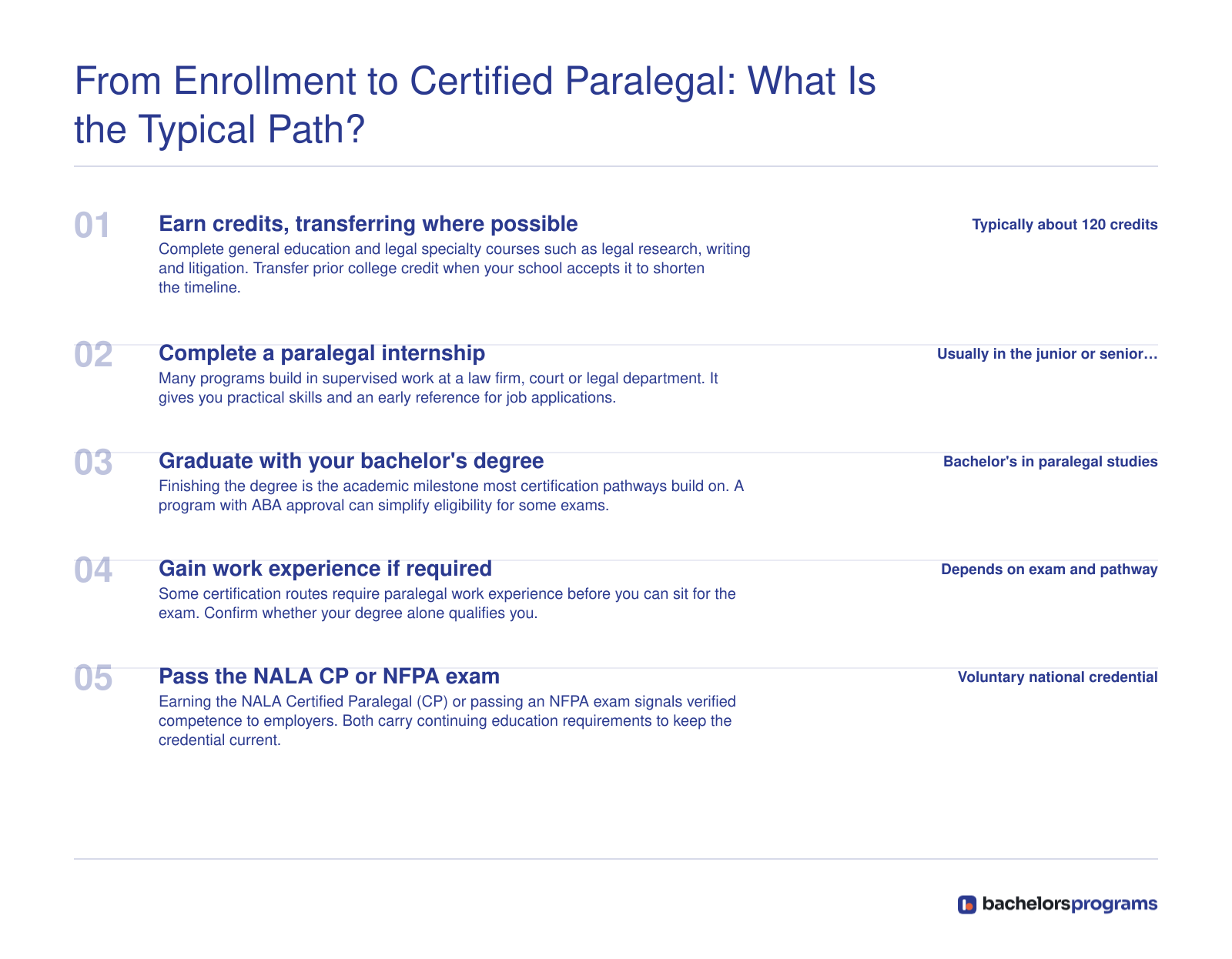
From Enrollment to Certified Paralegal: What Is the Typical Path?
A bachelor's degree in paralegal studies is one route to voluntary national certification, not the finish line. The order below reflects how most students move from first credit to credential. Check each certifying body's current eligibility rules before you plan your timeline.
What Paralegals Earn Nationally
Paralegals and legal assistants earned a national median of $62,890 a year in May 2025, or about $30.24 an hour, according to the Bureau of Labor Statistics.
Paralegal programs by state
Paralegal Degree FAQs
These answers cover the questions prospective students ask most often about a bachelor's degree in paralegal studies. Figures reflect the programs and sources discussed elsewhere on this page and can change by school and year.
How long does it take to earn a bachelor's degree in paralegal studies?
How much does a paralegal degree cost per credit?
Can I become a paralegal if my bachelor's is in another field?
Is a paralegal bachelor's good preparation for law school?
Compare Paralegal programs on the data that matters
Explore more Criminal Justice & Law majors or browse every field of study.
All Criminal Justice & Law programs Browse every field of study