Best Online Legal Studies Degree Programs
Compare 40+ accredited online Legal Studies programs, with net price after aid, graduation rates, earnings and debt from IPEDS and the U.S. College Scorecard.

A fully online legal studies bachelor's trades the structure of a campus pre-law track for flexibility, and the tradeoff only pays off if the degree matches the job you want. Most programs here run about 120 credit hours, though Bellevue University requires 127. Tuition runs from roughly $212 to $459 per credit at the schools that publish a rate.
Every program ranked here is 100% online, and hybrid formats are excluded. None of them licenses anyone to practice law. Graduates typically move into paralegal, legal assistant, or compliance roles, or on to a J.D. program.
Practicing law still requires law school and a bar exam, and no bachelor's major substitutes for either.
Key Points
- ABA approval covers specific paralegal programs, not legal studies degrees broadly.
- Most online bachelor's programs need about 120 credits, but Bellevue requires 127.
- No legal studies, paralegal, or criminal justice degree licenses you to practice law.
Top 10 Best Fully Online Legal Studies Degree Programs for 2027
Every program on this list can be completed fully online, with hybrid and campus-based formats set aside. Ordering reflects the overall strength of each program and institution rather than any single measure, so a school with a higher published price can still sit above a cheaper one. Each entry summarizes the school, the legal studies credential it awards, and the details that matter most to working adults.
University of Central Florida
#1Orlando, FL · ~$10,000/yr (est.)
Best for: Mock trial and moot court competitors
UCF is a large public research university whose legal studies bachelor's is offered fully online, with five concentration options that let students steer toward advocacy, business and technology, family matters, or international law. Faculty are graduates of ABA-approved law schools, and students can compete in mock trial, moot court, or mediation while contributing to an undergraduate law journal. The school's graduation rate is 78%.
- Five concentrations, including Law and Policy, Advocacy, and International
- 120 credit hours, designed as a four-year degree
- Thesis or capstone option
- Mock Trial, Moot Court, Mediation Team, and Undergraduate Law Journal
- All faculty are graduates of ABA-approved law schools
- Start terms in fall, spring, and summer
- Fully online option available
American Public University System
#2Charles Town, WV · $5,000 – $10,000/yr (est.)
Best for: Military and public service professionals
American Public University System serves a heavily military and public-service student body, and its legal studies bachelor's is built for working adults who want structured, career-relevant coursework entirely online. Students pick from eight concentrations and finish 120 credits with a capstone, with core work in civil and criminal procedure, legal ethics, and constitutional law. The school's graduation rate is 57%.
- Eight concentration options
- 120 total credit hours with a required capstone
- Core courses in civil and criminal procedure, legal ethics, and constitutional law
- Concentrations include criminal law support and legal data analytics
- Prepares for law firms, corporate legal departments, and government agencies
- Fully online format
University of Wisconsin-Whitewater
#3Whitewater, WI · $10,000 – $15,000/yr (est.)
Best for: Working adults who want part-time pacing
UW-Whitewater offers legal studies in both BA and BS form, delivered fully online with full-time and part-time pacing for students who are also working. The interdisciplinary curriculum spans public law, business law, comparative and international law, and public policy, and students complete an internship in a court, law firm, or advocacy organization. Textbook rental is included in tuition, faculty advising sits inside the program, and a Madison College partnership lets eligible paralegal students bring up to 60 credits. The school's graduation rate is 59%.
- Choose a BA or BS track
- 100% online, taught by nationally recognized faculty
- Full-time and part-time enrollment options
- Internship in a court, law firm, or advocacy group
- Curriculum covers public, business, comparative, and international law
- Textbook rental included in tuition
- Faculty advising built into the program
Dominican University
#4River Forest, IL · ~$12,000/yr (est.)
Dominican University runs an accelerated Bachelor of Professional Studies in Legal Studies aimed squarely at adults returning to finish a degree, with eight-week sessions and a completion path of roughly 20 months. Students take classes fully online or in evening sections, transfer prior college credit and CLEP exams, and can move into an accelerated master's in mediation and conflict resolution. Each student gets a dedicated advisor and an adult learning seminar at the start. The school's graduation rate is 55%.
- Complete in as little as 20 months
- Accelerated eight-week sessions
- Fully online or evening classes at Triton College
- Rolling admissions
- CLEP credit and prior college credit accepted
- BPS to MA accelerated pathway in mediation and conflict resolution
- Dedicated advisor and adult learning seminar
- Prepares students for paralegal certification
Lander University
#5Greenwood, SC · $15,000/yr (est. net price)
Lander University's paralegal studies bachelor's can be completed entirely online, with a face-to-face option on campus and a blended format at the University Center of Greenville. Students entering with an associate degree can finish in about two years, and the curriculum is designed for careers in law firms, insurance, banking, mortgage, and government as well as for graduate study. Articulation agreements with South Carolina technical colleges and a Bright Horizons EdAssist partnership support transfers. The school's graduation rate is 50%.
- Entire program available online
- Finish in two years with an associate degree
- Fall, spring, and summer start terms
- 16-week fall and spring courses; 6-week summer terms
- Internships and experiential learning encouraged
- Transfer agreements with South Carolina technical colleges
- Prepares graduates for law firms, banks, insurance, and government
Regent University
#6Virginia Beach, VA · ~$20,000/yr (est.)
Regent University's Bachelor of Arts in Law is a 120-credit online degree taught by sitting judges and attorneys, with a concentration in legal education preparation built for students aiming at law school. Coursework covers legal analysis, research, writing, oral advocacy, constitutional law, and LSAT logical reasoning, plus guidance on application essays. Sessions start throughout the year, and military benefits and partnership scholarships are available. The school's graduation rate is 57%.
- 120 credit hours, fully online
- Courses taught by judges and attorneys
- LSAT logical reasoning and legal analytical writing coursework
- Guidance on law school admission essays
- Next session starts January 11, 2027
- Military benefits and partnership scholarships available
- Constitutional law and persuasive communication in the core
Bellevue University
#7Bellevue, NE · ~$18,000/yr (est.)
Bellevue University designs its legal studies bachelor's for working adults, using a cohort model where students take one accelerated course at a time in a fully asynchronous online format. The 127-credit program adds a dedicated student coach, accepted transfer credit, and military benefits to a curriculum in legal research, writing, constitutional law, and civil and criminal procedure. It is a non-licensure degree, so graduates move into policy, business, or law school preparation. The school's graduation rate is 33%.
- 127 total credit hours
- 100% asynchronous online classes
- Cohort format, one course at a time
- Dedicated student coach assigned
- Transfer credits accepted
- Non-licensure degree
- Accelerated cohort option
- Military benefits accepted
Crestpoint University
#8Phoenix, AZ · ~$16,000/yr (est.)
Crestpoint University, formerly National Paralegal College, offers a Bachelor of Science in Legal Studies with instructor-led courses that combine live interaction and asynchronous materials. Courses cover torts, contracts, legal research and writing, and ethics, and remote exam security is handled through Voice Proctor. The institution is accredited by the Distance Education Accrediting Commission and assigns each student a personal academic advisor. The school's graduation rate is 33%.
- Synchronous and asynchronous course options
- Instructor-led courses with live interaction
- Voice Proctor remote exam security
- Accredited by the Distance Education Accrediting Commission
- Personal academic advisor assigned
- Transfer credits accepted
- Formerly National Paralegal College
- New sessions in November 2026 and January 2027
University of Maryland Global Campus
#9Adelphi, MD · $22,000/yr (est. net price)
University of Maryland Global Campus specializes in online education for working adults, and its legal studies bachelor's can be completed entirely online with a capstone at the end. The 120-credit curriculum covers civil, criminal, and administrative law along with torts, contracts, domestic relations, and litigation, and assignments include drafting client letters and case reports. Students can transfer up to 90 credits, use no-cost digital materials, and join the Lambda Epsilon Chi honor society. The school's graduation rate is 33%.
- 120 credit hours with a required capstone
- All courses available online
- Transfer up to 90 credits
- Rolling admissions with spring, summer, and fall starts
- No-cost digital course materials
- Interest-free monthly payment plan
- Lambda Epsilon Chi honor society chapter
- Coursework in torts, contracts, domestic relations, and litigation
Florida National University
#10Hialeah, FL · $20,000 – $25,000/yr (est.)
Florida National University offers a Bachelor of Arts in Legal Studies that runs 120 credits over roughly four years of full-time study, with small classes and flexible scheduling for working students. The curriculum covers legal research, writing, and analysis, and graduates move into paralegal, legal assistant, and compliance roles or continue to law school. The university is accredited by SACSCOC. The school's graduation rate is 31%.
- 120 credit hours, about four years of full-time study
- SACSCOC accredited
- Small class sizes
- Prepares for paralegal, legal assistant, or compliance roles
- Eligible for law school admission
Cost & outcomes by school
Federal data for the highest-earning Legal Studies programs, independent of the ranking above. Earnings are this field's bachelor's graduates four years after completing where the Scorecard reports them, else the school's undergraduate median.
| School | Net price / yr | Grad rate | Earnings | Debt | Grads/yr | Format |
|---|---|---|---|---|---|---|
| Harvard University MA | $19,066 | 98% | $101,817 | $14,000 | — | Online |
| Rutgers University-Newark NJ | $19,703 | 64% | $74,479 | $21,500 | 5 | Hybrid |
| Texas Tech University TX | $19,070 | 69% | $62,454 | $21,500 | — | Online |
| American Public University System WV | $9,597 | 57% | $61,532 | $30,518 | 89 | Online |
| University of Central Florida FL | $10,411 | 78% | $59,715 | $17,956 | 243 | Online |
| University of Mississippi MS | $13,314 | 72% | $50,994 | $25,500 | 53 | Online or campus |
| University of Memphis TN | $12,397 | 51% | $48,458 | $23,300 | — | Online |
| Humphreys University CA | $5,524 | 62% | $39,248 | $35,500 | — | Hybrid |
Sources: U.S. Department of Education. Net price, graduation rate, earnings and debt: College Scorecard (earnings and debt for this field's bachelor's graduates where reported, else school-wide); graduates: IPEDS. A dash means no figure is reported.
Cost, debt & payoff
Median earnings of this field's bachelor's graduates (4 yrs after completing, else the school's undergraduate median) vs. their median federal loan debt · U.S. College Scorecard
Across these programs the median graduate earns about $53,071 and finishes with roughly $23,000 in debt — a ratio that clears a common rule of thumb (keep debt below first-year salary). Net price and debt vary widely school to school, so check the per-school figures in the table above before you shortlist.
How We Ranked These Fully Online Programs
The Online-Only Filter
Delivery is fully online across this list, with no required campus visits, residencies, or in-person labs. Programs that blend online coursework with mandatory on-campus sessions, including the hybrid formats some regional campuses offer, were set aside even when the online portion is substantial. A single required weekend on campus fails that test, no matter how strong the outcomes look. That keeps the list usable for readers who cannot relocate or commute to class.
What the Composite Measures
Three signals feed the composite: affordability, measured by published tuition and average net price; institution-wide graduation and retention rates; and program-level College Scorecard outcomes, chiefly median earnings and typical debt for graduates. A program that costs less, keeps more of its students through to graduation, and sends graduates into better-paying work moves up the list.
What the Numbers Cannot Tell You
Neither figure describes the legal studies major alone; both cover the whole institution. The net price shown is what students paid on average after federal, state, and institutional aid, not a quote, so your own figure will shift with your aid package, transfer credits, and residency status. Scorecard outcomes reflect the most recent snapshot year available, so treat earnings and debt as a direction rather than a forecast. Some programs do not report earnings or debt at all; where that happens, the composite rests on cost and completion alone.
The underlying data comes from IPEDS and the College Scorecard, refreshed to the latest year each source publishes.
Online Legal Studies Degree Cost: The Lowest Net Prices Among Fully Online Programs
Rows are sorted by average annual net price, lowest first, using 2024 IPEDS and College Scorecard data from the U.S. Department of Education. Sticker tuition is the published rate, while net price is what undergraduates paid on average after grants and scholarships against the full cost of attendance (including books and living costs), which is why net price can exceed tuition at a low-tuition school like American Public University System, and because it is an institution-wide undergraduate average, an adult transfer student's actual cost may differ. Residency drives the sticker price at a public school like UCF ($6,368 in-state vs. $22,467 out-of-state), while APUS and Dominican charge one rate regardless of state, and as a budget rule of thumb, private sticker prices run far higher but aid narrows the gap: Dominican's $38,978 tuition drops to an $11,745 net price, not far above UCF's $10,411.
| Rank (by Net Price) | School | Location | Sector | In-State Tuition & Fees | Out-of-State Tuition & Fees | Average Net Price | Degree & Format |
|---|---|---|---|---|---|---|---|
| 1 | American Public University System | Charles Town, WV | Private for-profit | $8,400 | $8,400 | $9,597 | B.S. in Legal Studies, online |
| 2 | University of Central Florida | Orlando, FL | Public | $6,368 | $22,467 | $10,411 | Legal Studies, BA/BS, fully online option |
| 3 | Dominican University | River Forest, IL | Private nonprofit | $38,978 | $38,978 | $11,745 | Bachelor of Professional Studies in Legal Studies, online or in-person evening classes |
Related Articles
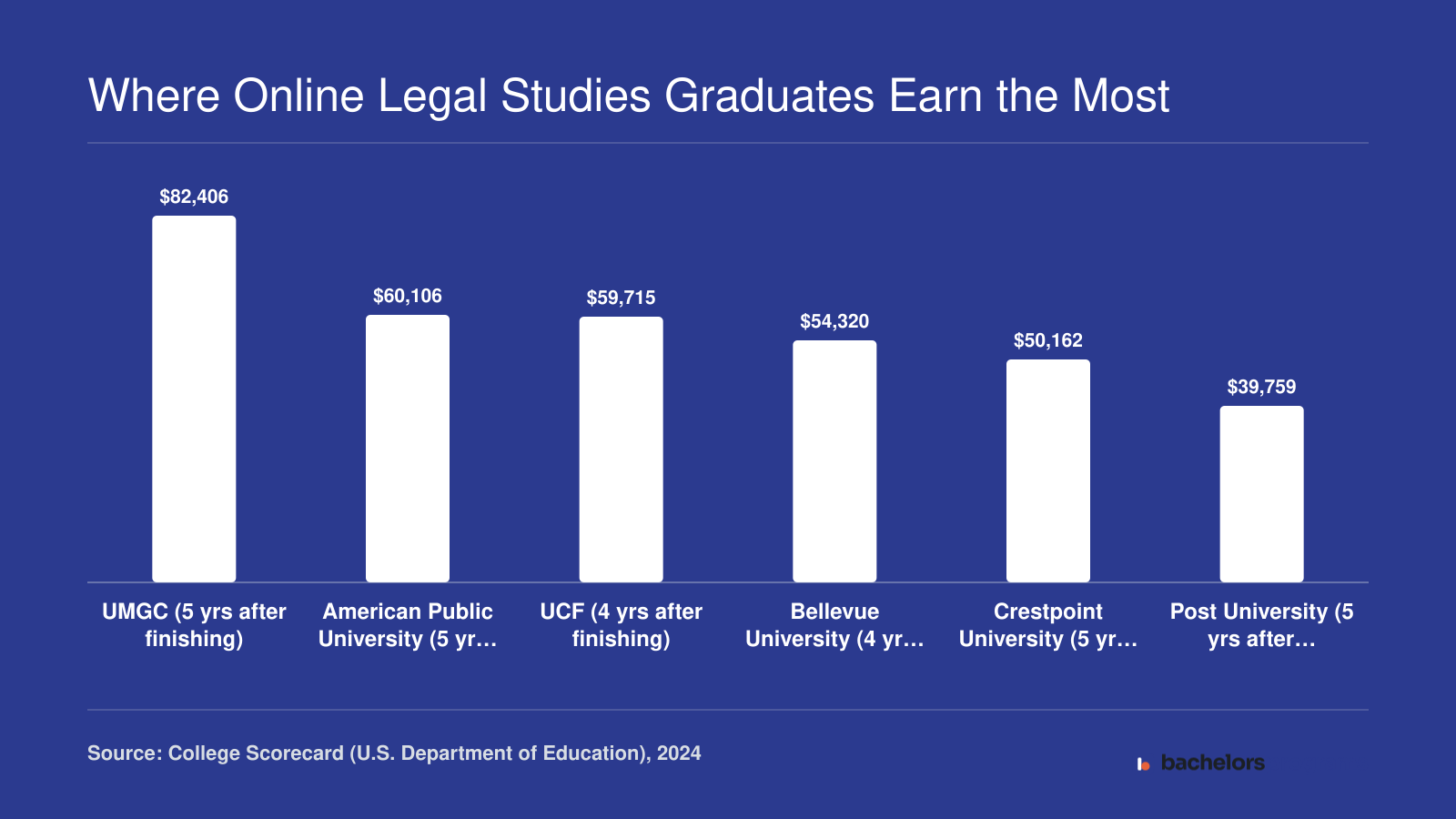
Where Online Legal Studies Graduates Earn the Most
Each bar shows median earnings for that school's legal studies bachelor's graduates, not an institution-wide figure, and the label notes whether pay was measured four or five years after finishing, so 4-year and 5-year results are not a strict head-to-head comparison. Differences often reflect regional labor markets and how many students were already working adults with established salaries when they enrolled. These are medians from fairly small graduating groups, so read them as a signal of typical outcomes rather than a promise of what you will earn.
Legal Studies vs. Paralegal Studies vs. Criminal Justice
Legal studies is broad and theory-oriented, paralegal studies is skills-based practice training, and criminal justice centers on law enforcement and corrections systems. All three are bachelor's-level options, and none of them licenses you to practice law. The right pick depends on whether your next step is law school, a paralegal job, or a public-sector or compliance role.
| Factor | Legal Studies | Paralegal Studies | Criminal Justice |
|---|---|---|---|
| Curriculum focus | Broad legal foundation: law, institutions, research and writing, ethics, social science | Practical paralegal skills: litigation and transactional procedure, legal technology, terminology | Justice system focus: policing, courts, corrections, criminology, public policy |
| Typical career paths | Legal support, compliance, government, administrative and advocacy work | Paralegal and legal assistant roles in law offices, corporations, and agencies | Law enforcement, probation and parole, corrections, victim services, court administration, crime analysis |
| Employer credential expectations | Varies by employer. A paralegal certificate is not a universal requirement | BLS lists an associate's degree as typical entry education for paralegals. Certification is optional, not a state license | Not geared to law-office hiring. Agencies usually look for justice-field training |
| Law school prep | Strong fit: reading, writing, and legal reasoning in a broad context | Useful, but the coursework is weighted toward practice tasks | Fits students aimed at criminal law or public-sector justice work |
| NALA CP pathway | Not listed under Category 1. A bachelor's degree can qualify under Category 2 with one year of paralegal experience or 15 substantive semester hours | Conditional under Category 1, only if the program meets NALA criteria | Not a Category 1 route. Category 2 applies with a bachelor's plus experience or coursework |
| NFPA PCC or CRP | Verify current NFPA eligibility rules before assuming a degree qualifies | Verify current NFPA eligibility rules before assuming a degree qualifies | Verify current NFPA eligibility rules before assuming a degree qualifies |
| Best choice if your goal is law school | Best fit | Possible, but narrower | Choose only if criminal law is your focus |
| Best choice if you want to work as a paralegal right away | Workable, but plan to add paralegal coursework | Best fit, especially if the program meets NALA criteria | Weakest fit |
| Best choice for a compliance or government role | Strong fit for compliance and administrative work | Good fit for legal-support roles in agencies | Best fit for public-sector justice roles |
ABA Approval and Accreditation: What It Covers and What It Doesn't
ABA approval is narrower than its name suggests. The American Bar Association's Standing Committee on Paralegals approves specific paralegal education programs, not legal studies degrees in general and not an entire college. A school can hold ABA approval for one paralegal program while a separate online legal studies bachelor's sits outside that approval.
What the current guidelines require
The published ABA Guidelines for the Approval of Paralegal Education Programs took effect January 1, 2023.1 Online delivery is permitted, but students must complete at least 9 semester credits of legal-specialty courses through synchronous instruction.2 Synchronous means real-time interaction between faculty and students or among students, either in person or remote; some courses may be asynchronous. Programs must also sit at an institution with an accreditor acceptable to the Standing Committee, have operated at least two academic years and graduated students, complete a self-evaluation, and face an inspection that covers online operations. Approval is reviewed every seven years, with an interim report in between.
Accreditation, approval, and the license to practice
Two separate checks matter, and neither makes a graduate a lawyer. Institutional accreditation comes from an agency recognized by the U.S. Department of Education, historically called regional accreditation; it governs transfer credit and access to federal student aid. ABA paralegal approval is a program-level mark that a specific paralegal curriculum meets the Standing Committee's guidelines. Legal studies graduates who want to practice law still need a law degree and a state bar license. ABA approval and institutional accreditation are quality signals, not a license to practice law.
How to verify a program
Start with the ABA Standing Committee on Paralegals directory and search by institution, city, or state. The directory updates every February and August; a program that is not listed is not ABA-approved.3 Read the "Online" label carefully: it means at least one program at that institution is available online, not that every course or credential is. We could not confirm that any program in this ranking appears in the directory, so check the exact degree rather than the school's general reputation. Then check the institution's accreditor through the U.S. Department of Education's database or the Council for Higher Education Accreditation, and ask which legal-specialty courses use synchronous instruction. That two-step check separates a genuine ABA-approved paralegal program from a legal studies major that only shares the campus.
Transfer Credits, Program Length, and Format for Working Adults
Transfer credit is the single biggest lever on how long an online legal studies degree takes and what it costs. Most bachelor's programs here require about 120 semester credits, though Bellevue University asks for 127.1
How Much Credit Schools Accept
Caps vary widely. UMGC, UMass Global, Liberty University and Herzing University each allow up to 90 credits.2 Stevenson University accepts up to 70 from a community college and 90 from a four-year school, plus up to 30 for prior learning. Texas Tech's B.A. reviews credit case by case, while its B.A.A.S. accepts up to 60 from an associate of applied science. UCF's 45-hour limit applies to alternative credit such as CLEP and military training, not ordinary transfer.
What That Means for Your Timeline
An associate degree or a prior paralegal certificate can remove a large share of general education and elective credits. Bellevue's accelerated cohort requires at least 60 transfer credits or an associate degree.1 UMass Global says a student bringing in 90 credits may have as few as 10 courses left.3 Texas Tech lists 2 to 4 years depending on transfer credit and course load, and Herzing's 36 months assumes full-time study with no transfer.4 Treat these as starting points: your own total will vary with approved credits and how many courses you take at once.
Format for Students Who Work Full-Time
Asynchronous courses let you finish work on your own schedule within weekly deadlines. Synchronous courses meet live at set times, which suits students who want structure but can clash with shift work. Accelerated terms compress a course into 7 or 8 weeks. Texas Tech and Liberty use 8-week courses, and Bellevue has students take one course at a time. That pace lets you focus on a single subject, though each week carries a heavier workload.
Before You Apply
Ask each school you are considering for an unofficial transcript evaluation. It shows which credits count toward the major, which count only as electives, and how many courses remain. Comparing those results side by side will tell you more than any advertised timeline.
Paralegal Pay at a Glance
Legal Studies programs by state
Online Legal Studies Degree FAQs
These answers cover the questions prospective students ask most often about online legal studies bachelor's programs. Requirements vary by school and state, so confirm details with any program you are considering.
Can you become a lawyer with a legal studies degree?
Is a legal studies degree the same as a paralegal degree?
Do fully online legal studies programs require proctored exams or campus visits?
Can I earn a paralegal certification while completing an online legal studies bachelor's?
Compare Legal Studies programs on the data that matters
Explore more Criminal Justice & Law majors or browse every field of study.
All Criminal Justice & Law programs Browse every field of study