Best Early Childhood Education Schools in Nebraska
Compare 7 accredited Early Childhood Education programs in Nebraska at 6 colleges, with net price after aid, graduation rates, earnings and debt from IPEDS and the U.S. College Scorecard.

A Nebraska bachelor's degree in early childhood education can cost under $9,000 a year in tuition at a public college or more than $40,000 at a private one, and the price tag says little about which classrooms graduates end up in. The standard credential is a Bachelor of Science (B.S.) in Early Childhood Education, though the packaging differs: the University of Nebraska, Lincoln's online option sits within Child, Youth and Family Studies, and Wayne State College titles its degree Early Childhood Inclusive Education.
That difference matters. Only programs tied to Nebraska licensure put a graduate in a public preschool or primary classroom. The rest point toward child care, Head Start and family services, where pay is lower.
Key Points
- In-state tuition ranges from $8,216 at Wayne State to $40,640 at Concordia.
- University of Nebraska-Lincoln's fully online option requires 120 total credit hours.
- Transfer students: plan for a second admission gate into teacher education.
Best Bachelor's Degree in Early Childhood Education Programs in Nebraska
Six Nebraska colleges award a bachelor's degree in early childhood education, and they fall into two clear groups: the public colleges in Wayne, Chadron and Peru, where in-state tuition sits a little above $8,200 a year, and the private universities in Omaha and Seward, which charge much more before financial aid is applied. Across these six schools, institution-wide graduation rates run from about 38% to 67%, and in-state tuition ranges from roughly $8,200 to $40,600 a year. Each card below sets the program's city, format, tuition, net price and graduation rate beside the details that separate one program from the next.
University of Nebraska-Lincoln
#1Lincoln, NE · $15,000 – $20,000/yr (est.)
Best for: Working paraeducators seeking apprenticeship pathways
The University of Nebraska-Lincoln runs two routes into the field: a fully online Child, Youth and Family Studies option built for students who already work with young children, and an on-campus inclusive program that leads to a Nebraska Birth through Grade 3 teaching certificate. The on-campus route now includes a Grow Your Own apprenticeship cohort backed by Nebraska Department of Education funding, with placements through Lincoln Public Schools and Papillion La Vista Community Schools. It is the only school on this list that offers the degree in both formats, and its alumni earnings one year after finishing are the highest of the six.
- 120 credit hours, delivered fully online
- 48 credits across 12 core courses
- Two practicum placements in different settings and age groups
- Delivered through the Innovative Digital Education Alliance consortium
- Remaining credits completed through Nebraska
- Internships include Head Start sites
- Coursework covers development from birth to age 8
- 120 credit hours with a 2.8 GPA minimum
- Leads to a Nebraska Birth through Grade 3 teaching certificate
- Full-semester, full-day student teaching
- Capstone and prerequisite courses required
- Early field placement in schools
- Prepares students for the Praxis exam
- Criminal background check required
College of Saint Mary
#2Omaha, NE · $17,000/yr (est. net price)
Best for: Women preparing for special education classrooms
College of Saint Mary pairs a 123-credit early childhood major with a special education minor, so graduates leave prepared for both general and inclusive preschool classrooms. The Omaha women's college builds field experience into several required courses and closes with clinical practice plus a seminar. With an 8-to-1 student-to-faculty ratio, it is the smallest instructional setting on this list, and its net price after aid lands well below its published tuition.
- 123 total credit hours, including a 39-credit Mercy Core
- 42-credit early childhood major plus a 21-credit special education minor
- Clinical practice, a clinical practice seminar and a research seminar
- Field experience built into several required courses
- Coursework in literacy, play and artistic development, and program administration
- Developmental courses do not count toward graduation
Wayne State College
#3Wayne, NE · ~$15,000/yr (est.)
Best for: Child care workers moving into leadership
Wayne State College keeps costs predictable, charging the same tuition rate to Nebraska residents and out-of-state students alike. Its Early Childhood and Family Studies major fits inside a 120-credit degree and is deliberately not a teacher certification track, which suits students aiming at child care, family support or program administration rather than a teaching license. Internships happen in day cares and preschools, and classes meet in Benthack Hall's labs.
- 57 credit hours in the major within a 120-credit degree
- Same tuition rate for in-state and out-of-state students
- Student chooses a B.A. or a B.S.
- Not a teacher certification program
- CDA credential requires 480 hours of documented experience
- Internships at day cares and preschools
- Classes meet in Benthack Hall labs
Chadron State College
#4Chadron, NE · ~$13,000/yr (est.)
Chadron State College offers a Bachelor of Science in Education with an Early Childhood Inclusive field endorsement spanning birth through Grade 3, one of five undergraduate education degrees it awards. The college publishes a four-year course rotation and an advising template so students can map the whole plan before they enroll. Some courses are shared online with Wayne State and Peru State, and the department also serves working teachers who want to add the endorsement to an existing certificate. Its net price after aid is the lowest of the private and public options here after Peru State.
- Field endorsement covers birth through Grade 3
- Four-year course rotation published
- Advising template for the early childhood inclusive plan
- Endorsement can be added to an existing teaching certificate
- Some courses shared online with Wayne State and Peru State
- One of five undergraduate education degrees at the college
Concordia University-Nebraska
#5Seward, NE · ~$24,000/yr (est.)
Concordia University, Nebraska in Seward awards a B.S.Ed. in Early Childhood Birth to 3rd Grade Inclusive Education that is approved by the Nebraska Department of Education and CAEP and leads to a Nebraska teaching certificate. Students log 100 hours of clinical experience and complete two student teaching placements, one in a local school and one in a different town, state or country. A Birth to Kindergarten concentration and a Lutheran Teacher Diploma option are also available, and the university reports a 100% career outcome rate.
- 125 credit hours over four years
- 100 clinical hours before student teaching
- Two student teaching placements: 8 weeks local, 8 weeks away
- International student teaching available
- Approved by the Nebraska Department of Education and CAEP
- Birth to Kindergarten concentration available
- Lutheran Teacher Diploma option
- Average class size of 11.2
Peru State College
#6Peru, NE · $12,000/yr (est. net price)
Peru State College's Bachelor of Science in Early Childhood Education lets students choose between an Inclusive endorsement covering birth to Grade 3 and a Supplemental endorsement for Pre-K through Grade 3. The School of Education runs a Teaching Experience Learning Lab stocked with classroom technology and places students in area elementary schools for field time. Faculty include former classroom educators, and graduates move into kindergarten and elementary teaching, early childhood special education or reading specialist roles.
- Inclusive endorsement (birth to Grade 3) or Supplemental endorsement (Pre-K to Grade 3)
- Four-year, on-campus program
- Teaching Experience Learning Lab with classroom technology
- Field time in area elementary schools
- Prepares students for Nebraska teaching certification
- Faculty include former classroom educators
Cost & outcomes by school
Federal data for the highest-earning Early Childhood Education programs, independent of the ranking above. Earnings are this field's bachelor's graduates four years after completing where the Scorecard reports them, else the school's undergraduate median.
| School | Net price / yr | Grad rate | Earnings | Debt | Grads/yr | Format |
|---|---|---|---|---|---|---|
| College of Saint Mary NE | $16,590 | 61% | $54,338 | $24,250 | 6 | Campus |
| University of Nebraska-Lincoln NE | $17,747 | 67% | $48,046 | $22,185 | 198 | Online |
| Chadron State College NE | $12,549 | 50% | $45,577 | $18,186 | 52 | Campus |
| Concordia University-Nebraska NE | $23,965 | 65% | $45,047 | $27,000 | 57 | Campus |
| Peru State College NE | $11,632 | 38% | $44,850 | $20,841 | 27 | Campus |
| Wayne State College NE | $15,360 | 52% | $43,369 | $19,731 | 90 | Campus |
Sources: U.S. Department of Education. Net price, graduation rate, earnings and debt: College Scorecard (earnings and debt for this field's bachelor's graduates where reported, else school-wide); graduates: IPEDS. A dash means no figure is reported.
Cost, debt & payoff
Median earnings of this field's bachelor's graduates (4 yrs after completing, else the school's undergraduate median) vs. their median federal loan debt · U.S. College Scorecard
Across these programs the median graduate earns about $45,577 and finishes with roughly $22,185 in debt — a ratio that clears a common rule of thumb (keep debt below first-year salary). Net price and debt vary widely school to school, so check the per-school figures in the table above before you shortlist.
How We Ranked Nebraska Early Childhood Education Schools
Every program here is a bachelor's degree in early childhood education at a Nebraska institution, delivered on campus or online, and each is measured against the same outcomes rather than against reputation alone.
What the Figures Mean
Net price is the average a student pays in a year after grant and scholarship aid. It is an institution-wide figure and an approximate average, not a quote for your household. Graduation rate is also campus-wide: it shows how often students who enroll go on to finish. Completions tell you how much of a presence early childhood education has at a given school.
Earnings and Debt, at Program Level
Earnings and debt come from federal College Scorecard data reported at the program level, with earnings measured a few years after graduates finish. Read the two together. A solid salary paired with heavy borrowing is a different outcome than the same salary with a manageable loan payment.
Scope of the List
The list covers Nebraska-based bachelor's programs only, so an online option from a Nebraska school sits alongside one you attend in person in Lincoln, Omaha, Wayne, Chadron, Seward or Peru. Treat the figures as a starting point, then confirm costs and licensure details directly with each school.
Online and Hybrid Bachelor's Options at Nebraska Schools
The University of Nebraska-Lincoln's Early Childhood Education in a Mobile Society option is the one program here labeled fully online. It runs 120 total credit hours, including 48 credit hours in 12 core courses, and it is delivered through a consortium of universities.1 College of Saint Mary, Wayne State College, Chadron State College, Concordia University-Nebraska and Peru State College list campus programs, and none of them is labeled hybrid in our data.
What stays in person
Even the online route has a hands-on component. UNL requires two practicum experiences in two different settings, and the program describes those settings as approved early-childhood sites with cooperating teachers.1 Campus programs lean harder on fieldwork. Concordia lists 100 clinical hours and two student teaching placements, one local and one away, each eight weeks. Peru State builds in field time in area elementary schools, and Wayne State lists internships at day cares and preschools.
Arranging placements from rural Nebraska
Online students outside Lincoln and Omaha usually arrange a nearby site with program staff. Typical options include a licensed child care center, a Head Start classroom or a public school. Ask early how a site gets approved, who supervises, and whether your current workplace can count. Program pages do not spell out every detail, so confirm these rules directly.
Delivery quirks to check
Chadron State shares some online courses with Wayne State and Peru State, so a campus program there may still include online coursework. Confirm whether a program leads to a Nebraska teaching certificate, since not every early childhood degree does.
The short answer
Yes, you can complete much of a bachelor's degree in early childhood education online, but not all of it. Practicum and student teaching still put you in a classroom with children.1
Admissions Requirements: GPA, Test Policy, and Transfer Credit
Nebraska teacher-education programs screen applicants twice: once for admission to the university, then again for formal admission to the professional sequence. The second gate is the one transfer students tend to miss.
Two Gates, Not One
University admission and program admission are separate decisions at the Nebraska schools on this list. A solid high school transcript can get you into the institution; it does not put you in the teacher-preparation cohort, and it does not by itself satisfy the basic-skills requirement the state expects of future teachers.
Transfer Credit at the University of Nebraska-Lincoln
The University of Nebraska-Lincoln publishes the most detailed transfer rules among the schools here. Transfer applicants need a 2.0 cumulative college GPA, and anyone applying with fewer than 24 semester hours of college coursework also has to meet a 16-unit high school core-course requirement.1 The degree-granting college decides which courses actually apply, University of Nebraska System credit is accepted, and no more than 60 semester credits (or 90 quarter credits) from a two-year college can count toward a UNL bachelor's degree.2 Outside coursework is evaluated for admission, but those grades do not enter your university GPA.
First-Year GPA and Test Policy
Minimum GPA floors and SAT/ACT statements differ by campus and get revised often. Where an admissions page states no first-year GPA or says nothing about testing, read that as "no policy published" and confirm the standard with a counselor. Silence is not evidence that scores are optional or that the bar sits low.
The Teacher-Education Gate
Nebraska teacher-education programs generally require candidates to pass Praxis Core for formal admission, and each program publishes its own GPA threshold for entry and again for student teaching, with figures commonly in the 2.75 range.
Three items worth confirming before you apply:
- Test policy: whether your target campus requires SAT or ACT for first-year applicants this cycle.
- Transfer evaluation: which office rules on course equivalency, and when.
- Praxis timing: the deadline your program sets, since a missed test date can push a practicum back a term.
Related Articles
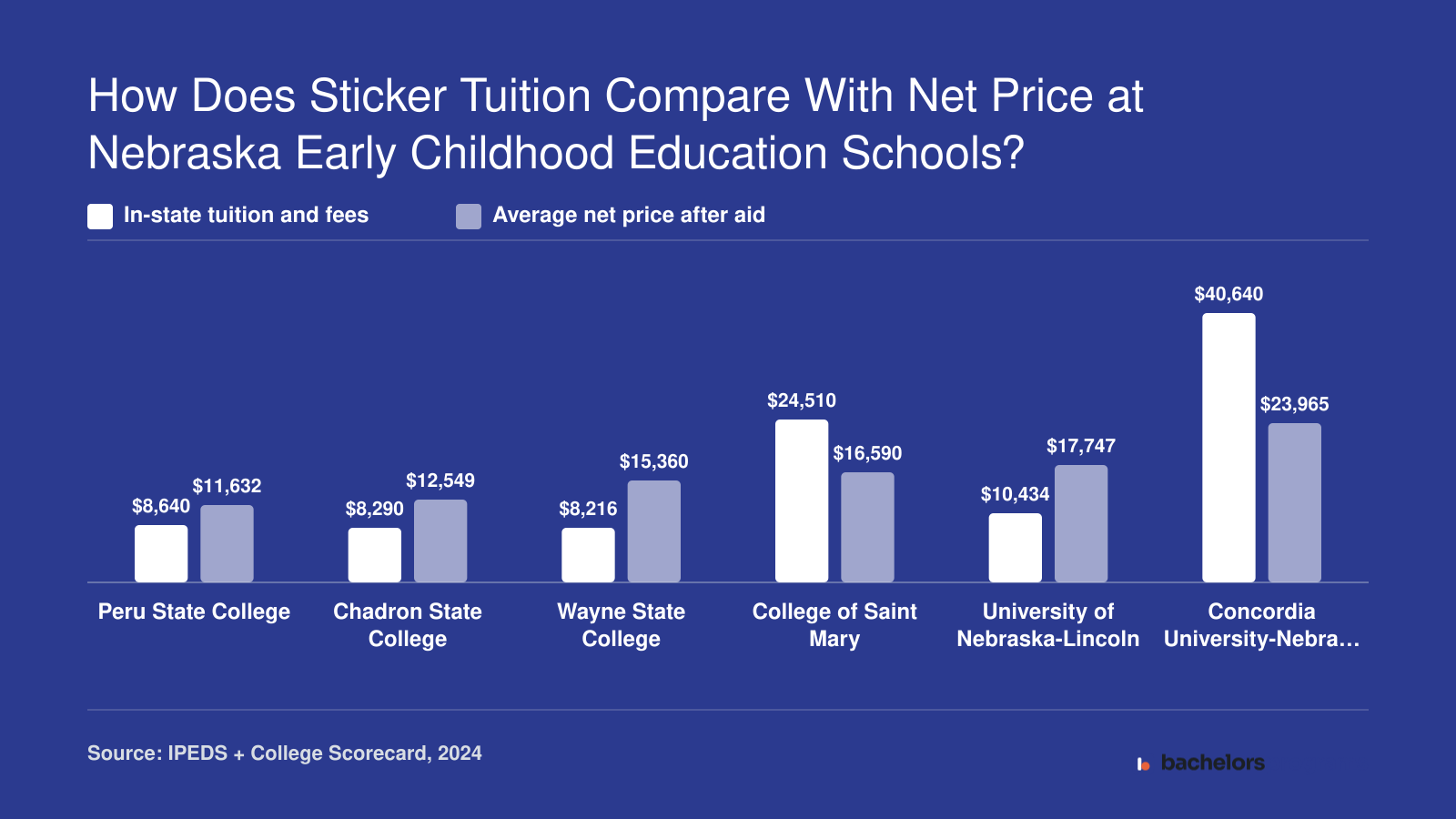
How Does Sticker Tuition Compare With Net Price at Nebraska Early Childhood Education Schools?
Published in-state tuition and fees run from $8,216 at Wayne State College to $40,640 at Concordia University-Nebraska. Concordia shows the widest gap: its average net price of $23,965 is about $16,675 below sticker tuition. At the public colleges, net price is higher than tuition because it also counts housing, books and other costs after grants. Net price is an average for students who receive aid, not a personal quote. These federal figures also lag current rates (UNL lists $303 per credit for resident undergraduates in 2026-2027), so confirm costs on each school's tuition page.
Highest Program Earnings Figure Among Nebraska Schools
Among the schools ranked here, Concordia University-Nebraska posts the highest program-level earnings figure in our data.
Questions to Ask Yourself
Do you want a classroom teaching license for birth through grade 3, or a role in childcare and preschool that does not require one?
Where will you complete student teaching, and can you be there full time?
Could starting at a Nebraska community college and transferring save money without losing credits?
Will you need online or evening coursework to keep working while you study?
Compare Early Childhood Education programs on the data that matters
Explore more Education & Teaching majors or browse every field of study.
All Education & Teaching programs Browse every field of study