Best Online Early Childhood Education Degree Programs
Compare 220+ accredited online Early Childhood Education programs, with net price after aid, graduation rates, earnings and debt from IPEDS and the U.S. College Scorecard.

A bachelor's degree in early childhood education, most often a Bachelor of Science (B.S.) in Early Childhood Education, trains you to teach or lead programs for young children. The practical question for working childcare staff and classroom aides is whether a fully online version fits around a job at a price that holds up.
Delivery is 100% online across the ranking; hybrid formats are excluded. Net price after aid runs from $3,214 to $15,364 across the top-ranked schools. Fieldwork, CDA credit and transfer pathways can move that cost as much as tuition does.
Many of these degrees carry no teaching license, and that difference shapes careers more than price does.
Key Points
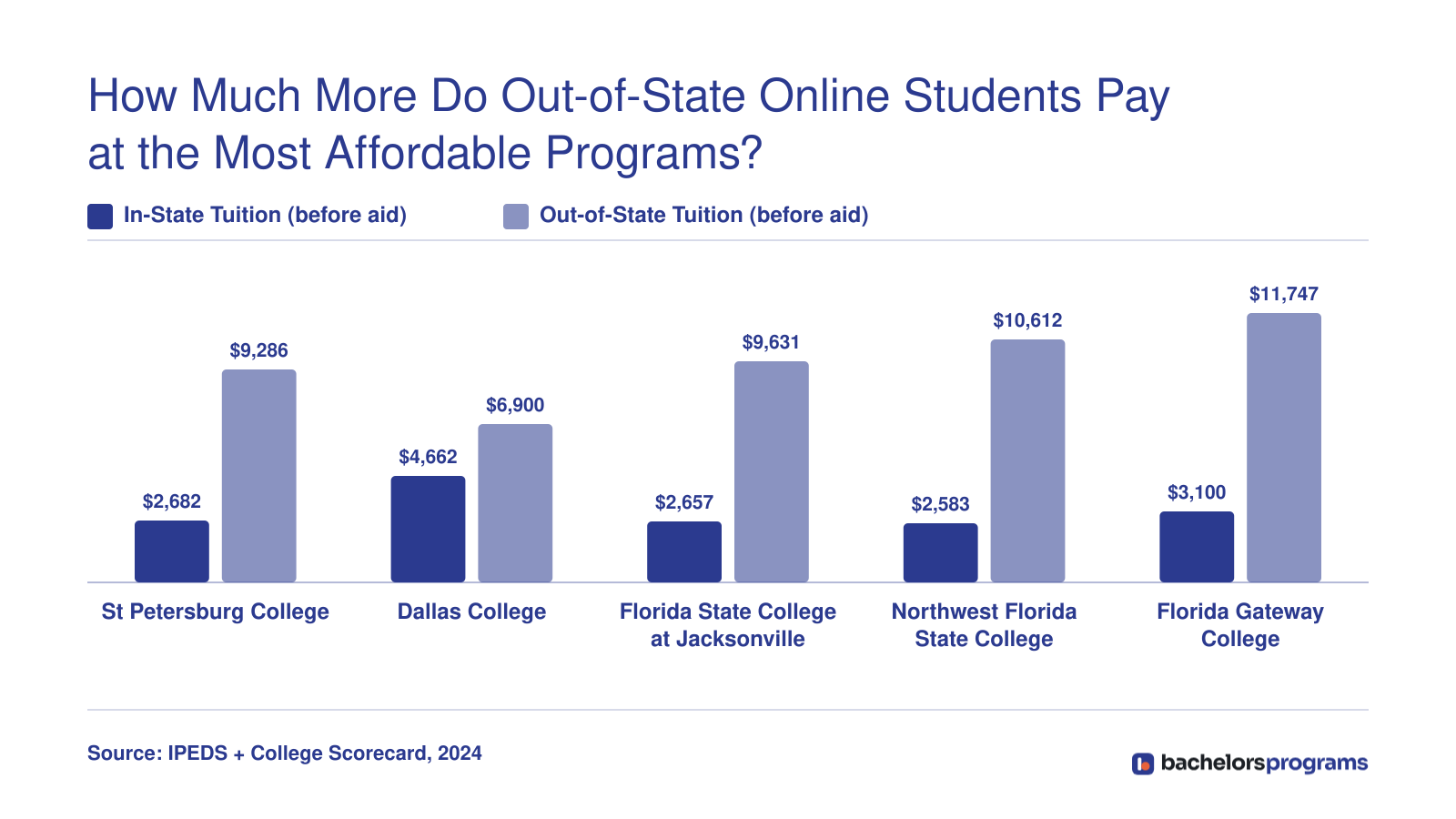
- Dallas College's online tuition gap is smallest: $4,662 in-state, $6,900 out-of-state.
- The federal TEACH Grant lists a $4,000 annual award in 2027.
- State education agencies, not your online degree, grant teaching licenses.
Best Fully Online Bachelor's in Early Childhood Education Programs: Our Top 10
Every program in this list is delivered fully online, so no hybrid or in-person coursework is required to finish the degree. The ten are ordered on a blend of cost and student outcomes rather than sticker price alone. Each card shows the average net price after aid and the institution-wide graduation rate alongside the details that matter day to day.
University of Florida
#1Gainesville, FL · ~$7,000/yr (est.)
Best for: Florida residents pursuing PreK to grade 3 certification
The University of Florida delivers its early childhood education degree through UF Online, and the program was created in response to the state's teacher shortage. The College of Education ties the degree to Florida certification for age 3 through grade 3, so graduates leave with a classroom credential rather than a general studies award. Partnerships with state early learning agencies, a campus collaboratory, and local school districts give students unusual access to practitioners and policy work.
- 54 credit hours with a typical load of 12 credits per semester
- Certification covers age 3 through grade 3 in Florida
- Endorsements in Prekindergarten Disabilities, Reading, and ESOL
- Average class size of 15 to 20 students
- Starts in fall with full-time and part-time tracks
- TEACH Early Childhood Scholarship for early learning staff
- Course content linked to field experiences
Amridge University
#2Montgomery, AL · $5,000 – $10,000/yr (est.)
Best for: Working adults balancing online study with full-time jobs
Amridge University is a small private institution in Montgomery, Alabama, that runs its undergraduate degrees through distance learning. The early childhood pathway is a Bachelor of Science in Human Development housed in the College of General Studies, and it sits among roughly 40 online programs the university offers. With a student-faculty ratio near 12 to 1, students get a compact, fully remote route into child and family work.
- Fully online through the College of General Studies
- Classified in human development and family studies
- One of about 40 online programs at the university
- Free admissions waiver
Florida International University
#3Miami, FL · ~$9,000/yr (est.)
Best for: Childcare professionals who do not need certification
Florida International University runs one of the largest online early childhood programs in the country, with more than 300 completions in the education field. The Bachelor of Science in Early Childhood Development serves students who want to work with children from birth to age 8 in childcare, early learning, and family support settings. Every undergraduate is paired with a success coach, and the program carries a research connection to Harvard Project Zero.
- 120 credit hours at $235.57 per credit hour in state
- No teacher certification from this track
- Three start dates across fall, spring, and summer
- Success coach assigned to every undergraduate
- Coursework covers children from birth to age 8
- Honors College option available
- Spring 2027 start January 11; Summer A 2027 start May 10
University of Washington-Seattle Campus
#4Seattle, WA · ~$14,000/yr (est.)
The University of Washington's College of Education anchors early childhood study inside a large public research university. Its online Bachelor of Arts in Early Care and Education is built for transfer students, and admission is capacity constrained, so applicants need 45 transferable credits and a personal statement before they begin. The degree emphasizes birth to age 8 practice, advocacy, and leadership, and it includes community-based learning with partner organizations.
- 87 credits of early childhood, education, and related coursework
- Serves children from birth through age 8
- Requires 45 transferable credits and a personal statement
- At least 64 major credits completed at the Seattle campus
- Capacity-constrained admission with a 2.0 GPA minimum
- Community-based learning with community partners
- Departmental honors available
University of Illinois Urbana-Champaign
#5Champaign, IL · ~$14,000/yr (est.)
The University of Illinois Urbana-Champaign prepares teachers for birth through grade 2 and is approved under Illinois's Gateways to Opportunity system. Students move through the same sequential gateways as on-campus candidates, including clinical experiences and licensure-area tests, and the degree adds early childhood special education coursework to the general education core. The program is offered on campus and online, and it has produced more than 130 completions in the education field.
- 120 credit hours, including at least 40 upper-division hours
- Prepares candidates to teach birth through grade 2
- 12-hour practicum in early childhood and elementary settings
- Early childhood special education coursework included
- Gateways to Opportunity approved program
- 2.5 GPA minimum with a C- or better in licensure coursework
- Third semester of a language other than English required
- Offered on campus and online
Florida Gateway College
#6Lake City, FL · $5,000 – $10,000/yr (est.)
Florida Gateway College is a public college in Lake City that built its early childhood bachelor's for students who already hold an associate degree. The program carries specialized accreditation from the Commission on the Accreditation of Early Childhood Higher Education Programs, a recognition few online bachelor's options hold. Full-time students finish in four semesters, and field experiences run from birth through age 8.
- Accredited by the Commission on the Accreditation of Early Childhood Higher Education Programs through March 2029
- 120 credits, finished in four semesters by full-time students
- Admission requires a conferred A.A. or A.S. degree
- Field experiences and an internship cover birth to age 8
- Full-time and part-time tracks starting each semester
- Classes conducted entirely online
- Faculty hold doctoral degrees
San Diego State University
#7San Diego, CA · $15,000/yr (est. net price)
San Diego State University offers child development as a full major inside a large public research university, with a separate degree plan through SDSU Global Campus for students who need an online route. The curriculum pairs preparation courses with upper-division electives in program administration, observation and assessment, and early childhood mental health. A capstone portfolio pulls together coursework, internships, and faculty research projects.
- 27 to 28 units of major preparation, grade C or better required
- 12 units of upper-division child development electives
- Electives include Administration of Early Childhood Education Programs
- Capstone reflective learning portfolio required
- No minor required with the major
- Upper-division writing course required for graduation
- Second degree plan available through SDSU Global Campus
University of North Florida
#8Jacksonville, FL · $10,000 – $15,000/yr (est.)
The University of North Florida runs a non-licensure early childhood education degree with a concentration in early childhood development, built for people already working in the field. Practicum hours can be completed at a student's own early childhood workplace with advisor approval, which removes a common barrier for full-time staff. The T.E.A.C.H. Early Childhood Scholarship can cover up to 90 percent of tuition and books for eligible students.
- 120-credit non-licensure track with an Early Childhood Development concentration
- Practicum may be completed at your own early childhood workplace
- Rolling admission with fall, spring, and summer starts
- T.E.A.C.H. scholarship covers up to 90 percent of tuition and books
- Level 2 background check with fingerprints required before Term 5
- Prepares for preschool teaching, Head Start, and director roles
- Path to Florida PreK and Primary certification
Dallas College
#9Dallas, TX · $3,200/yr (est. net price)
Dallas College awards a Bachelor of Applied Science in Early Childhood Education and Teaching, a bachelor's-first route to Texas certification built at a community college price. Students pair online coursework with work-based learning in PreK-6 settings and finish with a year-long paid teacher residency. Tuition of $99 per credit for Dallas County residents includes textbooks, which makes it one of the lowest-cost teacher preparation paths in the state.
- $99 per credit for Dallas County residents, textbooks included
- Year-long teacher residency in the senior year
- Paid apprenticeship of about $30,000 with tuition assistance
- Each lab course adds about 32 hours a semester in a classroom
- 2.5 GPA to enter, 2.75 for degree conferral
- Prepares for EC-6, ESL, bilingual, or special education certification
- Rolling admission with July 1, Nov. 1, and April 1 deadlines
- Classes offered online on days, evenings, and weekends
Humphreys University
#10Stockton, CA · $6,000/yr (est. net price)
Humphreys University is a small private institution in Stockton, California, that structures its degrees around working adults. The early childhood education bachelor's runs in 11-week quarters, and students who arrive with an associate degree or substantial early childhood coursework can often finish in about two years. Up to 12 units can be awarded for work in the field, and a PK-3 Credential pathway is available for students who want a California teaching credential.
- $375 per unit on 11-week quarter terms
- Associate degree holders can often finish in about two years
- Up to 12 units awarded for work in early childhood education
- Degree alone is not a teaching credential
- PK-3 Credential pathway available
- Institutionally accredited by WSCUC, with teacher preparation approved by CTC
- Prepares for lead teacher, site supervisor, and director roles
- Reduced course load possible
Cost & outcomes by school
Federal data for the highest-earning Early Childhood Education programs, independent of the ranking above. Earnings are this field's bachelor's graduates four years after completing where the Scorecard reports them, else the school's undergraduate median.
| School | Net price / yr | Grad rate | Earnings | Debt | Grads/yr | Format |
|---|---|---|---|---|---|---|
| California State University-East Bay CA | $9,320 | 48% | $71,401 | $16,544 | — | Online |
| Charter Oak State College CT | $15,815 | 67% | $64,209 | $18,683 | 33 | Online |
| University of Washington-Seattle Campus WA | $14,091 | 85% | $59,736 | $15,249 | 80 | Online |
| University of Illinois Urbana-Champaign IL | $14,355 | 85% | $55,105 | $18,425 | 154 | Online or campus |
| Florida International University FL | $9,288 | 74% | $53,854 | $16,100 | 226 | Online |
| Arizona State University AZ | $14,967 | 68% | $53,195 | $16,238 | 540 | Online or campus |
| University of Florida FL | $6,541 | 91% | $53,079 | $14,757 | 40 | Online |
| University of North Florida FL | $10,154 | 69% | $49,545 | $16,487 | 89 | Online |
| San Diego State University CA | $15,364 | 76% | $48,471 | $12,691 | 154 | Online or campus |
Sources: U.S. Department of Education. Net price, graduation rate, earnings and debt: College Scorecard (earnings and debt for this field's bachelor's graduates where reported, else school-wide); graduates: IPEDS. A dash means no figure is reported.
Cost, debt & payoff
Median earnings of this field's bachelor's graduates (4 yrs after completing, else the school's undergraduate median) vs. their median federal loan debt · U.S. College Scorecard
Across these programs the median graduate earns about $48,046 and finishes with roughly $23,350 in debt — a ratio that clears a common rule of thumb (keep debt below first-year salary). Net price and debt vary widely school to school, so check the per-school figures in the table above before you shortlist.
What a Bachelor's Degree in Early Childhood Education Online Costs
The real cost of an online early childhood education bachelor's sits less in tuition than in the fine print on grants, scholarships and loan forgiveness. In 2026, the federal TEACH Grant lists a $4,000 annual award, though recent disbursements have been cut to about $3,7721, and awards made after October 1, 2026 are not yet settled.
The Cheapest Published Net Prices
The lowest published net price here belongs to St. Petersburg College at $1,471, against in-state tuition of $2,682 and out-of-state tuition of $9,286. Dallas College follows at $3,214. Public options cluster in the low thousands; private Humphreys University comes in at $5,524 and Gods Bible School and College at $9,329. The public-private spread is roughly $4,000 a year.
Debt in Monthly Terms
Median federal debt at completion runs from $6,992 at Florida Gateway College to $35,500 at Humphreys University. Published 10-year monthly payments range from $125 at Northwest Florida State College to $406 at Humphreys. St. Petersburg College graduates carry $16,868 in median federal debt, or about $201 a month. Whether those payments sit comfortably depends on the early childhood salary behind them, which makes the aid package as important as the tuition line.
Can It Be Free?
Rarely in the literal sense. Pell Grants are need-based and do not cover every cost. The TEACH Grant pays up to $16,000 total for undergraduates, but it requires an Agreement to Serve and four full-time years in a high-need field at a low-income-serving school or educational service agency within eight years. Miss that obligation and the grant converts to a Direct Unsubsidized Loan with interest from disbursement.1 State T.E.A.C.H. Early Childhood scholarships are built for working childcare staff. Nevada's program, for example, covers 80% of tuition and books, adds a $50 per-semester travel stipend and a $250 to $400 completion bonus, and carries a 2% wage increase requirement, three semesters of support, annual renewal, and one extra year with the sponsoring center.2 In practice, free usually means an employer or a scholarship covered the bill.
Loan Relief and Transfer Credits
Teacher Loan Forgiveness pays up to $17,500 or $5,000, depending on subject, after five complete consecutive years at a qualifying low-income school. Early childhood positions qualify only when the job and employer meet the federal definition. Public Service Loan Forgiveness has no low-income school requirement and ignores job title, but the employer must be a government or nonprofit agency and the loans and payments must meet program rules.3 The same service period cannot count for both programs. Transfer credits and residency requirements can change the total more than sticker price: an associate degree or approved early childhood work experience can remove terms, while a residency rule can add them.
How Much More Do Out-of-State Online Students Pay at the Most Affordable Programs?
Every low-cost program charted here bills non-residents more than in-state students, even for fully online study. Dallas College has the smallest gap, about $2,238 ($4,662 in-state vs. $6,900 out-of-state), while the Florida colleges charge non-residents roughly $6,600 to $8,600 more per year. These are published tuition and fees before financial aid, so they will run higher than the net price figures in our ranking, which reflect what students typically pay after grants and scholarships.
Licensure vs. Non-Licensure Programs: Which Online Track Fits Your Goals?
A teaching license does not come bundled with an online bachelor's degree in early childhood education. State education agencies issue licenses, and no federal agency approves or accredits a preparation program.1 What the degree can do is carry you through a state-approved licensure track, settle whether the program you choose offers one before you apply.
Two Tracks, Two Different Jobs
Initial-licensure programs are built for candidates who want a classroom license, typically labeled pre-K through grade 3 or birth through grade 3. Those labels are not uniform: each state sets its own credential name and grade span, so read the fine print instead of assuming a national standard.2 Licensure tracks include supervised student teaching and a recommendation for certification at the end.
Non-licensure programs, often marketed as degree-completion options, skip student teaching and the license recommendation. They suit people who work, or plan to work, in childcare centers, Head Start classrooms, private preschools, and early learning administration.
The Costliest Mistake: Assuming Approval Travels
Program approval is granted state by state. A program approved where the school sits may not satisfy requirements where you live or intend to teach. Under federal disclosure rules, Title IV-eligible licensure programs must state whether they meet, do not meet, or cannot determine your state's requirements, and for online students it is the student's state that governs, not the campus state.3 Ask for that determination in writing before you enroll. Institutional accreditation and federal aid eligibility are separate matters and prove nothing about licensure.4
What NASDTEC Does and Does Not Do
The NASDTEC Interstate Agreement helps educators who already hold a license move between participating states.5 It does not transfer a license automatically, does not create a national license, and does not decide your eligibility; the receiving state does, under its own rules. Another state may still require additional coursework or assessments, and policies can treat experienced and new applicants differently.6 It is not a shortcut around initial licensure after an online bachelor's.
Hurdles to Plan For, and a Rule of Thumb
Licensure candidates generally face state content and pedagogy exams, fingerprinting and background checks, a supervised clinical placement, and application paperwork. Exam requirements vary by state, so check yours early.7
The rule of thumb: non-licensure for a preschool lead teacher, center director or Head Start role; licensure for teaching kindergarten through third grade in a public school.
Related Articles
The Preschool Pay Reality Check
Before choosing a track, compare what early childhood roles typically pay nationally.
Early Childhood Education programs by state
Compare Early Childhood Education programs on the data that matters
Explore more Education & Teaching majors or browse every field of study.
All Education & Teaching programs Browse every field of study