Best Early Childhood Education Schools in Utah
Compare 3 accredited Early Childhood Education programs in Utah, with net price after aid, graduation rates, earnings and debt from IPEDS and the U.S. College Scorecard.

A bachelor's degree in early childhood education in Utah is a licensure degree first. The common credential, a Bachelor of Science (B.S.) in Early Childhood Education, pairs coursework on children from birth to age 8 with practicum hours and student teaching that lead toward a Utah PreK-3 license. Brigham Young University, Utah State University and Weber State University all offer it, in campus and online formats.
Admission, cost, licensure and careers each carry their own hurdles. Teacher-education entry is stricter than university entry, and Praxis exams and licensing fees sit on top of tuition.
Weber State cites starting salaries of $38,000 and up, so what a program costs to finish matters as much as its name.
Key Points
- Weber State has the lowest net price, $10,258, but highest median debt.
- Utah State requires a 3.00 GPA and Praxis II for teacher-education admission.
- Utah licensure requires a program recommendation and a 240-plus test score.
Best Bachelor's Degree in Early Childhood Education Schools in Utah
Choose BYU for a private, faith-based campus with a lab school and early public school placements; Utah State if you want a statewide campus network and room to combine teaching with special education or child development; Weber State if you want a small, cohort-based program with heavy supervised classroom time. All three lead to a Utah PreK-3 license and require supervised field work before graduation. Institution-wide graduation rates at the three schools range from 46% to 81%.
Brigham Young University
#1Provo, UT · $15,000 – $20,000/yr (est.)
Best for: Students wanting a private, faith-based teacher path
A private university in Provo, BYU runs its early childhood major through the McKay School of Education, pairing coursework with the Child and Family Studies Laboratory and local public school classrooms through a formal district partnership. Undergraduates take 18 courses in the major, including PreK-K and primary grade practica, then finish with 12 hours of student teaching or an academic internship. A 2.7 GPA is required for admission and retention, and graduates must pass PRAXIS II plus a fingerprint background check before Utah licensure. Median earnings for program graduates were $50,251 four years after finishing.
- 67 to 68 credit hours, 18 courses in the major
- 2.7 GPA required for admission and retention
- C or better required in education and major courses
- PreK-K and primary grade practica included
- 12 hours of student teaching or academic internship
- Prepares for PRAXIS II and Utah teacher licensure
- Fingerprint background clearance and licensing fees required
Utah State University
#2Logan, UT · $9,000 – $25,000/yr (est.)
Best for: Students near statewide campuses in rural Utah
Utah State University offers the degree as both a BS and a BA through the Emma Eccles Jones College of Education, Health, and Human Sciences, with an emphasis requirement and more than 600 hours spread across eight practicum experiences that begin in the first year. Students can pair teacher preparation with human development, special education, or communicative disorders coursework, and the BA adds a foreign language requirement. Admission to the major involves a 3.00 GPA benchmark for transfer students and the teacher education program, specified core courses, a criminal background check, and at least two sections of the Praxis II Elementary Education Multisubjects exam. Median earnings were $51,874 four years after finishing, and graduates work in public schools, Head Start, early intervention, and child welfare.
- Choose a BS or BA track; the BA adds a foreign language requirement
- More than 600 hours across eight practicum experiences
- Practicum work begins in the first year
- At least one emphasis area required
- 3.00 GPA benchmark plus 30 semester credits for teacher education admission
- Criminal background check required before field placement
- At least two Praxis II Elementary Education Multisubjects sections
- Leads to preschool teaching and a Utah K-3 license
Weber State University
#3Ogden, UT · ~$10,000/yr (est.)
Best for: Cohort-style learners wanting small-group instruction
Weber State University's early childhood degree prepares students for a Utah PreK-3 license through coursework covering development from birth to age 8, developmentally appropriate practice, curriculum for young children, and work with parents and exceptional children. Practica and student teaching run through the Melba S. Lehner Children's School and partner field placements, including 60 days of student teaching, and the program is NAEYC-accredited through March 2032. Admission is separate from university admission: applicants must be accepted into the Teacher Education program, which admits a limited cohort each March for fall and October for spring. The program reports roughly 100% job placement and starting salaries typically at $38,000 and up with benefits, and median earnings were $55,299 four years after finishing.
- Leads to the Utah PreK-3 educator license
- Coursework covers development from birth to age 8
- Practica at the Melba S. Lehner Children's School
- 60 days of student teaching
- Separate Teacher Education admission with limited March and October cohorts
- NAEYC-accredited through March 2032
- Cohort-based structure with low student-to-teacher ratios
- Program reports about 100% job placement
Cost & outcomes by school
Federal data for the highest-earning Early Childhood Education programs, independent of the ranking above. Earnings are this field's bachelor's graduates four years after completing where the Scorecard reports them, else the school's undergraduate median.
| School | Net price / yr | Grad rate | Earnings | Debt | Grads/yr | Format |
|---|---|---|---|---|---|---|
| Weber State University UT | $10,258 | 46% | $55,299 | $17,895 | 66 | Campus |
| Utah State University UT | $14,936 | 59% | $51,874 | $15,750 | 139 | Campus |
| Brigham Young University UT | $15,564 | 81% | $50,251 | $13,385 | 179 | Campus |
Sources: U.S. Department of Education. Net price, graduation rate, earnings and debt: College Scorecard (earnings and debt for this field's bachelor's graduates where reported, else school-wide); graduates: IPEDS. A dash means no figure is reported.
Cost, debt & payoff
Median earnings of this field's bachelor's graduates (4 yrs after completing, else the school's undergraduate median) vs. their median federal loan debt · U.S. College Scorecard
Across these programs the median graduate earns about $51,874 and finishes with roughly $15,750 in debt — a ratio that clears a common rule of thumb (keep debt below first-year salary). Net price and debt vary widely school to school, so check the per-school figures in the table above before you shortlist.
How We Ranked Utah Early Childhood Education Schools
Our order puts measurable outcomes ahead of reputation, and it leaves the question of fit to you.
The Four Measures Behind the Order
Four federal College Scorecard measures set the sequence. Earnings a few years past completion show what graduates went on to earn. Net price, the figure families actually pay after grant aid, keeps cost in view. Completion counts show how many students finish what they start. Selectivity shows how competitive entry is at each campus.
Two of those figures describe the whole institution rather than the early childhood program. The graduation rate and the average net price cover every major at Brigham Young University, Utah State University and Weber State University. Read them as context for the school, not as a prediction about your own cohort.
What the Ranking Cannot Tell You
A number will not tell you whether fieldwork lands you in a strong preschool classroom, how the courses handle literacy or child development, or how flexible the schedule is for someone already working in a center. Those details live in the program write-ups.
GPA expectations, standardized testing rules and transfer credit policy are collected in the admissions table. Utah's PreK-3 licensure path is broken out in the licensure section, since state requirements matter more to your first job than any score does.
Treat the order as a starting filter, then read the sections that describe how you will actually spend the next few years.
Online and Hybrid Bachelor's Options at Utah Schools
Online coursework has made early childhood degrees more reachable for working adults, but it has not moved the practicum out of the classroom. A bachelor's degree in early childhood education in Utah still requires supervised hours with young children, and the schools ranked here handle that in-person requirement differently.
Campus, Hybrid and Online Formats
Brigham Young University lists its early childhood program on its Provo campus, built around a PreK-K practicum, a primary grade practicum and a K-3 student teaching placement, with fingerprint background clearance required before students enter schools.
Utah State University's early childhood program runs on its Logan campus. Students begin working with children in their first year, complete more than 600 clinical hours across eight practicum experiences, and must pass a criminal background check.
Weber State University delivers its early childhood education bachelor's degree as a hybrid: most coursework can be completed online, while fieldwork and student teaching happen in person, 60 days of student teaching within more than 600 hours overall. Weber State also offers a separate Bachelor of Applied Studies in Early Childhood, fully online and asynchronous, paired with more than 400 hours of in-person field experience in an approved workplace or community setting.
Who Arranges the Placement
Weber State's field experiences center on its lab school, the Melba S. Lehner Children's School, and taking part requires a separate application to the Children's School, due November 1 for fall and March 15 for spring. Student teaching in the lab classroom also requires a Utah Department of Health child care licensing background screening card, or proof of fingerprinting until the card arrives.
A Practical Note for Working Adults
Ask the fieldwork office in writing whether student teaching can be completed near your home district, and request the approved list of districts or centers before you enroll. Then map those daytime hours onto your work schedule, and start background clearance early.
Admission Requirements: GPA, Test Policy and Transfer Credit
Getting into a Utah university and getting into its teacher-education program are two separate steps, and the second is usually stricter: Utah State University sets a 3.00 GPA and Praxis II sections at that stage, and Weber State University calls its Teacher Education admission competitive and separate from university admission. Where a school's program page does not state a policy, the table says so instead of guessing. If you plan to start at a Utah community college, compare your courses against the receiving school's transfer guide early, aim for at least a 3.00 GPA so you clear the highest bar here, and finish your Child and Family Studies coursework within 10 years if Weber State is your target.
| School | Minimum GPA | Test Policy | Teacher-Education Admission | Transfer Credit Policy |
|---|---|---|---|---|
| Brigham Young University | 2.7 total GPA, which must be maintained after admission to the teacher-preparation major | No policy published | Separate admission through the Teacher Education Department; the catalog directs applicants to the department for requirements | No policy published |
| Utah State University | 3.00 total GPA for transfer students and students changing from other USU majors; 3.00 GPA after 30 semester credits for teacher-education admission | No general admissions test policy published; teacher education requires passing at least two sections of the Praxis II Elementary Education Multisubjects Exam | 30 semester credits with a minimum 3.00 GPA, specified core courses with minimum grades, a criminal background check, and at least two passed Praxis II Elementary Education Multisubjects sections | 3.00 total GPA required for admission to the major; no course-equivalency or credit-acceptance policy published |
| Weber State University | 2.0 cumulative college GPA with at least 30 semester credit hours from an accredited institution (transfer admission) | No policy published | Competitive application to the Teacher Education program, separate from university admission | Use the Weber State transfer guide for course equivalents; Child and Family Studies courses older than 10 years must be repeated to count toward the major or minor |
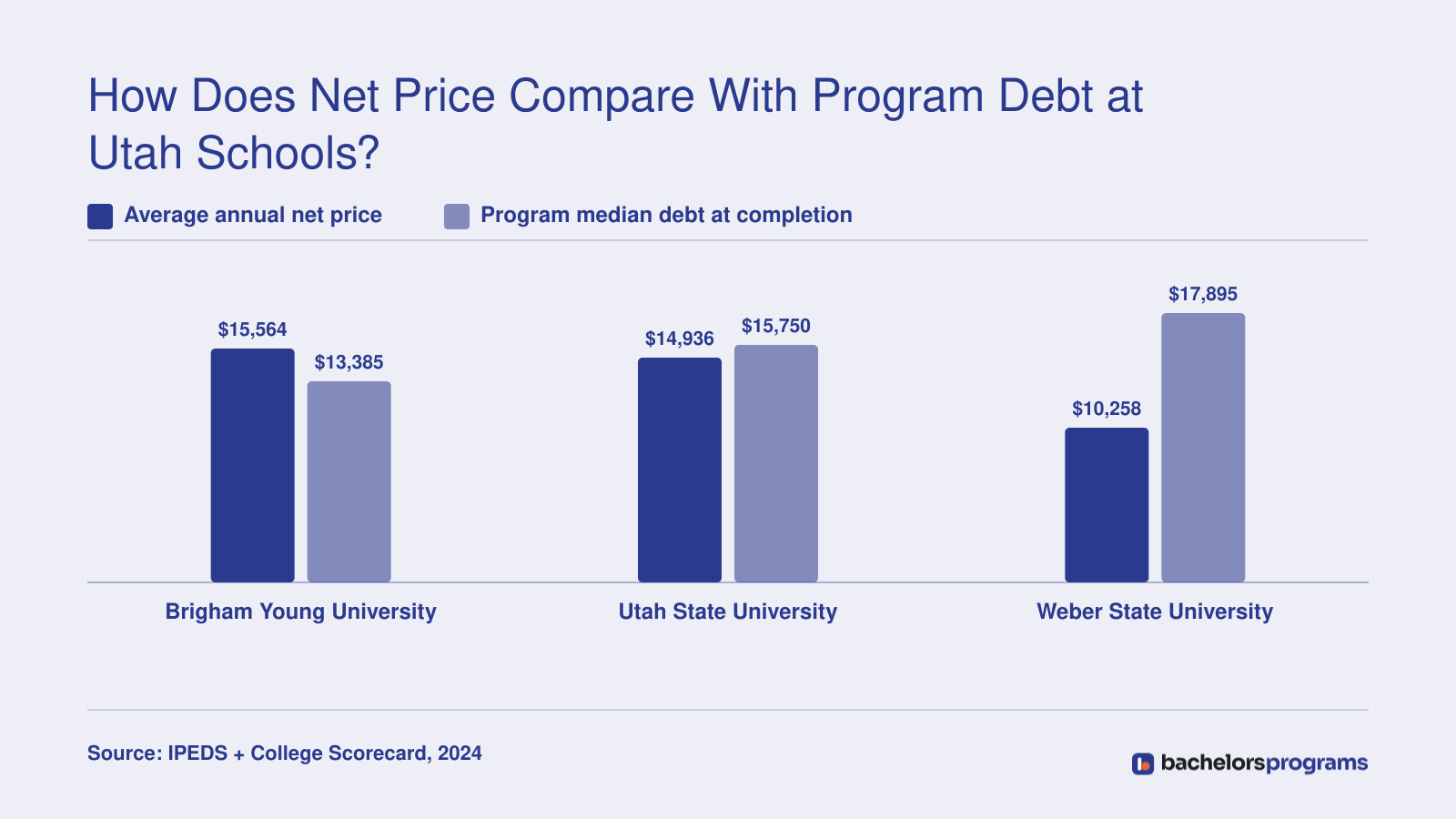
How Does Net Price Compare With Program Debt at Utah Schools?
Weber State University has the lowest average annual net price of these schools, at $10,258, yet its early childhood education graduates finish with the highest program median debt, at $17,895. Brigham Young University shows the opposite pattern: a $15,564 net price paired with $13,385 in median debt. Net price is a one-year figure and debt is the total at graduation, so a low sticker cost alone does not guarantee a low loan balance.
Related Articles
Utah Prek-3 Educator Licensure at a Glance
Questions to Ask Yourself
Do you need a PreK-3 teaching license, or would a non-licensed preschool or child-care role be enough?
Can you complete a full-time student-teaching placement in a Utah school, or do you need an online program with local placement?
Are you transferring credits from a Utah community college, or starting as a freshman?
Compare Early Childhood Education programs on the data that matters
Explore more Education & Teaching majors or browse every field of study.
All Education & Teaching programs Browse every field of study