Best Early Childhood Education Schools in Washington
Compare 12 accredited Early Childhood Education programs in Washington at 11 colleges, with net price after aid, graduation rates, earnings and debt from IPEDS and the U.S. College Scorecard.

The real choice in this field is between a program that carries a Washington teaching certificate and one that does not. A bachelor's degree in early childhood education prepares you for preschool, ECEAP and Head Start classrooms, but teaching transitional kindergarten or K-3 in a public school generally requires certification through a state-approved P-3 program.
Washington schools title the degree several ways, Bachelor of Applied Science, Bachelor of Arts in Education, Bachelor of Arts and Bachelor of Science, and offer it on campus and online.
Cost adds a second variable: published in-state tuition runs from about $4,800 at Highline College to roughly $13,000 at the University of Washington-Seattle Campus.
Key Points
- In-state tuition runs from about $4,800 (Highline) to $13,000 (UW-Seattle).
- UW-Seattle's Early Care and Education bachelor's is offered fully online.
- Certification needs a PESB-approved program, two testing stages, and OSPI approval.
Best Early Childhood Education Schools in Washington: Our Ranked List
These ten Washington schools all award a bachelor's degree in early childhood education or child development, and they range from a large research university with a fully online major to community colleges built around working adults. Each card lists the location and format so you can see quickly which ones fit your schedule and budget. Net price figures are institution-wide averages after aid, not quotes for any individual student.
University of Washington-Seattle Campus
#1Seattle, WA · ~$14,000/yr (est.)
Best for: Working adults wanting a fully online major
The University of Washington's Seattle campus is the state's flagship research university, and its College of Education awards a Bachelor of Arts in Early Care and Education taught entirely online. The major is capacity constrained, so admission depends on a personal statement, transcripts and evidence of interest through work, volunteer or internship experience. Students can pursue departmental honors and join the Early Care and Education Student Leadership Council. Graduation rates at schools offering this program are high, with UW near the top of this list.
- 87 credits of early care and education coursework, delivered fully online
- Covers children from birth through age 8: development, teaching, advocacy
- Applicants need at least 45 transferable credits and a 2.0 GPA
- Personal statement of two to three pages and transcripts required
- At least 64 major credits must be completed through UW Seattle
- Community-based learning experience with community partners
- Departmental honors available for high-achieving students
Western Washington University
#2Bellingham, WA · $10,000 – $29,000/yr (est.)
Best for: Future P-3 teachers seeking licensure
Western Washington University's Woodring College of Education runs a capacity-constrained early childhood major in Bellingham, with the same program offered in Bremerton and Poulsbo. The P-3 option pairs an academic major with professional certification courses that lead to teacher licensure for prekindergarten through third grade, and student teaching spans three quarters, one of them full time. Placements are arranged in Whatcom and Skagit county schools, and graduates go on to public school primary classrooms, preschools, childcare centers and Head Start.
- Bachelor of Arts in Education, Early Childhood Education P-3 option
- Three options: non-certification, P-3, and P-3 with Elementary Education
- Leads to Pre-K through grade 3 teacher licensure in Washington
- Three-quarter student teaching internship, one quarter full time
- Placements in Whatcom and Skagit county schools
- Offered in Bellingham, Bremerton and Poulsbo
- Capacity-constrained major in the Department of Elementary Education
North Seattle College
#3Seattle, WA · $10,000 – $15,000/yr (est.)
Best for: Bilingual educators in Seattle childcare settings
North Seattle College awards a Bachelor of Applied Science in Early Childhood Education designed for students who are already working in the field, with classes in evenings, on weekends and online. The 180-credit degree stacks statewide certificates earned along the way, and prior learning assessment can substitute for a specific course. Instruction is available in Somali, Arabic, Spanish and Oromo, and a Spanish-language version of the degree serves bilingual educators. Graduates qualify as Head Start lead teachers and can move into family support or curriculum specialist roles.
- Bachelor of Applied Science, 180 credits, six quarters full time
- Evening, weekend and online classes for working adults
- Statewide stackable certificates: Initial, Short and State Certificate
- Spanish-language BAS option and instruction in Somali, Arabic and Oromo
- Prior learning assessment can substitute for a specific course
- Prepares graduates for Head Start lead teacher roles
- Monthly virtual information sessions for prospective students
Lake Washington Institute of Technology
#4Kirkland, WA · $6,000 – $12,000/yr (est.)
Lake Washington Institute of Technology in Kirkland offers a Bachelor of Applied Science in Early Childhood Education that accepts students with an associate degree in the field and builds on it over six full-time quarters. The program is hybrid, with some classes online plus evening and weekend options, and admits students three times a year in fall, winter and spring. Admission is selective and requires prerequisite coursework in child development, curriculum, health and safety, observation and assessment, and guiding behavior. The college is accredited at the baccalaureate level by the Northwest Commission on Colleges and Universities.
- Bachelor of Applied Science completed in six full-time quarters
- Hybrid format with evening and weekend class options
- Three start dates per year: fall, winter and spring
- Applicants need an associate degree in early childhood education or related field
- 2.0 GPA plus prerequisites in child development and curriculum
- Aligned with NAEYC standards; NWCCU accredited at baccalaureate level
- Free drop-in tutoring center and quarterly information sessions
Columbia Basin College
#5Pasco, WA · ~$8,000/yr (est.)
Columbia Basin College in Pasco awards a Bachelor of Applied Science in Teacher Education that leads to Washington teacher certification with an early childhood (P-3) endorsement. The degree builds on professional-technical associate degrees such as the AAS, adding general education and upper-division coursework plus student teaching, and most classes run in the evening and online for working adults. The program is approved by the Washington Professional Educator Standards Board. Average tuition to complete an applied bachelor's degree at CBC is about $18,500.
- Bachelor of Applied Science in Teacher Education with P-3 endorsement
- Prepares for Washington teacher certification
- Accepts non-transferable AAS degree credits
- Most classes in the evening and online for working adults
- Includes student teaching experience and 300- and 400-level coursework
- Average tuition to complete the applied bachelor's degree about $18,500
- Approved by Washington Professional Educator Standards Board
Highline College
#6Des Moines, WA · ~$10,000/yr (est.)
Highline College in Des Moines offers a Bachelor of Applied Science in Early Childhood Education focused on leadership and inclusive practices, aimed at students who want to direct programs rather than only teach in them. Graduates pursue roles as center directors and owners, childcare licensors, state trainers, Head Start and ECEAP lead teachers, and family services managers. It is one of seven applied bachelor's degrees at Highline, and the college says these cost a fraction of attending a university. The application fee is waived for all applied bachelor's programs.
- Bachelor of Applied Science in Early Childhood Education: Leadership & Inclusive Practices
- Focus on leadership and inclusive practices, not only classroom teaching
- Prepares for center director, childcare licensor and family services manager roles
- One of seven applied bachelor's degrees at the college
- Application fee waived for applied bachelor's programs
- Designed as a lower-cost alternative to university tuition
Central Washington University
#7Ellensburg, WA · ~$18,000/yr (est.)
Central Washington University in Ellensburg runs early childhood education through its College of Education and Professional Studies, with a major focused on children from birth through grade 3. Students complete quarterly field experience in daycares and centers plus classroom internships, and coursework covers play-based, emergent curriculum across developmental areas. CWU also offers a separate child development and family science degree with a child development specialization for students aiming at research, case management or site coordination. The university reports pathways to teacher certification and endorsements.
- Bachelor of Arts in Early Childhood Education, birth through grade 3 focus
- Quarterly field experience in daycares and early learning centers
- Coursework in play-based, emergent curriculum across developmental areas
- Classroom internships and small class sizes
- Pathways to teacher certification and endorsements
- Separate child development and family science degree with specialization
Eastern Washington University
#8Cheney, WA · ~$14,000/yr (est.)
Eastern Washington University in Cheney blends early childhood education with early childhood special education in a single major that recommends graduates for both a preschool through third grade certificate and a birth through third grade special education certificate. The program requires 99 to 100 major credits and 180 cumulative credits, including field experience, practicum, full-time student teaching and a capstone. Students can add endorsements in elementary education or special education. A minimum 2.0 cumulative GPA is required.
- Blended major in early childhood education and early childhood special education
- Recommends for P-3 early childhood and birth to grade 3 special education certification
- 99 to 100 major credits; 180 cumulative credits to graduate
- Includes field experience, practicum, full-time student teaching and capstone
- Optional add-on endorsements in Elementary Education and Special Education
- 2.0 cumulative GPA minimum with a four-year plan of study
Seattle Pacific University
#9Seattle, WA · ~$24,000/yr (est.)
Seattle Pacific University offers a Bachelor of Arts in Early Childhood Education for students who want to work in early childhood systems without pursuing a teaching certificate. The 94-credit major includes a Foundations Quarter, methods courses and a capstone, and the practicum repeats until it reaches 22 credits, arranged with an advisor in early learning centers. Students may enter the major with a 2.0 cumulative GPA and must earn a C minus or better in major classes. Transfers can enter the major within two quarters.
- Bachelor of Arts in Early Childhood Education, no certification route
- 94 credits total, including 56 upper-division credits
- Practicum repeats to 22 credits in early learning centers
- Foundations Quarter, methods courses and a capstone
- 2.0 GPA to enter; C minus or better in major classes
- Transfers can enter the major within two quarters
Pierce College District
#10Lakewood, WA · ~$10,000/yr (est.)
Pierce College in Lakewood awards a Bachelor of Applied Science in Teaching that leads to Washington teacher certification with two P-3 endorsements, one in early childhood education and one in early childhood special education. The degree builds on an AAS-T in early childhood education and runs as a cohort that starts once a year in fall, with most courses meeting monthly in person at the Fort Steilacoom campus and some weekly in the evening. Applicants need at least 90 college-level credits plus background and fingerprint checks. Applications open February 1, with a June 1 priority deadline.
- Bachelor of Applied Science in Teaching with dual P-3 endorsements
- Early Childhood Education and Early Childhood Special Education endorsements
- Builds on an AAS-T in Early Childhood Education
- Cohort model, one fall start per year, finishing in a set sequence
- Most courses meet monthly at Fort Steilacoom; some weekly evenings
- Applicants need 90 college-level credits and background checks
- Priority deadline June 1, final deadline August 15
Cost & outcomes by school
Federal data for the highest-earning Early Childhood Education programs, independent of the ranking above. Earnings are this field's bachelor's graduates four years after completing where the Scorecard reports them, else the school's undergraduate median.
| School | Net price / yr | Grad rate | Earnings | Debt | Grads/yr | Format |
|---|---|---|---|---|---|---|
| Seattle Pacific University WA | $24,488 | 62% | $64,506 | $24,000 | 4 | Campus |
| Western Washington University WA | $21,193 | 65% | $62,500 | $20,043 | 49 | Campus |
| North Seattle College WA | $10,740 | 33% | $61,250 | $15,458 | 41 | Online or campus |
| University of Washington-Seattle Campus WA | $14,091 | 85% | $59,736 | $15,249 | 80 | Online |
| Central Washington University WA | $18,476 | 54% | $59,659 | $20,205 | 179 | Online or campus |
| Eastern Washington University WA | $13,886 | 44% | $55,671 | $18,994 | 45 | Hybrid |
| Lake Washington Institute of Technology WA | $6,817 | 37% | $50,669 | $15,047 | 8 | Hybrid |
| Highline College WA | $9,879 | 36% | $47,869 | $9,500 | 20 | Campus |
| Pierce College District WA | $10,222 | 31% | $47,532 | $19,000 | 18 | Hybrid |
| Columbia Basin College WA | $8,317 | 33% | $46,680 | $14,829 | 19 | Hybrid |
| Lower Columbia College WA | $7,630 | 23% | $40,691 | $10,506 | 39 | Hybrid |
Sources: U.S. Department of Education. Net price, graduation rate, earnings and debt: College Scorecard (earnings and debt for this field's bachelor's graduates where reported, else school-wide); graduates: IPEDS. A dash means no figure is reported.
Cost, debt & payoff
Median earnings of this field's bachelor's graduates (4 yrs after completing, else the school's undergraduate median) vs. their median federal loan debt · U.S. College Scorecard
Across these programs the median graduate earns about $57,665 and finishes with roughly $17,226 in debt — a ratio that clears a common rule of thumb (keep debt below first-year salary). Net price and debt vary widely school to school, so check the per-school figures in the table above before you shortlist.
How We Ranked Washington Bachelor's Degree in Early Childhood Education Schools
Before you apply, confirm each school's standing yourself. Institutional accreditation, state program approval, professional accreditation, and program recognition are four separate things, and a school can hold one without the others. Start on the school's official website and program page, where current statements should name the body involved and point to evidence.
Four Checks for Every School
- NWCCU: The Northwest Commission on Colleges and Universities accredits the institution. Its directory lists Seattle Pacific University, Highline College, Pierce College, and Lower Columbia College as accredited.1 Institutional accreditation does not automatically cover every degree.
- PESB: The Washington Professional Educator Standards Board approves programs that lead to a teaching certificate or endorsement. A bachelor's degree alone does not make you certificate-eligible. Seattle Pacific's program is listed as a no-certification track, so check the pathway at every school.
- CAEP: This is professional accreditation of educator preparation. It is separate from NWCCU and PESB, and it may not cover every campus or program.
- NAEYC: This recognition is specific to an early childhood program. It does not prove institutional accreditation or certification eligibility.
How to Confirm a Claim
Search the NWCCU, PESB, CAEP, and NAEYC directories for the exact institution and program name. Look at current status, scope, and review dates. If a program page is vague or the directories do not match it, contact the school's accreditation office or education department and ask for the status in writing. Rely on the official directories and the school, not third-party summaries, because status and review dates change.
Context Beyond Accreditation
For career and outlook context, use BLS.gov. For field standards, look to professional associations such as NAEYC. Then use those checks to compare the Washington bachelor's programs on equal terms.
Cheapest Bachelor's in Early Childhood Education Programs in Washington
These programs post the lowest average net price among Washington schools offering a bachelor's degree in early childhood education, based on 2024 IPEDS and College Scorecard data from the U.S. Department of Education. In-state tuition is the published annual price before any grants or scholarships. Average net price is an institution-wide figure for all aided undergraduates, not a cost specific to the early childhood program. Pierce College District also reports a program-level median debt of $19,000, and Columbia Basin College advertises $18,500 in total program tuition for its applied bachelor's.
| School | City | Program | Format | In-State Tuition (per year) | Average Net Price (per year) | Pell Grant Recipients | Program Median Debt |
|---|---|---|---|---|---|---|---|
| Lake Washington Institute of Technology | Kirkland | Early Childhood Education | Hybrid | $5,997 | $6,817 | 72.7% | N/A |
| Lower Columbia College | Longview | Teacher Education Bachelor in Applied Science (BAS) | Hybrid | $4,626 | $7,630 | 91.2% | N/A |
| Columbia Basin College | Pasco | Bachelor of Applied Science in Teacher Education | Hybrid | $6,555 | $8,317 | 87.8% | N/A |
| Highline College | Des Moines | Bachelor of Applied Science in Early Childhood Education: Leadership & Inclusive Practices | Campus | $4,772 | $9,879 | 92.9% | N/A |
| Pierce College District | Lakewood | Bachelor of Applied Science in Teaching (BAS-T) | Hybrid | $5,418 | $10,222 | 81.0% | $19,000 |
Related Articles
Online and Hybrid Bachelor's in Early Childhood Education Options at Washington Schools
Washington offers more flexibility than most states, but the format you choose decides whether you finish with a teaching certificate or not.
Delivery formats at a glance
- Online: University of Washington-Seattle Campus (Early Care and Education), plus fully online options at North Seattle College and Central Washington University.
- Hybrid: Lake Washington Institute of Technology, Columbia Basin College, Eastern Washington University and Pierce College District. Pierce's courses mostly meet in person monthly on weekday evenings.
- Campus: Western Washington University, Highline College and Seattle Pacific University.
Practicum and student teaching
Online does not mean placement-free. North Seattle College requires at least five hours a week in a formal setting serving children ages 0 to 8, and students need a camera and microphone for video teaching demonstrations.1 UW's online program includes weekly community-based learning.2 Central Washington's birth to grade 3 online major requires a double major with Elementary Education or Educational Foundations, and its placement terms are not clearly published.3
Out-of-state students and licensure
None of the program pages we reviewed confirms that an out-of-state student can complete placements at home. Ask each admissions office directly before you apply. North Seattle College and UW both state that their online programs do not lead to a teaching certificate. Washington certification pathways with built-in student teaching, such as Western Washington, Columbia Basin and Eastern Washington, are best planned around in-state placements.
Who should choose what
Online and hybrid formats suit working paraprofessionals, Head Start staff and career changers who need to keep their jobs and already work in a classroom or center. Choose a campus or hybrid certification route if your goal is a Washington teaching certificate and you can commit to full-time student teaching.
Admission Requirements for Washington Early Childhood Education Bachelor's Programs
Admission to a Washington early childhood bachelor's program usually happens in two stages: getting into the school, then entering the major or applied bachelor's cohort. Among schools that report an admission rate, the University of Washington-Seattle Campus is the most selective at 39%, while Western Washington, Central Washington, Eastern Washington and Seattle Pacific admit most applicants. Community college applied bachelor's programs admit on prior credits and prerequisites instead. Classroom placements often call for clearances such as the background and fingerprint checks Pierce College lists, so confirm each requirement with the school's admissions office before you apply.
| School | Minimum GPA | SAT/ACT Policy | Transfer Credit and Pathways | Program-Entry Steps | Admission Rate |
|---|---|---|---|---|---|
| University of Washington-Seattle Campus | 2.0 | No policy published | 45 transferable credits required to enter the Early Care and Education major | Capacity-constrained, limited admission; two-to-three page personal statement | 39% |
| Western Washington University | No policy published | No policy published | No policy published | Capacity-constrained major; one third-party listing shows a P-3 option in moratorium, so confirm current status | 93% |
| North Seattle College | No policy published | No policy published | An AAS or AAS-T in early childhood education or a related field is the best preparation; any two- or four-year degree may be considered; applicants with more than 70 transferable college-level credits and no degree may apply | Online application; prerequisite courses required for applicants without an early childhood associate degree | N/A |
| Lake Washington Institute of Technology | 2.0 | No policy published | No policy published | Selective admission with a separate application; prerequisite courses; rolling admissions with fall, winter and spring starts | N/A |
| Columbia Basin College | No policy published | No policy published | Builds on professional-technical associate degrees and accepts non-transferable AAS credits | Designed for associate degree holders; includes student teaching | N/A |
| Central Washington University | No policy published | No policy published | Des Moines route, offered at Highline College, requires CWU general education through a Direct Transfer Agreement (DTA), a bachelor's degree, or an equivalent credential | Ellensburg program requires a minor or second major | 91% |
| Eastern Washington University | 2.0 | No policy published | No policy published | Field experience, practicum and full-time student teaching built into the major | 91% |
| Seattle Pacific University | 2.0 | No policy published | Transfer students enter the major within two quarters | C- or better required in major classes | 83% |
| Pierce College District | No policy published | No policy published | 90 college-level credits required; builds on an AAS-T in Early Childhood Education | Background and fingerprint checks; prerequisite courses; fall cohort start with a June 1 priority deadline and an August 15 final deadline | N/A |
Cost of a Bachelor's in Early Childhood Education in Washington
Tuition Versus Net Price
Among the ranked schools, published in-state tuition runs from about $4,800 at Highline College to roughly $13,000 at the University of Washington-Seattle Campus. Net price after aid tells a different story. It runs from about $6,800 at Lake Washington Institute of Technology to about $21,200 at Western Washington University. Net price counts housing, food, books, and transportation, then subtracts grants. That is why a low-tuition applied bachelor's program can still show a net price above its tuition.
Pell Grant share and median debt show who gets need-based aid and who borrows. The share of students receiving Pell runs from about 53% at Western Washington to about 93% at Highline. Median debt among completers runs from $9,500 at Highline to $19,500 at Eastern Washington University and Central Washington University. These are school-wide figures, not outcomes for this major specifically.
Washington College Grant
The Washington College Grant is the main state need-based award. It is open to Washington residents, including undocumented students, of any age, full-time or part-time, who do not yet hold a bachelor's degree.1 For 2026-27, a family of four qualifies for a full award at $83,500 or less, a partial award up to $104,500, and some aid up to $139,500.1 A family of two gets a full award at $57,000 or less. Full-time students can generally use it for up to 12 semesters or 18 quarters.2
There is no separate application. Submit the FAFSA, or the WASFA if you are not eligible for federal aid, and you are considered automatically.3 Award amounts vary by income, family size, enrollment, and the school you attend.
Other State Aid
The Washington State Opportunity Scholarship serves low- and middle-income students in trade, health-care, and STEM fields and pays quarterly.4 Whether an early childhood program qualifies is not clear from the public information, so ask your school. Early learning workforce funding through DCYF, including Early Achievers-related options, may also exist for working educators. Confirm current eligibility directly.
State aid amounts change every year. Check the school's financial aid office and the Washington Student Achievement Council (WSAC) for current figures before you budget.
What Early Childhood Educators Earn in Washington
Early childhood pay in Washington varies by role, region, work setting, and experience, so treat any single figure as a starting point and confirm current numbers before you compare offers. The Bureau of Labor Statistics posts Washington median wages and employment counts in its Occupational Employment and Wage Statistics (OEWS) state tables and national job outlook in its Occupational Outlook Handbook, but OEWS data is updated once a year and can lag current hiring conditions, so cross-check it against Washington school district and educational service district job postings, public salary schedules, community and technical college and private school employment pages, Washington Employment Security Department and WorkSource wage data, and Child Care Aware of Washington for childcare and early learning roles. Before you negotiate, ask employer HR offices and groups such as NAEYC, the Washington Education Association, and childcare provider unions or associations for current pay ranges, benefits, and outlook, then compare offers across public school, private school, and childcare settings.
| Occupation | Median Annual Wage (WA) | Employment (WA) | Typical Setting |
|---|---|---|---|
| Preschool teachers (except special education) | Check the BLS OEWS Washington table; compare with center and private school postings | Check the BLS OEWS Washington table | Preschools, day care centers, and other child development facilities |
| Kindergarten teachers (except special education) | Check district salary schedules and the BLS OEWS Washington table | Check the BLS OEWS Washington table | Kindergarten classrooms |
| Elementary school teachers (except special education) | Check district salary schedules and the BLS OEWS Washington table | Check the BLS OEWS Washington table | Elementary schools |
| Childcare workers | Check the BLS OEWS Washington table and Child Care Aware of Washington | Check the BLS OEWS Washington table and WorkSource data | Schools, businesses, private households, and childcare institutions |
| Preschool and childcare center directors | Check the BLS OEWS Washington table and ask employer HR offices | Check the BLS OEWS Washington table | Preschools, childcare centers, and before- and after-school care programs |
Washington Teacher Licensure and Where Early Childhood Graduates Work
A classroom teaching certificate and a degree without certification lead to different jobs, so decide which one you want before you pick a program.
The Washington Certification Route
The Professional Educator Standards Board (PESB) approves every teacher preparation program in the state.1 The path runs in four steps:
- Program: Complete a PESB-approved preparation program.2 PESB warns that providers do not run every approved program each year, so confirm the endorsement is currently offered.3
- Residency certificate: The residency teacher certificate requires basic-skills and content-knowledge assessments.4 Check with your program about which basic-skills test applies and whether you qualify for an exemption.
- Endorsement: Early Childhood Education is an add-on endorsement to the residency certificate.5 PESB lists NES as its content assessment for it, though its general framework also mentions WEST-E depending on the area.6
- edTPA: It is no longer a state requirement. The Legislature eliminated it in 2021 through 2SHB 1028.4 Programs may still use it formatively if they disclose that.4
K-3 Certification and the Early Childhood Endorsement
The two overlap. Early childhood preparation is generally built around the primary grades plus younger children, while elementary endorsements center on kindergarten onward. Western Washington University's P-3 option reflects this blend. Confirm the exact grade span with PESB before assuming it covers the job you want.
Where Graduates Work
Rules for these settings come from agencies other than PESB, so verify current standards with each employer. These notes reflect general practice.
- Transitional kindergarten: Run by public school districts. Districts typically staff it with certificated teachers, but check the district's posting.
- ECEAP: The state-funded preschool program, administered through the Department of Children, Youth, and Families (DCYF), for eligible children not yet in kindergarten. Staff qualifications are set by state program standards.
- Head Start: A federally funded program serving income-eligible families through local grantees. Federal rules set degree expectations for teaching staff, and a certificate is generally not the requirement.
- Private preschool: Licensed by the state and run independently. Qualifications vary by employer, and many accept a degree or credential without a teaching certificate.
Seattle Pacific University's no-certification bachelor's fits the last two settings, while certificate-track programs suit public school classrooms.
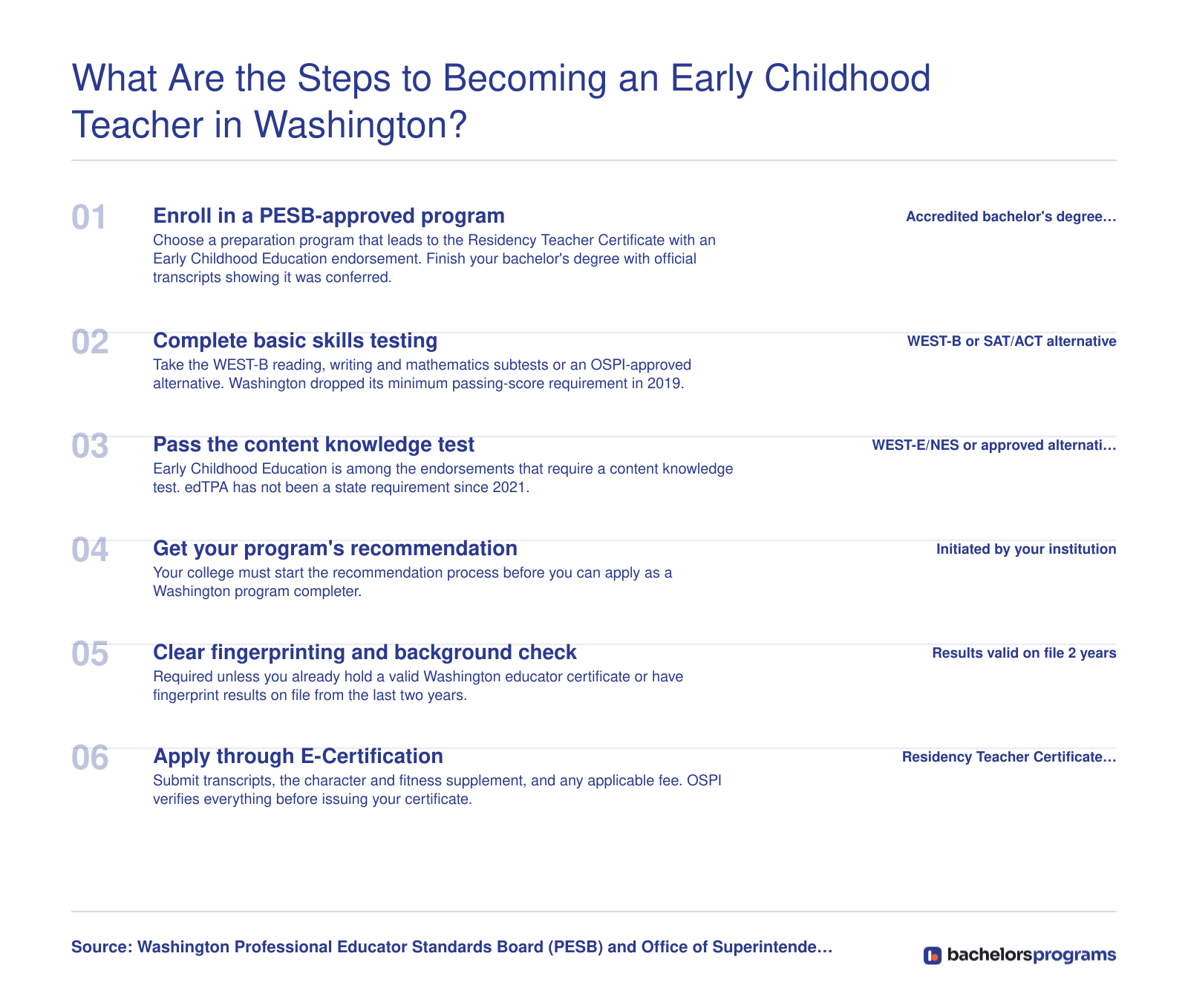
What Are the Steps to Becoming an Early Childhood Teacher in Washington?
Washington's route to teaching young children runs through a state-approved bachelor's program, two testing stages, and an OSPI application. The order matters because you cannot apply for your certificate until your program recommends you.
Choosing the Right Washington School for Your Bachelor's in Early Childhood Education
The hard part of this choice is balancing price against flexibility, and neither one matters if the program does not lead to the credential you need. Start with your goal, then use cost and format to narrow the list.
Match the School to Your Goal
- Public school teaching: Look for programs that include a teacher preparation pathway and a Washington residency certificate. Western Washington University's P-3 option and Eastern Washington University's early childhood and special education major are built around teaching. Seattle Pacific University's option carries no certification, so it fits a different goal.
- Lowest cost: Compare net price after aid, not sticker tuition. The applied baccalaureate programs at the community and technical colleges generally cost less than the university programs.
- Online flexibility: Confirm whether student teaching or practicum hours still require in-person placements near you, and check how each program delivers its coursework.
- Location: Seattle-area students can choose among the University of Washington, North Seattle College, Highline College, Lake Washington Institute of Technology and Seattle Pacific University. Pierce College District serves Tacoma-area students, Central Washington University is in Ellensburg, Eastern Washington University is near Spokane, and Columbia Basin College and Lower Columbia College serve more rural parts of the state.
Community College Students: Confirm Before You Commit
Before you enroll, ask the program in writing which associate credits transfer and whether your coursework covers the endorsements you want. Transfer-friendly applied degrees are designed for associate holders, but requirements differ from school to school.
Your Next Step
Request information from the programs that fit your goal, then compare financial aid offers side by side.
Compare Early Childhood Education programs on the data that matters
Explore more Education & Teaching majors or browse every field of study.
All Education & Teaching programs Browse every field of study