Best Elementary Education Degree Programs in Colorado
Compare 11 accredited Elementary Education programs in Colorado, with net price after aid, graduation rates, earnings and debt from IPEDS and the U.S. College Scorecard.

The Colorado Department of Education, not the university, issues a Colorado elementary teaching license, and that fact shapes every bachelor's degree in elementary education in the state. Programs fold the coursework, the supervised student teaching semester and the state content exams into the degree itself.
The most common credential is the Bachelor of Arts (B.A.) in Elementary Education, though at least one Colorado school awards a Bachelor of Science with the same licensure track attached.
What separates the choices is money and geography. Net price after aid varies sharply between regional publics and private colleges, yet the license at the end is identical.
Key Points
- Colorado State University Pueblo posts the lowest net price after grant aid.
- The Colorado Department of Education, not your college, issues the teaching license.
- Online or hybrid formats still require in-person student teaching in real classrooms.
Best Elementary Education Schools in Colorado: Our Ranked List
Colorado offers several routes into an elementary classroom, from a small liberal arts college in Colorado Springs to regional public universities that serve their own corner of the state. Every program below is a bachelor's degree in elementary education that leads to a Colorado teaching license, and several add endorsements that widen what a graduate is qualified to teach. Each entry covers what the program asks of students, how much time they spend in real classrooms, and which applicants tend to fit best.
Colorado College
#1Colorado Springs, CO · ~$33,000/yr (est.)
Best for: Small liberal arts campus experience
A private liberal arts college in Colorado Springs with small classes and a tight-knit residential campus, Colorado College pairs a broad liberal arts foundation with a state-approved route to elementary licensure. The elementary teaching license track was rebuilt for 2026 and now runs 17 units, with four practicum placements and a senior research capstone that sits inside student teaching. Applicants who want a small-cohort, discussion-driven program rather than a large school of education tend to land here.
- 17 units total: 13 major units plus 4 certification units
- Four practicum units plus one senior research capstone
- Capstone embedded in student teaching
- Coursework in pedagogy, education policy, law, and research methods
- Requirements updated for 2026 and entering the catalog next cycle
- Track is new and leads to elementary teacher licensure
University of Colorado Boulder
#2Boulder, CO · $25,000 – $30,000/yr (est.)
Best for: Aspiring K-6 teachers seeking a research university
Colorado's flagship public research university, CU Boulder runs its elementary education program inside the School of Education and places students with Front Range partner schools for clinical work. The BA leads to a K-6 license with an added endorsement in culturally and linguistically diverse education, and licensure candidates log more than 800 hours in public classrooms before graduating. Current CU students can move into the major through an intra-university transfer rather than starting over as first-years.
- Leads to a Colorado K-6 teaching license
- Adds an endorsement in Culturally and Linguistically Diverse Education
- More than 800 hours in public elementary classrooms and community settings
- Methods courses for every subject taught in self-contained classrooms
- Open to first-year applicants or by intra-university transfer
- Fieldwork in schools along the Front Range
Colorado Mesa University
#3Grand Junction, CO · ~$15,000/yr (est.)
Best for: West Slope residents wanting local licensure pathways
A public university in Grand Junction, Colorado Mesa serves the Western Slope with a four-year elementary education degree built on heavy field experience. Students complete 120 semester hours, including 840 field experience hours and a 12-credit teaching internship, largely in western Colorado schools. Formal admission to the Center for Teacher Education comes after 60 credits of content and essential learning coursework, so students should plan the prerequisites early.
- 120 semester hours, including 840 field experience hours
- 12-credit teaching internship in western Colorado schools
- Over 200 classroom hours before student teaching
- Admission requires 60 credits of coursework and a 2.80 GPA
- EDUC 115 and EDUC 215 must be completed before applying
- PRAXIS II content exam required before the internship
- C or better in required courses; B or better in all EDUC courses
University of Northern Colorado
#4Greeley, CO · $18,000/yr (est. net price)
The University of Northern Colorado in Greeley runs one of the state's larger elementary education pipelines and has a long-standing reputation for preparing teachers. The 120-credit BA leads to a Colorado K-6 license and requires more than 900 hours in K-6 classrooms, 100 above the state minimum. Eight concentrations let students specialize in mathematics, science, social studies, special education, or a non-licensure educational studies track, and a five-year path adds a master's degree with the fifth year delivered online.
- 120 credits over four years, leading to a Colorado K-6 license
- 900 clinical hours, 100 above the state requirement
- Eight concentrations, including mathematics, science, and special education
- Non-licensure Educational Studies option available
- Five-year BA to MAT path with the fifth year fully online
- School reports 95% job placement for graduates
- Future Teacher Club for networking
Western Colorado University
#5Gunnison, CO · $16,000/yr (est. net price)
A small public university in Gunnison, Western Colorado built its elementary education major around a year-long clinical residency that seniors complete in an elementary classroom, including placements outside Colorado or abroad. The first three years are content-heavy, and education coursework during the residency runs online with a summer session beforehand. Western was the first Colorado university program approved as meeting READ Act requirements, and it also runs a licensure pathway for paraprofessionals through its Adult Degree Completion program.
- First three years are content coursework; senior year is a clinical residency
- Residency can be completed in an elementary classroom anywhere in the world
- Education coursework online during student teaching, plus a summer session
- First Colorado university program approved for READ Act requirements
- Licensure pathway for paraprofessionals through Adult Degree Completion
- Foundation scholarships offered specifically for this program
University of Colorado Colorado Springs
#6Colorado Springs, CO · $10,000 – $24,000/yr (est.)
The University of Colorado Colorado Springs takes an inclusive approach, bundling a K-6 initial license with a special education generalist endorsement and a culturally and linguistically diverse education endorsement inside a single 122-credit degree. Students spend more than 1,000 hours in inclusive classrooms with mentor teachers providing coaching and feedback. The program runs on campus, online, and in hybrid form, and UCCS teacher preparation recently earned A grades from the National Council on Teacher Quality for reading instruction.
- 122 credits combining a K-6 initial license with two endorsements
- Special Education Generalist endorsement for ages 5-21
- Culturally and Linguistically Diverse Education K-12 endorsement
- Over 1,000 hours in inclusive instructional settings
- Available on campus, online, or hybrid
- Admission requires a 2.75 cumulative CU GPA
- B- or better in all IELM courses
- Praxis 5903, 5205, and 5355, or approved content competency measures
Colorado Christian University
#7Lakewood, CO · $25,000 – $30,000/yr (est.)
A private Christian university in Lakewood, Colorado Christian University runs its elementary education licensure degree through the Adult Undergraduate Education program, built for students balancing study with work and other commitments. The degree combines 45 general education credits, a 50-credit professional core, and 25 elective credits, and entry into the professional core is selective rather than automatic. Applicants complete a background check and a small-group webinar, and conditional admission can cover up to 9 outstanding general education credits.
- 45 general education credits, a 50-credit professional core, and 25 elective credits
- General education spans arts and humanities, biblical studies, and communications
- Cumulative 2.75 GPA in CCU coursework required
- SEP background check and a 30-minute small-group webinar
- 9 CCU credit hours must be complete before admission
- Professional core admission is not guaranteed
- Conditional admission with up to 9 general education credits outstanding
Colorado State University Pueblo
#8Pueblo, CO · $10,000/yr (est. net price)
A regional public university in Pueblo, CSU Pueblo awards a Bachelor of Science in Elementary Education with a K-6 teacher preparation concentration and requires an education minor for traditional licensure. The 123-credit degree splits into 35 general education credits, 61 major credits, and a 27-credit minor, with coursework covering English language learners, gifted learners, and family engagement. Admission to the School of Education requires a 2.600 cumulative GPA, and student teaching requires a 2.500 GPA in the major with a C or better in every required course.
- 123 credits: 35 general education, 61 major, and a 27-credit minor
- Education minor required for traditional licensure
- 2.600 cumulative GPA for School of Education admission
- 2.500 GPA in the major for admission to student teaching
- C or better in every required course
- 1-credit capstone seminar plus a student teaching semester
- Outcomes tracked through eportfolios and supervisor ratings
Adams State University
#9Alamosa, CO · $13,000/yr (est. net price)
Adams State University in Alamosa offers elementary education on campus and through a fully online degree completion option designed for candidates who already hold an associate degree. The School of Education reports that 99% of graduates are employed within 90 days and that 73% of teachers and administrators in the Alamosa School District are alumni. A tuition scholarship is among the aid options for education students, and coursework includes methods and educational psychology.
- Fully online degree completion option for associate degree holders
- On-campus and online routes to a BA in Elementary Education
- Coursework includes ED 310 science methods and ED 345 educational psychology
- Student teaching field experience required
- School reports 99% of graduates employed within 90 days
- Tuition scholarship available for education students
Fort Lewis College
#10Durango, CO · ~$17,000/yr (est.)
Fort Lewis College sits in Durango and prepares students for the Colorado Elementary Education License through a sequenced four-year roadmap. Students move through ED 222, ED 341, and ED 342 with grades of B- or better, hold a 2.75 GPA, and clear a fingerprint and background check before student teaching. Graduates go into classroom teaching, bilingual coordination, English language learner support, and curriculum development, and scholarships are available along the way.
- 2.75 GPA required, with B- or better in ED 222, ED 341, and ED 342
- Sequenced roadmap from first year through senior year
- Elementary Content Test registration before student teaching
- Immersion I begins junior spring; student teaching in the spring
- Fingerprint and background check required
- Leads to the Colorado Elementary Education License
- Career paths include bilingual coordinator and curriculum developer
Cost & outcomes by school
Federal data for the highest-earning Elementary Education programs, independent of the ranking above. Earnings are this field's bachelor's graduates four years after completing where the Scorecard reports them, else the school's undergraduate median.
| School | Net price / yr | Grad rate | Earnings | Debt | Grads/yr | Format |
|---|---|---|---|---|---|---|
| University of Colorado Boulder CO | $25,346 | 74% | $69,738 | $19,500 | 74 | Campus |
| Colorado College CO | $33,375 | 88% | $65,222 | $18,257 | 15 | Campus |
| Colorado State University Pueblo CO | $10,051 | 40% | $55,563 | $21,500 | 5 | Campus |
| Metropolitan State University of Denver CO | $15,327 | 32% | $49,025 | $23,528 | 69 | Campus |
| Western Colorado University CO | $16,425 | 51% | $46,833 | $20,250 | 7 | Campus |
| University of Colorado Colorado Springs CO | $15,788 | 47% | $46,244 | $25,000 | 75 | Online or campus |
| Colorado Mesa University CO | $15,103 | 41% | $45,823 | $22,000 | 3 | Campus |
| University of Northern Colorado CO | $17,760 | 51% | $45,008 | $22,250 | 116 | Campus |
| Adams State University CO | $12,980 | 39% | $44,372 | $19,500 | 4 | Online or campus |
| Colorado Christian University CO | $29,500 | 64% | $43,168 | $25,750 | 30 | Campus |
| Fort Lewis College CO | $17,296 | 36% | $41,032 | $18,389 | 12 | Campus |
Sources: U.S. Department of Education. Net price, graduation rate, earnings and debt: College Scorecard (earnings and debt for this field's bachelor's graduates where reported, else school-wide); graduates: IPEDS. A dash means no figure is reported.
Cost, debt & payoff
Median earnings of this field's bachelor's graduates (4 yrs after completing, else the school's undergraduate median) vs. their median federal loan debt · U.S. College Scorecard
Across these programs the median graduate earns about $46,244 and finishes with roughly $21,500 in debt — a ratio that clears a common rule of thumb (keep debt below first-year salary). Net price and debt vary widely school to school, so check the per-school figures in the table above before you shortlist.
How We Ranked Colorado Bachelor's Programs in Elementary Education
Tuition, graduation rates and graduate earnings rarely point the same way, which makes comparing Colorado elementary education programs difficult.
What Moves a Program Up the List
Cost carries the most weight: net price after grant aid, not the sticker tuition, because that is the number a family actually pays. Outcomes come next, including earnings and typical debt for graduates. Completions matter too, since a program that steadily produces licensed teachers signals real capacity and advising support. Graduation rate rounds out the picture, because a weak rate suggests students are stalling somewhere between enrollment and a teaching license.
Where the Numbers Come From, and What They Miss
Both numbers are institution-wide averages. They describe the whole university, not the elementary education major, so read them as context rather than a verdict on one department. Net price is also approximate; it shifts with housing, meal plans, scholarship stacking and how many credits a student transfers in.
Program-level earnings and debt come from the federal College Scorecard and are measured at a stated window after students finish, not at graduation. A first-year teacher's salary is not a mid-career salary, and a program feeding high-cost districts along the Front Range can look different from one serving rural southern Colorado.
How to Use This List
Scope is bachelor's programs only, campus and online, at Colorado-based schools. Treat the ranking as a shortlist, then verify the one thing it cannot settle: whether the program's clinical practice and state-approved preparation lead to a Colorado initial teacher license.
Cheapest Bachelor's Programs in Elementary Education in Colorado
These Colorado public universities are sorted by average annual net price, the cost after grants and scholarships, using 2024 IPEDS and College Scorecard data from the U.S. Department of Education. Colorado State University Pueblo has the lowest net price at $10,051 a year, and in-state tuition and fees across the table run from $9,720 to $11,124. Tuition, net price, debt and earnings figures are institution-wide, not specific to the elementary education major, so confirm program fees and student teaching costs with each school.
| School | City | Program | Format | In-State Tuition and Fees | Average Net Price | Median Debt at Graduation | Median Earnings 10 Years After Entry |
|---|---|---|---|---|---|---|---|
| Colorado State University Pueblo | Pueblo | Elementary Education: K-6 Teacher Preparation Concentration, Bachelor of Science | Campus | $9,720 | $10,051 | $21,500 | $55,563 |
| Adams State University | Alamosa | Elementary Education | Campus and online | $9,824 | $12,980 | $19,500 | $44,372 |
| Colorado Mesa University | Grand Junction | Education: Elementary Education (BA) | Campus | $9,927 | $15,103 | $22,000 | $45,823 |
| Metropolitan State University of Denver | Denver | Elementary Education Major, B.A. | Campus | $11,124 | $15,327 | $21,500 | $52,093 |
| University of Colorado Colorado Springs | Colorado Springs | Inclusive Elementary Education, BA | Campus and online | $10,149 | $15,788 | $20,000 | $54,659 |
Cost of a Bachelor's Degree in Elementary Education in Colorado
Two numbers decide what a Colorado elementary education degree actually costs: published in-state tuition and fees, and the net price a family pays after grants and scholarships. The gap between them, and between public and private schools, is where most budgeting mistakes happen.
Sticker Price vs. Net Price
Among the public schools here, annual in-state tuition and fees run from $6,120 at Adams State University to $13,510 at the University of Colorado Boulder. Colorado Christian University, the private school here, lists $27,631. Net price tells a different story. Colorado Christian's average net price is $29,500, well below its sticker price. Colorado State University Pueblo's is $10,051, and Boulder's is $25,346.
Treat net price as an estimate. It is an institution-wide average for aided students, not a figure for education majors, and it includes living costs as well as tuition. That is why a public school's net price can sit above its tuition line. Your own number depends on income, residency and housing.
Colorado Aid Education Majors Can Use
Availability, deadlines and participating schools vary, and the sources do not show that these programs can be combined. Confirm details with each school.
- TREP: Students in an educator career pathway can take college courses at no tuition for up to two years after 12th grade, which trims the credits left to pay for later.2
- Colorado Opportunity Scholarship Initiative: Funds flow through local partner programs rather than one statewide award. Students generally need financial need (roughly 0 to 250 percent of Pell eligibility), Colorado residency for tuition purposes and enrollment at an eligible public institution.1
- Teach Colorado: A free service offering licensure coaching, program information and fee reimbursement guidance.3
- Rural commitments: Up to $4,000 for student teaching in a rural school, and up to $10,000 toward preparation tuition, each tied to teaching in a rural district for three years.4
- Residency stipends: Up to $11,000 for a 16-week placement and up to $22,000 for a 32-week placement, paying for clinical time.4
Planning the Total
Plan for about four years. A rough multiple of annual net price gives a starting estimate: about $40,000 at Colorado State University Pueblo, or about $101,000 at Boulder, before any teacher-specific awards.
File the FAFSA or the Colorado Application for State Financial Aid (CASFA) as early as possible, since many awards are first-come. Then ask each education department directly about teacher-specific scholarships, because those often are not advertised on general aid pages.
Online and Hybrid Elementary Education Options at Colorado Schools
Many future elementary teachers in Colorado weigh online against campus first, and the two formats differ less than the labels suggest. What changes is where you take your coursework. What stays the same is the hundreds of hours you will spend in a real elementary classroom before you graduate.
Which programs offer an online or hybrid route
- Colorado Christian University: the licensure track is offered online statewide, and the professional core can be completed in 16 months, with field hours in the student's own community and remote coaching from university field supervisors.
- University of Colorado Colorado Springs: the Inclusive Elementary Education bachelor's is offered online, with roughly 1,000 clinical hours built into the degree.
- Adams State University: lists a fully online option, including a route designed for students who arrive with an associate degree.
- University of Northern Colorado: blends in-person, online and hybrid classes at its Denver-Lowry site, built around students working paid paraprofessional jobs during the school day.2
- Western Colorado University: offers both in-person and online delivery, with a year-long clinical residency and education coursework taken online while student teaching.3
- Campus-based: Colorado College, CU Boulder, Colorado Mesa, CSU Pueblo and Fort Lewis organize their programs around on-campus attendance.
Field hours do not move online
Programs that lead to a Colorado license include field experience, and student teaching in a school classroom is standard even when the seminars are virtual. Colorado Christian, for instance, requires 60 field hours in the first semester, 70 in the second, then a 640-hour full-time student-teaching practicum. Placements are generally arranged in the community where you live, so students living outside Colorado should ask early how supervision and a mentor teacher will be handled, and whether a particular district can be guaranteed.
Who the flexible formats suit
Working parents, paraprofessionals already in a school building, career changers, and transfer students arriving with an associate degree.
Confirm the license before you enroll
A Colorado license does not automatically travel across state lines. Confirm the program is a CDE-approved educator preparation program1, and if you plan to teach outside Colorado, ask about reciprocity.
Related Articles
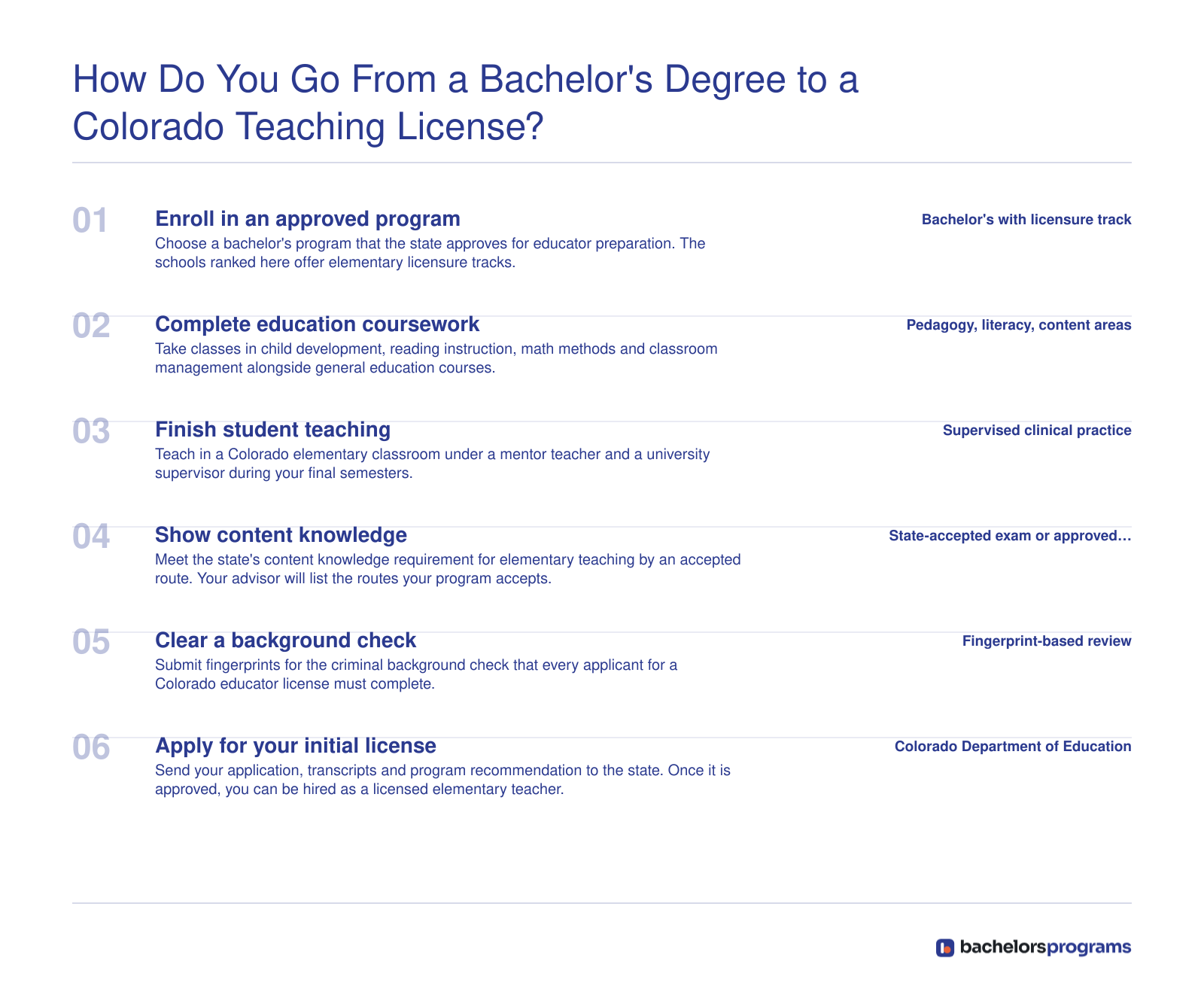
How Do You Go From a Bachelor's Degree to a Colorado Teaching License?
A bachelor's degree in elementary education is the first part of the path to a Colorado classroom. The license itself comes from the Colorado Department of Education. These steps show the usual order, and your program's licensure office will confirm the exact requirements in effect when you apply.
Common Questions About Elementary Education Degrees in Colorado
These answers draw on the 2026 comparison of the schools ranked here. It is one comparison built on public federal data, not an official state or accreditor ranking.
What are the best elementary education degree programs in Colorado?
Which Colorado schools offer an elementary education degree online?
How much does a bachelor's degree in elementary education cost in Colorado?
Does an elementary education degree in Colorado lead to a teaching license?
How long does it take to earn a bachelor's degree in elementary education in Colorado?
Compare Elementary Education programs on the data that matters
Explore more Education & Teaching majors or browse every field of study.
All Education & Teaching programs Browse every field of study