Best Elementary Education Degree Programs in Hawaii
Compare 4 accredited Elementary Education programs in Hawaii, with net price after aid, graduation rates, earnings and debt from IPEDS and the U.S. College Scorecard.

A bachelor's degree in elementary education is the standard route into a Hawaii K-6 classroom, and the credential itself varies: the University of Hawaii awards a Bachelor of Education, Hawaii Pacific University a Bachelor of Arts, and Brigham Young University-Hawaii a Bachelor of Science. The Hawaii Teacher Standards Board licenses teachers, so the program you choose has to lead to that license.
The tension is practical: Honolulu living costs are high, teacher pay is modest, and student teaching takes a full semester. Every school here is Hawaii-based, whether you study on campus or online.
The Department of Education still reports vacancies each fall, so licensed graduates stay in demand.
Key Points
- University of Hawaii at Manoa ranks first and offers neighbor-island distance study.
- At Manoa, apply to elementary education after 55 credits and prerequisites.
- Hawaii still faced 1,000 to 1,200 teacher vacancies in 2026.
Best Bachelor's Degree in Elementary Education Programs in Hawaii
The University of Hawaii at Manoa is the strongest overall choice for a bachelor's degree in elementary education in Hawaii, pairing a public research university with the state's broadest licensure footprint and a distance option for neighbor-island students. The other three campuses each answer a different question: Brigham Young University-Hawaii for the lowest published tuition, Chaminade University of Honolulu for a fully online route to a Hawaii license, and Hawaii Pacific University for evening and web coursework that fits around a full-time job.
University of Hawaii at Manoa
#1Honolulu, HI · $15,000 – $20,000/yr (est.)
Best for: Hawaii residents wanting the public-university route
Honolulu's public research university and the largest teacher-preparation pipeline in the state, with an elementary education bachelor's that runs on campus and by distance so neighbor-island students can finish without moving to Oahu. The licensure track is cohort-based and block scheduled, pairing a 60-credit core with two full days a week in early childhood classrooms before a final semester of student teaching and seminar. UH Manoa also anchors the Hoapili Teacher Pathways transfer route across the UH system and Direct2UH, which admits eligible Hawaii public high school seniors without an application fee. Schools offering this program have a graduation rate of about 64%.
- 120 total credits, 69 of them in the major
- 60-credit licensure track core plus a 9-credit pre-licensure sequence
- Cohort-based, block-scheduled courses with a fall start
- Two full days a week in early childhood classrooms (STE 315)
- Final semester pairs student teaching with a seminar
- Pre-licensure courses SPED 304, STE 318 and STE 425
- Selective admission: 55 credits, 40 leadership hours, interview
- 45 upper division credits required; C or better in core courses
Brigham Young University-Hawaii
#2Laie, HI · ~$17,000/yr (est.)
Best for: Students prioritizing the lowest sticker tuition
A small faith-based university in Laie on Oahu's North Shore, where the elementary education bachelor's is built on an 18-credit content knowledge core plus 45 credits of education content. Students who want a Hawaii teaching license add the Teacher Licensing Minor and finish with a K-6 student teaching capstone tied to Hawaii Teacher Standards Board performance standards. Admission to the school teaching track runs on recommendation letters, a completed application packet and a formal interview, and no grade below C- counts.
- 18-credit Content Knowledge Core plus 45 credits of education content
- Teacher Licensing Minor required for Hawaii licensure
- K-6 student teaching capstone
- Admission: recommendation letters, application packet, formal interview
- No grade below C- accepted; education courses retakeable once
- From September 2026: 63 major credits, two minors, 120 total
- Methods coursework in literacy, math, science, writing, music and art
- Coursework aligned to Hawaii Teacher Standards Board standards
Chaminade University of Honolulu
#3Honolulu, HI · $25,000 – $30,000/yr (est.)
Best for: Working adults needing fully online licensure
The private Catholic university in Honolulu offers a Bachelor of Science in Elementary Education with Licensure that leads to a Hawaii K-6 license and can be completed on campus or entirely online. The AAQEP-accredited program follows a published four-year plan, requires a 3.00 GPA to enter, and includes ED 494 student teaching plus a service-learning partnership with nearby Palolo Elementary School. A Hawaii licensure recommendation requires student teaching at a school in the state, so online students should plan for that in-state placement. Schools offering this program have a graduation rate of about 55%.
- Leads to a Hawaii teaching license for kindergarten through sixth grade
- On campus or fully online
- AAQEP accredited through December 31, 2030
- 3.00 GPA minimum to enter the program
- Praxis II or subject-credit eligibility per HTSB guidelines
- ED 494 Student Teaching plus service-learning at Palolo Elementary
- Published four-year plan and Four-Year Graduation Guarantee
- Hawaii license requires student teaching in a Hawaii school
Hawaii Pacific University
#4Honolulu, HI · $30,000/yr (est. net price)
Hawaii Pacific University in downtown Honolulu awards a Bachelor of Arts in Elementary Education that prepares candidates for K-6 licensure, with evening classes and web-based courses built for students who are already working. Clinical practice spans two semesters at 225 hours each, 450 hours total, in Hawaii schools, and the School of Education is approved by the Hawaii Teacher Standards Board and AAQEP-accredited through June 2028. Admission to candidacy is comparatively open at a 2.0 cumulative GPA, with a Praxis core test, an interview and a criminal background check to clear.
- Prepares for K-6 teacher licensure in Hawaii
- 450 clinical hours across two semesters, 225 each
- Evening classes and web-based courses
- Admission to candidacy: 2.0 cumulative GPA
- Praxis I PPST or Core Academic Skills for Educators test required
- Admissions interview and criminal background check
- AAQEP accredited through June 30, 2028; approved by HTSB
- Electronic portfolios and mentorship by elementary teachers
Cost & outcomes by school
Federal data for the highest-earning Elementary Education programs, independent of the ranking above. Earnings are this field's bachelor's graduates four years after completing where the Scorecard reports them, else the school's undergraduate median.
| School | Net price / yr | Grad rate | Earnings | Debt | Grads/yr | Format |
|---|---|---|---|---|---|---|
| Hawaii Pacific University HI | $29,657 | 35% | $59,593 | $22,000 | 5 | Online or campus |
| University of Hawaii at Manoa HI | $15,664 | 64% | $55,490 | $18,263 | 91 | Campus |
| Brigham Young University-Hawaii HI | $16,774 | 53% | $52,064 | $9,413 | 15 | Campus |
| Chaminade University of Honolulu HI | $28,856 | 55% | $51,215 | $23,250 | 30 | Online or campus |
Sources: U.S. Department of Education. Net price, graduation rate, earnings and debt: College Scorecard (earnings and debt for this field's bachelor's graduates where reported, else school-wide); graduates: IPEDS. A dash means no figure is reported.
Cost, debt & payoff
Median earnings of this field's bachelor's graduates (4 yrs after completing, else the school's undergraduate median) vs. their median federal loan debt · U.S. College Scorecard
Across these programs the median graduate earns about $53,777 and finishes with roughly $20,132 in debt — a ratio that clears a common rule of thumb (keep debt below first-year salary). Net price and debt vary widely school to school, so check the per-school figures in the table above before you shortlist.
How We Ranked Hawaii Elementary Education Schools
Ranking elementary education programs in Hawaii starts with the same public numbers you can pull yourself: federal College Scorecard figures on net price, graduation rates, earnings after graduation, and typical student debt. We line those up side by side, then weigh them against the questions a future teacher actually asks: does the program lead to a Hawaii teaching license, and can it be completed online?
What the numbers can and cannot tell you
The pool is small. Only a handful of Hawaii schools publish a bachelor's program in elementary education with Scorecard data attached, and the institutional figures -- net price, graduation rates -- are school-wide rather than specific to the education major. Net price averages all aid recipients, so your own cost will shift with your family income and any scholarships you win. Earnings windows also differ from one data row to the next, so compare them as rough ranges rather than exact outcomes.
Verify before you apply
Confirm current tuition, fees, and program requirements directly with each admissions office. Costs and course sequences change, and the education program's licensure coursework matters more than any single number here. Ask specifically which courses sit inside the licensure track and where field placements happen.
Online and Hybrid Bachelor's in Elementary Education Options at Hawaii Schools
Fully online and partly online are two different promises, and in teacher preparation the difference matters. An elementary education bachelor's program leads to a license, and a license requires supervised time in a real classroom. No Hawaii program removes that.
What is offered online
Chaminade University of Honolulu lists a fully online option for its Elementary Education with Licensure program, while noting that Hawaii licensure still requires student teaching completed in the state. Hawaii Pacific University's Bachelor of Arts in Elementary Education mixes formats as well and schedules evening courses, with two semesters of clinical practice and 450 clinical hours. The University of Hawaii at Manoa's program runs both on campus and hybrid, with field experience two full days each week, though the College of Education advertises more than 30 online and hybrid options across its wider catalog. BYU-Hawaii's elementary program runs on campus in Laie and ends with a student teaching capstone for grades K-6.
The in-person pieces
Expect coursework and seminars to move online and the practical work to stay local. Hybrid pathways in the University of Hawaii system typically combine online meetings with two to four face-to-face weekends per semester, place candidates in a school on their island of residence, and finish with full-time Monday through Friday student teaching. Note that the University of Hawaii at West Oahu states plainly that its online courses and programs do not lead to teacher certification1, which is worth reading carefully if an online degree search brought you there.
Who it fits
Online and hybrid formats suit working paraprofessionals, neighbor island residents who cannot relocate to Oahu, and transfer students with credits in hand. Budget for travel to weekend sessions and confirm early that a partner school near you can host your placement.
Admission Requirements for Hawaii Bachelor's Programs in Elementary Education
At the University of Hawaii at Manoa, you are admitted to the university first and apply to the elementary education program once you have 55 or more credits and the required prerequisite courses, so plan your general education coursework around that list from your first semester. Chaminade University of Honolulu applies its 3.00 GPA minimum when you apply to the program and refers to Praxis II passing scores or subject-credit eligibility under Hawaii Teacher Standards Board guidelines, so check when those scores fit into your timeline before you apply. Where a school publishes no policy, contact its admissions or education office before you choose transfer courses.
| School | Minimum GPA | Test Policy | Prerequisites | Transfer Credit |
|---|---|---|---|---|
| University of Hawaii at Manoa | 2.75 or higher | No SAT/ACT or other admissions test listed on the program page | MATH 111 and MATH 112; HWST 107; HDFS 230 or PSY 240; SPED 304; STE/EDEF 360; EDEF 310 or EDEF 352; EDEP 311; additional courses may apply by track | 55+ credits required before starting the program, from UH Manoa and/or approved transfer work; an articulated Associate of Arts from a two-year campus in the same university system meets general education core requirements, with some exceptions reviewed by an advisor |
| Chaminade University of Honolulu | 3.00 at application to the program | No SAT/ACT policy published; program page refers to Praxis II passing scores or subject-credit eligibility under Hawaii Teacher Standards Board guidelines | No policy published | One named community college transfer pathway; no broader transfer-credit policy published |
| Brigham Young University-Hawaii | No policy published | No policy published | No policy published | No policy published |
| Hawaii Pacific University | No policy published | No policy published | No policy published | No policy published |
Hawaii Grants, Scholarships and Teacher Incentives for Education Majors
Aid that makes an elementary education bachelor's degree affordable in Hawaii is rarely one big award; it is a stack of state, federal and campus dollars, and missing deadlines is what usually costs families the most.
Hawaii Promise and Tuition Waivers
Hawaii Promise is a need-based grant for Hawaii residents who file the FAFSA, enroll at least half time (6 credits) and show unmet need.1 It has operated as a last-dollar award, covering tuition, fees, books, supplies and transportation after other gift aid.2 It is not available at every campus, so confirm your program qualifies.1 A 2026 law change is designed to move the program toward covering up to 95% of tuition while letting students keep Pell and private scholarships.3 Confirm the current cycle with the financial aid office.
The Native Hawaiian Tuition Waiver at the University of Hawaii at Manoa is for Native Hawaiian students seeking a first degree, with Hawaii residency, FAFSA need and at least 6 credits.4 Award amounts and campus terms vary; apply through the financial aid office with the FAFSA.
Teacher Incentives and Federal Aid
For teacher-specific incentives, start with the Hawaii Department of Education and your campus aid office; programs and award amounts change with each funding cycle. Eligibility often depends on the subject, school and service commitment. On the federal side, file the FAFSA for grants and loans. The federal TEACH Grant is another option for future teachers who accept a service commitment, but confirm its current terms with the aid office.
Stacking Tip
Apply for gift aid first (state grants, waivers, private scholarships), then use federal loans only for the gap. File the FAFSA early, renew it every year, and keep copies of every award letter so you can compare net cost.
Hawaii Teacher Licensure and K-6 Certification After Your Bachelor's Degree
A degree alone does not make you a licensed teacher, but a degree built into a state-approved preparation program can. In Hawaii, the Hawaii Teacher Standards Board (HTSB) issues the license, while the educator preparation program (EPP) at your school sets most of the day-to-day requirements.1
How to Become an Elementary Teacher in Hawaii
- Earn the degree: Complete a bachelor's degree from a regionally accredited institution through a Hawaii state-approved teacher education program leading to Elementary K-6 authorization.1
- Pass the required exams: HTSB accepts Praxis, typically Core Academic Skills for Educators plus a Subject Assessment.2 Exact tests depend on your program and current HTSB instructions, so confirm them before registering.
- Complete student teaching: HTSB rules call for at least 450 supervised clinical hours, through student teaching, an internship, or a residency.3 Since July 1, 2025, K-12 and P-12 candidates need at least 225 hours at each level recommended.5 Ask your program how it structures the hours.
- Clear professional fitness: Expect a fitness check and uploads of a government photo ID and U.S. Social Security card.1
- Apply through the HTSB portal: Your program submits its recommendation, and you submit the application.
Out-of-State and Online Students
Check the HTSB approved program list by field and grade level before enrolling.4 A program that is approved in another state may lead to a different pathway, and an online degree is not automatically a Hawaii-approved route. Ask whether your clinical placement can happen in a Hawaii classroom, since that placement is part of what the EPP arranges and recommends.
Timelines and Costs to Budget
Hawaii charges no licensing, application, or renewal fee to public-school teachers, thanks to state funding under Act 116 (2019). That does not cover program tuition, exam registration, transcripts, or background-check costs, so set aside money for those separately.
New graduates from a state-approved program who have under three years of full-time teaching generally qualify for a Provisional License, valid for three years.6 The Standard License requires at least three years of full-time contracted teaching in Hawaii or another U.S. state.7
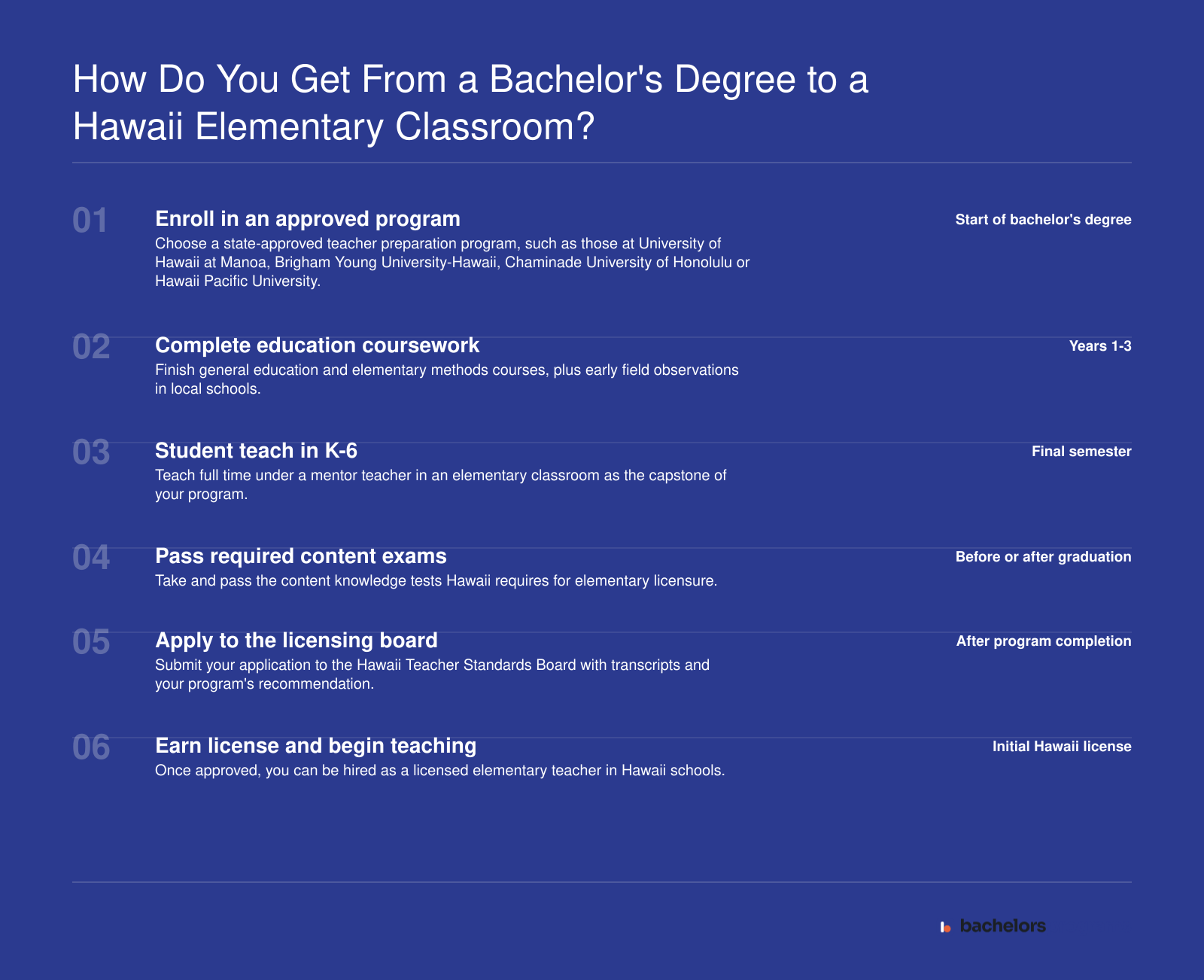
How Do You Get From a Bachelor's Degree to a Hawaii Elementary Classroom?
Licensure in Hawaii follows a set order, and your bachelor's program handles most of it. The steps below show the typical path from your first semester to your first K-6 classroom.
Elementary Teacher Careers and Pay in Hawaii
Hawaii's elementary classrooms have a retention problem more than an applicant problem. The Department of Education processed more than 11,000 applications in the 2025-2026 hiring season, yet 2026 legislative findings still describe 1,000 to 1,200 vacancies at the start of a school year.1 Roughly 10 percent of teachers, about 1,000 educators, leave each year, and about half are gone within five years.2
Pay and Outlook
BLS lists Hawaii's median wage for elementary teachers (excluding special education) at $62,930 as of May 2023, across about 5,000 jobs.3 The national median was $63,970 in May 2025.4 Entry-level pay for bachelor's-degree teachers starts slightly above $50,000, according to a 2026 legislative resolution.5 Emergency hires may start nearer $38,500. A 2026 measure effective July 1, 2026 aims to add automatic yearly step increases for satisfactory service, subject to appropriations.
Nationally, BLS projects 0 percent growth for kindergarten and elementary teachers from 2025 to 2035, with about 99,400 openings a year, mostly from replacement.4 Hawaii has no state-specific projection. Shortages are worst at rural and neighbor-island schools, and nearly half of new hires in 2024-2025 entered without full licensure, so a licensed graduate is in demand.2
What Graduates Earn
Program-level Scorecard figures exist for only some schools here. University of Hawaii at Manoa's Elementary Education graduates have a median of $50,401 in earnings one year after completion, $55,490 four years after, and $57,532 five years after. About 92 percent were working one year out. Median debt for the program's completers is $18,263. That is manageable against a $55,000-plus salary, though it is not trivial.
Chaminade University of Honolulu's licensure program shows median earnings of $51,215 four years after completion and $54,858 at five years. Program-level earnings are not reported for Hawaii Pacific University or Brigham Young University-Hawaii, so weigh those schools on licensure fit and cost instead.
Cost of Living
Housing and everyday costs in Hawaii are high, and legislators cite them as a main reason teachers leave. Budget for a starting salary around $50,000, not the statewide median.
Related Articles
How to Choose the Right Hawaii Elementary Education Program
Chaminade University of Honolulu names its program Elementary Education with Licensure, while Hawaii Pacific University awards a Bachelor of Arts in Elementary Education. That difference in wording is a reminder to compare the credential itself, not just the program's name, before you apply.
Five Criteria to Weigh
- Campus location: The University of Hawaii at Manoa, Chaminade and Hawaii Pacific are in Honolulu, and BYU-Hawaii is in Laie. Commute and housing will matter more than which campus you pick.
- Format: Ask each school whether coursework is on campus, hybrid or online. Classroom placements happen in person either way.
- Transfer needs: Ask how associate-degree credits apply and how many semesters you would still need.
- Licensure timeline: Find out whether the degree includes licensure coursework or leaves steps for after graduation.
- Net price: Compare cost after aid, not sticker tuition.
Rules of Thumb
- Community college transfer: Favor the school that gives you a written credit evaluation before you commit.
- Working adult: Favor flexible scheduling, and ask early how student teaching fits around your job.
- Residential first-year: Favor campus fit, housing and the lowest net price.
Your Next Step
Request information from your shortlisted schools, confirm that each program is approved by the Hawaii Teacher Standards Board (HTSB), and file the FAFSA so you can compare aid offers side by side.
Hawaii Elementary Education Degree: Common Questions
These quick answers cover the questions prospective students ask most about studying elementary education in Hawaii. Each one points back to the section of this page with more detail.
Which Hawaii colleges offer a bachelor's degree in elementary education?
Can you get an elementary education degree online in Hawaii?
How much does an elementary education degree cost in Hawaii?
How do you become an elementary school teacher in Hawaii?
Compare Elementary Education programs on the data that matters
Explore more Education & Teaching majors or browse every field of study.
All Education & Teaching programs Browse every field of study