Best Online Elementary Education Degree Programs
Compare 230+ accredited online Elementary Education programs, with net price after aid, graduation rates, earnings and debt from IPEDS and the U.S. College Scorecard.

A bachelor's degree in elementary education, most often the Bachelor of Science (B.S.) in Elementary Education, can lead to a K-6 classroom without a single day on a campus. The catch is that the degree and the license are separate things. Coursework can be completed from anywhere, but supervised student teaching happens in a real school, and the license is issued by a state.
That gap is why marketing copy is a poor guide. A program's price, completion record and graduates' earnings tell you more than a brochure does.
Most states require both a bachelor's degree and a state-approved preparation program, so a cheap online degree that does not meet your state's rules can cost you more later.
Key Points
- Coursework runs fully online, but supervised student teaching happens in person.
- Licensure follows the program's approving state, so out-of-state graduates must apply separately.
- Many states require a reading exam like Praxis Teaching Reading: Elementary (5205).
The 10 Best Fully Online Elementary Education Degree Programs
Every program in this ranking delivers its coursework fully online, and hybrid formats were left out. The order reflects a composite of cost, completion, program-level earnings and student debt. Where a school does not report a program-level earnings or debt result, that line stays off the card rather than being filled with a school-wide substitute.
University of Florida
#1Gainesville, FL · ~$7,000/yr (est.)
Best for: Working school staff seeking certification
The University of Florida is a flagship public research university in Gainesville whose College of Education runs a selective, limited access elementary education degree built around steady classroom time. Candidates take lesson planning, elementary mathematics and science methods, ESOL foundations, reading and classroom management, and spend each semester in a local elementary school before a full-year senior internship. Online candidates are placed through partnerships with Florida school districts, so practicum and internship work happens in Florida public schools.
- Bachelor of Arts in Elementary Education leading to K-6 certification
- Reading and ESOL endorsements built into the degree
- Two-year upper-division program starting in fall for juniors and transfers
- Supervised clinical rotations in elementary schools each semester
- Full-year senior internship in an elementary classroom
- Admission needs a 2.6 GPA, 60 credits and the Florida General Knowledge test
- Themed block scheduling with a cohort; typical load of 6 to 16 credits
- Online candidates complete placements in Florida public schools
Florida International University
#2Miami, FL · ~$9,000/yr (est.)
Best for: Transfer students weighing certification tracks
Florida International University is a large public research university in Miami whose College of Arts, Sciences, and Education houses the elementary education degree. The 120-credit bachelor's program trains teachers for K-6 classrooms and lets students choose among certification, endorsement and internship pathways. It sits inside a major urban school system, which gives candidates access to a wide range of field placements.
- Bachelor of Science in Elementary Education, 120 credits over four years
- Three concentration options, including certification and endorsement pathways
- Internship pathway available alongside standard preparation
- Prepares graduates to teach in K-6 classrooms and other K-6 settings
- Housed in the College of Arts, Sciences, and Education
Florida Atlantic University
#3Boca Raton, FL · $4,900 – $17,000/yr (est.)
Best for: Future teachers focused on language learners
Florida Atlantic University is a public research university in Boca Raton whose K-6 elementary education bachelor's carries ESOL and Reading endorsements. Coursework spans child development, curriculum design, instructional strategies, classroom management and the use of assessment data, with field experiences placed in local schools. The program is accredited by the Florida Department of Education and the Council for the Accreditation of Educator Preparation.
- K-6 elementary education bachelor's with ESOL and Reading endorsements
- Two concentration options
- Field experiences with local partner schools
- Coursework in child development, assessment data and classroom management
- Prepares teachers for English language learners and students of varying abilities
- Personalized advising for candidates
Indian River State College
#4Fort Pierce, FL · ~$3,800/yr (est.)
Indian River State College is a public state college in Fort Pierce, Florida, that builds workforce-focused bachelor's degrees on top of associate-level study. Its elementary education bachelor's carries Reading and ESOL endorsements and places students in Florida schools for multiple field experiences, with coursework centered on literacy and learning English as a second language. The college also offers an exceptional student education bachelor's with the same endorsements and an Educator Preparation Institute for people who already hold a degree.
- Bachelor of Science in Elementary Education with Reading and ESOL endorsements
- Multiple field experiences in Florida schools
- Coursework focused on literacy and English as a second language
- College reports a 100% job placement rate for education bachelor's graduates
- Scholarships and financial aid available for education majors
- Educator Preparation Institute available for bachelor's degree holders
Southern Utah University
#5Cedar City, UT · $7,000 – $21,000/yr (est.)
Southern Utah University is a public university in Cedar City that awards both a Bachelor of Arts and a Bachelor of Science in Elementary Education. Coursework covers assessment, instructional planning, learner development and ethical practice, preparing graduates for licensure and teaching careers in Utah and beyond. Online students pay the same tuition regardless of residency, and online courses are also open to students who study on campus.
- B.A. and B.S. options in Elementary Education
- Coursework in assessment, instructional planning and ethical practice
- Prepares graduates for Utah licensure and teaching careers
- Same online tuition for in-state and out-of-state students
- Scholarships available, and online courses are open to campus students too
- Education-focused student organizations
California State University-San Marcos
#6San Marcos, CA · $10,000/yr (est. net price)
California State University San Marcos is a public university whose elementary teaching route runs through its Liberal Studies program and is delivered online by Extended Learning. The 120-unit degree covers the seven K-8 subject areas and includes field experience, and graduates who hit the GPA threshold earn a Multiple Subject CSET waiver. It prepares students for elementary or middle school teaching and for a California Multiple Subject Credential.
- Liberal Studies, Teaching: Elementary Subject Matter Preparation, 120 units
- 52 to 61 lower-division units must be completed before admission
- Covers seven K-8 subject areas plus a 15-unit reading and literature focus
- 9 units of field experience included
- 2.67 GPA earns the CCTC-approved CSET I-III waiver
- All major courses require a C or better
Arizona State University
#7Tempe, AZ · ~$15,000/yr (est.)
Arizona State University is a large public research university in Tempe with a clinically embedded elementary education degree offered from its Tempe, West Valley and ASU Local sites as well as online. Candidates move through a series of internships in their sophomore, junior and senior years before a semester of full-time student teaching. The degree leads to an Arizona K-8 elementary credential and requires the state's educator exams for public school certification.
- Bachelor of Arts in Education in elementary education, 120 credit hours
- Leads to a K-8 elementary education credential in Arizona
- Clinically embedded program with internships from sophomore year
- Semester-long, full-time student teaching experience
- Team-based professional experiences with peers
- Arizona educator exams required for public school certification
Appalachian State University
#8Boone, NC · $8,000 – $25,000/yr (est.)
Appalachian State University is a public university in Boone, North Carolina, that prepares elementary teachers through the Reich College of Education's Department of Learning, Teaching and Curriculum. The K-6 major builds classroom experience into every teacher education degree and requires no minor. App State reports that it is the top school in the country for National Board Certified Teachers.
- Bachelor of Science in Elementary Education leading to K-6 certification
- Classroom experience built into all teacher education degrees
- No minor required
- Coursework includes Foundations of Educational Equity and Building Classroom Community
- Offered at the Boone and Hickory campuses and online
- Scholarships and financial aid available
Northwest Florida State College
#9Niceville, FL · $4,600/yr (est. net price)
Northwest Florida State College is a public state college in Niceville that offers a 2+2 elementary education bachelor's for students arriving with an associate degree or at least 60 transferable credits. The 120-credit program leads to Florida K-6 certification and includes elementary school placements every semester, ending in a 15-week student teaching internship under a certified mentor. ESOL and Reading endorsements are embedded in required coursework at no extra credit hours.
- Bachelor of Science in Elementary Education (K-6), 120 credits over two years
- Built for students with an associate degree or 60 transferable credits
- Leads to Florida K-6 teacher certification
- ESOL and Reading endorsements at no extra credit hours
- Elementary school placements every semester
- 15-week full-time student teaching internship with a mentor teacher
Gods Bible School and College
#10Cincinnati, OH · ~$9,000/yr (est.)
God's Bible School and College is a small private Bible college in Cincinnati, Ohio, whose education degree is aimed at preschool, child care, private religious school and community program settings. The elementary track carries CAEP accreditation and is recognized for Ohio teacher licensure as well as ACSI requirements. Tuition is charged per credit hour, and most tracks can be completed online.
- Bachelor of Arts in Education with an Elementary Track
- CAEP accredited
- Eligible for Ohio teacher licensure and meets ACSI requirements
- 135 to 141 total credits, including 30 in Bible and theology
- Prepares graduates for private religious school and child care settings
- $295 per credit hour
Cost & outcomes by school
Federal data for the highest-earning Elementary Education programs, independent of the ranking above. Earnings are this field's bachelor's graduates four years after completing where the Scorecard reports them, else the school's undergraduate median.
| School | Net price / yr | Grad rate | Earnings | Debt | Grads/yr | Format |
|---|---|---|---|---|---|---|
| George Mason University VA | $17,915 | 68% | $76,343 | $19,500 | 77 | Hybrid |
| University of Florida FL | $4,815 | 85% | $71,588 | $15,000 | — | Online or campus |
| University of New Hampshire NH | $23,805 | 76% | $66,479 | $26,814 | — | Online |
| Western Governors University UT | $12,548 | 46% | $60,615 | $11,116 | 1,660 | Online |
| The University of Tennessee-Knoxville TN | $18,976 | 74% | $60,249 | $20,500 | — | Online or campus |
| Florida International University FL | $9,288 | 74% | $53,854 | $16,100 | 226 | Online or campus |
| Touro University NY | $29,627 | 72% | $53,419 | $15,547 | — | Online |
| University of Florida FL | $6,541 | 91% | $53,079 | $14,757 | 40 | Online or campus |
Sources: U.S. Department of Education. Net price, graduation rate, earnings and debt: College Scorecard (earnings and debt for this field's bachelor's graduates where reported, else school-wide); graduates: IPEDS. A dash means no figure is reported.
Cost, debt & payoff
Median earnings of this field's bachelor's graduates (4 yrs after completing, else the school's undergraduate median) vs. their median federal loan debt · U.S. College Scorecard
Across these programs the median graduate earns about $48,824 and finishes with roughly $24,000 in debt — a ratio that clears a common rule of thumb (keep debt below first-year salary). Net price and debt vary widely school to school, so check the per-school figures in the table above before you shortlist.
How We Ranked These Fully Online Programs
A low price and a fully online format mean little if the program will not lead to a teaching license where you live. That tradeoff shaped every judgment behind this list.
The Online-Only Filter
Every program below delivers its elementary education coursework entirely online. Hybrid programs, the ones that pull students to campus for methods courses or practicum seminars, were set aside even when they were otherwise strong. A required student teaching placement does not disqualify a program, since clinical work happens in a school building by definition rather than in a classroom on campus.
What Weighed in the Score
- Cost: average net price after federal and institutional aid, rather than the published sticker tuition.
- Completion: institution-wide graduation and retention rates.
- Outcomes: program-level earnings and median debt for graduates, as reported through the College Scorecard.
- Scale: how many students actually finish the elementary education program.
Where the Numbers Stop
These figures come from College Scorecard and IPEDS snapshots, and they carry real limits. The graduation rate you see belongs to the whole institution, not the elementary education major, so a school with a strong overall number can still run an uneven education department. Earnings data pools graduates across state lines and district pay scales, which vary widely.
Most importantly, this ranking does not confirm that each program holds licensure approval in your state. That check is yours to make, and the licensure guidance explains exactly how to run it before you apply.
What a Bachelor's Degree in Elementary Education Involves
The requirements come down to credits, a professional coursework sequence, and supervised time in schools.
Most programs award the Bachelor of Science (B.S.) in Elementary Education, though you will also see the B.A., the B.S.Ed. and the B.Ed. The titles differ more than the substance does: all of them point to the same destination, a K-6 or K-8 teaching license.
Credits and Core Coursework
About 120 semester credits is the standard load. Drexel University lists 180 quarter credits, which equals 120 semester credits, and Campbellsville University requires 123. Expect three layers: general education, a professional education sequence, and clinical work in schools.
The professional sequence covers literacy and reading methods, math methods, classroom management, child development, special education and English language learner instruction, and assessment. Reading methods usually carry the heaviest credit weight, since early literacy is the core of the job.
Admission and Progression
Beyond the application, expect a minimum GPA, a background check cleared before your first field experience, and basic-skills testing where your state requires it. Some programs also ask you to pass a content or methods checkpoint before student teaching.
How Long It Takes
Starting from scratch, plan on about four years. An associate degree or roughly 60 transferable credits typically cuts that to two to three years. The University of Northern Colorado requires about 65 credits after the associate degree and reports completion in as little as two years at 12 to 18 credits per term.1 Morningside University requires an associate degree or at least 60 transferable credits, reports two to three years, and requires at least 40 credits in the completion program itself.2
Transfer maximums commonly reach 90 semester credits at schools such as Brenau University, Campbellsville and Arkansas State University4, while Liberty University caps transfer credit at 75% of the degree total and Drexel accepts up to 90 quarter credits, or 60 semester credits. What you are allowed to transfer and what actually applies to your major are different numbers: Western Governors University students bring in an average of 28 credits.3
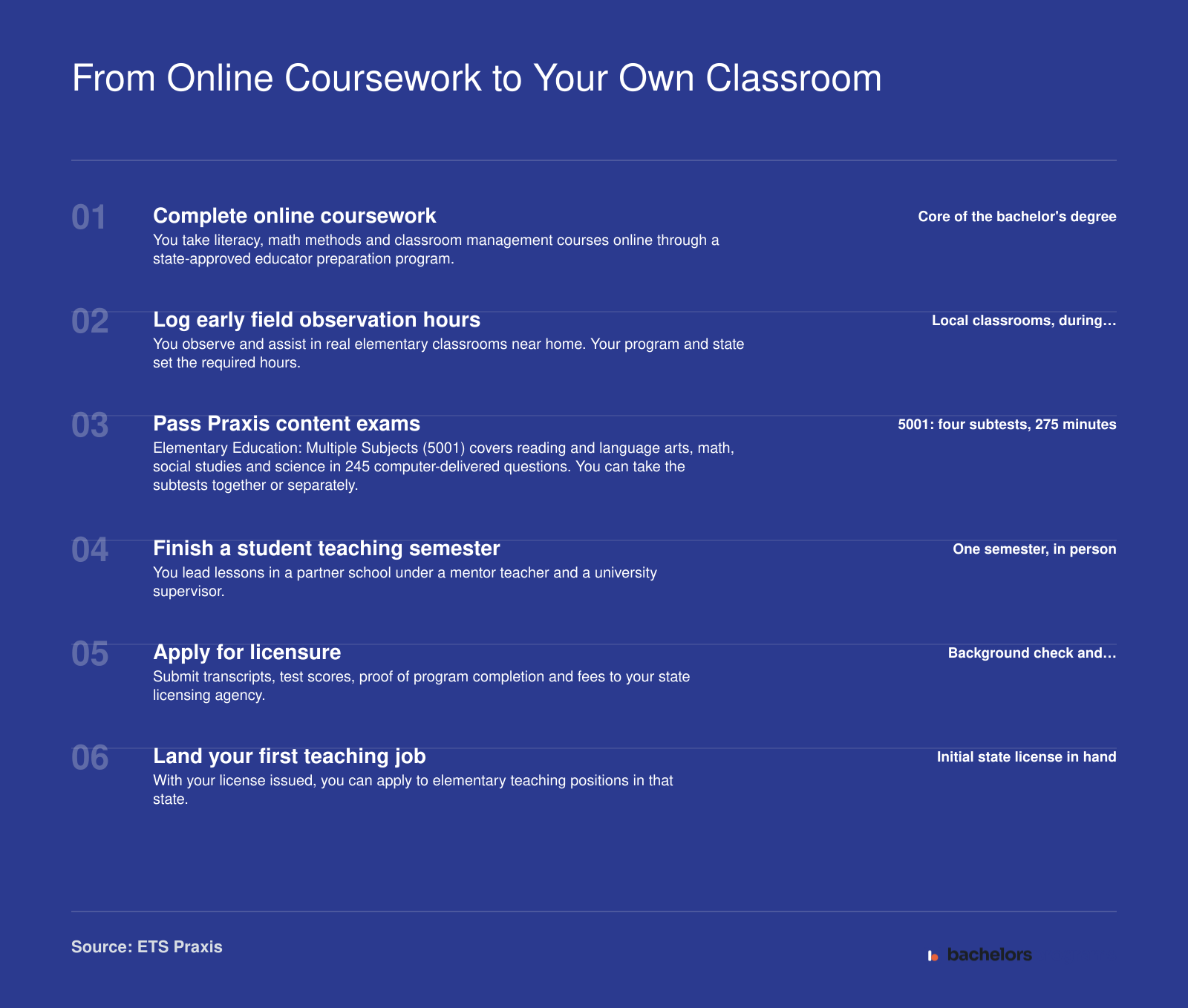
From Online Coursework to Your Own Classroom
An online elementary education degree follows a clear path from virtual classes to a licensed teaching role. Many states also require a reading or pedagogy test, such as Praxis Teaching Reading: Elementary (5205), and exam names, passing scores and steps vary by state. Confirm your state's requirements before you register for any test.
Online Coursework vs. In-Person Student Teaching
Online elementary education degrees split into two very different halves. Your courses, readings, quizzes and discussions can be completed entirely at a distance. The supervised classroom work cannot. State licensing rules generally require candidates to spend supervised time in a school building with a supervising teacher, and no online program can substitute for it.
The field hours come first
Before student teaching, most programs require observation or practicum hours in a local classroom. Published totals at the schools reviewed here run from roughly 75 to 190 hours, and they are built differently from program to program: Kansas State uses a series of shorter field experiences, Liberty runs three practicums, and Drexel's number sits at the high end. Treat any single figure you see as that program's rule, not a national standard.
Student teaching is a full-time semester
The capstone is typically 12 to 20 weeks of full-time classroom work. Campbellsville describes it as a semester that often runs 16 to 18 weeks; Western Governors sets a 12 to 20 week minimum; Drexel requires 12 consecutive full-day weeks; Oregon State spreads the experience across a yearlong internship in year four. Background checks are standard, and some programs require you to be 18 before you enter a classroom.
Who finds your school
Placement arrangements differ sharply. Campbellsville coordinates placements with local schools near your home or job so you do not relocate. The University of Phoenix lets you choose a district with help from a placement specialist. Kansas State asks you to request an assignment in your own community. Wherever you enroll, your state may restrict you to approved districts, and the program's licensure approval has to cover the state where you plan to teach.
Plan your calendar and your budget
Asynchronous coursework is flexible; live seminars and field hours are not. Working full time during student teaching is rarely realistic, so map out that semester's finances before you enroll.
Related Articles
Licensure, State Authorization and CAEP Accreditation
An online degree is convenient from anywhere, but your teaching license is not. It leads to licensure in the state where the program is approved, so graduates who live elsewhere must apply for an out-of-state license. An online degree does not automatically qualify you in your home state.8
How Out-of-State Licensing Works
The usual sequence is to earn the program state's license first, then apply to your home-state licensing agency. Wisconsin applies its out-of-state process to programs headquartered outside the state, online ones included.3 Iowa's 2026 guidance asks for home-state approval and a resulting license, not just a diploma.4 Home-state rules can add more. Indiana tests every content area on a license, even for graduates of CAEP, AAQEP or state-approved programs elsewhere.5 Wisconsin asks most out-of-state applicants to verify science-based reading and language arts coursework.3
What the NASDTEC Agreement Does and Does Not Do
The NASDTEC Interstate Agreement eases moving a license between states, but it is not full reciprocity.1 It is a set of more than 50 agreements, and a 2026 disclosure lists the 50 states, DC, Guam, DoDEA and Ontario as signatories.2 NASDTEC issues no licenses.1 The receiving state decides, and it may still require testing, coursework or background checks. It may also decline certain license types, such as provisional or alternative ones.
Three Approvals, Three Different Jobs
- Regional institutional accreditation: Confirms the college itself is legitimate. Check the school's accreditor on its website and on the U.S. Department of Education's database.
- State program approval: Comes from the state education agency and authorizes the program to prepare candidates for that state's license. Confirm it on the state education department's list of approved providers.
- CAEP or AAQEP accreditation: National accreditation of the preparation provider. Look the school up in the CAEP directory. It does not replace state approval, issue a license or guarantee reciprocity.7 Tennessee's 2026 process shows the split: new providers need full state approval first, and CAEP standards apply as well.6
Check State Authorization Before You Apply
Online programs may not be allowed to enroll students, or recommend them for licensure, in certain states. Find the program's state disclosures page and look up your state before you apply.
Get the Answer in Writing
Email admissions and ask: "Does this program lead to a teaching license in [your state], and will you recommend me for it?" Request a written reply, and save it. Then ask your state education department what it would require of a graduate of that program.
Cheapest Fully Online Elementary Education Degrees and Transfer Credit Rules
These are the lowest-cost online elementary education bachelor's programs in federal College Scorecard data, ranked by approximate average net price after grants and aid. Transfer caps vary by school: Drexel University's online B.S. in Elementary Education, for example, accepts up to 90 quarter credits (60 semester credits), requires a B or better in transferred core courses and a C or better in general education. Quarter credits convert at about two-thirds of a semester credit, so confirm which system each school uses before counting your credits. To lower costs further, complete the FAFSA, which determines Pell Grant eligibility and is required for the federal TEACH Grant (up to $4,000 per year, or $3,772 after the 5.70% federal reduction for awards first disbursed from October 2020 through September 2026, with a $16,000 undergraduate maximum), which requires four years of full-time teaching in a high-need field at a low-income school within eight years, or the grant converts to a Direct Unsubsidized Loan.
| School | Location | Average Net Price After Aid (approx.) | In-State Tuition and Fees | Endorsements | Format Notes |
|---|---|---|---|---|---|
| St. Petersburg College | St. Petersburg, FL | $1,471 | $2,682 | ESOL and Reading | Fully online option; face-to-face and blended classes also offered |
| Indian River State College | Fort Pierce, FL | $3,815 | $2,764 | Reading and ESOL | Fully online option available |
| Northwest Florida State College | Niceville, FL | $4,571 | $2,583 | ESOL and Reading | Online and campus options; school lists campus classes one to two days weekly |
What Elementary School Teachers Earn Nationally
This is a nationwide median for the occupation as a whole. It does not show what graduates of any program on this page earn.
Elementary Education programs by state
Online Elementary Education Degree FAQs
These answers cover the questions prospective students ask most about earning a bachelor's degree in elementary education online. Requirements vary by state and school, so confirm details with your program and your state education department.
Can you get an elementary education degree completely online?
Will an online elementary education degree let me get licensed in my state?
Can I keep my job while completing student teaching in an online program?
Can I switch to an online elementary education program if I already have an associate degree?
Compare Elementary Education programs on the data that matters
Explore more Education & Teaching majors or browse every field of study.
All Education & Teaching programs Browse every field of study