Best Online Special Education Degree Programs
Compare 190+ accredited online Special Education programs, with net price after aid, graduation rates, earnings and debt from IPEDS and the U.S. College Scorecard.

Special education vacancies are among the hardest for U.S. school districts to fill, and that pressure has moved a large share of teacher preparation online. A bachelor's degree in special education, awarded as a Bachelor of Science (B.S.) or Bachelor of Arts (B.A.) in Special Education, remains the standard entry credential for a teaching license.
The practical question is whether a fully online route can meet a student teaching requirement, and the answer depends on where you live. Average net price after aid among the fully online programs ranked here runs from roughly $3,800 to $20,300.
Key Points
- Special education teachers earned a $67,170 median salary in May 2025.
- University of Hawaii at Manoa graduates lead first-year earnings among ranked programs.
- Accredited online programs may still fall short of your state's licensure rules.
Best Fully Online Special Education Bachelor's Programs for 2027
Each school below offers its special education bachelor's degree with a substantial online component, and most can be completed without ever visiting campus for class. Where a program keeps some in-person class time, the entry says so, and every route still includes fieldwork in real classrooms. Each entry notes the concentration or track on offer, the credential it leads to, and the kind of student it fits, whether that is a career changer, a working paraprofessional, or a transfer student finishing a four-year degree.
Florida International University
#1Miami, FL · ~$9,000/yr (est.)
Best for: South Florida students balancing work and study
Florida International University, based in Miami, awards its Bachelor of Science in Exceptional Student Education in person or fully online, so students outside South Florida can complete the whole degree remotely. The major is deliberately broad: graduates move into behavior analysis, advocacy, policy, law, health services, or alternative K-12 teaching certification rather than only classroom roles. Coursework follows cognitive, language, and social and emotional needs across the lifespan.
- 120 credits, about four years of full-time study
- Available in person or fully online
- Concentration in Special Education, Educational Foundations, and Policy
- Prepares students for the BCaBA credential
- Builds a foundation for alternative K-12 teacher certification
- Covers cognitive, language, and social needs across the lifespan
- Median earnings of $36,598 one year after graduation
University of Central Florida
#2Orlando, FL · ~$10,000/yr (est.)
Best for: Advocates pursuing nonteaching disability roles
The University of Central Florida delivers its Exceptional Student Education bachelor's degree through UCF Online with a learning and language track built for students who want to work outside a traditional school. A practicum pairs each student with a learner in their own community, so fieldwork happens near home rather than on a distant campus. Students can line up their specialization courses with state certification requirements and apply for a teaching license after graduating.
- Noncertificate learning and language track
- 120 credit hours, fully online
- Practicum pairs each student with a learner in their community
- Coursework in autism spectrum disorder and communication disorders
- Students can align courses to state certification requirements
- Median earnings of $48,147 one year after graduation
University of West Florida
#3Pensacola, FL · $5,000 – $10,000/yr (est.)
Best for: Dual certification seekers in elementary and ESE
The University of West Florida in Pensacola combines exceptional student education and elementary education in one online bachelor's degree, so graduates leave with two Florida teaching credentials instead of one. Reading and ESOL endorsements are built in, and two 100-hour clinical experiences plus a full student teaching semester supply the classroom hours. The program is accredited under CAEP standards through spring 2030.
- 132 credit hours in 16-week courses, about 48 months
- Leads to Florida ESE (K-12) and Elementary (K-6) certification
- Reading and ESOL endorsements included
- Two 100-hour clinical experiences plus a student teaching semester
- CAEP accredited through spring 2030
- Fingerprinting required for school placements
Indian River State College
#4Fort Pierce, FL · ~$3,800/yr (est.)
Indian River State College is a Florida public college in Fort Pierce whose exceptional student education bachelor's degree leans on literacy and English for speakers of other languages. It is a practical route for working paraprofessionals and teacher's assistants, who can tap Florida Department of Education funding while they study. The college also offers an autism spectrum disorder endorsement and reports full job placement for its education bachelor's graduates.
- Fully online, prepares teachers for grades K-12
- Reading and ESOL endorsement concentration
- Autism spectrum disorder endorsement also offered
- State funding available for paraprofessionals and teacher's assistants
- College reports 100% job placement for education graduates
- Scholarships available for education majors
Arizona State University
#5Tempe, AZ · ~$15,000/yr (est.)
Arizona State University's special education bachelor's degree sits in the Mary Lou Fulton College for Teaching and Learning Innovation and can be completed through ASU Online. Internships and student teaching are spread across the sophomore, junior, and senior years rather than saved for the end, and the online route serves students in other states but not outside the United States. Graduates qualify for Arizona's K-12 mild and moderate disabilities certificate, and an accelerated path lets strong students begin a master's early.
- 120 credit hours; online, Tempe, ASU Sync, or ASU Local
- Standard Professional Mild/Moderate Disabilities Certificate, K-12
- Internships and student teaching from sophomore through senior year
- Accelerated bachelor's plus master's option
- Online option not open to students living outside the U.S.
- Arizona educator exams required (NES or AEPA)
- Accelerated three-year option requires at least 90 credits
- Median earnings of $49,882 one year after graduation
Appalachian State University
#6Boone, NC · $8,000 – $25,000/yr (est.)
Appalachian State University's Reich College of Education runs two K-12 special education concentrations, one for students who will need substantial curriculum modifications and one for the general curriculum. Classroom experience is woven into every teacher education degree on the Boone campus, and an accelerated bachelor's to master's route lets students begin graduate work early. The teacher education programs are CAEP accredited, and a minor is required alongside the major.
- Adapted Curriculum K-12 concentration
- For students who need significant curriculum modifications
- Coursework in assistive technology and the science of literacy
- Classroom experience built into every teacher education degree
- A minor is required; chemistry and anthropology are popular
- Accelerated bachelor's to master's option
- General Curriculum K-12 concentration
- Special education minor available
- Taught on the Boone campus or online
University of North Carolina at Charlotte
#7Charlotte, NC · $15,000 – $20,000/yr (est.)
UNC Charlotte prepares special education teachers for general classrooms and for settings serving students with extensive support needs, split into General Curriculum and Adapted Curriculum licensure tracks. The final year is a yearlong internship that grows from one day a week in a classroom to full-time student teaching in that same room. Current K-12 special education teaching assistants can finish the General Curriculum track through an accelerated online route in about two years while staying employed.
- General Curriculum and Adapted Curriculum licensure tracks
- Yearlong internship builds to full-time student teaching
- Accelerated online track for current K-12 special education TAs
- TA track takes about two years while students keep working
- Coursework in reading instruction, behavior management, curriculum design
University of Arizona
#8Tucson, AZ · ~$17,000/yr (est.)
The University of Arizona's College of Education structures its mild and moderate disabilities degree as three semesters of coursework followed by a supervised internship semester in a special education setting. Students apply after roughly 60 credits and can study online or in person in Tucson. Every student gets an assigned advisor, and an accelerated master's path lets motivated students finish a graduate degree in as few as five years.
- Three semesters of coursework plus a supervised internship semester
- Prepares graduates to teach K-12 students with mild to moderate disabilities
- Apply after about 60 credits with two recommendation letters
- Arizona IVP fingerprint card required
- Online or in person at the Tucson campus
- Accelerated master's path in as few as five years
University of Missouri
#9Columbia, MO · ~$20,000/yr (est.)
The University of Missouri offers a cross categorical special education bachelor's degree that is 100% online with asynchronous classes, which suits students who need to keep working while they study. Fieldwork, including a practicum and student teaching, is still part of the program. Graduates are prepared for the Praxis exam and Missouri teacher certification.
- 100% online, asynchronous courses
- 120 credits with a cross categorical special education concentration
- Prepares students for the Praxis exam for Missouri certification
- Fieldwork includes a practicum and student teaching
- Accredited by the Higher Learning Commission and Missouri DESE
George Mason University
#10Fairfax, VA · $15,000 – $20,000/yr (est.)
George Mason University's special education bachelor's degree is a campus-first program: classes run mainly in person during the day at the Fairfax campus, with some online and evening sections rather than a fully online route. It offers four licensure concentrations, including blindness and visual impairments and early childhood special education, which are uncommon at the undergraduate level. A 45-credit special education core ends in a full-semester internship, and nearby Virginia school districts sometimes offer tuition reimbursement to employees who enroll.
- 120 credits; daytime classes mainly at the Fairfax campus
- Some online and evening sections; no fully online option
- Concentrations: adapted, general, visual impairments, early childhood
- 45-credit special education core ending in a 12-credit internship
- Transfer priority dates are March 1 and October 1
Cost & outcomes by school
Federal data for the highest-earning Special Education programs, independent of the ranking above. Earnings are this field's bachelor's graduates four years after completing where the Scorecard reports them, else the school's undergraduate median.
| School | Net price / yr | Grad rate | Earnings | Debt | Grads/yr | Format |
|---|---|---|---|---|---|---|
| Drexel University PA | $38,509 | 78% | $84,648 | $25,325 | — | Online |
| Linfield University OR | $26,536 | 71% | $78,638 | $25,000 | — | Online or campus |
| George Mason University VA | $17,915 | 68% | $76,343 | $19,500 | 12 | Hybrid |
| Rutgers University NJ | $24,406 | 84% | $74,479 | $21,500 | — | Hybrid |
| Florida International University FL | $9,288 | 74% | $60,249 | $17,500 | 49 | Online or campus |
| University of Central Florida FL | $10,411 | 78% | $58,308 | $18,190 | 44 | Online |
| Oklahoma State University OK | $17,447 | 68% | $57,413 | $20,500 | — | Hybrid |
| University of South Florida FL | $9,812 | 77% | $51,759 | $17,988 | 8 | Hybrid |
Sources: U.S. Department of Education. Net price, graduation rate, earnings and debt: College Scorecard (earnings and debt for this field's bachelor's graduates where reported, else school-wide); graduates: IPEDS. A dash means no figure is reported.
Cost, debt & payoff
Median earnings of this field's bachelor's graduates (4 yrs after completing, else the school's undergraduate median) vs. their median federal loan debt · U.S. College Scorecard
Across these programs the median graduate earns about $51,641 and finishes with roughly $23,250 in debt — a ratio that clears a common rule of thumb (keep debt below first-year salary). Net price and debt vary widely school to school, so check the per-school figures in the table above before you shortlist.
How We Ranked Each Online Bachelor's Degree in Special Education
A fully online program and a hybrid program can carry the same degree title, yet they ask very different things of your calendar and your zip code. Only programs delivered fully online made this list. Hybrid programs that require recurring campus visits were excluded, even when the school markets an online option alongside them.
What Goes Into the Ranking
Each program receives a composite score built from several measures:
- Cost: The average net price a student pays after grants and scholarships.
- Completion: The school's overall graduation rate.
- Outcomes: Program-level earnings and student debt from the U.S. Department of Education's College Scorecard, where those figures are published.
- Scale: The number of students completing the program, which signals how established it is.
Limits Worth Knowing
None of these inputs is perfect, so read the results with that in mind. These graduation rates cover the entire school, not the special education major. Costs here are averages after aid, so your own bill may land higher or lower depending on your finances and transfer credits. When a program has no published earnings figure, often because too few graduates were counted, the school is scored on the remaining measures.
What the Ranking Cannot Tell You
No dataset captures whether a program is approved by your state to lead to a teaching license, or how much help you will get with student-teaching placement in your own community. Both matter a great deal in special education, and both vary by state and by school. Confirm them directly with the program and your state's education agency before you apply. The next section explains how licensure works for online graduates.
What Graduates Earn One Year After Finishing
Among the programs ranked here, the highest median earnings one year after finishing belong to University of Hawaii at Manoa's special education bachelor's graduates.
Can You Become a Special Education Teacher With an Online Degree?
The convenience of an online bachelor's degree in special education comes with a licensure risk: a program can be accredited, well taught, and entirely online yet still not qualify you to teach in your own state. Yes, an online degree can make you a special education teacher, but only if you verify the conditions before you enroll.
Licensure-track versus non-licensure programs
A bachelor's degree in special education leads to initial teacher licensure when the program is a state-approved educator preparation program and you finish its full sequence: the preparation curriculum, supervised clinical or student teaching, state-required assessments, background checks, and the degree itself.1 Many schools also offer non-licensure versions of the B.A. or B.S., aimed at paraprofessionals, early intervention staff, or students who plan to pursue a master's later. Those can be a sensible fit, but on their own they do not make you eligible for a teaching license. Confirm which track you are applying to before you commit.
If You Live in Another State
Online delivery does not create eligibility by itself.2 States regulate curriculum, clinical placements, assessments, and endorsement or grade-span alignment, and your home state's rules decide whether the program counts. Programs are expected to publish professional licensure disclosures stating whether their curriculum meets, does not meet, or is undetermined for each state.2 Ask whether the program can place you for student teaching where you live, since that requirement is usually arranged locally.
What Reciprocity Does and Does Not Do
The NASDTEC Interstate Agreement, which covers all 50 states plus D.C., Guam, DoDEA, and Ontario, offers some authorization to teach across state lines, but it is not automatic full reciprocity.3 It applies mainly to educators who already hold a license in a participating jurisdiction, and it does not waive degree, testing, or prerequisite requirements.4 A receiving state may still require its own exams, a matching license title and grade span, comparable coursework, classroom experience, or additional training.4
One Question to Ask Before You Enroll
Ask admissions for the program's state licensure disclosure list in writing, then confirm the answer with your own state education agency, which sets and can change its requirements without notice.4
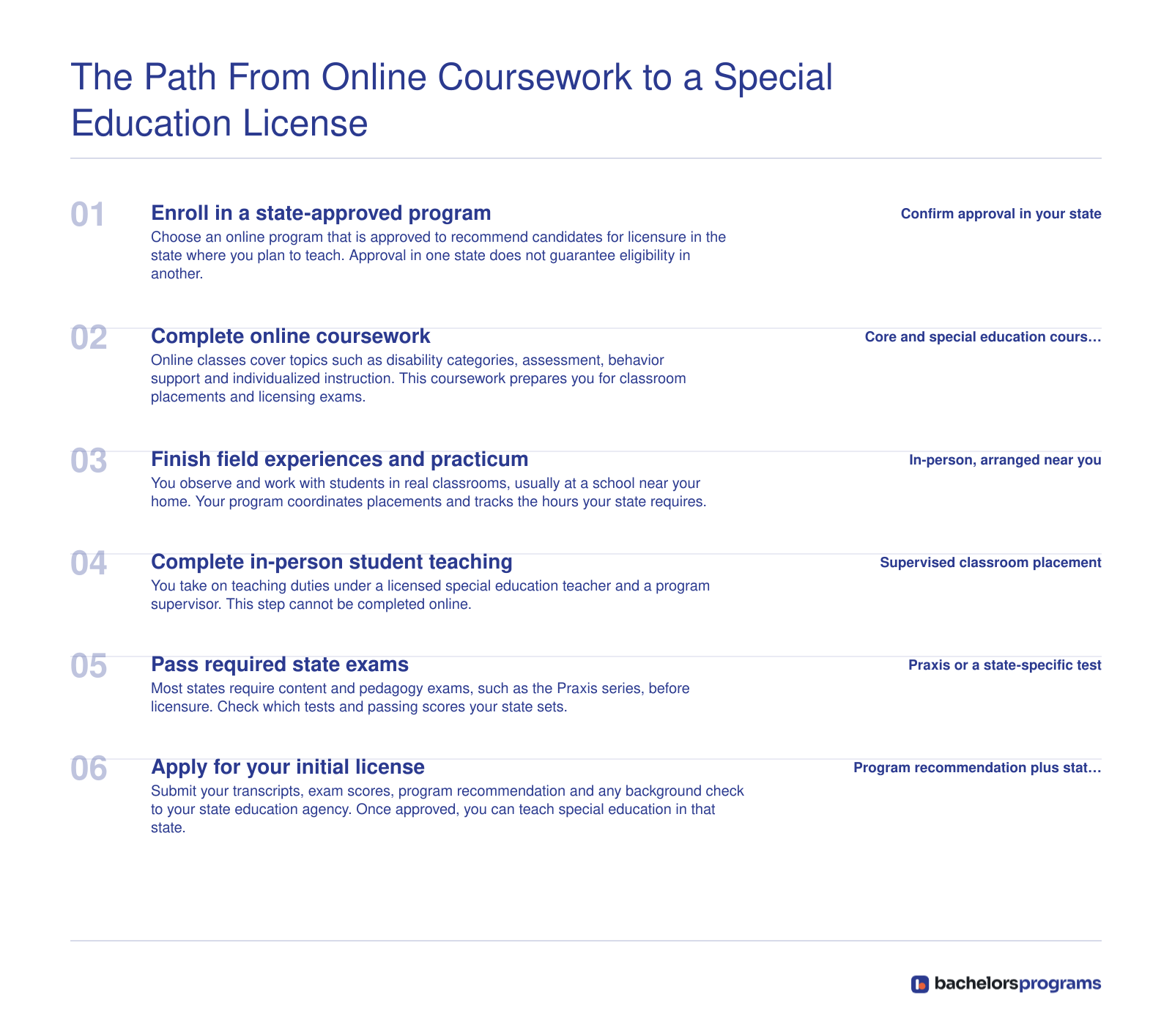
The Path From Online Coursework to a Special Education License
An online bachelor's degree in special education leads to a teaching license only when it follows your state's approved route. The steps below show the typical order, from enrollment to your first license. Exact exams, field hours and student teaching requirements vary by state, so confirm the details with your state education agency before you enroll.
Related Articles
Most Affordable Fully Online Special Education Degrees
If you are searching for an affordable or cheap online special education degree, these public colleges post the lowest average net prices among the programs ranked here, based on 2024 federal IPEDS and College Scorecard data. Out-of-state tuition and fees run higher than in-state rates at each school, from $9,174 to $10,201 a year, so confirm which rate your college charges online students who live outside its state. A low price only pays off if the program leads to a teaching license where you plan to work: St. Petersburg College prepares students for the Florida Teacher Certification Examination, and Eastern New Mexico University notes reciprocity with many states for its New Mexico license.
| School | Program | Average Net Price (After Aid) | In-State Tuition & Fees | Out-of-State Tuition & Fees | Graduation Rate (School-Wide) |
|---|---|---|---|---|---|
| St. Petersburg College (St. Petersburg, FL) | B.S. in Exceptional Student Education (K-12) with Infused ESOL & Reading Endorsements | $1,471 | $2,682 | $9,286 | 38% |
| Indian River State College (Fort Pierce, FL) | B.S. in Exceptional Student Education with Reading and ESOL Endorsements | $3,815 | $2,764 | $10,201 | 45% |
| Eastern New Mexico University (Portales, NM) | B.A. in Education with Elementary (K-8) and Special Education (PreK-12) Licensure | $4,904 | $7,194 | $9,174 | 45% |
Special Education Teacher Median Salary
Licensed special education teachers in the U.S. earned a median of $67,170 per year as of May 2025, the most recent national figure from the Bureau of Labor Statistics.
Special Education programs by state
Compare Special Education programs on the data that matters
Explore more Education & Teaching majors or browse every field of study.
All Education & Teaching programs Browse every field of study