Best Elementary Education Degree Programs in South Dakota
Compare 11 accredited Elementary Education programs in South Dakota, with net price after aid, graduation rates, earnings and debt from IPEDS and the U.S. College Scorecard.
South Dakota ties its elementary teaching certificate to a degree, not a test score. The qualifying credential is a bachelor's degree in the field, usually a Bachelor of Science (B.S.) in Elementary Education from a state-recognized program.
Cost separates the schools more than rank does. Average net price after grants varies by thousands of dollars a year across the public universities and the private and tribal colleges; Oglala Lakota College comes in lowest among the schools ranked here while carrying the same certificate weight.
Format is the other split: online and hybrid routes keep a working adult in place, while campus programs tie field placements to the school's region. Either way, state approval decides whether the degree counts toward the K-8 certificate.
Key Points
- Public in-state tuition and fees run $9,230 to $10,170 for 2026-2027.
- The Critical Teaching Needs Scholarship covers full tuition for five years' service.
- Expect a second application to teacher education, usually in sophomore year.
Best Bachelor's in Elementary Education Programs in South Dakota: Our Ranked List
These ten programs are ranked for readers who want a bachelor's degree in elementary education from a South Dakota school, whether they plan to study on the main campus or online. Every entry leads to a state-approved route to a K-8 teaching certificate. The net price shown with each card is an institution-wide average after federal, state and institutional aid, not an exact quote for the education major, so use it to compare schools rather than to predict your own bill.
Augustana University
#1Sioux Falls, SD · $20,000 – $25,000/yr (est.)
Best for: Commuter students in Sioux Falls wanting early fieldwork
Augustana University is a private liberal arts university in Sioux Falls, and its elementary education major puts students in area classrooms from the first year, with more than 100 field hours before a full semester of student teaching. The program is approved by the South Dakota Department of Education and offers a kindergarten endorsement option plus a three-year degree track. Its institution-wide graduation rate is about 73%, the highest of the South Dakota schools on this list.
- Bachelor of Arts in elementary education on campus in Sioux Falls
- South Dakota Department of Education approved teacher preparation
- More than 100 hours in area classrooms before student teaching
- Field experiences begin in the first year
- Three-year degree option available
- Kindergarten endorsement option
- Student organization: Augustana Elementary Education Association
- Prepares students for the Praxis exam
South Dakota State University
#2Brookings, SD · $15,000 – $20,000/yr (est.)
Best for: Future teachers weighing a special education dual major
South Dakota State University is the state's largest public research university, in Brookings, and its elementary education bachelor's degree runs 120 credits over roughly four years with fall, spring and summer starts. Coursework covers literacy, math, science, the arts and health and physical education, and students finish with student teaching in a selected public school. Early childhood education is a suggested minor, and special education is a common dual major. About 62% of SDSU students complete a degree.
- 120 credit hours over about four years
- Fall, spring and summer start terms
- Student teaching in a selected public school
- Prepares teachers for kindergarten through grade eight
- Coursework spans literacy, math, science, the arts, health and PE
- Early childhood education minor suggested
- Dual major option in special education
- Student chapter of the South Dakota Education Association
University of South Dakota
#3Vermillion, SD · ~$20,000/yr (est.)
Best for: Students seeking an extended student teaching residency
The University of South Dakota, in Vermillion, was the first school in the state to move to a yearlong student teaching residency, and students choose their own placement from a network of more than 50 partner schools. An educational technology endorsement is built into the degree, and a special education double major can be completed in four years. USD awards a $20,000 scholarship, paid as $5,000 a year, to future teachers who commit to teaching in South Dakota. Its graduation rate is about 60%.
- Yearlong student teaching residency, first of its kind in South Dakota
- Students choose their own residency placement location
- Technology endorsement embedded in the degree
- Residency network of more than 50 partner schools
- Add a special education major and finish in four years
- Classes on the Vermillion campus and in Sioux Falls
- $20,000 scholarship for graduates who stay to teach in South Dakota
- Prepares K-8 teachers
University of Sioux Falls
#4Sioux Falls, SD · $21,000/yr (est. net price)
The University of Sioux Falls is a private Christian university in Sioux Falls whose elementary education degree is offered fully online as well as on campus. The Fredrikson School of Education holds CAEP accreditation and state approval through 2030, and graduates can be recommended for an initial South Dakota teaching certificate once Praxis II requirements are met. The program prepares teachers for kindergarten through grade six and emphasizes servant leadership. Its institution-wide graduation rate is about 63%.
- Fully online option available
- Prepares teachers for kindergarten through grade six
- CAEP accredited and approved by the South Dakota State Board of Education
- Graduates can be recommended for an initial South Dakota teaching certificate
- Certification requires Praxis II scores and dates
- Christian foundation with a servant-leadership emphasis
Northern State University
#5Aberdeen, SD · $15,000 – $20,000/yr (est.)
Northern State University in Aberdeen offers elementary education on campus or fully online, and every incoming full-time elementary education major automatically receives the Millicent Atkins 1901 Scholarship of at least $1,901 a year, which stacks with the WolfPACT Unleashed award. The 120-credit program is CAEP accredited, starts classroom experience in the first year and arranges practicum and teaching placements in Aberdeen and the surrounding region. Northern also partners with the Huron Community Campus to widen access to teacher preparation. About 49% of its students finish a degree.
- 120 credit hours over about four years
- On campus in Aberdeen or fully online
- CAEP-accredited teacher preparation
- Classroom experience from the first year
- Placements arranged in Aberdeen and the surrounding region
- Automatic Millicent Atkins 1901 Scholarship of at least $1,901 a year
- Award stacks with the WolfPACT Unleashed scholarship
- May qualify for the federal TEACH Grant
Dakota State University
#6Madison, SD · $10,000 – $13,000/yr (est.)
Dakota State University in Madison was founded as a teacher education college and now offers elementary education on campus, fully online or in a hybrid mix, part time or full time. The 120-credit degree includes a reading endorsement within the coursework and a semester-long student teaching residency, and an accelerated path can finish the bachelor's in three years. The program is CAEP accredited and approved by the South Dakota State Board of Education, and DSU reports that its education graduates are employed or in further study. Its institution-wide graduation rate is about 51%.
- 120 credits with fall, spring and summer starts
- Campus, online or hybrid formats, part time or full time
- Semester-long student teaching residency
- Reading endorsement included in coursework
- CAEP accredited and approved by the South Dakota State Board of Education
- Accelerated path to finish the bachelor's in three years
- Endorsement options in kindergarten, art and health science
- TEACH Grant up to $4,000 a year for eligible students
Black Hills State University
#7Spearfish, SD · $16,000/yr (est. net price)
Black Hills State University in Spearfish builds its elementary education degree from four credit blocks, moving students from a 36-hour pre-professional core through a 38-hour professional core and a methods block before K-8 student teaching in the final semester. A pre-admission practicum comes first, and coursework includes Math Concepts for Teachers, Foundations and Theory of Reading, and South Dakota Indian Studies. The program is the region's main route into elementary teaching in the northern Black Hills. About 43% of BHSU students complete a degree.
- 19 semester hours of required general education
- 36-hour pre-professional core and 38-hour professional core
- Pre-admission practicum (EDFN 295) required
- Methods block covers K-8 science, math, social science, language arts and reading
- Student teaching (ELED 488) in the final semester
- Coursework includes Math Concepts for Teachers I and II
- Includes South Dakota Indian Studies (INED 411)
Mount Marty University
#8Yankton, SD · ~$22,000/yr (est.)
Mount Marty University in Yankton is a private Catholic university whose elementary education major requires 128 credits, 59 of them in the major, with field experiences that begin at freshman orientation. Graduates are eligible to teach all subjects in kindergarten through eighth grade, and a double major with special education adds K-12 certification for teaching students with disabilities. The program is accredited by the South Dakota Department of Education, and about 52% of Mount Marty students complete a degree.
- 128 credits, including 59 in the major
- Eligible to teach all subjects in kindergarten through grade eight
- Field experiences start with freshman-year observations
- Student teaching during the senior year
- Double major with special education to teach K-12 students with disabilities
- Coursework includes reading diagnosis and remediation
- Accredited by the South Dakota Department of Education
Dakota Wesleyan University
#9Mitchell, SD · $15,000 – $20,000/yr (est.)
Dakota Wesleyan University in Mitchell runs its elementary education program inside an on-campus preK-5 school, so methods classes, labs and meetings happen in a working classroom building. Majors complete more than 300 hours of classroom experience plus a 75-school-day student teaching capstone, and admission to student teaching requires a 2.6 GPA, education department approval and passing Praxis II scores. The university's institution-wide graduation rate is about 48%.
- Classes meet inside a preK-5 building on campus
- More than 300 hours of classroom experience
- One-semester student teaching capstone of 75 school days
- Student teaching requires a 2.6 GPA and department admission
- Passing Praxis II scores required to student teach
- Coursework includes Curriculum Standards and Assessment
- Spring practicum pairs three education courses
Sinte Gleska University
#10Mission, SD · ~$13,000/yr (est.)
Sinte Gleska University in Mission offers a K-8 elementary education bachelor's degree with concentrations in early childhood, Lakota studies and middle school, plus a dual major option combining K-8 elementary and K-12 special education. Courses model culturally relevant pedagogy grounded in Lakota culture while aligning with South Dakota state standards and INTASC competencies, and field experiences and internships are required. The educator preparation program was fully accredited by the South Dakota Department of Education after a November 2025 review. Its reported institution-wide graduation rate is about 15%.
- Concentrations in early childhood, Lakota studies and middle school
- Dual major option in K-8 elementary and K-12 special education
- Required field experiences and internships
- Culturally relevant pedagogy grounded in Lakota culture
- Aligned with South Dakota state standards and INTASC competencies
- Fully accredited by the South Dakota Department of Education after a 2025 review
- Higher Learning Commission accredited since 1983
Cost & outcomes by school
Federal data for the highest-earning Elementary Education programs, independent of the ranking above. Earnings are this field's bachelor's graduates four years after completing where the Scorecard reports them, else the school's undergraduate median.
| School | Net price / yr | Grad rate | Earnings | Debt | Grads/yr | Format |
|---|---|---|---|---|---|---|
| Dakota Wesleyan University SD | $19,735 | 48% | $53,728 | $27,000 | 15 | Campus |
| Mount Marty University SD | $22,227 | 52% | $49,652 | $27,000 | 17 | Campus |
| Dakota State University SD | $21,057 | 51% | $48,997 | $23,500 | 42 | Online or campus |
| Augustana University SD | $23,894 | 73% | $46,600 | $25,550 | 35 | Campus |
| University of South Dakota SD | $19,858 | 60% | $46,034 | $25,500 | 91 | Campus |
| Black Hills State University SD | $15,911 | 43% | $44,958 | $23,594 | 36 | Campus |
| University of Sioux Falls SD | $21,383 | 63% | $44,735 | $26,500 | 22 | Online |
| Northern State University SD | $15,812 | 49% | $44,147 | $20,500 | 34 | Online or campus |
| South Dakota State University SD | $19,841 | 62% | $43,934 | $24,313 | 51 | Campus |
| Oglala Lakota College SD | $1,895 | 9% | $22,517 | — | 5 | Campus |
| Sinte Gleska University SD | $12,768 | 15% | $20,948 | — | 6 | Campus |
Sources: U.S. Department of Education. Net price, graduation rate, earnings and debt: College Scorecard (earnings and debt for this field's bachelor's graduates where reported, else school-wide); graduates: IPEDS. A dash means no figure is reported.
Cost, debt & payoff
Median earnings of this field's bachelor's graduates (4 yrs after completing, else the school's undergraduate median) vs. their median federal loan debt · U.S. College Scorecard
Across these programs the median graduate earns about $44,958 and finishes with roughly $25,500 in debt — a ratio that clears a common rule of thumb (keep debt below first-year salary). Net price and debt vary widely school to school, so check the per-school figures in the table above before you shortlist.
Cheapest Bachelor's in Elementary Education Programs in South Dakota
This table orders South Dakota's most affordable elementary education options by average annual net price, the amount students typically pay after grants and scholarships, using 2024 IPEDS and College Scorecard data from the U.S. Department of Education. Oglala Lakota College in our directory and Sinte Gleska University, both tribal colleges, post the lowest costs. Dakota Wesleyan University shows how aid changes the picture: its private sticker price is far higher, but its net price stays under $20,000.
| School | City | Sector | Annual In-State Tuition and Fees | Average Annual Net Price | Graduation Rate | Program Format |
|---|---|---|---|---|---|---|
| Oglala Lakota College | Kyle | Public (tribal college) | $2,684 | $1,895 | 8.7% | Campus |
| Sinte Gleska University | Mission | Public (tribal college) | $4,714 | $12,768 | 15.4% | Campus |
| Northern State University | Aberdeen | Public | $8,845 | $15,812 | 48.9% | Campus and online |
| Black Hills State University | Spearfish | Public | $8,764 | $15,911 | 42.6% | Campus |
| Dakota Wesleyan University | Mitchell | Private nonprofit | $33,790 | $19,735 | 48.3% | Campus |
Online and Hybrid Bachelor's Options at South Dakota Schools
An online elementary education bachelor's and a campus-based one can both lead to the same South Dakota teaching certificate, but only the online route lets you stay where you live while you earn it. The difference surfaces at student teaching, which puts you in a real classroom under a real mentor.
Which South Dakota Schools Offer Flexible Delivery
Several programs here are campus-first: Augustana University, South Dakota State University, Black Hills State University, Mount Marty University, Dakota Wesleyan University, and Sinte Gleska University. The University of South Dakota teaches at both Vermillion and Sioux Falls. For online study, the University of Sioux Falls and Northern State University each advertise a fully online option, while Dakota State University runs its B.S.Ed. on campus, online, or hybrid, full time or part time.
Student Teaching Still Happens in Person
No online program can supervise you through a screen. At Dakota State, the closing semester-long residency must take place in a district that holds a formal partnership with the university and staffs co-teaching-trained teachers; out-of-area placements are not granted.1 USD's yearlong residency is full time, roughly 8:00 to 4:00, off campus in the senior year, arranged by a field placement office and dependent on school staffing and mentor availability. Expect a university supervisor plus a cooperating teacher in the building.
Before You Enroll
Dakota State opens online coursework to out-of-state students, but notes that licensure rules vary by state and that it cannot guarantee certification outside South Dakota.1 Ask, in writing, where your placement will be and who supervises it before you pay a deposit.
Questions to Ask Yourself
Can you spend a full semester student teaching in a school, and do you live near a district that will host you?
Do you plan to teach in South Dakota, or do you need a degree that transfers easily to another state's license?
Would a rural placement appeal to you, or do you need to stay near a larger city?
Admission Requirements for South Dakota Elementary Education Programs
At most South Dakota schools, the harder admission decision is not the one that gets you onto campus. It is the second one, usually in your sophomore year, when you apply to the teacher education program itself. Plan for both gates from the start.
The first gate: university admission
South Dakota State University accepts freshman applicants who meet any one of several thresholds: a 2.6 high school GPA, an 18 ACT, a 970 SAT Math and Critical Reading score, or a class rank in the top 60 percent. SDSU and the University of South Dakota both make the ACT or SAT optional, though scores can still support conditional admission, scholarships, and course placement. USD's general admission page does not publish a minimum high school GPA or test score.
Transfer rules differ by campus. SDSU asks for a 2.0 cumulative college GPA and good standing, and applicants with fewer than 24 transferable credits must also satisfy freshman requirements. Northern State University also sets a 2.0 transfer GPA with good standing, and requires ACT or SAT scores only from transfer applicants under 22. USD is the simplest path for students moving between South Dakota public schools: if you have not been enrolled in the last three academic terms, an application and fee are enough. Transcripts from outside the U.S. need a WES or ECE course-by-course evaluation.
The second gate: entering the education program
At SDSU, you need a 2.5 overall GPA to enroll in education courses, plus Praxis Core scores of 140 in Reading, 150 in Writing, and 132 in Math. The 2026-2027 catalog also lists a 2.6 major GPA and a 2.7 combined major and education GPA.1 Field placements require a background check, a negative TB test, and CPR and first-aid certification. Dakota Wesleyan University lists a 2.6 GPA minimum, and Black Hills State requires a pre-admission practicum before methods coursework.
Not every school publishes program-entry rules in a form we could confirm. For USD, Augustana University, Dakota State University, and Northern State, ask the education department directly about Praxis Core, background checks, and application deadlines before you commit.
Related Articles
What a Bachelor's in Elementary Education Costs in South Dakota
South Dakota's public universities set tuition through the Board of Regents.1 For 2026-2027, a year of in-state tuition and mandatory fees for 30 undergraduate credit hours runs from about $9,230 at Black Hills State to $10,170 at Dakota State.2 Per-credit rates are $267.45 at Black Hills State, Dakota State and Northern State, and $273.00 at South Dakota State and the University of South Dakota.2 Annual totals differ even where the per-credit rate matches, because campus fees vary. Sinte Gleska University in Mission lists a much lower sticker price, about $4,710 a year.
Sticker Price vs. Net Price
Private tuition sits on another scale: the University of Sioux Falls lists about $21,750 a year, Dakota Wesleyan about $33,790 and Mount Marty about $34,600. Augustana University is private as well, so it prices with the private schools rather than the public ones.
Aid closes much of it. Average net price, the institution-wide figure after grants and scholarships, is roughly $15,800 to $21,100 at the public universities here and $19,700 to $22,200 at the private ones. Treat those as approximate campus-wide averages, not a promise for an elementary education major. The direction still holds: a sticker gap of $12,000 or more can shrink to a few thousand dollars, because private schools discount more deeply from a higher list price.
Debt and Your Own Number
Where federal data is reported for these programs, median debt for graduates is about $22,300 to $27,000, with a median monthly payment near $217 to $286 over 10 years. Those are program-level figures, not campus averages. For your own estimate, use the net price calculator on each school's site and file the FAFSA early.
South Dakota Grants and Scholarships for Future Elementary Teachers
Full tuition is available to South Dakota high school graduates who commit to five years in a critical-teaching-need field through the state's Critical Teaching Needs Scholarship.1 The service obligation is the trade-off; the South Dakota Department of Education lists the award among its teacher-specific aid options.
State awards tied to service
- Critical Teaching Needs Scholarship: Full tuition for South Dakota high school graduates who teach five years in a designated shortage field after finishing a participating program. Confirm deadlines, eligible fields and fee coverage each cycle.
- Build Dakota Scholarship: A full ride with a three-year commitment to live and work in South Dakota. It funds high-need technical institute programs, so an elementary education major qualifies only if that program is on the eligible list; 618 Build Dakota scholars were named for 2026-27.2
- HB 1092 student-teacher grants: Up to $5,000 per district or accredited school, paid to the school, for student teachers holding a Student Teacher Permit or Advanced Student Teacher Permit.
Federal options and where to apply
TEACH Grants, Teacher Loan Forgiveness for shortage-area teachers and Public Service Loan Forgiveness round out the federal side.4 File the FAFSA first, then check the Department of Education's aid page and the Department of Labor and Regulation's tuition assistance listing.
The South Dakota Opportunity Scholarship is the state's broad merit award; confirm current eligibility rules for teacher candidates. Amounts change yearly, so verify before you count on an award, and stack state aid with the scholarships each school's education department offers.
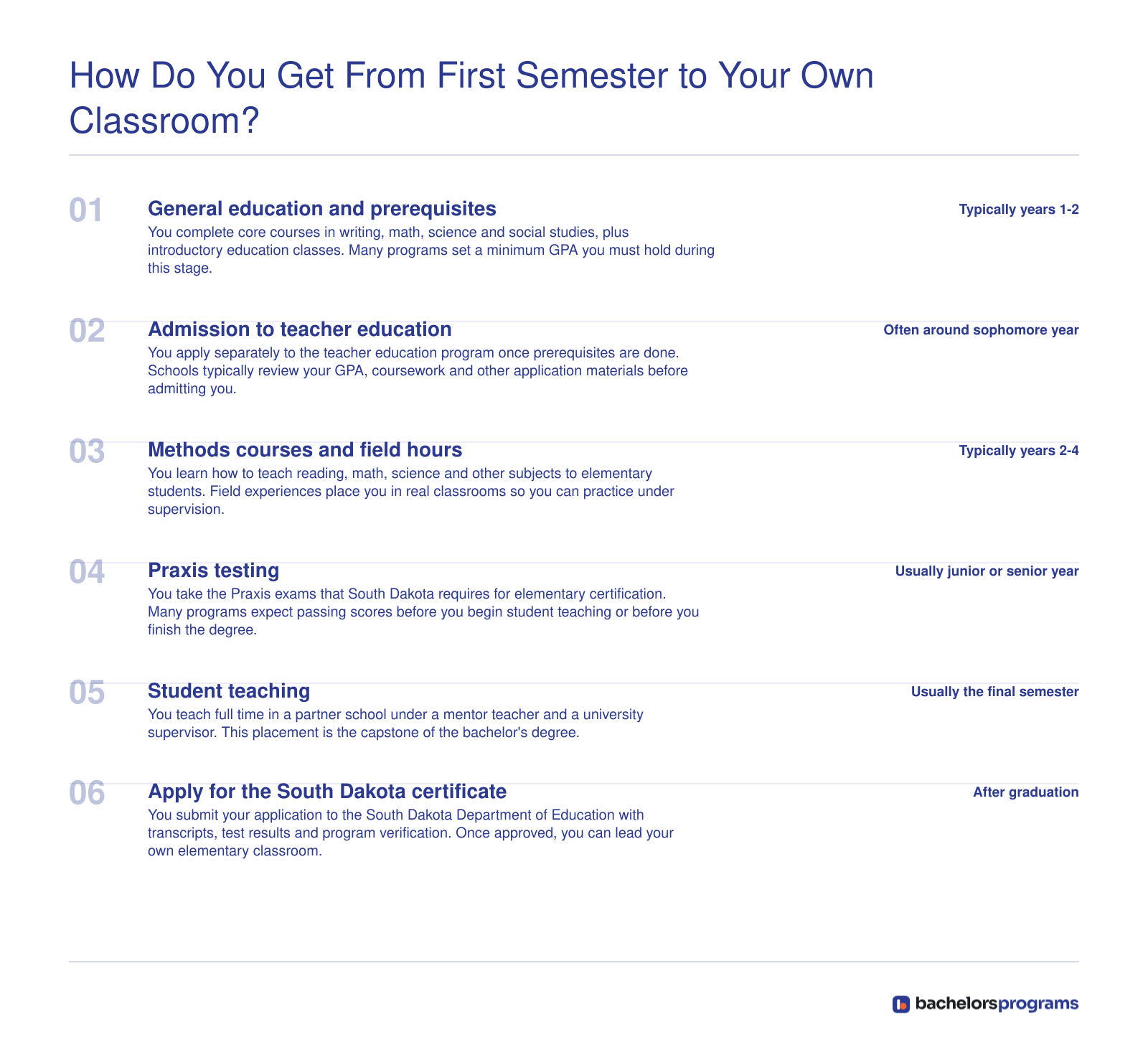
How Do You Get From First Semester to Your Own Classroom?
Most bachelor's degree in elementary education programs in South Dakota follow the same basic sequence, even though each school sets its own calendar. Use this timeline as a general guide, then confirm exact timing, field hour totals and testing deadlines with your program advisor.
South Dakota K-8 Elementary Teaching Certificate: Requirements Checklist
South Dakota issues an Initial Educator Certificate through the South Dakota Department of Education. Use this checklist to track each step from graduation to your first certificate.
- Bachelor's degree and approved programFinish a bachelor's degree through a state-approved teacher preparation program. Your official transcript must show the degree and program, with sign-off from your university.
- Praxis content testPass Praxis 5001, 7801 or 8006, matched to the exact endorsement shown in the state certification system. Passing scores by subtest are 5002 Reading/Language Arts 150, 5003 Math 146, 5004 Social Studies 147 and 5005 Science 150, or 7802 at 156, 7803 at 143, 7804 at 144 and 7805 at 147.
- Praxis pedagogy testNew teachers must also pass a Principles of Learning and Teaching test that matches their preparation level: Grades K-6 (5622) or Grades 5-9 (5623). Both require a 160.
- Application and feeCreate your Educator Profile through mySD.gov. Then submit the Initial Educator Application with your transcript and test results. Endorsements must be requested; they are not added automatically.
- Fee and validityA non-refundable $60 fee activates the application. The certificate is valid for five years.
- Background checksHiring districts may run their own employment background checks. Ask each district during the hiring process.
- Moving out of stateEach state sets its own reciprocity rules, so check with the licensing agency where you plan to teach. Expect to send an official transcript and a full copy of your South Dakota certificate.
Common Questions About Elementary Education Degrees in South Dakota
These answers cover the questions prospective teachers ask most often. Each one points to the section of this page with the full detail.
What is the best elementary education degree program in South Dakota?
Can you get an elementary education degree online in South Dakota?
How long does it take to get an elementary education degree in South Dakota?
What are the requirements to become an elementary teacher in South Dakota?
Which South Dakota college is cheapest for an elementary education degree?
Compare Elementary Education programs on the data that matters
Explore more Education & Teaching majors or browse every field of study.
All Education & Teaching programs Browse every field of study