Best ESL Education Degree Programs
Compare 140+ accredited ESL, English as a Second Language programs, with net price after aid, graduation rates, earnings and debt from IPEDS and the U.S. College Scorecard.

Some students pair a linguistics major with a TESOL minor, which builds expertise but does not always qualify them to lead a public school classroom. A bachelor's degree in ESL education is the more direct route to a license. Every program on this list is undergraduate; graduate study is out of scope.
The decision comes down to which program leads to a license at a price that makes sense. Net price among the schools here runs from $4,195 at CUNY Queens College to $24,402 at Boston University. The ranking covers campus, online and hybrid formats and weighs net price, graduation rates, program earnings and debt.
Licenses are issued by states, so a program that satisfies one state's requirements may leave gaps in another.
Key Points
- CUNY Queens College has the lowest average net price here: $4,195.
- U.S. public schools enrolled 5.3 million English learners in fall 2021.
- Every ranked program delivers its ESL coursework on campus, not online.
Best ESL Education Schools Ranked for 2027
Average net prices across these ten programs run from about $4,200 at CUNY Queens College to roughly $24,400 at Boston University, and every one of them delivers its ESL coursework on campus. What separates them is less about cost than about how quickly they move a student to a teaching license, how much supervised classroom time sits inside the degree, and whether the ESL credential arrives as a stand-alone major or as a second major paired with something else.
Vanderbilt University
#1Nashville, TN · ~$16,000/yr (est.)
Best for: Students pairing ESL with another major
Vanderbilt University is a private research university in Nashville where undergraduates in Peabody College can add a second major in Multilingual and Multicultural Studies with an ESL Teacher Licensure track, and the major is open to students from every Vanderbilt college. Because the ESL pathway is a second major rather than a stand-alone teaching degree, students pair it with a primary field and graduate with two credentials. The school's graduation rate is 94%, and undergraduate admission is highly selective.
- Two concentration options, including the ESL Teacher Licensure track
- Undergraduate major open to students across Vanderbilt colleges
- Minor in Multilingual Learner Education also offered
- Prepares graduates to teach multilingual learners in K-12 settings
- Leads to careers in international education and nonprofit work
- Foundation for advanced study in linguistics or language policy
University of Virginia
#2Charlottesville, VA · $22,000/yr (est. net price)
Best for: Virginia residents seeking in-state licensure
The University of Virginia is a public flagship in Charlottesville whose Bachelor of Science in Education in English as a Second Language is a full four-year teacher preparation degree, or two academic years once a student is admitted into the major. Undergraduates complete 120 credits, including a six-credit half-time ESL internship in a local classroom two days a week and a twelve-credit full-time teaching internship that runs from January through April. The school's graduation rate is 96%.
- 120 total credit hours across four years
- 6-credit half-time ESL internship in a local classroom
- 12-credit full-time teaching internship, January to April
- English linguistics course required alongside methods work
- Praxis English to Speakers of Other Languages taken before fourth year
- Leads to initial Virginia licensure with an ESL preK-12 endorsement
- Guaranteed admission to select UVA master's programs for up to five years
University of Georgia
#3Athens, GA · ~$14,000/yr (est.)
Best for: Undergrads finishing licensure in two semesters
The University of Georgia is a public flagship in Athens whose B.S.Ed. in TESOL and World Language Education enrolls teacher candidates during their final undergraduate year and finishes in two semesters with T-4 initial certification to teach in Georgia public schools. Cohorts stay at 20 or fewer students, placements run from elementary through high school grade bands, and the program reports that all of its graduates are employed in P-12 or adult education. The school's graduation rate is 90%.
- Two-semester program for teacher candidates in their final year
- T-4 initial teaching certification in Georgia
- TESOL endorsement earned alongside the degree
- 3.0 overall GPA and 50 documented pre-professional hours required
- Two fall classroom placements plus full-time spring student teaching
- Placements span PK-2, 3-5, 6-8 and 9-12 grade bands
- Groups of 20 or fewer students
Brigham Young University
#4Provo, UT · $15,000 – $20,000/yr (est.)
Brigham Young University is a private religious university in Provo, Utah, where the BA in Applied English Linguistics lets majors build a 48- to 60-credit degree from a 12-hour primary track and a 6-hour secondary track taken in a different area. The TESOL and Language Acquisition track covers listening, speaking, reading, writing and vocabulary instruction along with a TESOL practicum and coursework in first and second language acquisition. The school's graduation rate is 81%.
- 48 to 60 total credit hours
- 12-hour primary track plus 6-hour secondary track in another area
- TESOL practicum and course and lesson planning included
- Foreign language study through the 200 level required
- 12 major credits can count toward a TESOL minor
- Experiential learning via internship, mentored research or journal editing
- TESOL minor and certificate also available
University of Illinois Urbana-Champaign
#5Champaign, IL · ~$14,000/yr (est.)
The University of Illinois Urbana-Champaign is a large public research university where the BALAS in Linguistics and Teaching English as a Second Language requires 120 hours, 41 of them in linguistics and TESL coursework. Students complete 15 hours of linguistics core, 15 hours of TESL core, a capstone course and at least 8 hours in a second foreign language, one of which must be non-Western. The school's graduation rate is 85%.
- 120 total credit hours for graduation
- 41 credit hours in linguistics and TESL coursework
- 15 hours of linguistics core plus 15 hours of TESL core
- 3-hour capstone course required
- At least 8 hours in a second foreign language, one non-Western
- Major Plan of Study due before the end of the fifth semester
- 12 hours of upper-level major coursework taken on campus
Ohio State University
#6Columbus, OH · $17,000/yr (est. net price)
Ohio State University is a large public university in Columbus whose Bachelor of Science in Education in Teaching English to Speakers of Other Languages leads to Ohio's K-12 multi-age TESOL teaching license. Field experiences run through K-12 ESL settings, and the final year pairs a year-long internship and student teaching with an ESL mentor teacher alongside weekly seminars led by current and former language teachers. The school's graduation rate is 88%.
- Leads to Ohio's K-12 multi-age TESOL teaching license
- Field experiences in K-12 ESL classroom settings
- Year-long internship and student teaching with an ESL mentor teacher
- Weekly seminars taught by current and former language teachers
- Coursework covers translanguaging and bilingual education
- Global Option Certificate available and education abroad encouraged
- Early action application deadline is November 1
Stony Brook University
#7Stony Brook, NY · ~$19,000/yr (est.)
Stony Brook University is a public research university on Long Island where undergraduates major in Linguistics and complete TESOL teacher preparation through the BA-TESOL Teacher Education Program. The program leads to initial New York State teaching certification and is distinctive locally for its emphasis on curriculum design and technology integration for English language learners. Applicants need a 3.0 overall and major GPA, specific linguistics prerequisites, and two years of college-level study of a language other than English; the school's graduation rate is 76%.
- Linguistics major combined with TESOL teacher preparation
- Leads to initial New York State teaching certification
- 3.0 overall GPA and 3.0 linguistics GPA required
- LIN 101 plus LIN 201 or LIN 311 with a C or better
- Two years of college-level study of a language other than English
- Focus on curriculum design and technology integration for English learners
- Rolling admissions with sophomore-year application recommended
CUNY Queens College
#8Queens, NY · ~$4,200/yr (est.)
CUNY Queens College is a public senior college in the City University of New York system, and its BA in Teaching English to Speakers of Other Languages leads to an Initial Certificate to teach English as a New Language in New York State public schools at all grade levels. Methods courses carry field experiences at both the elementary and secondary levels, and a student teaching course is built into the major. The school's graduation rate is 53%. Median earnings for graduates of the program were $48,923 one year after completion.
- Initial Certificate to teach English as a New Language in New York
- Certification covers all grade levels
- Student teaching course built into the major
- Field experiences embedded in two methods courses
- Placements at both elementary and secondary levels
- Also referred to as ESL or ESOL teaching
Emmaus Bible College
#9Dubuque, IA · ~$13,000/yr (est.)
Emmaus Bible College is a small private Bible college in Dubuque, Iowa, where the K-12 ESL Education major is a four-year Bachelor of Science with 53 to 56 credits of professional ESL coursework alongside 30 credits in Bible and theology. Students choose a K-8 track of 12 credits or a 5-12 track of 9, and candidates seeking an initial Iowa teaching license complete all program and state licensure requirements through the Iowa Board of Educational Examiners. The school's graduation rate is 83%.
- Four-year Bachelor of Science, 120.5 total credit hours
- 53 to 56 credits in ESL professional studies
- K-8 track of 12 credits or 5-12 track of 9 credits
- 30 credits in Bible and theology, 38 in general studies
- Prepares candidates for an initial Iowa teaching license
- 2.5 cumulative GPA minimum, with 3.0 required in some courses
- Coursework includes Linguistics and English Phonetics and Introduction to TESOL
Boston University
#10Boston, MA · $20,000 – $25,000/yr (est.)
Boston University is a private research university offering a BS in Bilingual Education and Teaching English to Speakers of Other Languages, which trains graduates for both bilingual and ESL classrooms rather than ESL alone. The degree sits inside a large urban university, and the school's graduation rate is 89%.
- Bachelor's degree in Bilingual Education and TESOL
- Prepares graduates for both bilingual and ESL classrooms
Cost & outcomes by school
Federal data for the highest-earning ESL, English as a Second Language programs, independent of the ranking above. Earnings are this field's bachelor's graduates four years after completing where the Scorecard reports them, else the school's undergraduate median.
| School | Net price / yr | Grad rate | Earnings | Debt | Grads/yr | Format |
|---|---|---|---|---|---|---|
| Vanderbilt University TN | $15,846 | 94% | $91,565 | $14,000 | — | Campus |
| University of Virginia VA | $21,565 | 96% | $86,863 | $17,500 | — | Campus |
| Boston University MA | $24,402 | 89% | $83,238 | $23,250 | — | Campus |
| University of Illinois Urbana-Champaign IL | $14,355 | 85% | $81,054 | $19,500 | — | Campus |
| CUNY Queens College NY | $4,195 | 53% | $79,175 | $10,298 | 11 | Campus |
| Linfield University OR | $26,536 | 71% | $78,638 | $25,000 | — | Campus |
| University of the Pacific CA | $25,447 | 69% | $78,445 | $19,500 | — | Campus |
| Brigham Young University UT | $15,564 | 81% | $75,790 | $11,069 | — | Campus |
| Stony Brook University NY | $18,784 | 76% | $74,502 | $18,228 | 8 | Campus |
| Rutgers University NJ | $24,406 | 84% | $74,479 | $21,500 | — | Campus |
| University of North Carolina at Chapel Hill NC | $11,655 | 91% | $72,200 | $14,000 | — | Campus |
| Drake University IA | $29,127 | 74% | $71,901 | $23,000 | — | Online or campus |
Sources: U.S. Department of Education. Net price, graduation rate, earnings and debt: College Scorecard (earnings and debt for this field's bachelor's graduates where reported, else school-wide); graduates: IPEDS. A dash means no figure is reported.
Cost, debt & payoff
Median earnings of this field's bachelor's graduates (4 yrs after completing, else the school's undergraduate median) vs. their median federal loan debt · U.S. College Scorecard
Across these programs the median graduate earns about $54,163 and finishes with roughly $21,500 in debt — a ratio that clears a common rule of thumb (keep debt below first-year salary). Net price and debt vary widely school to school, so check the per-school figures in the table above before you shortlist.
How We Ranked These ESL Education Schools
Debt has become the deciding question for many future teachers, and ESL education is no exception. Each school here was judged on five factors that reflect an ESL teaching career.
The Five Factors
- Average net price after aid: What students actually pay after grants and scholarships, not the sticker price.
- Graduation rate: The institution-wide share of students who finish, a signal of how well a school carries students to the diploma.
- Program earnings after completion: What graduates of the specific program earn soon after finishing.
- Median federal debt: The typical loan balance graduates leave with.
- Number of completions: How many students finish the program, a sign of an established track record.
Why Cost and Debt Matter So Much
Teacher pay is modest, so a large loan balance can shape your finances for years. A lower net price and lighter debt give an ESL teacher more room to build a career, whether in a public school classroom or an adult education setting. That is why cost and debt carry so much weight here.
Scope and Data Gaps
Programs in every delivery format were eligible: online, hybrid and on-campus. Only bachelor's-level programs were considered.
Some programs lack published earnings or debt figures. That usually reflects small cohorts, where federal reporting rules withhold numbers to protect student privacy, not weak results. Treat a missing figure as a reason to ask the school directly, not as a warning sign.
How Many English Learners Are in U.S. Public Schools?
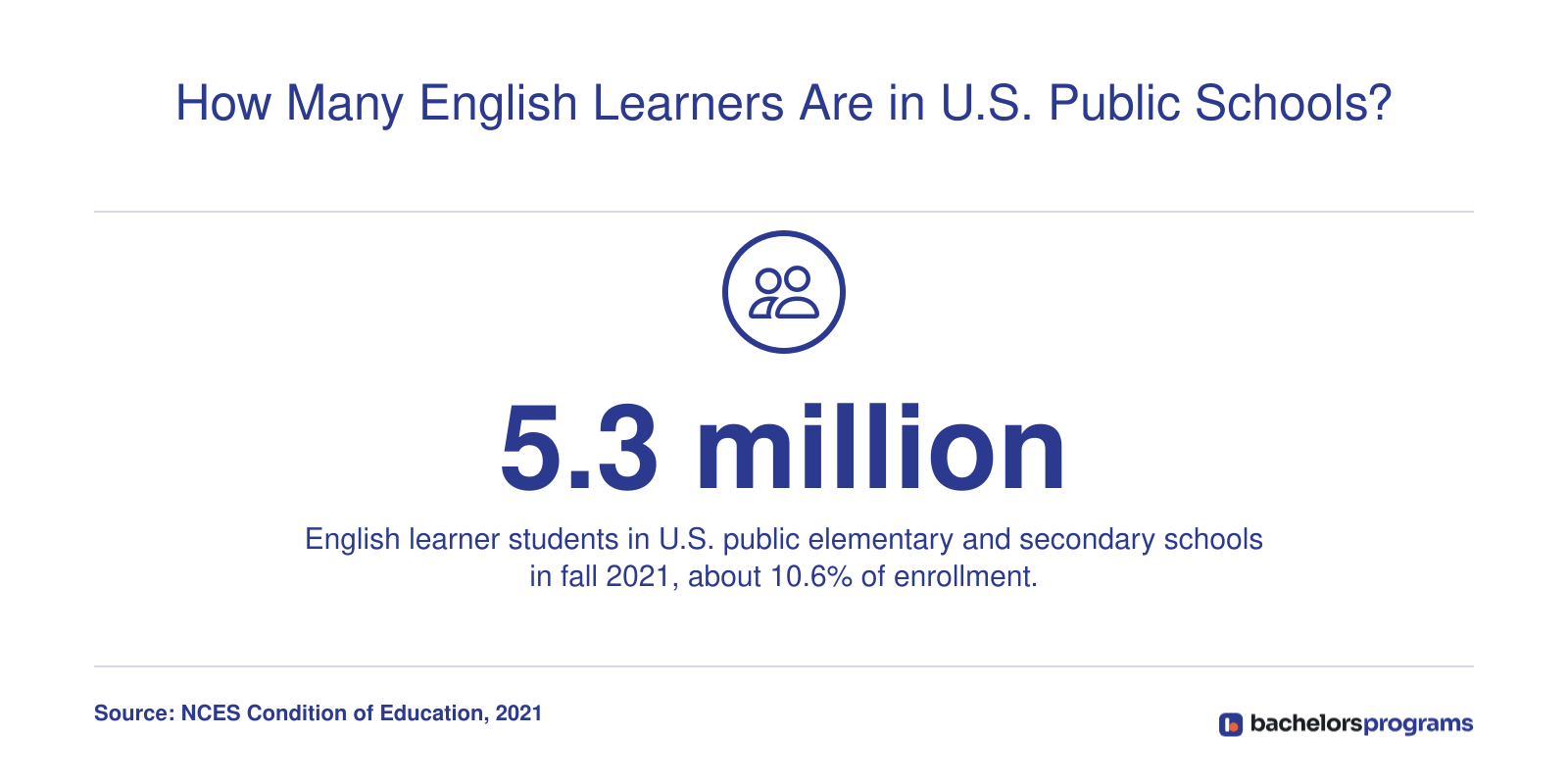
The most recent NCES Condition of Education figures count 5.3 million English learner students in U.S. public elementary and secondary schools in fall 2021 (the 2021-22 school year). That is 10.6% of all public school students, up from 9.4%, or 4.6 million students, in fall 2011. Roughly one in ten K-12 students now needs language support from a qualified teacher, and that steady growth is the clearest demand case for earning a bachelor's degree in ESL education.
What a Bachelor's Degree in ESL Education Covers (And How It Differs From TESOL)
A bachelor's degree in ESL education prepares you to teach English learners. Typical coursework covers linguistics, second-language acquisition, literacy, and assessment, plus clinical hours working directly with English learners. What the degree leads to depends on which of three paths you choose.
Three Paths, Three Outcomes
- Standalone ESL major: Some programs make ESL the licensure field itself. Augsburg University's ESL K-12 major, for example, prepares students for a K-12 license1, and Belmont University's ESL teaching major covers PreK-12.2
- Education major plus ESL: You earn an elementary or secondary education degree and add an ESL concentration, minor, or endorsement. UW-La Crosse pairs English Education with TESOL, preparing graduates for English Language Arts 4-12 and ESL K-12.3
- Non-licensure TESOL or applied linguistics: These degrees build language-teaching knowledge without a state license. They typically point toward adult education or overseas teaching rather than public K-12 classrooms.
What the Degree Alone Qualifies You to Do
A licensure-track program is built to lead to a K-12 teaching license. A non-licensure TESOL major generally does not. If your goal is a public school classroom, confirm that the program is state-approved for licensure before you enroll.
What K-12 Employers and States Require
For public schools, the decisive factor is rarely whether your major was called ESL or education. Hiring generally turns on a bachelor's degree, a valid state teaching license for the relevant grades, and a state-recognized ESL, ENL, or TESOL endorsement or authorization when the job involves English learners.4 A stand-alone TESOL certificate from an independent provider generally does not replace that state credential.
The details vary by state:
- Illinois: The ESL endorsement is the minimum credential for certified teachers who want to teach ESL in public schools. It requires 18 credits plus either 100 clinical hours or three months of teaching experience in an ESL or bilingual program.5 The ENL endorsement adds two more courses.6
- Nebraska: The University of Nebraska-Lincoln requires an elementary or secondary teaching license before the ESL endorsement can be added.7
- Idaho: The state recognizes separate credentials for ESL, ENL, and bilingual education, all K-12.8
Districts may post openings as ESL, ENL, or English learner roles, so check your target state's licensing agency, such as the California Commission on Teacher Credentialing, before choosing a program.
Related Articles
ESL Degree Programs Tuition Comparison: The Lowest-Cost Options
According to 2024 IPEDS and College Scorecard data from the U.S. Department of Education, the most affordable options here range from an average net price of $4,195 at CUNY Queens College to $9,096 at Murray State University, and out-of-state students pay about $7,950 to $12,600 more in tuition and fees than residents, with California State University-Fresno showing the widest gap. A median monthly payment on a 10-year plan is not reported for these ESL programs, so school-wide median graduate debt of $10,298 to $20,500 is the clearest guide: a smaller balance means a smaller fixed loan bill to fit beside rent, transportation and classroom supplies in a new teacher's budget. Net price is an average after grants and scholarships, so your actual cost can fall well above or below it depending on your family's income.
| School | Program | In-State Tuition and Fees | Out-of-State Tuition and Fees | Average Net Price | Median Graduate Debt (School-Wide) |
|---|---|---|---|---|---|
| CUNY Queens College (Queens, NY) | Teaching English to Speakers of Other Languages | $7,538 | $15,488 | $4,195 | $10,298 |
| California State University-Fresno (Fresno, CA) | Linguistics, TESOL/SLAT Option (B.A.) | $7,350 | $19,950 | $7,000 | $14,505 |
| Murray State University (Murray, KY) | English, TESOL Track | $9,900 | $19,836 | $9,096 | $20,500 |
Online vs. Campus ESL Education Programs: Student Teaching Included
Online coursework has made teacher preparation easier to start, but the classroom portion is still local and tightly regulated.
Where the Ranked Programs Stand
Every school in the ranking above, from Vanderbilt to Boston University, delivers its program on campus. None is listed as online or hybrid. Students who need a fully online route will find it in other listings; Liberty University Online's ESL B.Ed. is one example.
Online Still Means In-Person Fieldwork
Searching for an "ESL bachelor's degree online" or a "TESOL bachelor's degree online" turns up programs that put lectures and assignments on a screen. Observations, practicum hours and student teaching still happen in a supervised school. Requirements vary by program and state, and they are not interchangeable:
- Liberty University Online: 90 practicum hours plus at least one full semester of student teaching, with placement in the student's own community.1
- Florida: for candidates entering in 2023-24 or later, at least 60 preservice field hours and a minimum of 12 weeks of student teaching.2
- Missouri State University: a semester-long field experience, a 10-day pre-student-teaching placement and a 15-hour lab with diverse learners.8
Why State Authorization Matters
Most online students are placed in a school in their home state. That placement depends on the university's approval in that state, district agreements and supervisor qualifications. La Salle University warns that online authorization does not guarantee field-placement eligibility elsewhere.3
Some programs restrict placement outright:
- The University of Louisville's online certification programs require student teaching at an approved Kentucky location.4
- Texas A&M University-Texarkana requires Texas or TEA-approved settings, with in-person experiences within about 100 miles.5
- South Carolina requires clearance from its Department of Education, which carries a $105 application fee.4
- Washington requires out-of-state institutions to get authorization and a field-placement agreement.6
- Iowa's education department has flagged some out-of-state online programs as not approved there.7
One Tip Before You Enroll
Ask admissions directly: "Do you place student teachers in my state, and will this program lead to a license there?" Get it in writing; a program that cannot place you locally can leave you with a degree and no path to a classroom.
How to Confirm an ESL Program Leads to a Teaching License
A bachelor's degree in ESL education only pays off if it qualifies you for a teaching license in the state where you plan to work. Check these points before you enroll.
- State-approved educator preparation programYour state education agency approves teacher preparation programs. Find the program on that agency's approved list. Approval in one state does not automatically carry over to another.
- CAEP or AAQEP accreditationBoth are programmatic accreditors that review educator preparation quality. Some states and districts value this accreditation, but it is not a license, does not replace state approval, and is not required nationwide.
- Institutional accreditation of the collegeConfirm that the college itself holds accreditation from a recognized institutional accreditor, separate from any program-level review.
- Licensure disclosure for your stateFederal rules require programs leading to licensure to disclose, before you enroll, whether they meet education requirements in each state. Online students are evaluated by their location or intended employment state.
- Student teaching with English learnersSupervised clinical experience is a core licensure requirement. Confirm that a student-teaching placement with English learners is built into the degree.
Highest First-Year Earnings Among Ranked ESL Programs
Among the ranked ESL education programs with program-level earnings data, one graduate group stands out in its first year of work.
ESL, English as a Second Language programs by state
Frequently Asked Questions About ESL Education Degrees
These answers cover the questions prospective students ask most often about licensure, degree types, endorsements, and adult ESL work. Requirements differ by state, so confirm details with your state education agency or the college that employs you.
Do you need a teaching license to teach English as a second language?
Is a TESOL bachelor's degree the same as an ESL education degree?
How long does it take to add an ESL endorsement to an existing teaching license?
Can you teach ESL at a community college with only a bachelor's degree?
Compare ESL, English as a Second Language programs on the data that matters
Explore more Education & Teaching majors or browse every field of study.
All Education & Teaching programs Browse every field of study