Best Online ESL Education Degree Programs
Compare 17 accredited online ESL, English as a Second Language programs, with net price after aid, graduation rates, earnings and debt from IPEDS and the U.S. College Scorecard.

Can you earn a bachelor's degree in ESL education fully online and still qualify to teach? Often, yes, but only the coursework moves online. Student teaching happens in a real school, and licensure is decided state by state. Every program below is a bachelor's degree, not graduate study.
Graduates can teach K-12 ESL, work in adult education or teach abroad. Net price after aid averages roughly $22,000 a year across the schools ranked here, from about $15,300 to $30,400, with the lowest figures mostly at public universities.
Key Points
- Licensure-track online programs usually require a semester of local student teaching.
- ESL teaching licenses are issued state by state, with no national credential.
- Verify institutional accreditation, educator prep accreditation and state approval separately.
Top 10 Fully Online Bachelor's in ESL Education Programs for 2027
Every program in this ranking is fully online. Hybrid and in-person formats were excluded, and the ten that remain are ordered by a mix of net price, completion, and reported earnings and debt where the data support it. Read the licensure notes carefully, because some schools award a full ESL teaching license while others add an endorsement to an existing elementary or secondary degree.
Liberty University
#1Lynchburg, VA · ~$29,000/yr (est.)
Best for: Transfer students seeking P-12 ESL licensure
Liberty University is a large private Christian university in Lynchburg, Virginia, and its School of Education holds CAEP accreditation. The ESL education degree is a 120-credit P-12 program with 90 practicum hours and a full semester of student teaching, and applicants are not required to submit SAT, ACT or CLT scores. Transfer students can bring in up to 75% of the degree, and candidates may qualify for the federal TEACH Grant. Graduates of the ESL program reported median earnings of $34,876 one year after completion.
- CAEP-accredited School of Education
- 120 credit hours with 90 practicum hours
- Full semester of student teaching, placements across Virginia
- No entrance exam; SAT, ACT and CLT scores not required
- Transfer up to 75% of the degree total
- Federal TEACH Grant eligibility
- Prepares for Virginia teaching licensure
Nova Southeastern University
#2Fort Lauderdale, FL · ~$30,000/yr (est.)
Best for: Florida career changers adding ESOL endorsements
Nova Southeastern University is a private university in Fort Lauderdale, Florida, with a state-approved teacher preparation pathway. Its elementary education degree carries an ESOL/Reading concentration that leads to Florida certification plus reading and ESOL endorsements. Every education course includes at least 10 field experience hours, and the program finishes with a 12-week full-time clinical internship. A cohort structure, exam preparation and mentoring support students who are balancing school with work.
- ESOL and reading endorsements; leads to Florida certification
- 12-week full-time clinical internship
- At least 10 field experience hours in each education course
- Cohort model with exam preparation and mentoring
- Federal TEACH Grant funding available
- Alumni hired in Broward, Miami-Dade and Palm Beach schools
Oral Roberts University
#3Tulsa, OK · ~$25,000/yr (est.)
Best for: Aspiring teachers planning to work abroad
Oral Roberts University is a private, faith-based university in Tulsa, Oklahoma, with a College of Education accredited by CAEP and the state's quality and accountability office. Its English in the Global Classroom degree is built for two audiences at once: future middle school English teachers in U.S. schools and teachers headed for English language classrooms abroad. Candidates complete two student teaching placements and between 90 and 155 pre-clinical hours, plus a 16-week Science of Reading micro-credential. Graduates can pursue ELL and middle school English certification and transfer it under the NASDTEC interstate agreement.
- CAEP and Oklahoma OEQA accredited College of Education
- Two student teaching placements, one in middle school English
- 90 to 155 pre-clinical hours in local schools
- 16-week Science of Reading micro-credential
- ELL and middle school English certification
- NASDTEC interstate certificate transfer
- Up to $5,000 in annual College of Education scholarships
- Up to 12 graduate credits earned as an undergraduate
Southwest Minnesota State University
#4Marshall, MN · ~$15,000/yr (est.)
Southwest Minnesota State University is a public regional university in Marshall, Minnesota, with one of the few degrees named specifically for teaching English as a second language. The K-12 TESL track is offered alongside a K-12 minor in the same subject and a separate certificate for teaching multilingual learners. Tuition sits at the lower end of the public options in this ranking, and the K-12 track is designed around Minnesota's licensure structure. Students who want a full course sequence should request the current catalog from the department before applying.
- K-12 track in teaching English as a second language
- Same subject also available as a K-12 minor
- Separate certificate for teaching K-12 multilingual learners
Eastern Michigan University
#5Ypsilanti, MI · $15,000 – $20,000/yr (est.)
Eastern Michigan University is a public university in Ypsilanti, Michigan, and its TESOL major sits in the Department of World Languages rather than the college of education. The major takes 36 hours and requires a minor, and Michigan ESL certification requires a second major, so students should plan that pairing early. Entry requires sophomore standing and two semesters of a world language. Some courses are offered entirely online, and the curriculum also prepares graduates for language testing and assessment work.
- 36 major hours: 33 required plus 3 restricted electives
- Requires a minor; Michigan ESL certification needs a second major
- 3-credit internship with coursework in assessment and advocacy
- Entry needs sophomore standing and two semesters of world language
- Some courses offered entirely online
- Prepares graduates for language testing and assessment roles
Lewis University
#6Romeoville, IL · ~$17,000/yr (est.)
Lewis University is a private university in Romeoville, Illinois, and one of the few schools here that bundles three endorsements into a single major. Students earn early childhood education, early childhood special education and English as a Second Language endorsements covering PreK through grade 12. An evening online pathway with synchronous sessions is designed for working adults, and field placements run through more than 60 partner districts. The licensure track ends with a 15-week, full-time student teaching placement.
- Bundles early childhood, early childhood special education and ESL endorsements
- ESL endorsement covers PreK through grade 12
- Evening online pathway with synchronous classes
- Field experiences across 60-plus partner districts
- 15-week full-time student teaching placement
- Accredited by the Illinois State Board of Education
- 2+2 transfer pathway with Joliet Junior College
Horizon University
#7Indianapolis, IN · ~$22,000/yr (est.)
Horizon University is a small private institution in Indianapolis, Indiana, and its TESOL bachelor's degree is delivered online. The 126-credit program devotes 69 credits to TESOL major courses taught from a Christ-centered perspective, with observed teaching experience in the United States or abroad. Graduates typically teach in classrooms, community and church-based programs, or mission settings. It is a distinct fit for students who want ministry and language teaching to overlap.
- 126 total credit hours
- 69 credits in TESOL major courses
- Christ-centered teaching tools and methodology
- Observed teaching experience in the U.S. or abroad
- Prepares teachers for community, church and mission settings
Grand Canyon University
#8Phoenix, AZ · ~$22,000/yr (est.)
Grand Canyon University is a large private university in Phoenix, Arizona, and its elementary education degree carries an emphasis in English as a Second Language rather than a stand-alone ESL major. The 120-credit program includes 160 hours of observational and practice-based experience plus a 15-week student teaching placement in a grades 1-8 ESL classroom. Online coursework is priced per credit, transfer students can bring up to 90 credits, and graduates may qualify for Arizona's provisional ESL endorsement. Five courses within the major also satisfy the state ESL endorsement requirement.
- 120 credit hours; 160 hours of observational and practice-based experience
- 15-week student teaching placement in a grades 1-8 ESL classroom
- $465 per credit for online study
- Up to 90 transfer credits accepted
- Arizona provisional ESL endorsement eligible
- Five courses satisfy the Arizona ESL endorsement
- Aligned with InTASC and TESOL standards
Drake University
#9Des Moines, IA · $25,000 – $30,000/yr (est.)
Drake University is a private university in Des Moines, Iowa, and it approaches ESL differently: the endorsement is an 18-credit add-on rather than a stand-alone bachelor's degree. Undergraduates pair it with a BS in Elementary Education or Secondary Education and take six TESL courses that can be completed fully online at their own pace. Rolling admissions let students start when convenient, and up to six credits can be taken before formal admission. Iowa classifies ESL as a teacher shortage area, and forgivable loan programs may apply.
- 18 credit hours across six TESL courses
- Open to undergraduate and graduate students
- Fully online sections; no campus attendance required
- Pairs with the BS in Elementary Education or Secondary Education
- Rolling admissions; up to six credits before admission
- ESL is an Iowa teacher shortage area
- Students work at their own pace
Texas State University
#10San Marcos, TX · ~$17,000/yr (est.)
Texas State University is a public university in San Marcos, Texas, and its online bachelor's in applied elementary education includes an ESL certification track. The 120-credit program prepares students for Early Childhood through Grade 6 certification with an ESL endorsement, and courses run in 8-week terms. It is built as an instructional aide pathway, so applicants must currently work as a Texas instructional aide with at least one year of experience. Clinical teaching residencies and transfer credit of up to 90 hours round out the degree.
- 120 credit hours leading to EC-6 certification with ESL endorsement
- Instructional aide pathway requires current Texas aide employment
- $407 per credit hour; $75 application fee
- 8-week course terms
- Up to 90 transfer credits
- Clinical teaching residencies built into the degree
- 2.5 GPA minimum for admission
Cost & outcomes by school
Federal data for the highest-earning ESL, English as a Second Language programs, independent of the ranking above. Earnings are this field's bachelor's graduates four years after completing where the Scorecard reports them, else the school's undergraduate median.
| School | Net price / yr | Grad rate | Earnings | Debt | Grads/yr | Format |
|---|---|---|---|---|---|---|
| Drake University IA | $29,127 | 74% | $71,901 | $23,000 | — | Online or campus |
| Lewis University IL | $17,028 | 67% | $66,099 | $21,500 | — | Online or campus |
| Hamline University MN | $20,744 | 61% | $61,106 | $23,770 | — | Hybrid |
| Texas State University TX | $16,805 | 55% | $56,906 | $21,000 | — | Online |
| Texas Woman's University TX | $11,963 | 49% | $56,544 | $19,218 | — | Online or campus |
Sources: U.S. Department of Education. Net price, graduation rate, earnings and debt: College Scorecard (earnings and debt for this field's bachelor's graduates where reported, else school-wide); graduates: IPEDS. A dash means no figure is reported.
Cost, debt & payoff
Median earnings of this field's bachelor's graduates (4 yrs after completing, else the school's undergraduate median) vs. their median federal loan debt · U.S. College Scorecard
Across these programs the median graduate earns about $54,163 and finishes with roughly $21,500 in debt — a ratio that clears a common rule of thumb (keep debt below first-year salary). Net price and debt vary widely school to school, so check the per-school figures in the table above before you shortlist.
What a Bachelor's Degree in ESL Education Covers (And How It Differs From TESOL)
Overseas employers usually cite a 120-hour TEFL or TESOL certificate as the benchmark1, and an ESL education bachelor's goes well beyond it. The degree is teacher preparation focused on English learners. Coursework covers linguistics, second-language acquisition, literacy methods and assessment, plus classroom practice.
ESL, TESOL and TEFL: Quick Distinctions
- ESL: Teaching English to non-native speakers in an English-dominant country. ESL or ESOL degrees typically point toward U.S. K-12 licensure.
- TEFL: Teaching English where it is not the main language, so it is tied to work abroad.
- TESOL: The broadest umbrella, covering both settings.4 It often labels adult programs or overseas teaching, and employers generally treat TEFL and TESOL certificates as interchangeable when the course is credible.5
Can an Online Bachelor's Let You Teach Abroad?
Often, yes, with caveats. South Korea and Japan generally ask for a bachelor's in any major2, and Spain commonly does too.3 A 120-hour certificate is frequently expected or preferred, and an ESL education degree can meet or exceed that. Requirements still vary by employer, visa type and nationality. In the Middle East, international schools and higher-paying posts often want a teaching license and experience as well.2
Takeaways
- Choose an ESL education degree if U.S. classroom licensure is your goal.
- Add a TEFL or TESOL certificate if overseas work is your priority and your program does not include one.
- Check visa and employer rules in each country before you commit.
Lowest-Cost Fully Online ESL Degree Programs: Net Price and Debt
Tuition below is annual tuition and fees, and average net price comes from IPEDS and College Scorecard (2024) data. Net price is an institution-wide average after grants and scholarships, so treat it as an estimate, not a quote for your own aid package. Southwest Minnesota State University charges the same rate in and out of state, and other schools may bill online learners a flat e-tuition rate, so confirm which rate applies to you before you weigh the out-of-state column. Median debt and 10-year monthly payment figures are not reported for these specific programs, and we have not substituted school-wide averages.
| School | Program | In-State Tuition | Out-of-State Tuition | Average Net Price | Median Program Debt | Monthly Payment (10-Year Plan) |
|---|---|---|---|---|---|---|
| St. Petersburg College (St. Petersburg, FL) | Secondary English Education with Reading and ESOL Endorsement (BS) | $2,682 | $9,286 | $1,471 | Not reported | Not reported |
| Texas Woman's University (Denton, TX) | BS in Education (EC-6 Core Subjects with ESL and Special Education) | $8,640 | $18,480 | $11,963 | Not reported | Not reported |
| Southwest Minnesota State University (Marshall, MN) | Teaching English as a Second Language (TESL), BS (K-12) | $10,361 | $10,361 | $15,291 | Not reported | Not reported |
Related Articles
Do Online ESL Degrees Lead to a Teaching License? Licensure and State Portability
ESL teacher licensure in the United States is decided state by state, and no national certificate travels automatically.1
Licensure Track vs. Non-Licensure Track
A licensure-track bachelor's program is approved by the school's home state education department and includes supervised student teaching, general licensure exams, an ESL content component and a background check.2 It leads either to an initial ESL certification or to an add-on ESOL endorsement layered onto an existing license.2 Non-licensure programs skip that state approval and suit adult education, nonprofits or teaching abroad.
Portability and Testing
State approval belongs to the school's home state. If you live elsewhere, you generally apply through your own state department of education, which may add tests or coursework.1
The NASDTEC Interstate Agreement, signed by 48 states and the District of Columbia, eases moving a license across state lines.4 It commits a receiving state to issue some form of authorization, but it is not automatic reciprocity: no guarantee of the same license, no waiver of exams or coursework, no guaranteed transfer of an ESL endorsement, and you still file a separate application.3
Many states use the Praxis English to Speakers of Other Languages (5362) exam for an ESL endorsement, but it is not a national requirement.5 Confirm your state's rules before you enroll.
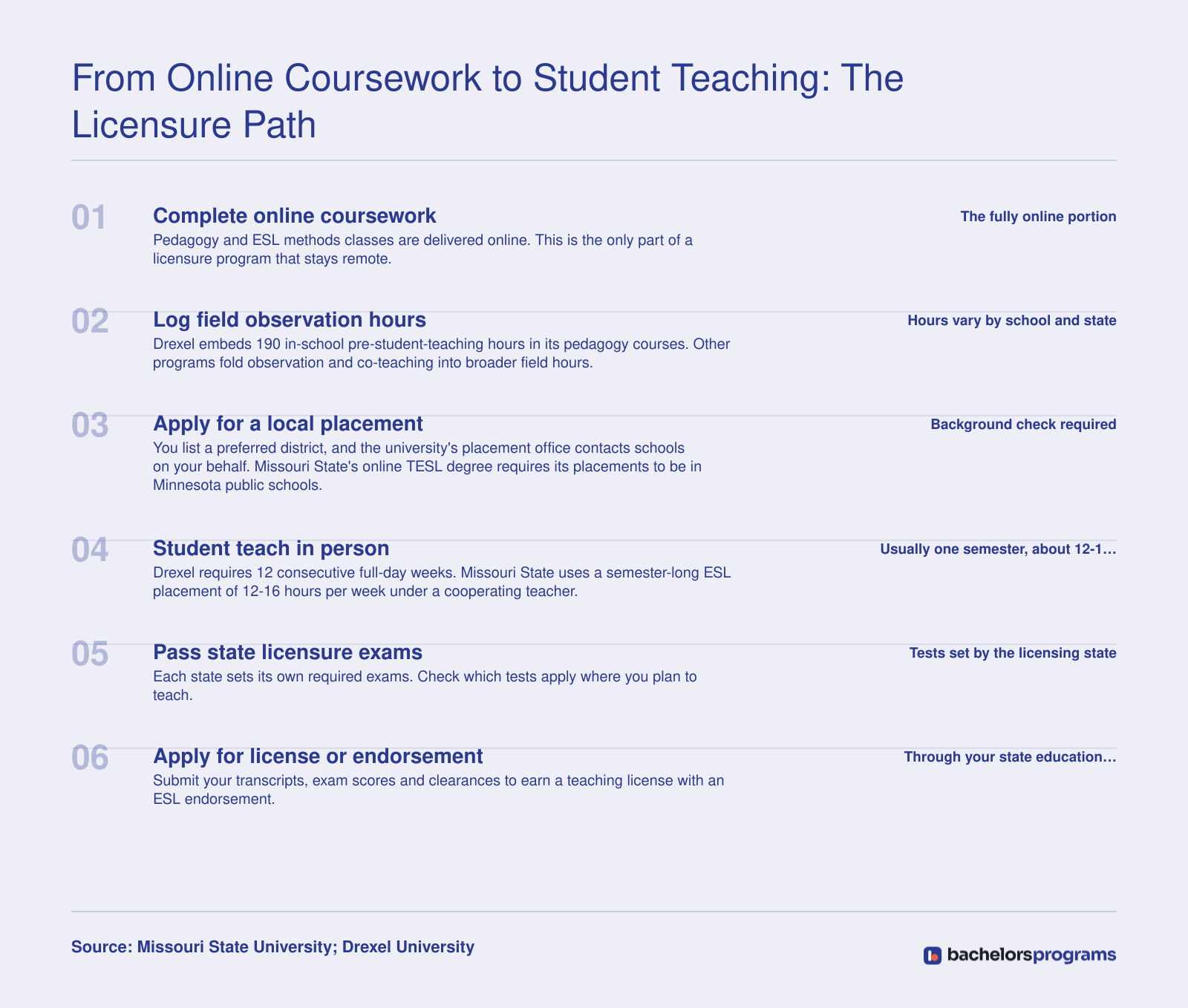
From Online Coursework to Student Teaching: The Licensure Path
In an online ESL education program, "fully online" describes the coursework, not the whole degree. Licensure-track programs still require supervised work in a real school, usually a semester of student teaching near your home. Placement approval rules vary by state, so confirm them before you enroll.
Accreditation Checklist: What to Verify Before You Enroll
Before you commit to any of the online ESL degree programs below, confirm each of these points yourself. Institutional accreditation, educator preparation accreditation and state approval are separate checks, and passing one does not guarantee the others.
- Institutional accreditationSearch the U.S. Department of Education's Database of Accredited Postsecondary Institutions and Programs (DAPIP) using the school's exact legal name. Use the CHEA directory as a second check, keeping in mind that its listings can lag behind recent status changes.
- Educator preparation accreditationLook up the school directly on the CAEP or AAQEP website. Confirm the exact provider, program level and expiration date. For CAEP, the provider should be accredited at the Initial-Licensure level. Wording such as "CAEP aligned" or "seeking accreditation" does not mean the program is currently accredited.
- State program approvalCheck with the education agency in the school's home state that the specific ESL program is an approved educator preparation program for the license or endorsement you want.
- Licensure disclosure for your stateUnder federal rules in effect since July 1, 2020, schools must disclose state by state whether a licensure program meets, does not meet or has not determined whether it meets requirements. Ask for written confirmation covering the state where you plan to teach.
- Licensure-track or non-licensureGet a clear answer on whether the degree leads to a teaching license. Some online ESL and TESOL bachelor's programs are non-licensure degrees designed for other career paths.
What ESL Teachers Earn
Graduates who teach ESL in public schools typically work as elementary teachers, while those who teach adults fall under a separate BLS occupation.
ESL, English as a Second Language programs by state
Online ESL Degree FAQs
How long does it take to earn an online bachelor's in ESL education?
Can you get a bachelor's degree in ESL online?
How much does an online ESL education degree cost?
Compare ESL, English as a Second Language programs on the data that matters
Explore more Education & Teaching majors or browse every field of study.
All Education & Teaching programs Browse every field of study