Best Public Health Schools in Florida
Compare 19 accredited Public Health programs in Florida, with net price after aid, graduation rates, earnings and debt from IPEDS and the U.S. College Scorecard.

A bachelor's degree in public health at a Florida public university costs a fraction of the private route: in-state tuition is $6,381 at the University of Florida, against $62,616 at the University of Miami. Most schools award a Bachelor of Science (B.S.) in Public Health, though titles vary.
Cost is only one variable. Net price, graduation rates, selectivity, earnings and online options differ widely, from a fully online degree at the University of West Florida to a selective campus program in Gainesville.
Several programs also build in accelerated master's pathways, which suggests students often treat the bachelor's as a first step rather than a final credential.
Key Points
- UF pairs a 91.1% graduation rate with the lowest net price here.
- USF and the University of West Florida teach public health fully online.
- Public in-state tuition runs from $4,879 at FAU to $6,565 at FIU.
Best Bachelor's Degree in Public Health Programs in Florida, Ranked
Florida's public health bachelor's programs range from large flagship campuses in Gainesville and Tallahassee to a fully online degree in Pensacola and a small liberal arts track in Winter Park. The ten programs below cover the strongest options in the state, with notes on what each school does distinctively, from a required 300-hour internship to a simulation hospital and accelerated routes into a master's degree.
University of Florida
#1Gainesville, FL · ~$7,000/yr (est.)
Best for: Students wanting a flagship research campus
The University of Florida anchors public health education in Gainesville inside a large research university with broad health-related resources. Undergraduates build a foundation across the five core public health areas and finish with a service learning practicum and a capstone exam. The College of Public Health and Health Professions is also involved in statewide work on maternal-fetal outcomes, uncontrolled hypertension and diabetes, and access to primary care, which puts students close to live Florida health problems.
- CEPH accredited program
- 120 total credit hours
- Five core public health areas, from biostatistics to health policy
- 3.0 GPA minimum with prerequisite coursework
- Service learning practicum and capstone exam required
- AP, IB, or AICE credit accepted for prerequisites
- Combination-degree option fast-tracks graduate study
- Starts fall or spring
Florida State University
#2Tallahassee, FL · ~$11,000/yr (est.)
Best for: Students planning to continue to an MPH
Florida State University runs its public health bachelor's through the College of Social Sciences and Public Policy, which gives the degree a health-focused social science character. Students learn to design public health interventions and work with advanced statistical and qualitative methods, and the program is built for both entry-level jobs and graduate study. Undergraduates in any major can also double-count up to 12 graduate credits toward an MPH at FSU with at least a 3.0 GPA and 90 completed undergraduate hours.
- CEPH accredited
- Built on the five core public health areas
- Health-focused social science lens
- Advanced statistical and qualitative methods coursework
- Trains students to design public health interventions
- Prepares students for entry-level roles and graduate study
- Career paths include community health worker and health education specialist
University of South Florida
#3Tampa, FL · ~$10,000/yr (est.)
Best for: Working adults needing a fully online option
The University of South Florida houses its public health bachelor's in Tampa inside the College of Public Health, which the university describes as the first bachelor's in public health in Florida based in an accredited college of public health. Students can complete the entire degree online and shape it with electives in global health, nutrition, environmental health or infection control. Faculty and students have recently worked with Hillsborough County officials on dengue surveillance, mosquito monitoring and public outreach during a Tampa Bay outbreak, so coursework sits close to real Florida practice.
- CEPH accredited
- Entire degree can be completed online
- Concentration areas include global health, nutrition, environmental health, infection control
- First bachelor's in public health in Florida in an accredited public health college
- Coursework in epidemiology, biostatistics and public health writing
- Careers include health educator and disease intervention specialist
Florida International University
#4Miami, FL · ~$9,000/yr (est.)
Florida International University's public health bachelor's sits in the Stempel College of Public Health and Social Work in Miami, at a Hispanic-serving institution with deep community ties across South Florida. The curriculum blends biostatistics, epidemiology, environmental health and health promotion, and students get hands-on experience through community partnerships and research laboratories. Graduates move into government agencies, nonprofits and health care settings, or continue into graduate study.
- CEPH accredited
- Coursework spans biostatistics, epidemiology, environmental health, health promotion
- State-of-the-art research laboratories
- Community partnerships for experiential learning
- Prepares students for government, nonprofit and health care roles
- Financial aid available
University of North Florida
#5Jacksonville, FL · $10,000 – $15,000/yr (est.)
The University of North Florida in Jacksonville offers its public health training as a Bachelor of Science in Health with a public health concentration, and the program is nationally accredited. A 300-hour internship in the final semester places students inside real health agencies before graduation, and a 4+1 pathway lets them continue to a master's in public health in five years. Students who arrive with prerequisites finished can complete the major in as few as three semesters.
- CEPH accredited
- 300-hour internship in the final semester
- Background check required for internship placement
- Aligns with CHES certification
- 4+1 pathway to a master's in public health in five years
- Major can be finished in as few as three semesters after prerequisites
- Coursework in community health assessment and program planning
Florida Atlantic University
#6Boca Raton, FL · $4,900 – $17,000/yr (est.)
Florida Atlantic University in Boca Raton offers public health study through its health science degree with a concentration in public, global and environmental health. Coursework mixes in-person and online classes, which the university designed with its Center for Online and Continuing Education, and FAU describes the degree as its fastest growing. Departmental scholarships and a combined bachelor's-to-master's pathway in five years give students both cost relief and a route to graduate study.
- Mix of in-person and online courses
- Four concentration options
- Combined bachelor's and master's pathway in five years
- Departmental scholarships available
- Described by FAU as its fastest growing degree
- Prepares students for health agencies, nonprofits and graduate study
University of West Florida
#7Pensacola, FL · $5,000 – $10,000/yr (est.)
The University of West Florida in Pensacola delivers its public health bachelor's entirely online, which makes it a practical choice for working adults and students outside the Panhandle. The curriculum follows the Council on Linkages competency framework and covers epidemiology, health equity, occupational safety, disaster response and the U.S. health care system. A capstone project and applied practice in community settings keep the online format grounded in real work, and an accelerated B.S. to MPH track is available.
- CEPH accredited
- 100% online delivery
- 120 credit hours, typically 48 months
- 8-week and 16-week course formats
- Capstone project required
- Council on Linkages competency framework
- Accelerated B.S. to MPH option
Florida Gulf Coast University
#8Fort Myers, FL · ~$13,000/yr (est.)
Florida Gulf Coast University in Fort Myers runs a Bachelor of Science in Public Health that spans epidemiology, biostatistics, environmental health, community health, health education and policy. Students take on contemporary issues such as chronic disease prevention, tobacco cessation, obesity, injury and violence prevention, and maternal and child health, with service-learning and a capstone to apply what they learn. Full-time and part-time enrollment options suit students balancing work, and the degree also feeds into medical, nursing and physician assistant paths.
- Full-time and part-time enrollment options
- Capstone project required
- Service-learning experiences built into the curriculum
- Covers epidemiology, biostatistics, environmental health and health policy
- Topics include chronic disease prevention, tobacco cessation and obesity
- Prepares students for medicine, nursing and physician assistant study
- Advisor meetings strongly encouraged
University of Miami
#9Coral Gables, FL · $37,000/yr (est. net price)
The University of Miami in Coral Gables offers a public health bachelor's inside a private research university with its own health system. The curriculum covers epidemiology, environmental health, social and behavioral health, global health and health policy, and students can plan ahead for a 4+1 residential or online Master of Public Health. Access to the school's S.H.A.R.E. simulation hospital gives undergraduates hands-on exposure that few programs can match.
- CEPH accredited
- 30 credits of core and elective public health coursework
- 4+1 residential or online Master of Public Health option
- Access to the S.H.A.R.E. simulation hospital
- Covers epidemiology, environmental health, global health and health policy
- Emphasis on evidence-based, culturally competent practice
- Scholarships and financial aid available
Rollins College
#10Winter Park, FL · ~$35,000/yr (est.)
Rollins College in Winter Park offers public health and health leadership through its Hamilton Holt undergraduate school, with a public health track and a separate health leadership track. The program was built with input from more than 30 partners and workforce leaders in the Central Florida health ecosystem, and coursework follows ASPPH and NCHEC standards. A required internship or practicum and an emphasis on health equity prepare graduates for nonprofits, government agencies and community initiatives, or for an MPH or MHA.
- Two tracks: public health and health leadership
- Four track courses plus two electives, 4 credits each
- Required internship or practicum
- Grounded in ASPPH and NCHEC standards
- Built with input from 30+ Central Florida health partners
- Emphasis on health equity and root causes of disparities
- Prepares students for MPH or MHA study
Cost & outcomes by school
Federal data for the highest-earning Public Health programs, independent of the ranking above. Earnings are this field's bachelor's graduates four years after completing where the Scorecard reports them, else the school's undergraduate median.
| School | Net price / yr | Grad rate | Earnings | Debt | Grads/yr | Format |
|---|---|---|---|---|---|---|
| West Coast University-Miami FL | $32,539 | 33% | $102,672 | $32,946 | — | Online |
| University of Miami FL | $37,244 | 84% | $75,328 | $17,500 | 58 | Campus |
| University of Florida FL | $6,541 | 91% | $68,605 | $15,454 | 200 | Campus |
| Florida State University FL | $11,297 | 86% | $61,675 | $18,000 | 311 | Campus |
| Florida International University FL | $9,288 | 74% | $60,249 | $16,500 | — | Campus |
| Nova Southeastern University FL | $30,371 | 63% | $59,209 | $24,250 | 72 | Campus |
| The University of Tampa FL | $36,211 | 64% | $58,777 | $22,500 | 29 | Campus |
| University of Central Florida FL | $10,411 | 78% | $58,308 | $18,190 | — | Campus |
| Rollins College FL | $34,732 | 75% | $58,295 | $25,500 | 4 | Campus |
| Florida Gulf Coast University FL | $12,568 | 57% | $58,119 | $17,500 | 33 | Campus |
| Florida Atlantic University FL | $8,752 | 63% | $56,746 | $17,236 | — | Campus |
| University of North Florida FL | $10,154 | 69% | $56,343 | $15,531 | — | Campus |
Sources: U.S. Department of Education. Net price, graduation rate, earnings and debt: College Scorecard (earnings and debt for this field's bachelor's graduates where reported, else school-wide); graduates: IPEDS. A dash means no figure is reported.
Cost, debt & payoff
Median earnings of this field's bachelor's graduates (4 yrs after completing, else the school's undergraduate median) vs. their median federal loan debt · U.S. College Scorecard
Across these programs the median graduate earns about $58,119 and finishes with roughly $18,190 in debt — a ratio that clears a common rule of thumb (keep debt below first-year salary). Net price and debt vary widely school to school, so check the per-school figures in the table above before you shortlist.
How We Ranked Florida Public Health Bachelor's Schools
Public health accreditation comes in three categories, not one, and the difference changes how you should read any ranking.1
What the ranking weighs
Our ranking weighs net price, graduation rate, selectivity, earnings, concentration range and CEPH accreditation, drawing on federal IPEDS and College Scorecard data. One caveat matters: graduation rate, net price, and 10-year earnings are institution-wide figures, not program-specific. They describe the university, not the public health major alone.
Accreditation, by category
The Council on Education for Public Health (CEPH) separates schools of public health, public health programs, and standalone baccalaureate programs.1 A school-level listing does not by itself prove a specific bachelor's degree is separately accredited. The University of Miami's Bachelor of Science in Public Health is listed as a standalone baccalaureate program through Dec. 31, 2030.2 The University of North Florida's program-level entry covers its BS and MPH programs through Dec. 31, 2028.2 Florida International University and the University of Florida hold school-level accreditation, through July 1, 2027 and Dec. 31, 2028, respectively.2 The University of South Florida's school-level term is listed through July 1, 2026, so confirm its current status.2 Florida State University's entry covers its MPH program and does not establish bachelor's-level accreditation. The University of West Florida appears in the directory, but its category and dates could not be confirmed. Where the directory lacks a clear bachelor's-level entry, check the program page directly.
Most Affordable Public Health Bachelor's Programs in Florida
The schools below are ordered by average annual net price, the amount students pay after grants and scholarships, using 2024 IPEDS and College Scorecard data from the U.S. Department of Education. The University of Florida has the lowest net price here at $6,541 a year and the highest graduation rate, while Florida Atlantic University posts the lowest in-state tuition and fees at $4,879. Net price is an average across all aided students, so your own cost will depend on your family's finances and the state and institutional aid you qualify for.
| School | City | Program | Format | In-State Tuition & Fees (per year) | Average Net Price (per year) | Graduation Rate |
|---|---|---|---|---|---|---|
| University of Florida | Gainesville | Bachelor of Public Health | Campus | $6,381 | $6,541 | 91% |
| Florida Atlantic University | Boca Raton | Health Science (Public, Global, and Environmental Health concentration) | Campus, with some online courses | $4,879 | $8,752 | 63% |
| Florida International University | Miami | Public Health | Campus | $6,565 | $9,288 | 74% |
| University of West Florida | Pensacola | Public Health | Online | $6,360 | $9,364 | 59% |
| University of South Florida | Tampa | Bachelor of Science in Public Health | Campus or fully online | $6,410 | $9,812 | 77% |
Online and Hybrid Bachelor's in Public Health Options at Florida Schools
You can earn a public health bachelor's degree entirely online from a Florida school. The University of South Florida and the University of West Florida deliver their public health bachelor's fully online1, the University of Florida runs its Bachelor of Public Health on campus in Gainesville, and the University of North Florida offers a Bachelor of Science in Health with a Public Health concentration.
Fully Online: USF and UWF
USF's Bachelor of Science in Public Health requires 120 credits and is delivered fully online, which makes it the best fit for a student who cannot relocate to Tampa. USF does not publish a typical completion time for that online route, so assume the standard full-time pace unless an adviser tells you otherwise.
UWF's online B.S. in Public Health also totals 120 credit hours, split between 60 general education and 60 core and major credits. The university lists 48 months, or four years, while noting that actual completion varies with transferred credits. Courses run in eight- and 16-week sessions, which suits students who want to accelerate or spread out their load.
Campus and Blended Formats
UF's curriculum requires 120 credits; taking 15 credits a semester reaches that total, though 15 is not required. Four years of full-time study is typical, and timing shifts with transferred credits, prerequisites, minors and certificates. Florida Atlantic University's health science program mixes in-person and online courses. UNF does not publish whether its concentration runs online, hybrid or on campus, so ask directly.
Degree-Completion and Accelerated Pathways
UWF structures its program as a degree-completion track for students at sophomore standing or above, so advanced public health coursework follows earlier college credit. UWF also offers an Accelerated Public Health B.S. to MPH route, and UNF runs a B.S.H.-to-MPH 4+1 pathway of roughly five years, with applications in the junior year and up to 12 graduate credits counting toward the bachelor's. All of these begin with the bachelor's degree.
How Long It Takes
Full time, four years is the normal span in Florida. Part-time students take longer. UNF does not publish a total credit count for its undergraduate program, so confirm the figure with an adviser before you compare timelines.
Related Articles
Admissions Requirements for Florida Public Health Bachelor's Programs
Getting into a Florida public health bachelor's program is usually a two-step process: you are admitted to the university first, then you qualify for the major itself. The University of Florida and the University of West Florida show how different those two steps can look.
First-Year Admission at the University of Florida
UF's published floor is a cumulative C average in academic core courses, recalculated across every high school and college you attended.1 That minimum is far below what admitted students actually present. The 2025-26 admitted profile shows:
- GPA: 4.5 to 4.7
- ACT: 31 to 34
- SAT: 1380 to 15102
These are ranges for the whole university, not cutoffs and not specific to public health. Every first-year applicant must submit an SAT, ACT, or CLT score, and scores can be self-reported through the Gator Portal.1 High school students who are also earning an A.A. are advised to apply as freshmen and submit test scores. If you are reviewed only as a transfer, UF does not use scores.
Entering the Bachelor of Public Health and Transferring In
UF's Bachelor of Public Health sets its own bar: a 3.0 overall GPA and a 3.0 GPA in prerequisite courses, with a C or better in each prerequisite. AP, IB, or AICE credit may satisfy some prerequisites. At application, three of the four prerequisites should carry final grades. The fourth may be in progress but must be finished before the program starts.
Transfer students generally need a Florida public A.A. or 60 semester credits, a 2.0 GPA, and good standing.3 The College of Public Health and Health Professions expects Florida public college transfers to complete the A.A., while other applicants may qualify with 60 transferable credits that include general education and prerequisites. Required prerequisites cannot be taken at UF, so finish them at your current school.
The University of West Florida's Online Route
UWF's online B.S. in Public Health admits students at sophomore standing or above. The school asks for an ACT or SAT score but lists no minimum, and it publishes no minimum GPA. Common prerequisites require a C or better. Apply to UWF and pay the $30 fee; once you are admitted, send official transcripts from every accredited school attended, a residency application, and a separate public health application. UWF does not publish a specific A.A. articulation rule, so confirm how your credits transfer before you enroll.
Plan on four years from first-year entry, and less if you transfer in with a completed A.A.
How Selective Are Florida's Public Health Bachelor's Schools, and How Many Students Graduate?
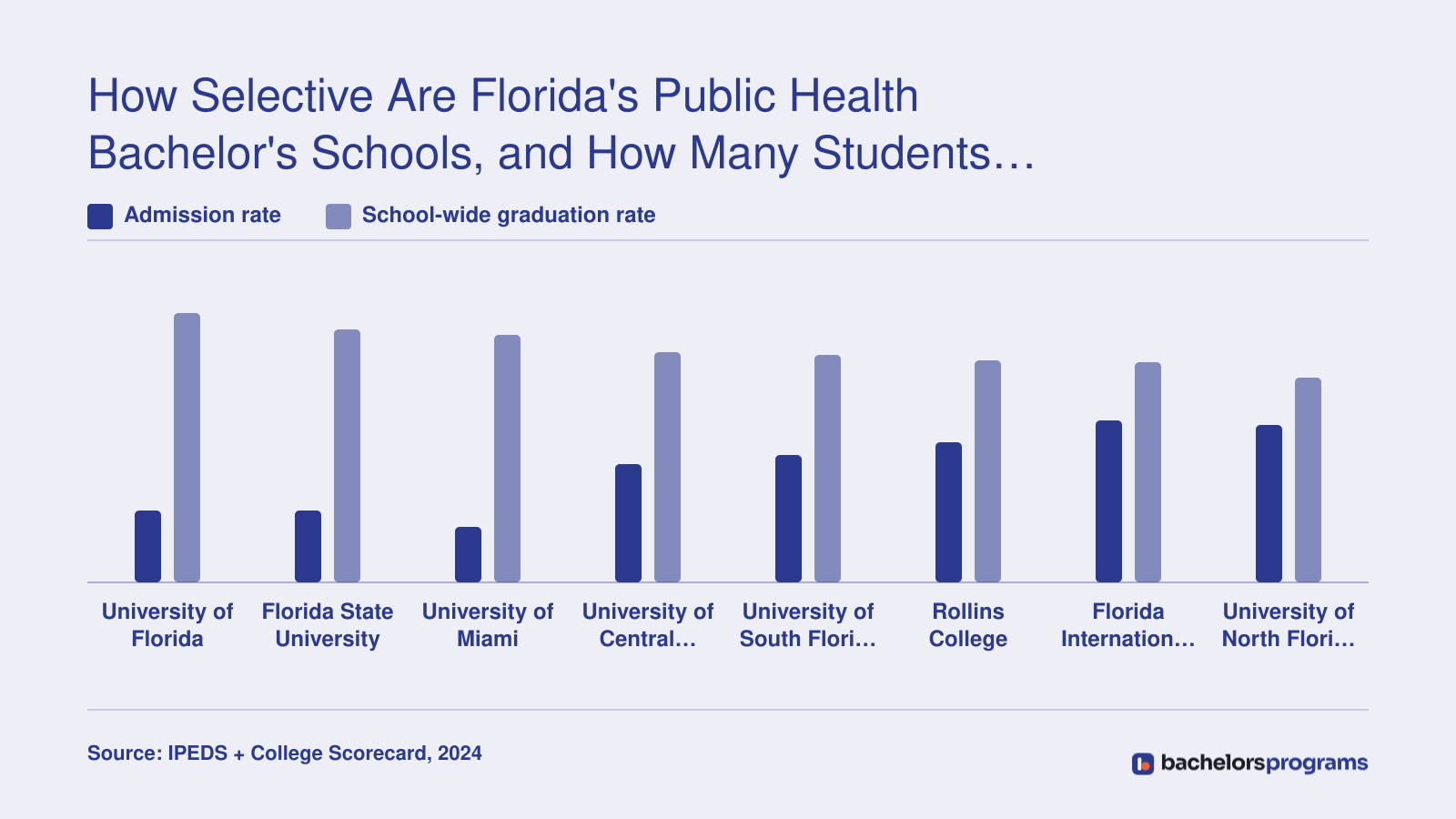
The University of Miami admits 18.9% of applicants and the University of Florida 24.2%, and UF posts the highest graduation rate shown at 91.1%. More accessible schools still graduate most students: Florida International University admits 54.7% and graduates 74.4%. Graduation rates in this chart are school-wide figures for all bachelor's students, not rates specific to each school's public health program.
Cost of a Public Health Bachelor's Degree in Florida
Sticker Price vs. Net Price
Published in-state undergraduate tuition at the public universities ranked here runs from $4,879 a year at Florida Atlantic University to $6,565 at Florida International University, while out-of-state rates climb from $17,324 to $28,659 at the University of Florida. Those numbers matter less than average net price, which is what students actually pay after grants and scholarships. Across these schools, average net price lands between roughly $6,500 and $12,600 a year, close to or a little above the in-state sticker for students with need. Net price is an institution-wide average, not a public health program figure.
State Aid: Bright Futures and the Florida Student Assistance Grant
Bright Futures requires Florida residency, U.S. citizenship or eligible noncitizen status, 16 college-prep courses, a qualifying weighted GPA and ACT, CLT or SAT score, 100 service or work hours, and an application filed between October 1 and August 31 of senior year.2 Recipients must carry at least six non-remedial credits per term.2 State guidance for the summer 2026 term set Florida Academic Scholars at 100 percent of tuition and specified fees and Medallion Scholars at 75 percent.3 The Florida Student Assistance Grant is need-based, open to resident undergraduates without a prior bachelor's degree, and worth $200 to $3,260 for 2026-27; it requires six credits per term at a public institution and twelve at a private one.1
Need-based aid reaches most students at these schools: about 81 percent of undergraduates at FIU receive Pell Grants, along with 72 percent at FAU, 69 percent at USF and 67 percent at UF.
A Practical Way to Lower the Bill
Start at a Florida College System school and transfer. Santa Fe College in Gainesville, listed in our directory, publishes in-state tuition of $2,563 a year, so the general education and prerequisite courses that fill the first two years cost far less there than at a research university.
Questions to Ask Yourself
Does the Bright Futures award you qualify for apply to the in-state public schools you are considering?
Would transferring from a Florida state college cut your total cost without extending your time to degree?
Does the program's published concentration match the role you want, such as community health, health education or epidemiology?
What Health Education Specialists Earn in Florida
Health education is one of the most common entry points for graduates with a bachelor's degree in public health.
Frequently Asked Questions About Florida Public Health Bachelor's Programs
Which Florida public health programs are CEPH accredited?
How long does a public health degree take in Florida?
Can you get a bachelor's degree in public health online in Florida?
How much does a public health bachelor's degree cost in Florida?
How do I choose between Florida public health schools?
Compare Public Health programs on the data that matters
Explore more Healthcare majors or browse every field of study.
All Healthcare programs Browse every field of study