Best Public Health Schools in Minnesota
Compare 13 accredited Public Health programs in Minnesota, with net price after aid, graduation rates, earnings and debt from IPEDS and the U.S. College Scorecard.

Minnesota offers a bachelor's degree in public health at flagship research campuses and small private colleges, and the price gap is wide: in-state tuition runs from roughly $9,600 a year at Minnesota State University-Mankato to nearly $60,000 at St Olaf College. Most programs award a Bachelor of Science (B.S.) in Public Health, though some, such as the University of Minnesota-Twin Cities, grant a Bachelor of Arts.
Accreditation is the other variable. Only some programs state CEPH status, and that affects graduate school plans and CHES eligibility. Online options from Minnesota-based schools add flexibility but change the cost and timeline.
For most graduates, entry-level work in health education, community health and program coordination is the realistic first step.
Key Points
- University of Minnesota-Rochester has the lowest average net price: $13,744 yearly.
- St Thomas public health graduates earn a median $67,515 five years out.
- University of Minnesota-Duluth and St Catherine University cite CEPH accreditation.
Best Schools for a Bachelor's Degree in Public Health in Minnesota
The University of Minnesota Twin Cities is the strongest overall choice for a bachelor's degree in public health in Minnesota, pairing a CEPH-accredited major taught by public health faculty with the state's deepest network of community and clinical placements. The list spans campus and online options, from large research universities to private colleges and a concentration-based liberal arts route. Graduation rates at the schools offering these programs run from roughly 48% to 85%, which is why the completion numbers matter as much as the price tags.
University of Minnesota-Twin Cities
#1Minneapolis, MN · ~$17,000/yr (est.)
Best for: Students wanting the state's deepest public health network
Minnesota's flagship public research university and home to a premier school of public health, where the public health major is taught by public health faculty rather than borrowed from another department. Undergraduates work across policy, data management, leadership, and community health, with undergraduate research and field experiences built into the degree. The university maintains more than 2,500 clinical-training partnerships across Minnesota, including rural and underserved communities, and participates in the Healthy Minnesota Partnership with the state health department.
- CEPH accredited public health major
- Interdisciplinary coursework in policy, data, and leadership
- Mentorship and field experiences through an alumni network
- Undergraduate research opportunities with faculty
- Community awareness courses and electives
- Taught by faculty at a premier school of public health
Rasmussen University-Minnesota
#2St. Cloud, MN · ~$18,000/yr (est.)
Best for: Working adults needing a fully online path
A private, career-focused university based in St. Cloud that opens a fully online route into public health work through its health care management degree. Coursework leans toward the business side of health care, covering strategic planning, population management, regulatory compliance, and community wellness. Eight start dates a year, a self-directed assessment option, and an accelerated master's pathway let working adults move at their own speed, and military and employer tuition benefits are accepted.
- Public health concentration inside a health care management degree
- $332 per credit, $29,880 total program tuition
- 90 credits across 23 courses, finish in as few as 18 months
- Eight start dates per year
- Fully online with live sessions and 24/7 tech support
- Up to five courses apply toward the MPH
- Military benefits and employer tuition reimbursement accepted
- Prepares students for CAPM and PMP certification exams
University of Minnesota-Duluth
#3Duluth, MN · $15,000 – $20,000/yr (est.)
Best for: Community health focused students in the Northland
A regional public university in Duluth whose CEPH-accredited public health curriculum qualifies graduates to sit for the Certified Health Education Specialist exam. Community health education and school health education concentrations pair with internships, job shadowing, and paid undergraduate research through the UROP program. Alumni move into government agencies, nonprofits, hospitals, schools, and businesses, and about half continue to graduate study in medicine, nursing, epidemiology, or public health.
- CEPH accredited, qualifies graduates for the CHES exam
- Concentrations in community health education and school health education
- Internships and job shadowing in community settings
- Paid undergraduate research through UROP
- Public Health Student Group and faculty mentorship
- About half of alumni go on to graduate study
University of St Thomas
#4Saint Paul, MN · ~$29,000/yr (est.)
A private Catholic university in St. Paul that pairs the public health major with statistics, psychology, biology, and communication coursework. Every student completes an experiential learning or research course, and the program runs a public health club that hosts a flu vaccine clinic along with a named scholarship supporting student research. Graduates work as epidemiologists, health educators, project managers, and health communications specialists in nonprofits, health care organizations, and government agencies.
- Combines public health with statistics, psychology, biology, and communication
- Covers global health, epidemiology, health policy, and program planning
- Every student completes an experiential learning or research course
- Public Health Club runs a flu vaccine clinic
- Bridget A. Duoos Scholarship supports student research
- Four-year program with internships and research built in
Winona State University
#5Winona, MN · ~$18,000/yr (est.)
A public university in southeastern Minnesota whose community health degree is built around a 600-hour practicum and internship with community organizations. Students design health promotion campaigns, write grants, and analyze how physical, social, and economic factors shape health, then prepare for the Certified Health Education Specialist exam. A 3+2 pathway leads to a Master of Public Health in five years, more than $21,500 in annual scholarships is available, and about 90% of graduates are employed or in graduate school.
- 600-hour practicum and internship requirement
- 120 credit hours with fall and spring starts
- Prepares students for the CHES certification exam
- 3+2 pathway to a Master of Public Health
- More than $21,500 in annual scholarships available
- Study abroad in Peru, Hawaii, and England
- Public Health Club and LeadHERS activities
- About 90% employed or in graduate school
Minnesota State University-Mankato
#6Mankato, MN · $10,000 – $19,000/yr (est.)
A public university in southern Minnesota where public health sits inside an applied health science degree rather than a standalone major. Students take health education theory alongside program planning, epidemiology, biostatistics, environmental health, and global health, then finish with a senior seminar and an internship. Majors need a 2.5 GPA in the major and can qualify for the Certified Health Education Specialist credential, and the degree also lays groundwork for graduate study.
- 120 credit hours over four years on the Mankato campus
- 2.5 GPA required in the major
- Eligible for the Certified Health Education Specialist credential
- Coursework in epidemiology, biostatistics, and environmental health
- Program planning, communication, and advocacy skills
- Senior seminar and internship build applied experience
St Catherine University
#7Saint Paul, MN · $15,000 – $20,000/yr (est.)
A private university in St. Paul that launched the first CEPH-accredited public health program in Minnesota, shaped in part by a national AAC&U and APTR collaboration. Students take eight core public health courses and choose a concentration in health sciences, public policy, or community health worker, then complete a practicum and senior seminar. Service learning and study abroad options extend the work into diverse communities, and the major doubles as preparation for pre-med and pre-PA tracks.
- First CEPH-accredited public health program in Minnesota
- Eight core public health courses plus three concentration options
- Concentrations in health sciences, public policy, and community health worker
- Practicum and senior seminar required
- 2.5 GPA minimum
- Service learning and study abroad opportunities
- Shaped by an AAC&U and APTR collaboration
Bemidji State University
#8Bemidji, MN · ~$15,000/yr (est.)
A public university in northern Minnesota with a community health degree aimed at entry-level public health and health education work. Coursework spans nutrition, exercise, HIV and STD prevention, substance abuse education, and worksite wellness, backed by an observational practicum and a community health internship. Students get individualized guidance to define a career path, and graduates move into public health agencies, health care organizations, and nonprofits, or continue to graduate study in public health, counseling, or accelerated nursing.
- Broad foundation in health education and community wellness
- Coursework in nutrition, exercise, HIV and STD prevention, and substance abuse
- Observational practicum plus a community health internship
- Individual guidance to define a career path
- Prepares students for entry-level public health roles or graduate study
- Leads toward counseling or accelerated nursing programs
Walden University
#9Minneapolis, MN · $34,000/yr (est. net price)
An online university headquartered in Minneapolis with a CEPH-accredited public health bachelor's designed for students balancing a degree with work and life. Students choose from health promotion and wellness, health psychology and behavior, or health care management concentrations, and can pursue more than one without extra credits or tuition. Course-based and self-paced options are both available, no entrance exam is required, and the health promotion track prepares students for the Certified Health Education Specialist exam.
- CEPH accredited online public health bachelor's
- Concentrations in health promotion and wellness, health psychology and behavior, and health care management
- Pursue up to three concentrations at no extra tuition
- Course-based or self-paced Tempo Learning options
- $360 per credit, $47,810 total program tuition
- No entrance exam required, test optional
- $0 application fee, plus up to 20 master's credits
- Health promotion track prepares students for the CHES exam
St Olaf College
#10Northfield, MN · ~$24,000/yr (est.)
A private liberal arts college in Northfield where public health is pursued as an interdisciplinary concentration rather than a standalone major. Students combine courses in the fundamentals of public health, the biological basis of health, social science perspectives, and research methods, then cap the work with a case studies course. The concentration welcomes scientists and pre-health majors as well as writers and activists, and study abroad programs in Denmark, Kenya, and Germany give the field a global frame.
- Interdisciplinary concentration open to students in any major
- Four course areas: fundamentals, biology, social science, and research methods
- Capstone case studies course
- Study abroad in Denmark, Kenya, and Germany
- Examines health across cultural and political boundaries
- Prepares students for health policy, global service, and community health
Cost & outcomes by school
Federal data for the highest-earning Public Health programs, independent of the ranking above. Earnings are this field's bachelor's graduates four years after completing where the Scorecard reports them, else the school's undergraduate median.
| School | Net price / yr | Grad rate | Earnings | Debt | Grads/yr | Format |
|---|---|---|---|---|---|---|
| University of Minnesota-Twin Cities MN | $16,778 | 85% | $69,020 | $19,500 | 13 | Campus |
| University of Minnesota-Rochester MN | $13,744 | 57% | $69,020 | $19,500 | — | Campus |
| Gustavus Adolphus College MN | $22,900 | 77% | $65,607 | $26,774 | — | Campus |
| St Olaf College MN | $23,874 | 84% | $65,543 | $26,000 | — | Campus |
| Bethel University MN | $28,556 | 71% | $63,764 | $21,500 | — | Campus |
| Walden University MN | $33,817 | — | $63,061 | $35,750 | 28 | Online |
| St Catherine University MN | $19,764 | 61% | $61,169 | $27,000 | 37 | Online |
| University of Minnesota-Duluth MN | $18,743 | 65% | $59,639 | $24,986 | 27 | Campus |
| University of St Thomas MN | $29,155 | 76% | $59,389 | $25,750 | 23 | Campus |
| Minnesota State University-Mankato MN | $19,139 | 54% | $56,922 | $21,106 | — | Campus |
| Bemidji State University MN | $15,261 | 48% | $53,755 | $19,750 | 2 | Campus |
| Rasmussen University-Minnesota MN | $17,962 | 54% | $49,032 | $25,607 | 10 | Online |
Sources: U.S. Department of Education. Net price, graduation rate, earnings and debt: College Scorecard (earnings and debt for this field's bachelor's graduates where reported, else school-wide); graduates: IPEDS. A dash means no figure is reported.
Cost, debt & payoff
Median earnings of this field's bachelor's graduates (4 yrs after completing, else the school's undergraduate median) vs. their median federal loan debt · U.S. College Scorecard
Across these programs the median graduate earns about $61,169 and finishes with roughly $24,986 in debt — a ratio that clears a common rule of thumb (keep debt below first-year salary). Net price and debt vary widely school to school, so check the per-school figures in the table above before you shortlist.
Are Minnesota's Bachelor's in Public Health Programs CEPH Accredited?
Minnesota does offer bachelor's degrees in public health, but accreditation varies by program. The University of Minnesota Duluth and St. Catherine University both state that their public health programs hold CEPH accreditation. No other program on this list confirms CEPH status, so treat their accreditation as unverified rather than assumed.
What CEPH accredits at the bachelor's level
The Council on Education for Public Health reviews standalone baccalaureate programs, meaning public health majors that are not housed inside an accredited graduate school of public health. CEPH reports 31 accredited standalone baccalaureate programs nationally in 2026. Accreditation shows that curriculum, faculty, and student outcomes were reviewed against national standards. Graduate admissions committees and public health employers recognize it as a benchmark, though it guarantees neither admission nor hiring.
Which Minnesota programs state accreditation
At the University of Minnesota Duluth, the Public Health Bachelor of Applied Science is listed by CEPH as a standalone baccalaureate program, accredited through July 1, 2027, with reaccreditation review scheduled in 2027. St. Catherine University states that its public health program is CEPH-accredited and that its bachelor's programs were the first in Minnesota to earn that status. The 2026 CEPH directory does not list St. Catherine among standalone baccalaureate programs, so confirm its current listing and term directly.
The University of Minnesota School of Public Health is CEPH-accredited, with initial accreditation in 1946. CEPH lists a term ending December 31, 2029, while the university reports July 1, 2029. That is school-level accreditation and does not by itself confirm a CEPH-accredited bachelor's program at the Twin Cities campus.
How to verify current status
Start at ceph.org with its school and program search. Filter by Minnesota, look for the standalone baccalaureate category, and check the term end date. A program's own page is a useful second source, but the directory is the public record. If a school is not listed, or its term has lapsed, ask the program director for the most recent accreditation letter before you enroll.
Most Affordable Bachelor's in Public Health Programs in Minnesota
University of Minnesota-Rochester has the lowest average net price here at $13,744 per year, with Bemidji State University ($15,261) and University of Minnesota-Twin Cities ($16,778) close behind. Net price is an institution-wide average of what students paid after grants and scholarships, based on 2024 IPEDS and College Scorecard data from the U.S. Department of Education, so treat it as an approximate benchmark rather than a quote for every student. Your own cost will depend on family income, aid eligibility and residency, and Rasmussen University-Minnesota's online offering is a Healthcare Management bachelor's with a public health concentration rather than a standalone public health major.
| School | City | Program | Average Net Price (After Aid) | In-State Tuition and Fees | Sector | Format |
|---|---|---|---|---|---|---|
| University of Minnesota-Rochester | Rochester | Public Health | $13,744 | $15,016 | Public | Campus |
| Bemidji State University | Bemidji | Community Health B.S. | $15,261 | $10,237 | Public | Campus |
| University of Minnesota-Twin Cities | Minneapolis | Public Health Bachelor of Arts | $16,778 | $17,214 | Public | Campus |
| Winona State University | Winona | Public Health: Community Health | $17,503 | $10,576 | Public | Campus |
| Rasmussen University-Minnesota | St. Cloud | Healthcare Management Bachelor's (Public Health concentration) | $17,962 | $11,490 | Private for-profit | Online |
Related Articles
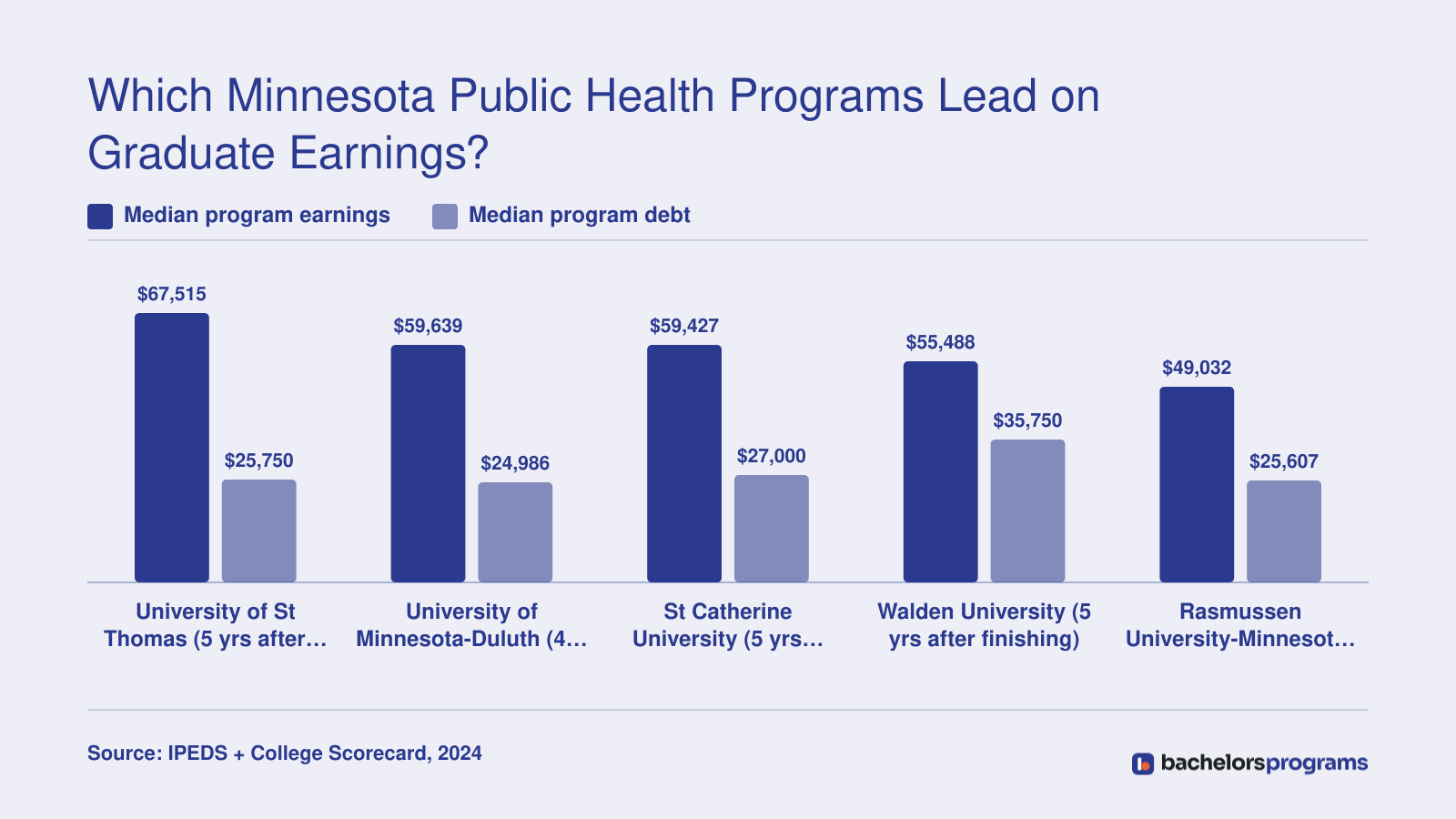
Which Minnesota Public Health Programs Lead on Graduate Earnings?
University of St Thomas public health graduates earn a median $67,515 five years after finishing, against $25,750 in median debt, the strongest pay-to-debt mix here. University of Minnesota-Duluth graduates earn $59,639 four years after finishing, St Catherine University $59,427 and Walden University $55,488 five years after finishing, and Rasmussen University-Minnesota $49,032 four years after finishing. Every program shown pays at least 1.5 times its median debt, but Walden's $35,750 debt load is the heaviest relative to earnings.
Online and Hybrid Bachelor's in Public Health Options at Minnesota Schools
St. Catherine University lists its online public health bachelor's at 24 months, with 46 to 48 credits in the major.1 Yes: you can complete a public health bachelor's entirely online through a Minnesota-based school. It is not the only online route.
How the Formats Sort
- Online: St. Catherine University (public health), Rasmussen University-Minnesota (a healthcare management bachelor's, not a public health major) and Walden University (B.S. in Public Health, with a 48-month timeline).
- Hybrid: Winona State University's Health Administration track within public health is hybrid, but coursework is primarily in person, with some health leadership classes fully online.2
- Campus: University of Minnesota-Twin Cities, University of Minnesota-Duluth, University of St Thomas, Minnesota State University-Mankato, Bemidji State University and St Olaf College are listed as campus programs, as is Winona State's Community Health major.
What Still Happens in Person
Online does not mean hands-off. St. Catherine's program includes an internship and seminar, service learning and a practicum with a community partner.1 Its program page states no required on-campus residency.1 None of the online or hybrid options reviewed states a residency requirement, but silence is not proof, so confirm with each admissions office.
Hybrid and campus students face the heaviest field demands. Winona State asks for a 600-hour internship plus 60 or more practical community hours.2 Bemidji State lists a practicum and community health internship. UMD describes internships and job shadowing3, and St Thomas reports that every public health major takes part in research or a career-focused internship.4 Expect to arrange your own local placement in any format.
Who Each Format Suits
- Working adults: St. Catherine's online format with a fixed 24-month timeline, or Rasmussen's online option, fits around a job. Plan for daytime placement hours.
- Rural students: Online study from St. Catherine or Walden cuts the commute, though a practicum still needs a community partner within reach.
- Degree-completers: The credit count listed for St. Catherine's major suggests a fit, but transfer credit rules vary, so check how your prior credits apply.
- Recent high school graduates: Campus programs such as Winona State or St Thomas give you built-in access to clinics, clubs and faculty.
Questions to Ask Yourself
Will the public health program you want accept Minnesota community college credits toward the major itself?
Is your net price after grants meaningfully lower than the published in-state tuition figure?
Do your income and residency make you eligible for the Minnesota State Grant or North Star Promise?
Median Wage for Health Education Specialists in Minnesota
Health education is one of the most common career paths for public health bachelor's graduates, and Minnesota pays well above the national level for this role.
Compare Public Health programs on the data that matters
Explore more Healthcare majors or browse every field of study.
All Healthcare programs Browse every field of study