Best Public Health Schools in Ohio
Compare 28 accredited Public Health programs in Ohio, with net price after aid, graduation rates, earnings and debt from IPEDS and the U.S. College Scorecard.

A bachelor's degree in public health at a large Ohio research university and one at a small private college can look alike on paper yet differ sharply in cost, class size and internship access. The Bachelor of Science (B.S.) in Public Health is the most common credential.
Programs here, on campus and online, are ranked on College Scorecard outcomes rather than school marketing claims, with cost, earnings, admissions and CEPH accreditation weighted in.
Entry-level public health jobs rarely require a state license, so internship placement and accreditation carry real weight.
Key Points
- Ohio University-Eastern Campus has the lowest average net price: $3,925.
- University of Cincinnati offers its B.S. in Public Health fully online.
- Ohio doesn't license general public health work; CHES certification helps graduates stand out.
Best Public Health Schools in Ohio: Our Ranked List of Bachelor's Programs
Ohio awards a bachelor's degree in public health at large research universities, mid-sized public campuses and small private colleges, plus a few fully online options. The ten schools below differ most in class size, how many concentration tracks they offer, and how much fieldwork is built into the degree. Use each entry to compare what the major actually requires before you apply.
Ohio State University
#1Columbus, OH · $17,000/yr (est. net price)
Best for: STEM-minded students focused on environmental health
Ohio State is the largest university in the state and runs one of the few public health bachelor's programs in Ohio backed by a dedicated college of public health. Undergraduates on the Columbus campus pick from three concentrations and finish with a capstone that can be an internship, a research project or study abroad. It is the most research-intensive option on this list and sits in the state capital, close to agencies and hospital systems.
- CEPH-accredited B.S.P.H. with a required capstone
- 3 concentrations: Environmental Public Health, Public Health Sociology, Public Health Methods
- 121 total credit hours
- Capstone may be an internship, research project or study abroad
- Environmental public health concentration is STEM-designated
- Honors options available
Miami University
#2Oxford, OH · $18,000 – $41,000/yr (est.)
Best for: Pre-law students pairing health and policy
Miami University is a mid-sized public university in Oxford with a liberal arts feel and a public health major taught jointly by faculty from two colleges. Students choose one of three tracks and can start research early through the First Year Research Experience. The degree works as a pre-med, pre-law or MPH pathway as much as a direct route into community health work, and Miami partners with Ohio University on a regional behavioral health workforce initiative.
- 3 tracks: human disease and epidemiology, health policy, health promotion
- Faculty drawn from two colleges
- First Year Research Experience (FYRE) available
- Gateway to a Master of Public Health
- Foundation for medical or law school
- Students served as pandemic contact tracers
University of Cincinnati
#3Cincinnati, OH · ~$26,000/yr (est.)
Best for: Career changers seeking hands-on co-op experience
The University of Cincinnati pairs its public health major with one of the strongest co-op cultures in Ohio, and the degree runs both on campus and online. Students can concentrate in health promotion and education, global health or health administration while logging community clinic and hospital experience. It suits students who want real work experience on the transcript before they graduate.
- CEPH accredited
- Offered on campus and online
- Concentrations: Health Promotion and Education, Global Health, Health Administration
- Four-year program with community clinic and hospital placements
- Strong co-op and internship culture
Ohio University
#4Athens, OH · ~$22,000/yr (est.)
Ohio University's Athens campus offers a community and public health major with a strong emphasis on assessing community needs and running programs that address them. Students are pointed toward the Certified Health Education Specialist credential and toward an MPH if they want one. The university also partners with Miami on a southern Ohio behavioral health workforce initiative, and an early assurance pathway into the Heritage College of Osteopathic Medicine lets qualified students shorten the road to a D.O.
- CEPH accredited
- Bachelor of Science in Health with a community and public health major
- Coursework in needs assessment, program design and evaluation
- Prepares students for the Certified Health Education Specialist credential
- Pathway to a Master of Public Health
- Scholarships available
Otterbein University
#5Westerville, OH · ~$19,000/yr (est.)
Otterbein University is a private liberal arts university in Westerville, just north of Columbus, and its public health education major is small by design. Every student completes a senior-year internship placed with central Ohio employers such as OhioHealth and the American Cancer Society. The program is built around the Certified Health Education Specialist exam and the community health educator roles that follow it.
- Prepares students to sit for the Certified Health Education Specialist exam
- Required senior-year internship
- Placements include OhioHealth, the YMCA and the American Cancer Society
- Coursework in needs assessment, program planning, evaluation and advocacy
- Eta Sigma Gamma public health honorary affiliation
Kent State University
#6Kent, OH · ~$21,000/yr (est.)
Kent State runs the largest public health bachelor's cohort in this group, with a B.S.P.H. that offers six concentrations and a hybrid format. Students can specialize in clinical trials research, health services administration, global health or a pre-medicine track, and several concentrations are available fully online. Combined B.S.P.H./M.P.H. options let strong students start graduate coursework early.
- CEPH accredited
- 6 concentration options, including clinical trials research and health services administration
- 120 total credit hours with a 2.0 GPA minimum
- 45 clinical hours
- Fully online for select concentrations
- Combined B.S.P.H./M.P.H. programs
- 3+3 accelerated law degree option
University of Toledo
#7Toledo, OH · $13,000 – $22,000/yr (est.)
The University of Toledo's public health bachelor's is built around practice: students shadow health professionals as early as their first year, and every student completes an internship. Undergraduates can join faculty research projects, with departmental funding available. The campus has a large pre-med population and an active alumni network in northwest Ohio.
- All students complete an internship; placements often lead to jobs
- Shadow health professionals as early as the first year
- Undergraduate research with faculty, with research funding available
- Pre-med track available
- 400+ student organizations
Bowling Green State University
#8Bowling Green, OH · ~$24,000/yr (est.)
Bowling Green State University offers a public health bachelor's with two career-focused concentrations, environmental health and health promotion, and a substantial internship requirement. Class sizes are small enough that faculty mentoring and undergraduate research are realistic. The environmental health track points at the registered sanitarian credential and at hiring by local health departments.
- 2 concentrations: Environmental Health and Health Promotion
- 180-hour internship plus field practicums
- CEPH-aligned curriculum covering epidemiology, environmental justice and health communication
- Environmental health grads eligible for the sanitarian credential exam
- Small classes with faculty mentorship
Youngstown State University
#9Youngstown, OH · ~$13,000/yr (est.)
Youngstown State delivers its public health bachelor's entirely online, priced by the course, with three concentration options. Students can transfer up to 90 credits and finish quickly, which suits adults who already have college coursework behind them. It posts the lowest published tuition on this list and the most flexible format.
- 100% online coursework
- 3 concentrations include health education and promotion, environmental health and safety
- Complete in as few as 12 months; 120 total credit hours
- Up to 90 transfer credits accepted
- $250 per credit hour, pay by the course
- 2.0 GPA minimum; $45 application fee
- Eligible for CHES certification
Baldwin Wallace University
#10Berea, OH · ~$28,000/yr (est.)
Baldwin Wallace is a private university in Berea with a compact public health major that leaves room for a second major or a pre-clinical track. Students complete a capstone thesis or project plus a credit-bearing internship, and can concentrate in population health and disparities or applied epidemiology and disease mapping. It is also a partner in an early assurance pathway to osteopathic medical school.
- 55 credit hours in the major
- 3 concentrations: Population Health and Disparities, Applied Epidemiology and Disease Mapping, Pre-Clinical
- Capstone thesis or project plus a 3-credit internship
- Required courses include biostatistics, epidemiology, global health and health policy
- Primary Healthcare Advancement affiliation program
Cost & outcomes by school
Federal data for the highest-earning Public Health programs, independent of the ranking above. Earnings are this field's bachelor's graduates four years after completing where the Scorecard reports them, else the school's undergraduate median.
| School | Net price / yr | Grad rate | Earnings | Debt | Grads/yr | Format |
|---|---|---|---|---|---|---|
| Ohio State University OH | $17,339 | 88% | $70,369 | $16,260 | 73 | Campus |
| John Carroll University OH | $28,746 | 79% | $62,860 | $26,000 | — | Campus |
| Ohio University OH | $21,637 | 66% | $62,153 | $23,875 | 9 | Campus |
| Ohio University-Eastern Campus OH | $3,925 | 21% | $62,153 | $23,875 | — | Campus |
| Ohio University-Southern Campus OH | $5,993 | 21% | $62,153 | $23,875 | — | Campus |
| Walsh University OH | $20,493 | 59% | $59,764 | $27,000 | 1 | Campus |
| The College of Wooster OH | $23,458 | 74% | $59,629 | $26,500 | — | Campus |
| Miami University OH | $28,384 | 80% | $56,955 | $21,880 | 63 | Campus |
| Bowling Green State University OH | $24,022 | 64% | $56,114 | $23,250 | 19 | Campus |
| Ohio Wesleyan University OH | $20,897 | 59% | $55,624 | $27,000 | 3 | Campus |
| Wittenberg University OH | $18,649 | 53% | $54,947 | $27,000 | 1 | Campus |
| Kent State University OH | $20,787 | 64% | $54,544 | $26,000 | 93 | Hybrid |
Sources: U.S. Department of Education. Net price, graduation rate, earnings and debt: College Scorecard (earnings and debt for this field's bachelor's graduates where reported, else school-wide); graduates: IPEDS. A dash means no figure is reported.
Cost, debt & payoff
Median earnings of this field's bachelor's graduates (4 yrs after completing, else the school's undergraduate median) vs. their median federal loan debt · U.S. College Scorecard
Across these programs the median graduate earns about $53,718 and finishes with roughly $25,406 in debt — a ratio that clears a common rule of thumb (keep debt below first-year salary). Net price and debt vary widely school to school, so check the per-school figures in the table above before you shortlist.
Most Affordable Public Health Schools in Ohio
Ohio University-Eastern Campus has the lowest average annual net price below at $3,925, according to 2024 IPEDS and College Scorecard data from the U.S. Department of Education. Lorain County Community College is close behind at $3,967 and offers the only fully online program in this group. Net price reflects the average cost after grants and scholarships, so it is usually lower than published in-state tuition.
| School | City | Program | Format | Average Annual Net Price | In-State Tuition and Fees |
|---|---|---|---|---|---|
| Ohio University-Eastern Campus | Saint Clairsville | Community and Public Health Major (B.S.) | Campus | $3,925 | $6,362 |
| Lorain County Community College | Elyria | Bachelor of Science in Applied Science-Public Health | Online | $3,967 | $4,265 |
| Ohio University-Southern Campus | Ironton | Community and Public Health Major (B.S.) | Campus | $5,993 | $6,362 |
| Wright State University-Lake Campus | Celina | Public Health | Campus | $11,081 | $7,728 |
| Kent State University at Ashtabula | Ashtabula | Public Health - B.S.P.H. | Hybrid (core classes on campus, major courses online) | $12,205 | $7,492 |
CEPH Accreditation Status of Ohio Bachelor's in Public Health Programs
The Council on Education for Public Health (CEPH) lists several schools ranked here, but each listing covers a school of public health or a Master of Public Health program, not a standalone bachelor's program. The distinction matters: school-level accreditation applies to the whole academic unit, while program-level accreditation applies only to the degree named, so neither listing alone confirms that a bachelor's curriculum was reviewed. Before you enroll, ask the school whether its B.S. in Public Health falls within the scope of its CEPH accreditation.
| School | CEPH Accreditation Type | Bachelor's Level Covered? | Accredited Unit |
|---|---|---|---|
| Ohio State University | School of public health | Not shown: the school-level listing does not establish bachelor's coverage | University's public health college (school-level accreditation) |
| Ohio University | Public health program | Not shown: the listing names a master's program only | Master of Public Health program |
| Youngstown State University | Public health program (shared regional consortium) | Not shown: the listing names a master's program only | Master of Public Health program offered through a multi-university consortium |
How We Ranked Ohio Bachelor's in Public Health Programs
The ranking weighs three things: what a public health bachelor's degree costs, what it leads to, and whether the program meets recognized quality standards. Every school here earned its place through public data, not advertising.
The Criteria
- Cost: We look at tuition and the average net price after grant and scholarship aid, so lower-cost schools get credit for value.
- Selectivity: Admission rates show how competitive each school is, which helps you build a balanced application list.
- Accreditation: We confirm institutional accreditation and note whether the public health program holds accreditation from the Council on Education for Public Health (CEPH).
Independent by Design
No school pays to appear on this list or to move up it. We also don't rely on numbers a school reports about itself, such as job placement rates or marketing statistics.
What the Data Can't Tell You
Graduation rates and net price figures describe each institution as a whole, not its public health major alone. A university's overall graduation rate may run higher or lower than the rate for its public health students. Treat these numbers as a starting point, then ask each department about its own outcomes, internship placements and class sizes before you commit.
Online and Hybrid Bachelor's in Public Health Options at Ohio Schools
The University of Cincinnati delivers its Bachelor of Science in Public Health fully online, requires no campus visits,1 and includes a senior internship of 3 to 6 credits2 that students can complete near their own community at health departments, hospitals or nonprofit partners.
Fully Online Options
Youngstown State University runs its Bachelor of Science in Applied Science in Public Health as 100% online coursework, priced at a published $250 per credit across 120 total credits, with up to 90 transfer credits accepted. Kent State University's B.S.P.H. is structured as a hybrid, and the university notes that select concentrations can be completed fully online, with 45 clinical hours built into the degree.
Hybrid and Campus-Based Programs
Ohio University lists its B.S. in Community and Public Health as on-campus, with a Community Health Services Internship sitting in the required core. Ohio State's B.S. in Public Health is a Columbus program whose capstone can take the form of research, an internship, an Honors thesis or education abroad. Internships are required elsewhere too: Otterbein University requires a senior-year internship, and the University of Toledo says all students complete one.
Enrolling from Outside Ohio
Online delivery means you do not have to live in Ohio to earn an Ohio degree; you apply as an out-of-state online student. Confirm which tuition rate applies before you commit. Some programs charge a flat per-credit online rate, as Youngstown State does, while others bill in-state or out-of-state rates based on residency. Get the answer in writing from an admissions counselor, and ask whether online students are charged campus fees they will never use.
Related Articles
Admissions Requirements for Ohio Public Health Bachelor's Programs
Ohio's public health bachelor's programs are broadly accessible, with one clear exception in the state's flagship.
Test Policy and GPA Expectations
Ohio State is the outlier. Applicants to the Columbus campus must submit an ACT or SAT score; the university is not test-optional, and its public health admissions page publishes no minimum first-year GPA or minimum exam score. Transfer students aiming for the major get firmer numbers: a 2.50 GPA and at least 15 semester credits, at which point an advisor moves them into the major. That page does not publish a maximum transferable-credit limit or a course-by-course acceptance rule.
Ohio University publishes no public-health-specific first-year GPA floor and no test-optional statement. Its general Athens transfer standard is a 2.0 cumulative GPA in academic coursework from a regionally accredited institution, and college credit earned with a D- or better at an Ohio state-supported school is accepted. Transfers arrive with no GPA on the university record, though prior coursework can still count toward program admission.
For the other schools ranked here, requirements sit at the university or program level. Confirm the current GPA floor, test policy and transfer-credit cap with each admissions office before you apply, rather than assuming a number.
Selective Versus Open-Access
Scorecard admission rates split the group into two tiers.
- Selective: Ohio State admits about 61 percent of applicants; Miami University and Baldwin Wallace admit roughly 75 to 76 percent.
- Broad access: Toledo admits about 92 percent, while Kent State, Youngstown State, Cincinnati, Ohio University, Otterbein and Bowling Green all land between roughly 81 and 86 percent.
One Practical Tip
Ohio's College Credit Plus program lets high school students bank college credit before they enroll. Credits in statistics, biology and the social sciences can clear general-education requirements and shorten the path to a public health bachelor's, though each school sets its own cap on how much transfer credit applies.
Cost of a Bachelor's Degree in Public Health in Ohio
Sticker price is where most families start, but the net price after aid is closer to what they actually pay. Both matter when you weigh Ohio's public health programs.
Tuition vs. Net Price
In-state tuition and fees run from about $11,100 at Youngstown State University to $12,744 at the University of Toledo and $13,244 at Ohio State University. Average net price after aid is $12,767, $17,249 and $17,339 at those schools, in the same order. Net price is an institution-wide estimate across all undergraduates, not a figure for the public health major, and it typically includes living costs, so it can run higher than tuition alone. Ohio State's out-of-state tuition is far higher at $40,022, so residency matters.
Median graduate debt is also an institution-wide figure. It is about $24,000 at Youngstown State, $22,250 at Toledo and $19,976 at Ohio State. Treat it as context for the school, not a forecast for your program.
Ohio Grants and Scholarships
The Ohio College Opportunity Grant (OCOG) is for Ohio residents in a first bachelor's, associate or nurse diploma program. For 2026-27, you need a FAFSA Student Aid Index of $3,750 or less and household income of $96,000 or less.1 The FAFSA deadline is October 1.1 Maximum annual awards depend on the sector:
- Public universities: up to $4,000
- Private nonprofit colleges: up to $5,000
- Private for-profit institutions: up to $2,000
- Select Pennsylvania schools: up to $600
These are maximums, not guarantees. Enrollment status and the state's calculation affect the final amount. State need-based aid is capped at 10 semesters or 15 quarters.1
College Credit Plus is state-funded dual enrollment that lets high school students earn college credit early, which can shorten a bachelor's timeline. Confirm current terms with your counselor and the college. Other options include the $3,000 Second Chance Grant for residents with some college and no degree, and the $5,000-per-year Top-5% Scholarship for eligible top graduates of Ohio high schools.2
Next Step
File the FAFSA first, since it is the application for state aid. Then check each school's scholarship page, because many offer their own awards. Ohio State and Toledo both list scholarships for their public health students.
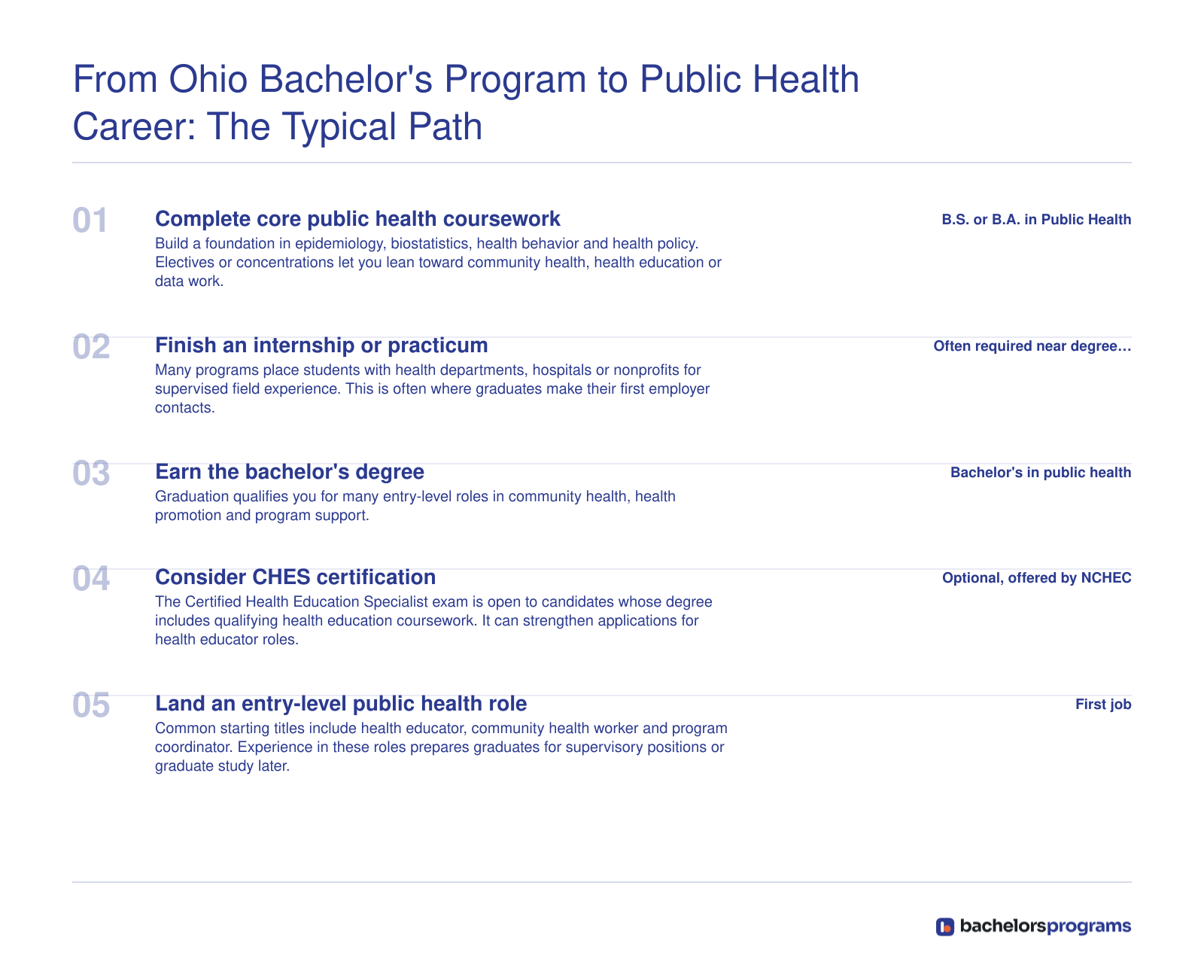
From Ohio Bachelor's Program to Public Health Career: The Typical Path
Most graduates of a bachelor's degree in public health at an Ohio school follow a similar route to their first job. The steps below show the common sequence. Exact requirements vary by program and employer.
Ohio Employers, CHES Certification and Licensure for Public Health Graduates
No state license stands between most Ohio public health graduates and the job market, but a national certification can still separate two similar resumes. Ohio does not regulate general public health practice at the state level1, so a bachelor's graduate can apply to the Ohio Department of Health, city and county health districts, hospitals, and community nonprofits without a state-issued credential.
CHES Certification, Explained
CHES is a voluntary national certification from NCHEC, not an Ohio license.2 Eligibility is academic only: a bachelor's, master's, or doctoral degree, plus either a major in a health education discipline or at least 25 semester credits (37 quarter hours), graded C or better, covering the Nine Areas of Responsibility.3 A graduate can sit for the exam as soon as the degree is conferred. NCHEC also awards the advanced MCHES credential. In 2026 postings, health educator roles at Richland Public Health and Ottawa County list CHES as preferred, alongside a bachelor's degree and about three years of experience.4
Ohio does credential some specialized occupations separately. Environmental health specialists register with the state1, and community health workers hold their own certification.5 Neither is a general public health license.
Build Experience Early
Complete a semester-long internship with a county health district while enrolled. Field work in inspections or community outreach builds the experience Ohio employers ask for.
Choosing the Right Ohio Public Health School: Accreditation, Internships and Fit
Choosing a public health bachelor's program in Ohio comes down to four filters: CEPH accreditation, the internship or field placement requirement, concentrations offered, and format.
Start with accreditation
Check the CEPH accreditation table above before you commit to a campus. Accreditation attaches to the program, not always the whole university, so confirm the specific bachelor's program is listed before you enroll. A program without it can still work, but ask how it handles practicum placement and transfer credit.
Match concentrations to your goal
Public health is broad: epidemiology, health policy, community health education, environmental health. Use the program highlights in the ranked list to see which schools lean toward your interest. A program built around community outreach may fit you better than one shaped by pre-med requirements.
Check format and internship load
Some programs require a semester-long practicum; others fold fieldwork into a capstone. Ask how placements are arranged, whether they are local, and whether the department helps students find one. If you work full time, confirm whether the program runs online, hybrid or evening sections.
Your next step
Shortlist three schools, then open each admissions page and compare GPA expectations, testing rules and transfer-credit limits side by side.
Compare Public Health programs on the data that matters
Explore more Healthcare majors or browse every field of study.
All Healthcare programs Browse every field of study