Best African and African American Studies Degree Programs
Compare 230+ accredited African and African American Studies programs at 220+ colleges, with net price after aid, graduation rates, earnings and debt from IPEDS and the U.S. College Scorecard.

Prestige and price pull in opposite directions in this field. Many of the strongest programs for a bachelor's degree in African and African American studies sit at private universities with sticker prices above $60,000. Princeton lists $62,688 in tuition and fees, yet its average net price after grants is $6,128.
The ranking spans online, on-campus, and hybrid formats. Each entry compares net price, graduation rate, delivery format, and program-level earnings and debt from College Scorecard.
The major can pay off. UC Berkeley graduates in African American studies earned a median of $50,728 one year after finishing, a figure that undercuts the idea that humanities degrees lead nowhere.
Key Points
- UC Berkeley's African American Studies program posts the highest median earnings here.
- Fully online majors are rare; most programs are taught on campus.
- Few of the 107 HBCUs offer a major titled African American studies.
Best African and African American Studies Schools Ranked
The programs below are ordered by a blend of cost, completion and outcomes data, shown next to the degree requirements each department publishes. Formats, locations and concentration options differ widely from one campus to the next, so read each card before you shortlist.
Princeton University
#1Princeton, NJ · ~$6,000/yr (est.)
Best for: Humanities researchers drawn to policy questions
Princeton's Department of African American Studies awards its bachelor's degree through three subfields: African American Culture and Life, Race and Public Policy, and Global Race and Ethnicity. Majors and minors draw from the same course offerings, and every major completes a junior seminar and a senior colloquium. Study abroad is open to majors, and the department runs public lectures and event series alongside its coursework. It also partners with the United Negro College Fund and five historically Black colleges on faculty research collaborations.
- Bachelor of Arts in African American Studies
- Three concentration options across the major's subfields
- Junior Seminar and Senior Colloquium required of all majors
- Study abroad opportunities open to majors
- Majors and minors share the same course offerings
- Department hosts public lectures and event series
University of Florida
#2Gainesville, FL · ~$7,000/yr (est.)
Best for: Florida residents seeking an affordable state option
Florida's Bachelor of Arts in African American Studies requires 120 credits, 30 of them in the major, built around a 9-credit core and 15 credits of electives. Core and elective courses are often cross-listed with history, English and political science, and a two-credit African Americans in Paris course runs over spring break. Every major course must be completed with a grade of C or better, and 15 major credits must be earned at Florida.
- 120 total credits, 30 of them in the major
- 9-credit core includes the senior integrative seminar
- Grade of C or better required in every major course
- 15 major credits must be earned at UF
- Two-credit African Americans in Paris course over spring break
- Internships available for college credit
- Courses cross-listed with history, English and political science
- 2.0 UF GPA required to stay in good standing
University of California-Berkeley
#3Berkeley, CA · ~$13,000/yr (est.)
Best for: Honors thesis writers in diaspora studies
Berkeley's African American Studies major begins with three prerequisite courses before declaration, followed by four upper-division core courses such as Black Intellectual Thought and Interdisciplinary Research Methods. Students add four upper-division electives, at least three of them inside the department. An honors thesis is available to seniors with a 3.3 overall GPA and a 3.5 major GPA, and the department now presents its work under an African American studies and African diaspora studies banner.
- Three prerequisite courses required to declare the major
- Four upper-division core courses, including Black Intellectual Thought
- Four upper-division electives, three of them in the department
- Senior honors thesis option with a 3.3 overall GPA
- Minor available with a 2.0 GPA minimum
- Median earnings of $70,366 four years after finishing
- Median debt of $14,972 for program graduates
Harvard University
#4Cambridge, MA · $15,000 – $20,000/yr (est.)
Harvard College awards the A.B. in African and African American Studies through its Department of African and African American Studies, with students choosing between an African track and an African American track. The field is interdisciplinary, comparative and cross-cultural, covering the histories, societies and cultures of African and African-descended peoples. Coursework draws on faculty and scholarship from across the humanities and social sciences rather than a single discipline.
- A.B. awarded by Harvard College
- Separate African and African American tracks
- Interdisciplinary, comparative and cross-cultural coursework
- Scholarship spanning many disciplines
- Program listing also names an Afro-Latin American and Caribbean area
University of North Carolina at Chapel Hill
#5Chapel Hill, NC · ~$12,000/yr (est.)
UNC-Chapel Hill awards the B.A. in African, African American, and Diaspora Studies through a dedicated department whose faculty come from anthropology, film, history, law, linguistics, literature, music and political science. Coursework covers Africa and the African diaspora, including the Caribbean and Latin America, and the department adds language courses in Kiswahili, Wolof, Yoruba, Chichewa and Lingala. Students declare with the director of undergraduate studies, who also advises them, and graduates move into international development, education, government, diplomacy, law and social work.
- B.A. in African, African American, and Diaspora Studies
- Faculty from anthropology, film, law, music and political science
- Language courses in Kiswahili, Wolof, Yoruba, Chichewa and Lingala
- African Studies minor also available
- Advising from the director of undergraduate studies
- Median earnings of $65,933 four years after finishing
- Median debt of $13,000 for program graduates
Brown University
#6Providence, RI · $25,000 – $30,000/yr (est.)
Brown's concentration in Africana Studies is an A.B. housed in the Department of Africana Studies, examining the artistic, historical, literary and theoretical expressions of Africa and the African diaspora. Concentrators work closely with faculty members and with artists, scholars and writers engaged in academic and artistic work on the world and human experience. Students are encouraged to study abroad in Africa, the Caribbean and Latin America and to build competency in a language other than English spoken in the diaspora.
- A.B. concentration in Africana Studies
- Study abroad in Africa, the Caribbean and Latin America encouraged
- Language competency in a diaspora language encouraged
- Collaboration with artists, scholars and writers
- Median earnings of $59,808 four years after finishing
- Median debt of $12,000 for program graduates
Williams College
#7Williamstown, MA · ~$18,000/yr (est.)
Africana Studies at Williams is an interdisciplinary major covering the history, politics, religion and culture of peoples of African descent, especially in the Americas, and it draws on music, dance, literature and the arts. Courses are grouped under headings such as Black Landscapes, Capstones, Culture, Performance, and Theories, Methods and Poetics. The program is transnational, encourages study abroad, and runs travel Winter Study courses that take students outside the classroom.
- Interdisciplinary Africana Studies major
- Course groups include Black Landscapes, Capstones and Performance
- Travel Winter Study courses held off campus
- Study abroad encouraged
- Median earnings of $43,501 four years after finishing
Pomona College
#8Claremont, CA · ~$19,000/yr (est.)
Pomona's Africana Studies major is a Bachelor of Arts built on 11 courses, at least six of them expected at the upper-division level, opening with a two-semester sequence finished by the end of sophomore year. Breadth requirements span literature, history and social science plus one course in art, music, philosophy or religion, and students pick an area of concentration in the arts, humanities or social sciences for four courses. The senior year pairs a fall seminar with a spring project, thesis or comprehensive examination.
- 11 courses total, six expected at upper-division level
- Two-semester Africana Studies sequence for sophomores
- Concentration in arts, humanities or social sciences
- Senior seminar plus project, thesis or comprehensive exam
- Four semesters of a diaspora language recommended
- Study abroad in Brazil, Africa or the Caribbean encouraged
Johns Hopkins University
#9Baltimore, MD · $19,000/yr (est. net price)
Johns Hopkins offers an undergraduate major in Africana Studies through the Center for Africana Studies in the Krieger School of Arts and Sciences, organized around three sub-fields: African Diaspora, African-American Studies and African Studies. Coursework draws on anthropology, English, history, history of art, Latin American studies, political science, public health, music, sociology and women, gender and sexuality studies. The center also offers a minor and senior honors, and its stated goals include comparing arguments about race, class and gender and placing facts in national and global context.
- Major organized around African Diaspora, African-American and African sub-fields
- Courses cross anthropology, history, public health and music
- Senior honors available
- Undergraduate minor also offered
- Learning goals include comparing race, class and gender arguments
Vanderbilt University
#10Nashville, TN · ~$16,000/yr (est.)
Vanderbilt's major in African American and Diaspora Studies requires at least 36 credit hours, with 6 credits each in gender and sexuality, literature and visual culture, and the social sciences, plus 12 electives and a 3-credit senior thesis. At least 6 credits must focus on the Americas outside the United States or on Africa, and no more than 9 credits may come at the 1000 level. Approved Fisk University courses can count as electives, and the program lists study abroad, service learning and internships.
- 36 credit hours required, including a senior thesis
- 6 credits each in gender and sexuality, literature, and social sciences
- At least 6 credits on Africa or the Americas outside the U.S.
- Approved Fisk University courses count as electives
- Study abroad, service learning and internships listed
- Minor requires at least 21 credit hours
- No more than 9 credits may be at the 1000 level
- Annotated bibliography of 15 sources required
Cost & outcomes by school
Federal data for the highest-earning African and African American Studies programs, independent of the ranking above. Earnings are this field's bachelor's graduates four years after completing where the Scorecard reports them, else the school's undergraduate median.
| School | Net price / yr | Grad rate | Earnings | Debt | Grads/yr | Format |
|---|---|---|---|---|---|---|
| Stanford University CA | $13,807 | 92% | $124,080 | $12,000 | 10 | Campus |
| University of Pennsylvania PA | $28,699 | 97% | $111,371 | $15,715 | 6 | Campus |
| Princeton University NJ | $6,128 | 98% | $110,066 | $10,320 | 8 | Campus |
| Lehigh University PA | $36,931 | 88% | $105,584 | $21,960 | 2 | Campus |
| Claremont McKenna College CA | $28,849 | 91% | $104,736 | $13,500 | 2 | Campus |
| Boston College MA | $41,704 | 91% | $103,937 | $19,000 | — | Campus |
| Georgetown University DC | $40,815 | 95% | $103,494 | $15,500 | 22 | Campus |
| Harvard University MA | $19,066 | 98% | $101,817 | $14,000 | 28 | Campus |
| Villanova University PA | $43,756 | 92% | $100,423 | $25,874 | — | Campus |
| Duke University NC | $29,612 | 97% | $97,800 | $13,000 | 30 | Campus |
| Cornell University NY | $28,690 | 95% | $96,976 | $17,250 | 44 | Campus |
| Columbia University in the City of New York NY | $21,590 | 96% | $96,884 | $21,636 | 46 | Campus |
Sources: U.S. Department of Education. Net price, graduation rate, earnings and debt: College Scorecard (earnings and debt for this field's bachelor's graduates where reported, else school-wide); graduates: IPEDS. A dash means no figure is reported.
Cost, debt & payoff
Median earnings of this field's bachelor's graduates (4 yrs after completing, else the school's undergraduate median) vs. their median federal loan debt · U.S. College Scorecard
Across these programs the median graduate earns about $62,763 and finishes with roughly $20,500 in debt — a ratio that clears a common rule of thumb (keep debt below first-year salary). Net price and debt vary widely school to school, so check the per-school figures in the table above before you shortlist.
How We Ranked These Programs
Each program was judged on three things a student will actually feel: what it costs, whether students finish, and what graduates earn.
Affordability, Completion, and Outcomes
- Affordability: the average net price once grant and scholarship aid is applied, closer to what families actually pay than the published sticker price.
- Completion: institution-wide graduation and retention rates, showing how many first-year students return and how many finish a degree.
- Outcomes: median earnings and median federal debt for that program's own graduates, from College Scorecard's program-level files.
Where the Figures Come From
Numbers come from the College Scorecard institution and program files, plus IPEDS tuition data. Every program is compared on the same reporting year, not a mix of years.
Limits Worth Knowing
Both rates describe the institution as a whole, not one department. Long-run earnings are reported at the program level where available, but small programs often have too few graduates to publish a figure, so those entries stay blank rather than estimated. Net price averages all aid recipients, so your own offer will differ.
Online, on-campus, and hybrid options were all eligible to be ranked. Each program's format label reflects how it is actually delivered, and no format receives a boost or a penalty in the evaluation.
How to Choose a Bachelor's Degree in African and African American Studies
Harvard's department lists three tracks under one roof: African Studies, African American Studies, and Afro-Latin American and Caribbean Studies. That split is the first thing to sort out, because programs lean in different directions.
Read the Department Name
The title usually signals the focus. "African American Studies," the label at Berkeley and Florida, tends to center the United States. "Africana Studies," used at Brown, Williams, Pomona, and Johns Hopkins, generally widens the lens to Africa and the diaspora. Names such as Vanderbilt's African American and Diaspora Studies and UNC's African, African American, and Diaspora Studies spell the scope out. Treat the name as a clue, then confirm it in the course list.
Check Concentrations and Faculty
Princeton, Pomona, and Johns Hopkins each list three concentration options. Look at what those tracks are called, then read the faculty pages. UNC's faculty are trained in fields like anthropology, film, law, and music, and the program offers Kiswahili, Yoruba, and Wolof. If you want to study West African languages or Black political thought, make sure someone on staff actually works there.
Major, Minor, or Double Major
- Major: Best if you want a thesis, honors track, or graduate study. Vanderbilt requires a thesis, for example.
- Minor: Berkeley, Johns Hopkins, and UNC (in African Studies) offer one. A minor pairs well with education, pre-law, or public policy, adding historical and cultural depth to a professionally oriented major.
- Double major: Works when departments share courses. Princeton's major and minor overlap in coursework, and Florida cross-lists courses across departments, which can ease the load.
Weigh the Hands-On Options
Experiential learning varies widely, so compare it directly. Florida offers internships for credit and a two-credit African Americans in Paris course. Pomona encourages a semester in Brazil or Africa, and Brown encourages study in Africa. Duke lists Caribbean, Kenya, South Africa, and Arab World options, including a two-month DukeEngage placement in Kenya.
Credit rules differ too. At Wisconsin-Milwaukee, the internship course AFRIC 289 carries 1 to 6 credits, requires a 2.25 GPA and faculty consent, and counts 40 hours per credit.1 Berkeley's internship course, AAS 197, needs a faculty sponsor, and study abroad counts toward only one upper-division elective.2 Delaware lets seniors finish with independent research, a community internship, or an electronic portfolio.3
Department pages are uneven. Many omit destinations or credit rules, so missing details do not mean missing opportunities. Fellowship deadlines, such as those for UCLA's travel and internship awards, change each cycle.4 Email the department and ask what is available for the coming year.
Online vs. On-Campus African American Studies Degrees
Fully online majors in this field are relatively rare, so most students will find more choice on campus. Online and hybrid routes suit working adults and transfer students, who can bring an associate degree or prior credits into a degree-completion plan. The trade-off is less access to in-person archives and community fieldwork.
| Factor | Online or Hybrid | On-Campus |
|---|---|---|
| Total credits | 120 credits at LSUA (General Studies in Africana Studies), Lehman College, the University of Arizona and the University of Kentucky. Arkansas lists a minimum of 45 credits in its online plan, an interdisciplinary studies degree with an African and African American Studies minor. | Commonly 120 credits for the full bachelor's degree |
| Typical completion time | About four years full time. Berklee Online lists four years at 10 courses per year. Part-time pacing extends this. | About four years full time, set by the campus calendar |
| Per-credit tuition | Varies by school and residency. Confirm the online rate, since it can differ from the campus rate. | Varies by school, residency status and fees |
| Transfer-credit limits | Each school sets its own cap. Students with an associate degree or prior credits can often finish through a degree-completion route, so request a credit evaluation before applying. | Each school sets its own cap. Transfer students may need extra time to meet major requirements. |
| Experiential learning | Mostly virtual coursework and discussion. In-person archives and community fieldwork are limited. | Campus archives, community fieldwork, internships and study abroad are easier to reach |
| Program availability | Fully online majors are rare. Real options include Lehman, Arizona and Kentucky, plus LSUA's general studies degree with an Africana focus. | Widely offered, including at HBCUs and large research universities |
| Best fit | Working adults and transfer students who need flexible scheduling | Students who want campus immersion and hands-on research |
HBCU African American Studies Programs
Judge HBCU programs in this field on their own terms, not by the name of the major. Of the 107 HBCUs nationwide1, few advertise a bachelor's major titled African American, Africana, or Black studies. Many cover the same ground through history, English, sociology, or related departments. Howard University offers an African Studies program, and a cultural-studies overview of HBCUs notes that most campuses do not have a department dedicated to Black Studies.
How HBCU Programs Differ in Emphasis
None of the schools in our rankings is an HBCU, so the list does not stand in for this category. Where an HBCU does offer coursework in the field, expect it to be shaped by the institution's own history. Many HBCUs hold archives, founder papers, and long-standing community partnerships, and these often feed directly into research, internships, and capstone work. That is a general pattern, not a guarantee. Read each school's catalog page for its actual requirements before assuming a particular focus.
Access and Affordability Context
Pell Grant share is a useful gauge of who a campus serves. Among the ranked schools here, Pell shares run from about 67% to 81%, and the highest-share schools are highly selective, well-endowed institutions. Compare that with the Pell share and net price at any HBCU you consider, since sticker prices at HBCUs and at selective private colleges tell very different stories.
Online HBCU Options
Forbes Advisor identifies 10 HBCUs with online bachelor's degrees in 2026:
- Florida A&M University
- Delaware State University
- North Carolina Central University
- North Carolina A&T State University
- Bowie State University
- Jackson State University
- Morgan State University
- University of Maryland Eastern Shore
- Fayetteville State University
- Tennessee State University
That list covers online degrees in general. It does not say any of them is an African American, Africana, or Black studies major. If you want this field fully online at an HBCU, ask each admissions office whether the major, or a related concentration, can be completed remotely.
Related Articles
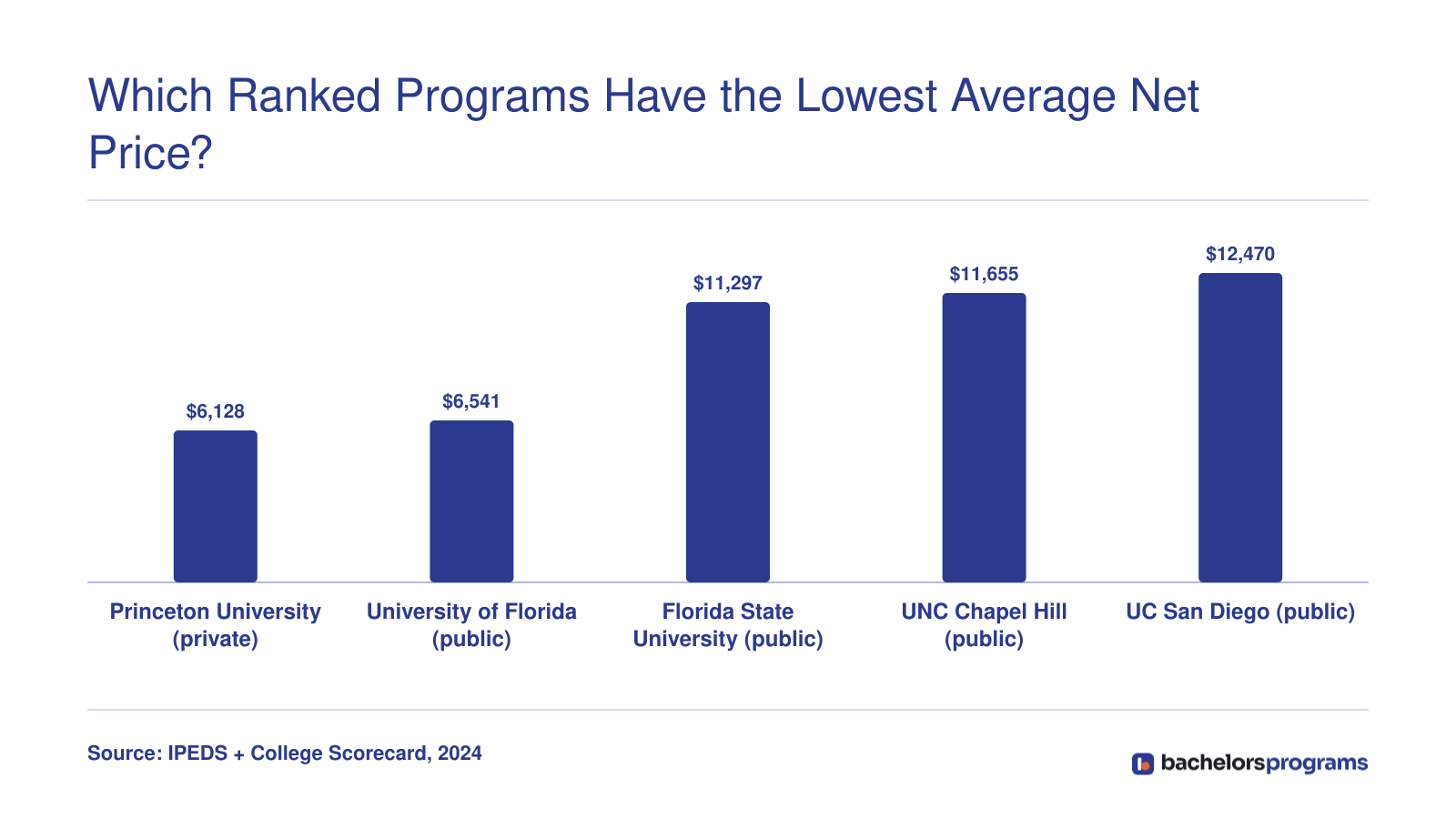
Which Ranked Programs Have the Lowest Average Net Price?
These are the lowest average annual net prices among the schools in our ranking. Each figure is an institution-wide average after grants and scholarships, not a guaranteed price, and it is not specific to the African American studies major. Princeton University is private. The University of Florida, Florida State University, UNC Chapel Hill and UC San Diego are public, and public figures reflect in-state students, so your own cost will depend on residency, family income and the aid you receive.
Top Program-Level Earnings in Our Rankings
Among the schools ranked here, UC Berkeley's African American Studies bachelor's program posts the highest program-level median earnings.
African and African American Studies programs by state
Frequently Asked Questions About African American Studies Degrees
These answers cover the questions prospective students ask most about this major. Requirements vary by school, so confirm details in the catalog of any program you are considering.
How long does it take to earn a bachelor's in African American studies?
Are there HBCUs that offer African American studies degrees?
What's the difference between African American studies, Africana studies, and Black studies?
Can you double major or minor in African American studies?
Compare African and African American Studies programs on the data that matters
Explore more Liberal Arts & Humanities majors or browse every field of study.
All Liberal Arts & Humanities programs Browse every field of study