Best Humanities Degree Programs
Compare 290+ accredited Humanities programs at 280+ colleges, with net price after aid, graduation rates, earnings and debt from IPEDS and the U.S. College Scorecard.

Is a bachelor's degree in humanities worth the cost? It depends on the school. Program-level earnings and graduate debt vary widely, and a Bachelor of Arts (B.A.) in Humanities can mean a thesis-driven research major at one university and a flexible interdisciplinary track at another.
Most of these programs run on campus, with an online option for students who can't relocate. Federal earnings and debt data anchor the comparisons.
Every program here is an undergraduate degree. The major rarely points to a single job title, so outcomes depend heavily on the writing, internships, and second skill a student builds alongside it.
Key Points
- CUNY John Jay College offers an average net price of just $3,203.
- MIT's humanities graduates post the strongest program-level earnings ranked here.
- Georgetown's 2025 study found humanities median earnings of $58,000 to $73,000.
Best Humanities Bachelor's Degree Schools: Our Top 10
The schools below share one trait: their humanities majors ask for sustained writing and independent research rather than a loose survey of great books. Most cap the degree with a thesis or senior essay, and most build in a concentration so students graduate with a named specialty instead of a general label. Figures on the cards cover net price after aid, graduation and admission rates, and, where the federal data publishes it, median earnings and debt four years after completing the program.
Massachusetts Institute of Technology
#1Cambridge, MA · ~$20,000/yr (est.)
Best for: Thesis-focused humanities students in a tech hub
MIT is a private research university in Cambridge, Massachusetts, where the humanities sit inside the School of Humanities, Arts, and Social Sciences rather than at the edge of campus. Undergraduates earn a Bachelor of Science in Humanities assembled from seven interdisciplinary areas, from American Studies to Women's and Gender Studies, and each option runs through an individually approved proposal with a pre-thesis tutorial and a thesis. Cross-registration at Harvard and Wellesley widens the course list considerably. Four years after completing the program, median earnings are $147,998, with median debt of $11,935.
- 7 interdisciplinary areas, from American Studies to Women's and Gender Studies
- Thesis required, preceded by a pre-thesis tutorial
- Every major option needs dean approval through a student proposal
- Cross-registration at Harvard and Wellesley
- Up to 72 units can double-count with General Institute Requirements
- American Studies track requires 108 elective units
University of Chicago
#2Chicago, IL · ~$15,000/yr (est.)
Best for: Independent researchers designing their own curriculum
The University of Chicago is a private research university on the city's South Side, and its humanities major is deliberately self-built. Students in Inquiry and Research in the Humanities design their own course of study across 1,200 units, then complete a mentored research project and a bachelor's thesis, with summer research funding available once a proposal is approved. The school admits 4.48% of applicants and has a graduation rate of 95.9%. Four years after completing the program, median earnings are $96,510.
- 1,200 units total, built as an individualized course of study
- Mentored research project plus a BA thesis
- Rolling admissions by application, minimum B average
- Applied mentored research experience pays a stipend but no credit
- Research Proposal Colloquium in spring of year three
- Honors needs a 3.25 overall and 3.5 major GPA
University of Michigan
#3Ann Arbor, MI · $18,000 – $61,000/yr (est.)
Best for: Arts-minded students combining two disciplines
The University of Michigan is a public research university in Ann Arbor, and its humanities major is taught inside the Residential College, a liberal arts unit of about 900 students and 60 faculty within a much larger institution. Arts & Ideas in the Humanities asks students to combine two humanities disciplines, or an art form with its history and theory, and a 15-credit Focus gives the degree a named shape. The school has a graduation rate of 93.2% and admits 15.64% of applicants. Four years after completing the program, median earnings are $67,859, with median debt of $20,728.
- 33 credits minimum, including a 15-credit Focus area
- 6 credits How to Think, 6 Core Humanities, 6 Core Arts
- One course before 1900 and one beyond Europe or the English-speaking world
- No prerequisites to declare
- Honors requires a 3.5 major GPA and a thesis
- Advisor-approved study abroad can count toward the Focus
- Taught inside the Residential College, about 900 students
Yale University
#4New Haven, CT · ~$24,000/yr (est.)
Yale University is a private research university in New Haven, Connecticut, and its humanities major is one of the more tightly structured interdisciplinary degrees in the country. Six core seminars in Traditions, Modernities, and Interpretations come first, followed by work across four areas of study, three electives, and a senior essay of at least 30 pages. The school admits 3.87% of applicants and has a graduation rate of 95.7%. Four years after completing the program, median earnings are $113,788, with median debt of $15,750.
- Six core seminars: two Traditions, two Modernities, two Interpretations
- Four areas of study plus three elective courses
- Senior essay of at least 30 double-spaced pages
- One intellectual journal entry each semester
- Senior essay advisor chosen by the student
- Essay may run one semester or two
Florida State University
#5Tallahassee, FL · ~$11,000/yr (est.)
Florida State University is a public research university in Tallahassee, and its Interdisciplinary Humanities degree asks students to build a program across three approved departments rather than settle into one. The major carries 42 credit hours with 24 at the upper level, offers 16 concentration options, and runs face to face at the main campus rather than online. The university launched a Humanities Center in 2026, and its inaugural undergraduate fellowship selected 15 seniors for a year of faculty collaboration and independent research under the theme The Human in the Humanities. The school admits 24.22% of applicants and has a graduation rate of 85.6%.
- 42 major credit hours across three approved departments
- 24 of the 42 hours must be at the 3000 or 4000 level
- 16 concentration options
- Foreign language through the intermediate level required
- No separate minor required
- Face-to-face at the Tallahassee main campus, not online
Soka University of America
#6Aliso Viejo, CA · ~$18,000/yr (est.)
Soka University of America is a small private university in Aliso Viejo, California, and it awards a BA in Liberal Arts with Humanities as one of five concentrations. A semester of study abroad is part of the degree, and coursework leans on language, art, and culture taught through comparative international perspectives. The school admits 43.38% of applicants and has a graduation rate of 91.8%. Four years after completing the program, median earnings are $52,896, with median debt of $18,750.
- Humanities is one of five concentrations in the BA in Liberal Arts
- A semester of study abroad is included in the degree
- Core Curriculum and Learning Clusters required
- Taught through comparative international perspectives
- Emphasis on language, art, and culture
Brigham Young University
#7Provo, UT · $15,000 – $20,000/yr (est.)
Brigham Young University is a private university in Provo, Utah, and its Interdisciplinary Humanities major sits in the Comparative Arts and Letters department. Students take a two-course Western Humanities sequence and sophomore and junior seminars, satisfy an upper-division foreign language requirement from about 30 options, then add a 12-hour track that names their specialty. A capstone seminar is taken twice, and an internship or approved experiential option closes the degree. The school admits 67.78% of applicants and has a graduation rate of 81.0%.
- 56 credit hours minimum, 87 maximum
- Two-course Western Humanities sequence plus sophomore and junior seminars
- Upper-division foreign language course, about 30 options
- 12-hour track in art history, English, environmental humanities, film, or theatre
- Internship or approved experiential learning required
- Capstone seminar in the humanities taken twice
University of California-Los Angeles
#8Los Angeles, CA · $13,000/yr (est. net price)
UCLA is a public research university in Los Angeles, and its humanities offering is the newest thing on this list: a Digital Humanities major inside a department created in fall 2026. The degree sits in the College of Letters and Science, which carries more than 100 majors, and a Health Humanities minor gives students an adjacent route into medicine and public health questions. The school admits 8.97% of applicants and has a graduation rate of 92.6%. First-year applicants are reviewed for their first-choice major only.
- Digital Humanities BA in a department launched in fall 2026
- Health Humanities minor available as an adjacent path
- College of Letters and Science offers more than 100 majors
- First-year applicants reviewed for first-choice major only
- Transfer Alliance Program applicants may be reviewed for an alternate major
Washington University in St Louis
#9St. Louis, MO · ~$22,000/yr (est.)
Washington University in St. Louis is a private research university in St. Louis, Missouri, and it is the one school on this list that delivers its humanities bachelor's degree online. The Bachelor of Science in Integrated Studies: Humanities is built for learners who already hold college credit and want to concentrate across humanities disciplines, with 18 units of basic requirements, 27 of distribution, and 27 in humanities. The university announced two humanities and humanistic social science funding programs totaling up to $2 million, with awards beginning in spring 2027. The school admits 12.06% of applicants and has a graduation rate of 94.3%.
- 18 units basic requirements, 27 distribution, 27 in humanities
- Built for learners who already hold college credit
- Coursework in writing, deep reading, communication and critical thinking
- Issues analyzed through multiple cultural and disciplinary lenses
- Degree requirements published in the WashU Bulletin
Harvard University
#10Cambridge, MA · $15,000 – $20,000/yr (est.)
Harvard University is a private research university in Cambridge, Massachusetts, and its humanities route is History and Literature, the oldest concentration in the College. Teaching runs through small-group and one-on-one tutorials rather than large lecture halls, and the concentration is an honors track that ends in a senior thesis at the intersection of art, history, politics, and culture. Gateway courses HUM 10A and HUM 10B open the sequence, and HL90 seminars are designed for first-years and sophomores. The school admits 3.65% of applicants and has a graduation rate of 97.6%.
- Harvard's oldest concentration
- Small-group and one-on-one tutorials
- Honors concentration ending in a senior thesis
- Gateway courses HUM 10A in fall and HUM 10B in spring
- HL90 seminars designed for first-years and sophomores
- Some GenEd courses count toward concentration credit
Cost & outcomes by school
Federal data for the highest-earning Humanities programs, independent of the ranking above. Earnings are this field's bachelor's graduates four years after completing where the Scorecard reports them, else the school's undergraduate median.
| School | Net price / yr | Grad rate | Earnings | Debt | Grads/yr | Format |
|---|---|---|---|---|---|---|
| Massachusetts Institute of Technology MA | $20,111 | 96% | $147,998 | $11,935 | 10 | Campus |
| Yale University CT | $23,777 | 96% | $113,788 | $15,750 | 38 | Campus |
| Georgetown University DC | $40,815 | 95% | $112,722 | $15,500 | 40 | Campus |
| University of Pennsylvania PA | $28,699 | 97% | $111,371 | $15,715 | 49 | Online |
| Stevens Institute of Technology NJ | $41,346 | 87% | $108,772 | $27,000 | 4 | Campus |
| Worcester Polytechnic Institute MA | $43,071 | 90% | $103,470 | $27,000 | 5 | Campus |
| Harvard University MA | $19,066 | 98% | $101,817 | $14,000 | 26 | Campus |
| University of Chicago IL | $14,860 | 96% | $96,510 | $15,000 | 27 | Campus |
| Bucknell University PA | $40,766 | 86% | $93,807 | $27,000 | 3 | Campus |
| Northwestern University IL | $29,167 | 95% | $93,180 | $15,000 | 2 | Campus |
| Champlain College VT | $35,860 | 65% | $91,533 | $12,500 | 18 | Campus |
| Case Western Reserve University OH | $41,190 | 87% | $87,989 | $24,000 | 2 | Campus |
Sources: U.S. Department of Education. Net price, graduation rate, earnings and debt: College Scorecard (earnings and debt for this field's bachelor's graduates where reported, else school-wide); graduates: IPEDS. A dash means no figure is reported.
Cost, debt & payoff
Median earnings of this field's bachelor's graduates (4 yrs after completing, else the school's undergraduate median) vs. their median federal loan debt · U.S. College Scorecard
Across these programs the median graduate earns about $54,384 and finishes with roughly $23,250 in debt — a ratio that clears a common rule of thumb (keep debt below first-year salary). Net price and debt vary widely school to school, so check the per-school figures in the table above before you shortlist.
How We Ranked Humanities Programs
The earnings and debt figures behind this ranking come from the College Scorecard, the U.S. Department of Education's public data tool, and a school had to award an actual bachelor's-level humanities credential to be considered at all. Format was never a filter: online, campus, and hybrid programs compete on the same measures, so a well-priced online B.A. in Humanities can sit ahead of a famous residential program.
The Four Measures
- Average net price after aid: the yearly cost a typical student pays after grants and scholarships, which matters more than the sticker tuition.
- Graduation and retention rates: how many first-year students come back, and how many finish. Steady retention tells you the advising and course availability hold up.
- Program-level earnings and median federal debt: what graduates of the specific humanities program earn after finishing, set against what they borrowed to get there. Read together, they show whether a degree pays for itself.
- Pell share: the proportion of students receiving federal need-based aid, used as a signal of access rather than prestige.
Where the Numbers Stop
No single figure captures a program. These two rates cover the whole institution rather than the humanities department, so a strong department can live inside a school with a middling overall rate. The net price figure averages every family income level, so it will land differently for your family.
Some small programs report no earnings data at all. Where that happens, the school is weighed on the measures it does publish rather than treated as a failure, and the gap stays visible.
What a Bachelor's Degree in Humanities Covers
Humanities vs. Liberal Arts
A B.A. in Humanities is an interdisciplinary major built around culture and human expression: literature, history, philosophy, religion, languages, and the arts. A liberal arts or liberal studies degree casts a wider net, adding natural sciences, social sciences, and quantitative reasoning. Antioch University's liberal studies degree, for example, requires 24 credits spread across six domains.7 A humanities major is usually more prescribed, with set foundational and upper-division courses.
Credits and Structure
Most bachelor's programs total about 120 semester credits. Tulane's catalog sets 120, with 30 in the major (12 lower-division, 18 upper-division).1 The University of Texas Permian Basin requires 120 or more, including a 42-credit core.2 The University of Houston-Downtown also lists 120.3 In general, major credits run roughly 30 to 42, and the rest goes to general education, electives, or a minor.
Liberal studies majors vary more. Palmetto College requires 27 major credits plus a 12-credit cognate5, La Salle requires 366, and Thomas Edison State University pairs 45 general education credits with a 42-credit major4. Antioch counts in quarter credits (180 total).7 No national standard exists, so check each school's catalog.
Common Concentrations
Tracks differ by school. Houston-Downtown offers Cultural Studies, Critical Race Studies, Latino Studies, and Religious Studies.3 In liberal studies, concentrations are often structured credit blocks, such as Thomas Edison's 18 credits4 or Antioch's Arts and Literature concentration at 40 credits8. If a specific focus matters to you, confirm it is offered before you apply.
Typical Courses
Expect a sequence that moves from broad to specialized:
- Foundational courses: Introductory surveys across literature, history, philosophy, and the arts. Tulane requires three lower-level courses.1
- Upper-division work: Advanced seminars with heavier reading, research, and writing. Tulane requires five courses at the 3000 level or above.1
- Capstone: Tulane ends with an interdisciplinary seminar1, and UTPB requires a capstone or seminar2. Liberal studies capstones vary, from a project at Thomas Edison4 to a senior course with a required internship at Palmetto5.
Related Articles
Online vs. Campus Humanities Programs: Cost, Time, and Transfer Credits
Yes, you can earn a bachelor's degree in humanities fully online, and format availability varies by school, so check each program's listing. The two formats lead to the same 120-credit degree at most schools. They differ in pace, flexibility, how transfer credits are handled, and how much daily contact you have with faculty and classmates.
| Factor | Online Humanities Program | On-Campus Humanities Program |
|---|---|---|
| Credits required | 120 total credits at American College of Education, which is typical for online bachelor's degrees | Most bachelor's degrees require 120 credits |
| Typical completion time | Transfer and degree-completion students can finish in as little as 12 months at American College of Education. A full-time start with no prior credit still takes about four years. | Four years is the traditional timeline for a full-time student with no prior college credit |
| Accelerated options | Transfer credits, a heavier course load, and summer courses can sometimes cut the timeline to two to three years | Summer terms and heavier course loads can also shorten the path, but the default is a four-year sequence |
| Transfer-credit acceptance | Up to 90 credits may be considered at American College of Education. Entering with 60 credits leaves 60 to complete, and entering with 90 leaves 30. | Caps vary by school and are often lower, so confirm the maximum with each admissions office |
| Cost drivers | Tuition and fees are the main costs. You typically avoid housing, meal plans, and commuting, but per-credit rates vary widely. | Tuition plus housing, meals, transportation, and campus fees. Total cost depends on school, residency, and aid. |
| Flexibility | High. Coursework often fits around jobs and family, with schedules that vary by school. | Lower. Fixed class times and a set campus schedule suit full-time attendance. |
| Faculty and peer interaction | Mostly through discussion boards, email, and video. It takes more initiative, but it works well for self-directed learners. | Face-to-face seminars, office hours, and campus life, which suit discussion-based humanities coursework |
| Best suited for | Working adults, degree-completers, and transfer students who need speed and flexibility | Traditional first-year students who want a full campus experience and in-person seminars |
Cost and Value: The Most Affordable Humanities Programs
For budget-conscious students, the most affordable humanities programs here pair low average net prices with strong aid reach. CUNY John Jay College of Criminal Justice has an average net price of $3,203 and an 89.6% Pell share, and Cal State Fullerton has an average of $6,555 and an 80.1% Pell share, which signals that aid is reaching lower-income students (U.S. Department of Education IPEDS and College Scorecard data). Net price varies by family income bracket, so use each school's net price calculator to estimate what you would actually pay.
| School | Program | Average Net Price After Aid | Median Federal Debt (Program Completers) | Pell Share | Format |
|---|---|---|---|---|---|
| CUNY John Jay College of Criminal Justice (New York, NY) | Humanities & Justice | $3,203 | 89.6% | Campus | |
| California State University-Fullerton (Fullerton, CA) | Humanities and Social Sciences, B.A. (online degree completion) | $6,555 | $12,550 | 80.1% | Online |
| University of West Florida (Pensacola, FL) | Humanities, Interdisciplinary, B.A. (Arts Administration) | $9,364 | 67.9% | Campus |
Top Program-Level Earnings Among Ranked Humanities Programs
The strongest program-level earnings among the schools ranked here belong to MIT's humanities graduates.
Humanities Degree Salary and Career Outcomes: Are Humanities Degrees Worth It?
A humanities degree pays off, but on a slower curve than engineering or health. In its 2025 report The Major Payoff, Georgetown University's Center on Education and the Workforce found median earnings of $58,000 to $73,000 across 19 humanities and arts majors, with 14 of them above $65,000.1 That trails the $81,000 median for all bachelor's holders. Still, prime-age workers with a bachelor's degree earn a 70% premium over high school graduates. Unemployment for prime-age humanities and arts graduates is 4.1%.2 That is above the 2.9% rate for all bachelor's holders but well below the 6.2% rate for workers with only a high school diploma.
Where Humanities Graduates Find Work
Employers keep asking for the skills humanities coursework builds. NACE's Job Outlook 2026 Spring Update names communication, teamwork, critical thinking and problem-solving among the skills employers want in Class of 2026 candidates, and written communication is specifically sought on resumes.3 The most employable paths include:
- Law and public policy: Programs such as Chico and San Jose State point students toward law school.
- Teaching: Humanities majors move into classrooms, museums and education roles.
- Communications and PR: Writing-heavy training fits media, marketing and public relations.
- Writing and editing: Research and argument skills transfer directly to publishing and content work.
- Public service and management: Justice-focused programs like John Jay's feed policy and government careers, and many graduates move into business management.
Graduate school often drives the biggest gains. An earlier Georgetown analysis found that about 40% of humanities and liberal arts graduates go on to earn a graduate degree.4 That is the usual route into law and many higher-paying professional tracks.
What Ranked Programs Report
Program-level federal data shows that earnings climb steadily after graduation. Five years after completion, median earnings among the programs ranked here run from $55,139 at California State University-Chico to $86,939 at Brigham Young University. Four years out, MIT humanities graduates report $147,998, though that figure comes from a very small graduating group. Growth is steep at public schools: San Diego State graduates move from $23,190 one year out to $58,202 at five years.
Where schools report it, 91% to 94% of graduates are employed one year after finishing, and 79% to 96% earn above the poverty threshold.
Debt Versus Early Earnings
Median debt stays manageable relative to pay. At UT Austin, graduates carry $18,625 in median debt. That works out to about $197 a month on a 10-year plan, roughly 5% of gross monthly income at the $45,243 median one year out. Chico graduates owe $15,688 ($166 a month) against $27,196 in first-year earnings. The fit is tighter at first but eases as pay passes $55,000 by year five. San Diego State's $136 monthly payment on $12,838 follows the same pattern.
A bachelor's degree in humanities is worth it if you choose an affordable program, build the writing and analytical skills employers name, and plan a clear route into a professional field or graduate study.
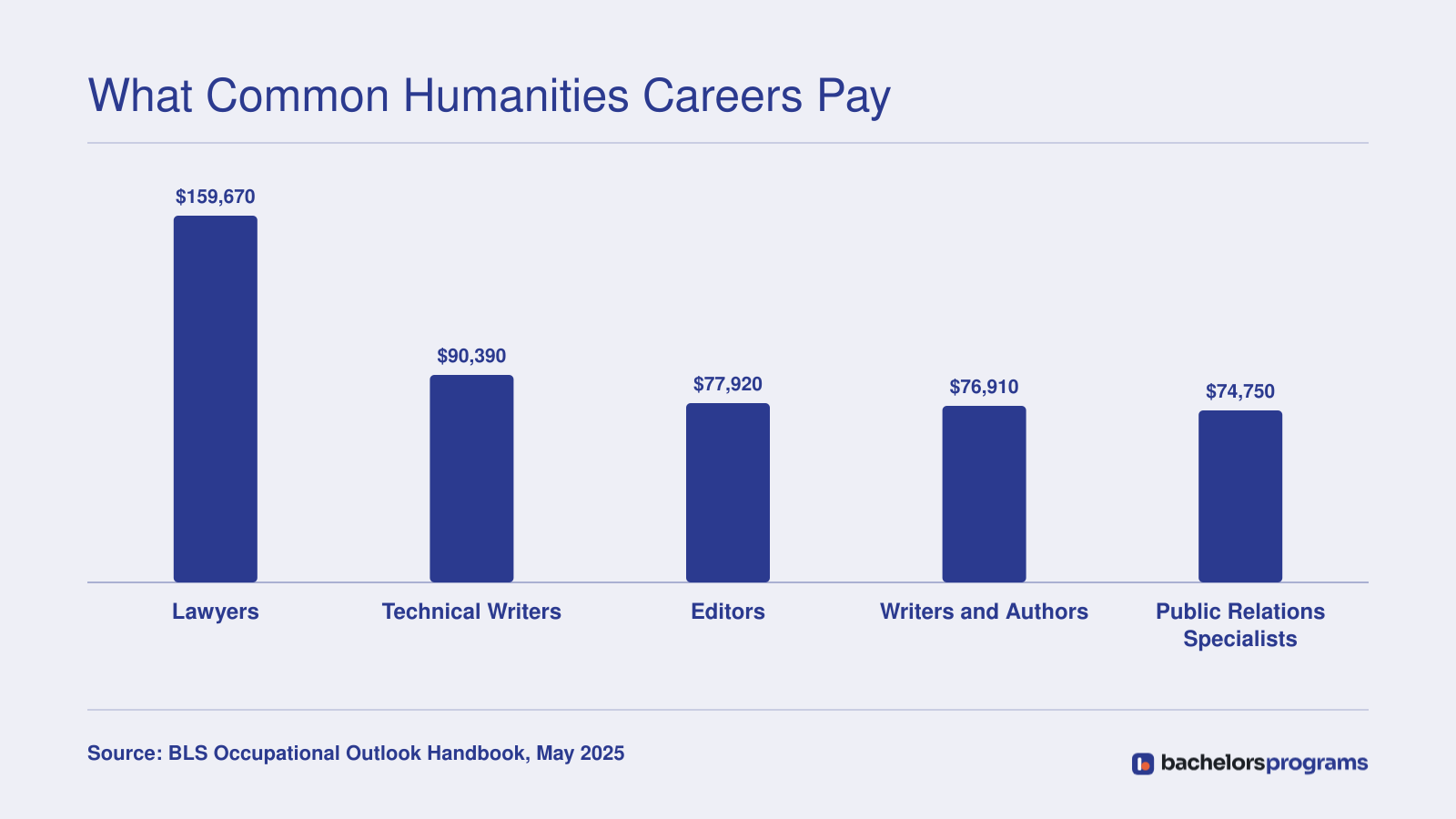
What Common Humanities Careers Pay
The chart shows May 2025 median annual wages from the Bureau of Labor Statistics Occupational Outlook Handbook for occupations that humanities graduates commonly enter. These are wages for everyone working in each occupation nationwide. They are not starting salaries or earnings for graduates of any specific program on this page. Some roles require more than a bachelor's degree: lawyers, the highest-paid group shown, must also complete law school and pass a state bar exam.
Accreditation and Admissions: What to Check Before You Apply
Before you submit an application for a bachelor's degree in humanities, confirm that the school is properly accredited and that you understand what admission requires.
- Confirm institutional accreditationSearch the U.S. Department of Education's Database of Accredited Postsecondary Institutions and Programs (DAPIP) using the school's exact legal name and campus. Check the accreditor, status, effective dates, and any probation, show-cause, or withdrawal action. Then confirm that the accreditor appears on the Department's recognized list and in the CHEA directory. DAPIP data are not audited, so compare it with the school's catalog and ask for written confirmation if anything conflicts.
- Watch for accreditation millsBe cautious if an accreditor is missing from both the Department of Education and CHEA lists. Names that use words like 'international' or 'worldwide' do not prove recognition. A state license, an association membership, or accreditation of a single program does not establish institutional accreditation. Recognized accreditation is required for federal aid, but it does not guarantee aid eligibility, so confirm that with the school's financial aid office. It also affects whether other colleges will accept your credits.
- Check the admission rateSelectivity varies widely among the schools ranked here. Harvard admits under 4 percent of applicants, while Brigham Young University admits about 68 percent.
- Review academic requirementsExpect to submit a high school diploma or GED and transcripts. Some schools also ask for an essay or writing sample. Testing policies vary, so check whether the school is currently test-optional. Some humanities majors have their own entry steps after you enroll. The University of Chicago's program requires a 750-word motivation statement and a minimum B average, and Michigan's program sets a 3.4 GPA minimum.
- Request a transfer credit evaluationThe receiving college decides which credits transfer, and acceptance is never guaranteed. Ask for an unofficial credit evaluation before you apply.
Humanities programs by state
Compare Humanities programs on the data that matters
Explore more Liberal Arts & Humanities majors or browse every field of study.
All Liberal Arts & Humanities programs Browse every field of study