Best Mathematics Degree Programs
Compare 1,300+ accredited Mathematics programs at 1,150+ colleges, with net price after aid, graduation rates, earnings and debt from IPEDS and the U.S. College Scorecard.

A bachelor's degree in mathematics leads directly into actuarial work, quantitative finance, data science, software engineering and, with a state license, public school teaching. Most U.S. universities award it as the Bachelor of Science (B.S.) in Mathematics, with a B.A. track that typically trades upper-level proof work for a language or a minor.
Cost decides it. Two mathematics programs can share a calculus sequence and still sit more than $14,000 a year apart in average net price, and early-career pay spreads nearly as wide.
Hiring managers increasingly screen on coursework, not the diploma: linear algebra, probability and a programming language.
Key Points
- After aid, Caltech, Princeton and Stanford net prices run $6,128 to $16,075.
- B.S. and B.A. math degrees typically require roughly 120 credits.
- A math degree alone won't certify you to teach public school.
Best Bachelor's Degree in Mathematics Programs: Our Top 10 Ranked Schools
This list mixes large public research universities with smaller private institutions, and every school in this top 10 awards its bachelor's degree in mathematics on campus. Two notes on the stats beside each card: the net price is an average after aid rather than a quote, and the graduation rate describes the whole institution, not just the mathematics department.
Princeton University
#1Princeton, NJ · ~$6,000/yr (est.)
Best for: Future math PhDs weighing thesis work
Princeton's mathematics department stays deliberately small, enrolling roughly 70 to 75 majors at a time, and it treats independent work as a requirement rather than an extra. Students build proof-writing fundamentals through analysis and linear algebra, then take core work in real and complex analysis, algebra, and geometry or topology before branching into electives across pure and applied mathematics. Many majors write a senior thesis with an adviser from another department plus a second reader from mathematics, and graduates frequently continue into leading doctoral programs.
- About 70 to 75 majors in the department
- Core courses in analysis, algebra, and geometry or topology
- Senior thesis with an adviser from another department
- Independent work alongside active researchers
- Electives spanning pure and applied mathematics
- Graduates often enter leading mathematics PhD programs
- Honors and awards available to majors
- International study and summer research options
Massachusetts Institute of Technology
#2Cambridge, MA · ~$20,000/yr (est.)
Best for: Quantitative finance and tech career starters
MIT awards the Bachelor of Science in Mathematics as Course 18, and the degree is mapped out down to the unit: 17 General Institute Requirement subjects plus 132 to 135 units in the major. Majors take one subject from each of five required areas, including differential equations, linear algebra, analysis, and probability and statistics, then spend six restricted electives, most of them advanced. The early earnings profile is the strongest on this list, which reflects both the quantitative depth of the curriculum and the recruiting pipeline around it.
- 180 units overall, with 132 to 135 in the major
- 17 General Institute Requirement subjects
- Five required areas include linear algebra and analysis
- Six 12-unit restricted electives, mostly advanced subjects
- Two communication-intensive subjects within the major
- 8 humanities, arts, and social science subjects
- At most 36 units may count toward another major
University of Florida
#3Gainesville, FL · ~$7,000/yr (est.)
Best for: Florida residents aiming at high school teaching
Florida's mathematics department offers a B.A. and a B.S. under one roof, and the split is purposeful: the B.A. suits students heading into math-adjacent careers or high school teaching, while the B.S. is built for doctoral study. Either route runs 120 credits with eight core courses, four approved electives, and at least 39 credits of mathematics completed with a C or better. Majors who finish requirements early can apply 12 graduate credits toward a master's, and the UFTeach minor carries the coursework Florida requires for high school mathematics certification.
- 120 credits: eight core courses plus four approved electives
- At least 39 mathematics credits, C or better in each
- B.A. suits math careers or high school teaching
- B.S. prepares students for graduate study in mathematics
- 12 graduate credits can count toward a master's degree
- UFTeach minor meets Florida high school certification requirements
- Career paths include actuarial science, cryptography, operations research
University of California-Berkeley
#4Berkeley, CA · ~$13,000/yr (est.)
Berkeley's mathematics department awards a Bachelor of Arts and lets students add a teaching concentration aimed at strengthening the supply of mathematics teachers. An honors track sits on top of the major and asks for a 3.5 upper-division mathematics GPA, a senior thesis, or two graduate courses at A- or better, plus the head adviser's recommendation. The department frames the degree broadly: graduates go on to doctoral work in mathematics, physical sciences, economics, and engineering, and into business, technology, government, and finance.
- Honors track requires a 3.5 upper-division math GPA
- Thesis option can be replaced by two graduate courses at A- or better
- Teaching concentration aimed at increasing math teachers
- Meet with an undergraduate adviser to declare the major
- Honors advising recommended by junior year
- Prepares students for graduate work in law, medicine, economics
- Career fields include technology, finance, government, teaching
Stanford University
#5Stanford, CA · $10,000 – $15,000/yr (est.)
Stanford's mathematics B.S. runs 61 units in the major against 180 university units overall, with at least eight mathematics courses at the 100 level and above plus four electives. Every major completes a capstone, whether through the honors thesis, an undergraduate or graduate course, or a capstone project, alongside the Writing in the Major requirement. An optional subplan in Computer Science Theory and Discrete Mathematics adds combinatorics, probability, and computer science coursework for students aiming at quantitative roles in tech and finance.
- 61 units in the major, 180 university units overall
- Eight mathematics courses at the 100 level and above
- Four electives from Math 101 and above or an approved list
- Capstone: honors thesis, course, or capstone project
- Writing in the Major through Math 190 or Math 195
- Optional subplan in Computer Science Theory and Discrete Mathematics
- Honors track requires a 3.3 mathematics GPA
California Institute of Technology
#6Pasadena, CA · ~$16,000/yr (est.)
Caltech's mathematics B.S. sits inside a small institute where undergraduates complete a shared core before specializing, and more than 20 recognized mathematicians teach in the division. Students can shape the degree toward mathematical finance, astrophysics, or machine learning, and requirements reach into probability, physics, algorithms, and mathematical logic. Cohorts are tiny, so majors work closely with professors and can join faculty and graduate students on research projects.
- Three emphasis options: mathematical finance, astrophysics, machine learning
- Core fields: algebra, analysis, and topology
- Advanced coursework in geometry, combinatorics, and set theory
- Requirements include probability, physics, algorithms, and mathematical logic
- More than 20 recognized mathematicians in the division
- Undergraduates can join faculty and graduate research projects
- Small cohorts allow close work with professors
University of Chicago
#7Chicago, IL · ~$15,000/yr (est.)
Chicago offers four mathematics degrees: a B.A., a B.S., a B.S. in applied mathematics, and a B.S. in mathematics with a specialization in economics. All majors complete a three-quarter calculus sequence or placement, abstract linear algebra, a three-quarter analysis sequence, and a quarter of algebra, while honors adds a 3.25 mathematics GPA and a sequence spanning algebra, analysis, and topology. The department also runs a spring quarter mathematics program in Paris and a combined bachelor's and master's route.
- Four degrees: B.A., B.S., applied math B.S., math with economics
- Three-quarter calculus sequence or placement exam
- Abstract linear algebra, three-quarter analysis, one algebra quarter
- Honors requires a 3.25 math GPA and a 3.0 overall GPA
- B.S. candidates complete a three-course minor outside mathematics
- Spring Quarter Paris mathematics program
- Combined B.A./M.S. or B.S./M.S. in mathematics
- Entering students take an online mathematics placement test
University of Michigan
#8Ann Arbor, MI · $18,000 – $61,000/yr (est.)
Michigan organizes its mathematics major into six submajors, and the Pure Mathematics track asks for four basic courses in modern algebra, differential equations, analysis, and geometry or topology, plus four approved electives and a cognate course outside the department. Transfer students need at least 18 credits in residence at Ann Arbor, six of them from the basic courses. A department adviser has to approve the plan for the major, and a working knowledge of a high-level programming language is encouraged.
- One of six mathematics submajors at Ann Arbor
- Four basic courses: algebra, differential equations, analysis, geometry
- Four approved mathematics electives
- Cognate course outside the department with advanced math content
- Minimum grade of C- in major coursework
- 18 credits in residence at Ann Arbor for transfer students
- A department adviser must approve the major plan
- Working knowledge of a high-level programming language encouraged
University of North Carolina at Chapel Hill
#9Chapel Hill, NC · ~$12,000/yr (est.)
Carolina's mathematics department offers both a B.A. and a B.S., and both are laid out to finish in eight semesters. The core covers discrete mathematics, differential equations, advanced calculus, and at least three courses above the 500 level, and honors adds a 3.5 mathematics GPA with a two-semester project. UNC-BEST lets a student leave with a North Carolina high school mathematics license in four years, and the department hires undergraduates as tutors and learning assistants.
- 33 credit hours in the major, laid out for eight semesters
- Core: discrete math, differential equations, advanced calculus
- At least three additional MATH courses above the 500 level
- 2.0 GPA required overall and in the major
- Suggested course sets for pure math, economics, and teaching
- Honors track requires a 3.5 mathematics GPA
- UNC-BEST adds North Carolina high school licensure in four years
- 45 credit hours must be earned at UNC
University of California-Los Angeles
#10Los Angeles, CA · $13,000/yr (est. net price)
UCLA's mathematics B.S. is a large public-university program in the University of California system, and the general catalog is the authoritative source for its requirements, published annually and updated without notice. Students should check course and fee details against the current catalog year rather than older advising sheets. The campus draws a deep, competitive applicant pool and sits in a major market for technology, data, and quantitative work.
- 120 total credit hours across eight semesters
- Honors versions of core courses available to majors
- Honors project spans two semesters
- Undergraduate research with faculty guidance
- Semester or yearlong study abroad options
- Learning assistant and tutor roles in the department
- Putnam Mathematical Competition participation
- Henderson Medal and Brauer Prize awards
Cost & outcomes by school
Federal data for the highest-earning Mathematics programs, independent of the ranking above. Earnings are this field's bachelor's graduates four years after completing where the Scorecard reports them, else the school's undergraduate median.
| School | Net price / yr | Grad rate | Earnings | Debt | Grads/yr | Format |
|---|---|---|---|---|---|---|
| Duke University NC | $29,612 | 97% | $297,029 | $9,500 | 76 | Campus |
| Massachusetts Institute of Technology MA | $20,111 | 96% | $174,951 | $9,751 | 176 | Campus |
| University of Chicago IL | $14,860 | 96% | $172,826 | $12,000 | 231 | Campus |
| Dartmouth College NH | $29,519 | 96% | $168,580 | $11,617 | 50 | Campus |
| Vanderbilt University TN | $15,846 | 94% | $141,171 | $9,644 | 186 | Campus |
| Johns Hopkins University MD | $18,809 | 94% | $134,785 | $10,859 | 74 | Campus |
| Cornell University NY | $28,690 | 95% | $134,455 | $13,500 | 109 | Campus |
| Williams College MA | $17,716 | 94% | $134,304 | $13,807 | 66 | Campus |
| California Institute of Technology CA | $16,075 | 94% | $128,566 | — | 18 | Campus |
| Amherst College MA | $23,367 | 94% | $124,324 | $13,900 | 92 | Campus |
| Stanford University CA | $13,807 | 92% | $124,080 | $12,000 | 93 | Campus |
| Georgia Institute of Technology GA | $12,116 | 94% | $122,099 | $21,672 | 94 | Campus |
Sources: U.S. Department of Education. Net price, graduation rate, earnings and debt: College Scorecard (earnings and debt for this field's bachelor's graduates where reported, else school-wide); graduates: IPEDS. A dash means no figure is reported.
Cost, debt & payoff
Median earnings of this field's bachelor's graduates (4 yrs after completing, else the school's undergraduate median) vs. their median federal loan debt · U.S. College Scorecard
Across these programs the median graduate earns about $57,944 and finishes with roughly $23,000 in debt — a ratio that clears a common rule of thumb (keep debt below first-year salary). Net price and debt vary widely school to school, so check the per-school figures in the table above before you shortlist.
How We Ranked These Mathematics Schools
Our ranking starts with a practical question: what will a mathematics program help you build, and what will it cost you to get there? We score each program on evidence you can check, not on name recognition.
The Factors We Weigh
- Earnings after completion: median pay for graduates of the program in the years after they finish.
- Average net price: what students actually pay once grant aid is subtracted from sticker price.
- Median debt: typical federal borrowing among graduates of the program.
- Graduation and retention rates: how many students return for a second year and how many finish.
- Selectivity: how competitive the admitted class is, which tells you about the academic environment you would join.
Where the Numbers Come From
Every figure traces to federal data: the College Scorecard from the U.S. Department of Education, alongside IPEDS for institutional reporting. We used the 2026 snapshot, so costs, debt and earnings reflect the most recent year the government published.
How This Differs From Reputation Rankings
U.S. News handles undergraduate mathematics through peer assessment.1 Deans and senior faculty rate only the programs they know on a 1 to 5 scale, may answer "don't know," and a program needs at least 10 ratings, after the two highest and two lowest are trimmed, to appear at all.1 Even the broader Best Colleges list gives peer assessment 20 percent of the score.2 That measures what academics think of a department, not what graduates earn.
What This Method Cannot Tell You
Graduation rates are school-wide, not specific to the math major. Earnings are medians, published only where the federal data reports them, so smaller programs sometimes have no figure. Treat the scores as a starting point and confirm the details with each department.
Cost, Debt and Earnings: Comparing Mathematics Program Outcomes
Caltech, Princeton and Stanford lead this comparison on value, and all three are private schools whose published tuition and fees top $62,000 a year while their average net price, after grants and scholarships, falls between $6,128 and $16,075, according to 2024 U.S. Department of Education data from IPEDS and the College Scorecard. That gap between sticker price and net price is typical of well-funded private universities, so compare net price rather than published tuition when weighing a private school against your in-state public option. The debt and earnings figures below cover all undergraduates at each school, not math majors alone, because math-specific earnings and repayment figures are not yet reported for these programs. When those numbers are available, the key affordability signal is a monthly loan payment that stays small next to early-career earnings, since that leaves room for living costs and savings.
| School | Average Net Price (2024) | Published Tuition and Fees (2024) | Median Federal Debt at Completion (All Undergraduates) | Median Earnings 10 Years After Entry (All Undergraduates) |
|---|---|---|---|---|
| California Institute of Technology (Pasadena, CA) | $16,075 | $65,898 | N/A | $128,566 |
| Princeton University (Princeton, NJ) | $6,128 | $62,688 | $10,320 | $110,066 |
| Stanford University (Stanford, CA) | $13,807 | $65,910 | $12,000 | $124,080 |
B.S. vs. B.A. in Mathematics: Which Degree Fits Your Goals?
Is a B.S. or a B.A. in mathematics the better choice if you plan to work in tech or head to graduate school?
At most U.S. universities both degrees total roughly 120 credits, so the difference is rarely length. It is composition. The B.S. is the more common credential, and it generally swaps liberal-arts flexibility for deeper math, science, or computing work. The B.A. leaves room for a language, a minor, or a second major.
Where the Two Degrees Diverge
Northeastern University is a clean example. Its B.A. requires at least 11 mathematics courses, two physics courses, and foreign language study; the B.S. requires at least 14 mathematics courses and two physics courses, with no language requirement.1 The University of La Verne gap is narrower: 67 major semester hours for the B.A. against 71 for the B.S., where the B.S. adds Real Analysis on top of the shared core.2 George Mason University builds its B.S. around a mathematics core, science, computational skills, and a concentration, while its B.A. leans on the college's liberal arts requirements.3
What Stays the Same
Total credits rarely move. Utah Tech University requires 120 credits and 40 upper-division credits for both degrees, and both also require 16 credits in a single foreign language.4 The University of Texas at Dallas B.A. needs 120 semester credit hours, a 42-hour core, 45 upper-division hours, and programming options such as CS 1325 or CS 1337.5 Online programs can differ sharply: American Public University's B.S. in Mathematics carries 57 units of STEM coursework plus 9 additional STEM units.6 Requirements shift by catalog year, so read the catalog for the year you enroll, not a general summary.
The Rule of Thumb
Choose the B.S. for applied, technical, or PhD paths; choose the B.A. for teaching, law, policy, or a second major.
Related Articles
Mathematics Specializations and Career Tracks
A pure mathematics track and an actuarial track can open with the same calculus sequence and still land graduates in very different first jobs. The courses you choose in your third and fourth years decide which one you get.
The core tracks
- Pure mathematics: proof-based analysis, algebra and topology, aimed at doctoral study or research-adjacent work.
- Applied and computational: numerical methods, modeling and programming, feeding into software, engineering and operations roles.
- Statistics and data science: probability, regression and statistical computing for analyst and data scientist positions.
- Mathematical finance: stochastic processes and pricing for quantitative finance and risk work.
- Teaching: mathematics plus education coursework and state licensure for high school classrooms.
Michigan is the school in the ranking whose program listing names a concentration outright: Pure Mathematics. Where a program is listed simply as Mathematics, your electives set the specialization, not the degree title, so read the course catalog closely before you commit.
Actuarial science: exams before graduation
Actuarial work has the most formalized undergraduate path. Students commonly sit Exam P (Probability) and Exam FM (Financial Mathematics) during college.1 Exam P covers probability theory, random variables and distributions, and assumes calculus plus some insurance and risk-management background.1 Passing those exams does not earn VEE credit. The Society of Actuaries awards Validation by Educational Experience separately, in three topics: Accounting & Finance, Economics, and Mathematical Statistics.2 You earn it by completing courses approved in the SOA's course directory, meeting the stated grade requirements, and then recording the credit through the actuarial organization. UT Dallas, for example, lists STAT 3355 and STAT 4352 for Mathematical Statistics, ACCT 2302 and ACTS 4302 for Accounting and Finance, and ECON 2301 and 2302 for Economics.3
Plan on one or two passed exams before you graduate. Entry-level actuarial employers commonly expect exam progress on a resume; each pass is evidence of the quantitative stamina the job demands.
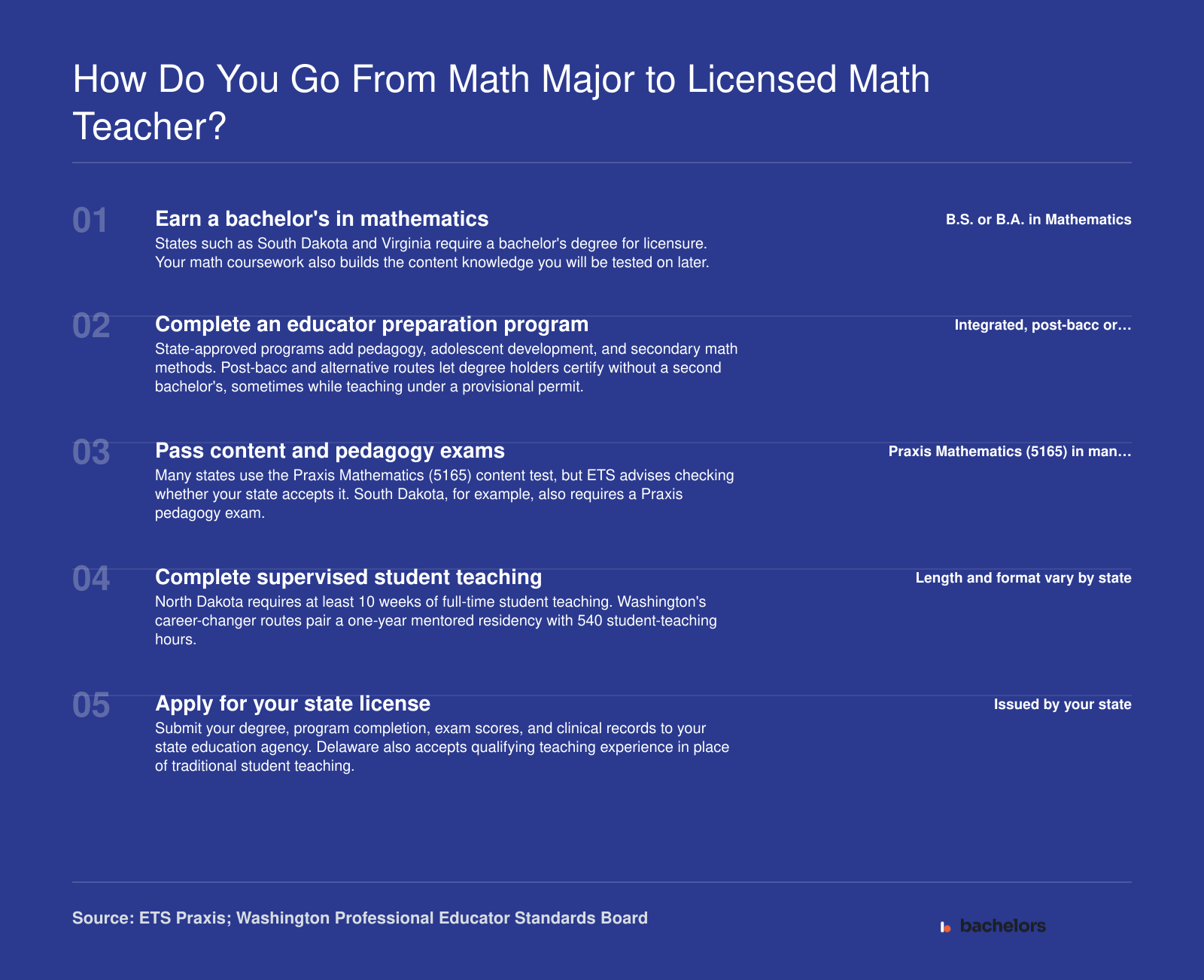
How Do You Go From Math Major to Licensed Math Teacher?
A bachelor's degree in mathematics does not, on its own, certify you to teach in a public school. Each state sets its own licensing rules, exams, and passing scores, so confirm the requirements with your state's education agency before you plan your path. Graduates who skipped a teaching track can still qualify through post-baccalaureate or alternative certification routes.
Questions to Ask Yourself
Do you prefer proofs and abstraction, or modeling real data?
Are you willing to study for SOA exams alongside your coursework?
Do you want to teach high school math?
Will you want a computer science or economics double major?
Early-Career Earnings for Math Graduates
Program-level federal data shows how much a bachelor's degree in mathematics can pay off within a few years of graduation.
Mathematics programs by state
Mathematics Degree FAQs
These answers cover the questions prospective math majors ask most often about graduate school preparation, degree length, and careers in actuarial science and data science.
Which universities are best for math if I plan to go to graduate school?
How many credit hours does a bachelor's degree in mathematics take?
Can I become an actuary with a math degree instead of an actuarial science degree?
Do I need a master's degree to work as a statistician or data scientist?
Compare Mathematics programs on the data that matters
Explore more Science & Engineering majors or browse every field of study.
All Science & Engineering programs Browse every field of study