Best Developmental Psychology Degree Programs
Compare 20+ accredited Developmental Psychology programs, with net price after aid, graduation rates, earnings and debt from IPEDS and the U.S. College Scorecard.

Net price after aid across these programs ranges from $10,990 to $30,434 a year, and that spread, not sticker tuition, is the real cost question for a bachelor's degree in developmental psychology. The field tracks how people change from infancy through old age, which points graduates toward child life, early intervention, family services or aging-adult care, and toward graduate study for clinical work. Only undergraduate programs appear here. Licensing rules for those roles sit with states and certifying bodies, so the credential, not the major, decides who gets hired.
Key Points
- Washington University psychology graduates earn a $75,261 median four years out.
- Social science research assistants earned a $61,990 BLS median in May 2025.
- Child psychology is usually a concentration, not a standalone accredited bachelor's degree.
The 10 Best Schools for a Bachelor's Degree in Developmental Psychology
Each program below awards a bachelor's degree in developmental psychology or a closely named equivalent, and together they range from large public research universities to small private colleges with hospital placements built into the senior year. Entries appear in ranked order across all formats, with the school's net price, admission rate, graduation rate and any published program-level earnings shown alongside. Where a school offers the field as a concentration inside a broader psychology major rather than as a standalone degree, the entry says so.
University of California-San Diego
#1La Jolla, CA · $10,000 – $15,000/yr (est.)
Best for: Aspiring researchers wanting lab experience
UC San Diego is a public research university in La Jolla, California, where psychology sits alongside neuroscience, cognitive science and medical school partners including the Salk Institute. Undergraduates pursue a Bachelor of Science in Psychology with a specialization in Developmental Psychology that covers language acquisition, perceptual development and developmental psychopathology. The specialization is a formal track inside the psychology major rather than a separately admitted program, and the department has proposed retiring it under a fall 2026 curriculum change, so applicants should confirm current requirements before applying.
- Specialization inside the Psychology B.S., not a standalone major
- Covers language acquisition, perceptual development and developmental psychopathology
- 32 lower-division units including statistics and a programming course
- 48 upper-division units: PSYC 101, three core courses, three specialization courses
- 8 units of research and a B.S. research paper required
- 2.0 GPA in upper-division major courses to graduate
- Maximum of three upper-division courses may be taken elsewhere
- Requirements shown apply to students enrolled before fall 2026
University of California-Davis
#2Davis, CA · $10,000 – $15,000/yr (est.)
Best for: Honors thesis seekers in psychology
UC Davis is a public land-grant university in Davis, California, and its psychology department organizes itself around five core areas, from biological psychology to quantitative psychology. The Bachelor of Arts in Psychology requires 56 to 62 units, and developmental coursework includes infant development, cognitive development and developmental disorders. Developmental psychology functions as one area of emphasis inside the major rather than a separately admitted degree, and honors candidates complete a two-quarter thesis with faculty supervision.
- Developmental psychology is one of five core areas in the major
- 56 to 62 total units, at least 40 of them upper division
- Preparatory work: PSC 001, PSC 041, a statistics course and a biology option
- 2.500 combined GPA in PSC 001 and PSC 041 to declare
- Developmental courses include infant development and developmental disorders
- Honors research project of at least 6 units across two quarters
- Bachelor of Science option also offered
- Internship program available to psychology majors
University of Illinois Urbana-Champaign
#3Champaign, IL · ~$14,000/yr (est.)
Best for: In-state students at a large research campus
The University of Illinois Urbana-Champaign is a large public research university in Champaign, Illinois, with a psychology department that supports a dedicated developmental track. The BSLAS in Psychology: Developmental Psychology is a Bachelor of Science in Liberal Arts and Sciences with a concentration, not a standalone major, and its coursework spans development from birth through old age. Students complete a research methods course, two advanced developmental courses and a fourth level of a foreign language, and they file a major plan of study by the fifth semester.
- 120 credit hours, including about 35 hours of psychology
- 40 hours of upper-division coursework required
- 12 hours of 300- and 400-level psychology must be taken on campus
- Required courses include PSYC 100, PSYC 235, PSYC 216 and PSYC 363
- Choose two advanced developmental courses
- Fourth level of a language other than English required
- Major Plan of Study Form filed by the fifth semester
- Concentration spans development from birth through old age
Washington University in St Louis
#4St. Louis, MO · ~$22,000/yr (est.)
Washington University in St. Louis is a private research university in St. Louis, Missouri, known for small faculty-guided cohorts and a highly selective admission process. Its Bachelor of Arts in Psychological & Brain Sciences includes a Lifespan Development specialization that tracks cognitive and physiological change across the whole lifespan, with particular attention to older adulthood. The specialization counts 12 units inside a 43-to-46-unit major and requires a capstone, often completed through a research mentorship or an internship in an assisted-living setting.
- 43 to 46 units total; the specialization counts 12 units
- Coursework includes Psychology of Aging and Social Gerontology
- Research mentorship or an approved internship required
- Internships often placed in assisted-living settings
- Culminates in an APA-style paper or an honors project
- A faculty advisor is assigned for the specialization
- Recognition appears on the academic record
- Prepares students for graduate study in psychology or gerontology
University of Pittsburgh-Pittsburgh
#5Pittsburgh, PA · ~$30,000/yr (est.)
The University of Pittsburgh is a public research university in Pittsburgh, Pennsylvania, with an applied developmental psychology program built around direct work with children, youth and families. Its Bachelor of Science in Applied Developmental Psychology is a standalone major with 48 credits of major coursework and 12 credits of advisor-approved electives, delivered across four upper-division terms in the junior and senior years. Students apply during sophomore year and choose a focus area such as Child Life, family support and intervention, play intervention or out-of-school time.
- Standalone major, not a concentration inside general psychology
- 120 credits total: 48 major credits plus 12 elective credits
- Four terms of upper-division study in junior and senior years
- Apply during sophomore year with 30 prerequisite credits planned
- 2.5 cumulative GPA required to enter and to remain in the program
- Focus areas include Child Life, family support and play intervention
- Child Life Council lists the program as preparing Child Life Specialists
- Yearly criminal, child abuse and FBI clearances plus a current TB test
University of Detroit Mercy
#6Detroit, MI · ~$15,000/yr (est.)
University of Detroit Mercy is a private Catholic university in Detroit, Michigan, where psychology majors choose among four concentrations, including developmental psychology. The concentration sits inside a 36-to-41-credit psychology major, and all students share a common core in the foundations of psychology alongside the university core curriculum. Practicum and internship hours come through onsite placements, and the department is direct that most psychology careers call for a master's degree, positioning the major as preparation for graduate study.
- Developmental Psychology is one of four concentrations
- Bachelor of Science in Psychology with 36 to 41 credits in the major
- 120 total credit hours including the University Core Curriculum
- Common core in the foundations of psychology for all majors
- Practicum and internship hours through onsite placements
- Psychology Clinic serves about 300 people a year on a sliding fee scale
- Accelerated track pairs the bachelor's with a master's in 11 semesters
Maryville University
#7Saint Louis, MO · ~$22,000/yr (est.)
Maryville University is a private university in St. Louis, Missouri, offering psychology with two concentrations and unusual scheduling flexibility. Its Bachelor of Arts in Psychology includes a Developmental Psychology concentration taught in a hybrid format, where some courses run online only and others meet face to face. The degree requires 120 credit hours, including a social science research sequence and internship experience, and part-time enrollment is available for students balancing work or family commitments.
- Hybrid delivery: some courses online only, others face to face
- Developmental Psychology is one of two concentrations
- 120 credit hours minimum, including 45 major credits
- 21 psychology credits including PSYC 101, 254, 321, 325, 365, 435 and 451
- 12 to 18 credit social science research sequence
- Full-time and part-time enrollment options
- Coursework follows APA recommendations
- Last 30 hours must be completed in residency
Western Kentucky University
#8Bowling Green, KY · $12,000 – $27,000/yr (est.)
Western Kentucky University is a public university in Bowling Green, Kentucky, with a psychological science department that spreads across nine concentrations. The Developmental Science concentration sits inside the Bachelor of Science in Psychological Science and covers physical, emotional, intellectual, social, perceptual and personality growth throughout the lifespan. Undergraduates can join faculty research projects, present at national conferences and apply for funding to lead their own studies, with individual advising on concentrations and career paths.
- Developmental Science is one of nine concentrations
- Concentration covers growth across the full lifespan
- Psychology courses meet APA guidelines for the undergraduate degree
- Faculty-supervised research and national conference presentations
- Funding available for student-led research projects
- Individual advising on degree concentrations and career paths
- Hands-on lab experiences and student organizations available
Lee University
#9Cleveland, TN · ~$19,000/yr (est.)
Lee University is a private Christian university in Cleveland, Tennessee, and its psychology program carries a distinctly liberal arts and faith-based shape. The Bachelor of Arts in Psychology with an emphasis in developmental psychology adds a religion core, 80 Christian service hours, a cross-cultural experience and intermediate foreign language study to the psychology requirements. Students round out the major with electives such as Educational Psychology, Psychology of Grief and Loss and Community Psychology.
- Religion core plus 80 Christian service clock hours
- Cross-cultural experience and Global Perspectives Seminar required
- Foreign language through the intermediate level
- 9 hours of psychology electives
- Electives include Educational Psychology and Psychology of Grief and Loss
- Curriculum listed for the 2026-2027 academic year
Emmanuel College
#10Boston, MA · ~$27,000/yr (est.)
Emmanuel College is a private college in Boston, Massachusetts, with a psychology department that leans heavily on clinical and hospital placements. The Bachelor of Arts in Psychology with a concentration in developmental psychology requires three age-period courses, an applied course and a two-semester capstone that can be either a research internship or an applied internship. Students have interned at Boston Children's Hospital, Brigham & Women's Hospital, Massachusetts General Hospital and McLean Hospital.
- Concentration requires Child Psychology, Adolescent Development and Adulthood and Aging
- Applied course options include child psychopathology and psychology of language
- Two-semester capstone: research internship or applied internship
- Internship sites include Boston Children's Hospital and McLean Hospital
- Core includes Methods and Statistics I and II
- Every student completes an internship
Cost & outcomes by school
Federal data for the highest-earning Developmental Psychology programs, independent of the ranking above. Earnings are this field's bachelor's graduates four years after completing where the Scorecard reports them, else the school's undergraduate median.
| School | Net price / yr | Grad rate | Earnings | Debt | Grads/yr | Format |
|---|---|---|---|---|---|---|
| George Mason University VA | $17,915 | 68% | $76,343 | $19,500 | — | Campus |
| Washington University in St Louis MO | $21,786 | 94% | $75,261 | $15,285 | 202 | Campus |
| University of Detroit Mercy MI | $15,232 | 67% | $71,030 | $23,250 | 2 | Campus |
| University of Pittsburgh-Pittsburgh PA | $30,434 | 86% | $66,125 | $24,250 | 601 | Campus |
| CUNY City College NY | $3,776 | 57% | $66,039 | $11,990 | — | Campus |
| University of California-San Diego CA | $12,470 | 86% | $63,130 | $14,814 | 99 | Campus |
| Maryville University MO | $22,066 | 66% | $62,105 | $22,000 | 10 | Hybrid |
| Elmhurst University IL | $24,185 | 70% | $61,462 | $20,489 | — | Campus |
| University of Illinois Urbana-Champaign IL | $14,355 | 85% | $60,168 | $19,385 | 580 | Campus |
| Emmanuel College MA | $26,706 | 68% | $60,022 | $25,489 | 17 | Campus |
| Northern Illinois University IL | $13,391 | 49% | $57,808 | $22,162 | — | Campus |
| University of California-Davis CA | $14,741 | 86% | $57,378 | $12,866 | 986 | Campus |
Sources: U.S. Department of Education. Net price, graduation rate, earnings and debt: College Scorecard (earnings and debt for this field's bachelor's graduates where reported, else school-wide); graduates: IPEDS. A dash means no figure is reported.
Cost, debt & payoff
Median earnings of this field's bachelor's graduates (4 yrs after completing, else the school's undergraduate median) vs. their median federal loan debt · U.S. College Scorecard
Across these programs the median graduate earns about $55,349 and finishes with roughly $22,406 in debt — a ratio that clears a common rule of thumb (keep debt below first-year salary). Net price and debt vary widely school to school, so check the per-school figures in the table above before you shortlist.
How We Built This List: Data Behind the Developmental Psychology Rankings
Which schools give you the most for your tuition dollar and time? That question shaped everything below. We pulled figures from the U.S. Department of Education's College Scorecard and IPEDS, then compared net price after aid, school-wide graduation rates, admission rates and delivery format. Where a program publishes its own earnings and debt figures, those counted too.
Two Kinds of Eligible Programs
Developmental psychology bachelor's degrees come in more than one form, so both formats qualified.
- Standalone majors: University of California-San Diego, Maryville University and the University of Pittsburgh (Applied Developmental Psychology) offer the subject as its own degree.
- Psychology degrees with a developmental focus: UC Davis, Illinois, Detroit Mercy, Western Kentucky, Lee and Emmanuel place a developmental concentration inside a broader psychology degree. Washington University in St. Louis does the same through its Lifespan Development specialization.
Maryville is the hybrid option, mixing online and on-campus courses. The rest are taught on campus.
Read the Numbers With Care
Two caveats matter. A school's graduation rate covers all of its students, not just psychology majors, so it may not match what you would experience in the program. Net price is also an average. Family income, scholarships and enrollment status all move your bill, so your number can land below or above the one shown.
Use the data to build a shortlist, then confirm details with each school.
Net Price, Debt and Financial Aid Compared
A school's published tuition and what a family actually pays after aid are rarely the same number, and that gap is what decides whether a program is affordable. Net price is the better guide.
Public vs. Private Net Price
Among the schools in this comparison, average net price runs roughly $12,400 at public institutions and about $17,800 at private ones. The cheapest options are all public: CUNY City College at $3,776, Kentucky State University at $8,040, and University of Minnesota-Morris at $8,837. Private options such as Detroit Mercy ($15,232), Lee University ($18,878) and Maryville College ($19,360) sit at the higher end, though publics such as George Mason ($17,915) and Troy ($16,527) land close to them.
In-State vs. Out-of-State Tuition
Residency can change the bill sharply at public schools. Published tuition for in-state students at UC Davis is $15,804, against $47,692 for out-of-state students. The gaps are smaller at Western Kentucky ($11,652 vs. $27,000) and Nebraska Omaha ($8,718 vs. $23,206). Northern Illinois charges the same rate to both groups, $13,060.
Debt: Three Different Measures
The three measures are easy to confuse, so check which one a school is quoting.
- Program-level debt at completion: the median owed by graduates of the developmental psychology program itself. It is $14,814 at UC San Diego, $19,385 at Illinois Urbana-Champaign and $12,866 at UC Davis.
- Estimated monthly payment over 10 years: the same program-level debt spread out. It comes to $157 at UC San Diego, $206 at Illinois and $136 at UC Davis.
- Institution-wide median debt: the median for all graduates of the school, not just psychology majors. Examples are $11,990 at CUNY City College and $25,938 at Kentucky State.
Program-level debt is not reported for most schools here, so treat institution-wide figures as a rough guide only. Before you commit, run your family's numbers through the school's net price calculator.
Where Graduates Earn the Most After Finishing
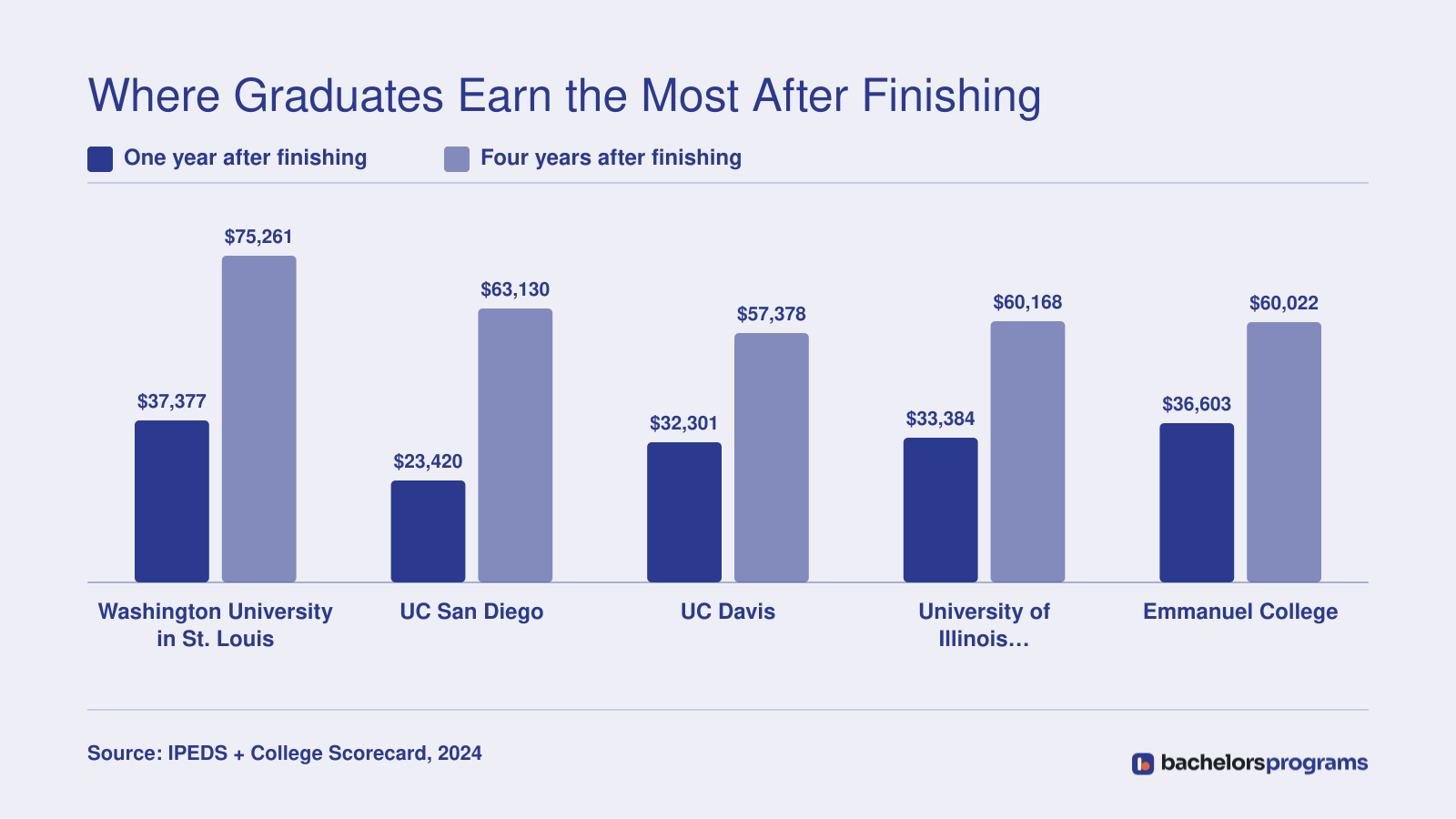
Washington University in St. Louis leads this group: its psychology graduates earn a median of $75,261 four years after finishing, roughly double their first-year figure. The chart compares program-level median earnings one year and four years after finishing for psychology-coded completers at the highest-earning schools here. These are early-career figures, and many graduates go on to graduate school, which pulls early medians down.
Developmental Psychology vs. Child Development, Human Development and Educational Psychology
Child psychology is usually a concentration or informal label, not a separate accredited bachelor's degree. Developmental psychology covers the full lifespan, from infancy through older adulthood. If a school has no standalone major, a psychology BA or BS with a developmental concentration is a sensible alternative, especially when you want the broad research and statistics core of a psychology department.
| Factor | Developmental Psychology | Child Development | Human Development | Educational Psychology |
|---|---|---|---|---|
| Academic home | Usually a psychology department | Applied human sciences or education college (Eastern Kentucky: School of Applied Human Sciences) | Human sciences college (Iowa State: Human Development and Family Studies) | Usually a college of education |
| Core coursework focus | Cognitive, social and emotional change across the lifespan | Birth through early childhood, guidance, play, observation, parent-child relationships | Infancy through adulthood, plus family and societal issues | Learning, motivation, teaching and assessment |
| Research methods and statistics | Typically the heaviest emphasis, as part of a psychology core | Observation and assessment courses; confirm the statistics requirement in the catalog | Varies by program; confirm in the catalog | Often includes measurement and assessment; statistics varies |
| Typical fieldwork | Varies; research lab or internship options are common | Practicum of 3 to 6 credits (Eastern Kentucky), plus an early childhood practitioner practicum | Child development practicum, field experiences and an 8 to 9 credit internship (Iowa State) | Varies; often classroom or school-based placements |
| Best-fit careers | Research support, human services, entry roles in child and family settings | Early childhood programs, children's services, family support | Family life education, community and care settings | Education support, learning and training roles |
| Strength as further-study preparation | Strongest for psychology-based paths | Good for education, social work and family services paths | Good for family science, counseling and social work paths | Good for education-related paths |
What Accredited Developmental Psychology Degree Programs Expect From Applicants
Accreditation and admission standards for a bachelor's degree in developmental psychology are set by each school, not by one national body. Use this checklist to confirm a program's standing and your own readiness before you apply.
- Institutional accreditationChoose a school accredited by an agency recognized by the U.S. Department of Education or CHEA. Graduate programs often treat a bachelor's degree from a recognized institution as a threshold requirement, though it never guarantees admission.
- APA accreditation applies to doctoral programsAPA's Commission on Accreditation accredits doctoral programs in clinical, counseling and school psychology, not bachelor's or master's programs. Undergraduate programs may follow APA's Guidelines for the Undergraduate Psychology Major, which set five goals and are not an accreditation process.
- GPA and courseworkNo nationwide GPA minimum exists. Admitted students' averages often run above a school's published floor, so check each program's current admissions page, including whether it is test-optional.
- Transfer creditThe receiving college decides which credits count. Expect official transcripts, minimum grades such as C or better and course-equivalency reviews for introductory psychology and statistics.
- Verify before you enrollLook up the school in the Department of Education or CHEA databases. Then ask how online or out-of-state credits apply to the major, since recency and residency rules can limit what transfers.
Related Articles
What You Can Do With a Developmental Psychology Degree: Jobs and BLS Pay
A bachelor's degree in developmental psychology leads most directly to social science research assistant roles, which the U.S. Bureau of Labor Statistics puts at a median annual wage of $61,990 as of May 2025, with a bachelor's degree as the typical entry-level credential.
Roles Where a Bachelor's Is the Standard
- Social science research assistants: Bachelor's degree typical. Median annual wage of $61,990 (May 2025). A bachelor's alone is enough here, and the Bureau lists no related work experience or on-the-job training. These positions sit in university labs, research centers and policy organizations studying child and family development.
- Social and community service managers: Bachelor's degree typical. Median annual wage of $80,390 (May 2025). Not always enough on its own, since some positions also ask for a master's degree and related work experience.
Roles That Hire Below or Above the Bachelor's
- Social and human service assistants: A high school diploma is typical, so a bachelor's exceeds the minimum and some employers prefer it. Median annual wage of $45,930 (May 2025). This is the most common entry point into direct service work, and it is where many graduates spend their first year or two before moving up.
Other titles that draw on developmental psychology sit at different points on the training timeline. Early intervention and case management roles commonly hire at the bachelor's level, child life specialists usually pair a bachelor's with a certification, and preschool teaching hires at the bachelor's level in many settings.
The graduate-level boundary is clear. Counseling and clinical practice require a master's or doctorate plus state licensure, and school psychology requires graduate training and a credential. A bachelor's degree in developmental psychology gets you into human services and research work now and sets up the graduate path later.
Demand tracks public spending on early childhood programs, school-based services and community mental health, so openings vary by region and by how well a program is tied to local agencies.
Entry-Level Pay Snapshot for Human Services Roles
Many graduates with a bachelor's degree in developmental psychology start in human services, supporting case managers, family programs and community agencies.
Questions to Ask Yourself
Can undergraduates join faculty developmental research labs, and how early?
Does the online or hybrid option include a supervised practicum I can complete near home?
How many of last year's graduates went straight into graduate programs in school psychology, child life, or counseling?
Is the bachelor's degree in developmental psychology offered fully online, and does the diploma or transcript note the format?
Developmental Psychology programs by state
Developmental Psychology Degree Questions, Answered
These answers cover the questions prospective students ask most about a bachelor's degree in developmental psychology. Credential rules for child life and early intervention change, so confirm current requirements with the certifying body or your state before you commit to a program.
Is developmental psychology the same as child psychology?
Can you earn a developmental psychology bachelor's degree fully online?
How much does a developmental psychology degree cost after financial aid?
Do graduate programs prefer a psychology major over a developmental psychology concentration?
Can you become a certified child life specialist with only a bachelor's degree?
Is a BA or a BS better for developmental psychology?
Can you work in early intervention with a bachelor's in developmental psychology?
Which community college courses usually transfer into a developmental psychology major?
Compare Developmental Psychology programs on the data that matters
Explore more Psychology majors or browse every field of study.
All Psychology programs Browse every field of study