Best Child Psychology Degree Programs
Compare 15 accredited Child Psychology programs at 13 colleges, with net price after aid, graduation rates, earnings and debt from IPEDS and the U.S. College Scorecard.
Does a bachelor's degree in child psychology make you a child psychologist? No. Licensure requires graduate training and supervised clinical hours, so this degree is a starting credential, and the programs here are undergraduate only.
It does qualify you for entry-level work in child and family services: behavior technician, early intervention support, school-based mental health aide. Cost shapes the decision too. Average cost after grants and scholarships ranges from $10,154 at the University of North Florida to $36,708 at Southern New Hampshire University.
The roles with the most clinical autonomy and the highest pay still require a graduate degree, so which bachelor's you choose depends partly on what comes next.
Key Points
- University of North Florida child psychology graduates carried median debt of $16,200.
- Clinical and counseling psychologists earned a $100,580 median in May 2025.
- Course lists reveal more than major titles, which vary between campuses.
10 Top-Rated Colleges for a Bachelor's Degree in Child Psychology
A bachelor's degree in child psychology comes in more than one shape, and this group of ten reflects that: several programs are fully online, several are campus-based, and a few run in both formats. Cost varies just as widely, with the lowest average net prices here near $10,000 and the highest past $30,000. On each card, the graduation rate is the institution-wide figure covering all undergraduates rather than the child psychology program alone, and the net price is an approximate average after aid for first-year, full-time students.
University of North Florida
#1Jacksonville, FL · $10,000 – $15,000/yr (est.)
Best for: Florida residents seeking research-intensive child coursework
A public university in Jacksonville, North Florida runs one of the more thoroughly child-focused psychology majors in this group, with dedicated coursework in advanced child and adolescent psychology and childhood psychopathology rather than a single elective. The research methods sequence is demanding, requiring a B or better to continue, and the required practicum or research elective has to center on children or adolescents. Florida residents pay a much lower rate than out-of-state students, so the cost picture here turns heavily on residency.
- 120 total credit hours, including 48 upper-division credits
- 12 prerequisite credits, with grades of C or above required
- B or better required in the research methods sequence and lab
- 12 credits of experimental psychology courses
- Practicum or research elective must focus on children or teens
- Coursework in advanced child psychology and childhood psychopathology
- Honors research counts toward major electives
Saint Mary's College of California
#2Moraga, CA · ~$30,000/yr (est.)
Best for: Aspiring child life specialists
A private liberal arts college in Moraga, California, Saint Mary's pairs psychology coursework with small, discussion-based classes and hands-on research. The Child/Adolescent Development concentration blends psychological theory, child development, and cognitive science, and steers students toward applied roles such as child life specialist, early intervention specialist, and school-based mental health aide. Its East Bay location puts schools, child-service agencies, and community organizations within reach for fieldwork and internships.
- Concentration blends psychological theory, child development, and cognitive science
- Small, discussion-rooted classes
- Directed laboratory and field research opportunities
- Internships and independent study available
- Prepares students for child life specialist roles
- Also prepares early intervention specialists and behavior technicians
- Scholarships and financial aid available
Cornerstone University
#3Grand Rapids, MI · $20,000 – $25,000/yr (est.)
Best for: Transfer students with prior college credit
A private Christian university in Grand Rapids, Michigan, Cornerstone shapes its psychology major around counseling preparation, with a track built specifically for students heading into work with children and adolescents. Courses such as Child and Adolescent Psychology, Interviewing and Counseling, and Family Life Cycle pair theory with applied technique, and graduates move into mental health services, case management, school-based support, or graduate study in counseling and social work. The program runs on campus or fully online, and faculty integrate a Christian worldview across the curriculum.
- Courses include Child & Adolescent Psychology and Interviewing & Counseling
- Family Life Cycle course covers development across the lifespan
- Available on campus or fully online
- Two start dates per year, spring and fall
- Transfer up to 75% of degree credits
- $0 application fee
- Three concentration options within the psychology major
- Faith-driven faculty integrate a Christian worldview
Bay Path University
#4Longmeadow, MA · $14,000/yr (est. net price)
A private university in Longmeadow, Massachusetts, Bay Path delivers its child psychology major both on campus and online, and both routes build in supervised field experience. Students study physical, intellectual, emotional, social, and moral growth from infancy through adolescence, along with diagnostic report writing, behavioral observation, and early intervention strategies. A double major option and a defined pathway into Bay Path graduate programs give students room to extend the degree without starting over.
- Covers development from infancy through adolescence
- Includes diagnostic report writing and behavioral observation
- Internship with community partners
- Coursework in early intervention strategies
- Family dynamics and educational influences covered
- Double major option available
- Seamless pathway into Bay Path graduate programs
- 120 total credit hours
- Asynchronous online classes
- 7-week accelerated courses
- Accepts up to 90 transfer credits
- One-on-one faculty instruction
- Curriculum aligned with national standards
Southern New Hampshire University
#5Manchester, NH · $37,000/yr (est. net price)
Southern New Hampshire University delivers its psychology degrees online in 8-week terms with six start dates a year, which suits students who need to keep working while enrolled. The child and adolescent development concentration adds four specialized courses on social development, disorders of childhood, and counseling techniques on top of a broad psychology foundation. Transfer credit is generous at up to 90 credits, and no entrance exam or test scores are required for admission.
- Four specialized courses in child and adolescent development
- Topics include social development and disorders of childhood
- Counseling techniques course included
- 8-week online terms with six start dates per year
- Transfer up to 90 credits
- No entrance exam or test scores required
- $0 application fee
- 120 total credit hours across 40 courses
East Tennessee State University
#6Johnson City, TN · ~$16,000/yr (est.)
A public university in Johnson City, East Tennessee, ETSU houses its child psychology concentration inside the psychology B.A. and supplements it with early childhood education coursework. Students take psychosocial and cognitive growth, child psychopathology, and language development, plus training in observation, assessment, and program planning for young children. The concentration also satisfies the requirements of the early childhood development minor, so the degree carries an extra credential without adding credits.
- Core courses in psychosocial and cognitive growth
- Includes child psychopathology and language development
- Early childhood education courses supplement the major
- Training in observation, assessment, and program development
- Concentration satisfies the Early Childhood Development minor
- 120 total credit hours; no minor required
- Major field test required for graduation
- Advising through the CASE center
Liberty University
#7Lynchburg, VA · ~$29,000/yr (est.)
A private Christian university in Lynchburg, Virginia, Liberty has run online distance learning since 1985 and delivers this developmental psychology degree fully asynchronously in 8-week terms with eight start dates a year. Coursework includes psychology of childhood, social psychology, and a course connecting psychology with Christian thought. Electronic textbooks come at no additional cost, military students are billed at a separate per-credit rate, and students can transfer up to three quarters of the degree total.
- 120 credit hours delivered fully online
- 8-week courses with eight start dates a year
- Asynchronous online classes
- Coursework in psychology of childhood and social psychology
- Psychology and Christianity course included
- Transfer up to 75% of the degree total
- Electronic textbooks at no extra cost
- Military students billed a separate per-credit rate
Walden University
#8Minneapolis, MN · $34,000/yr (est. net price)
Walden University, based in Minneapolis, is an online institution built for working adults, and its psychology bachelor's uses quarter credits on a timeline of roughly 48 months. The child and adolescent development concentration sits alongside coursework in developmental psychopathology, cognitive psychology, and cross-cultural psychology, aimed at students who want to support children and families in individual and family services, schools, or advocacy organizations. Concentrations add no extra credits or cost, and up to 135 transfer credits are accepted.
- 181 quarter credits; about 48 months to finish
- Asynchronous online classes
- No entrance exam; test optional
- Up to 135 transfer credits accepted
- Coursework in developmental psychopathology and cross-cultural psychology
- Concentrations add no extra credits or cost
- Career-focused micro-credentials available
- Curriculum aligned with APA undergraduate psychology standards
Carlow University
#9Pittsburgh, PA · $20,000 – $25,000/yr (est.)
A private university in Pittsburgh, Carlow offers its child development concentration in psychology on campus and online, and both versions keep class sizes small. Students can complete an internship at a local facility, collaborate with faculty on research, and, through an accelerated option, begin master's coursework while still an undergraduate. A three-year completion track and a capstone requirement give the degree a clear finish line.
- Courses in child psychology and adolescent psychology
- Capstone required
- Internship at a local facility
- Faculty-led research opportunities for undergraduates
- Accelerated option allows master's coursework as an undergraduate
- Three-year degree completion track
- Transfer up to 90 credits
- $0 application fee
- 120 total credit hours
- Asynchronous online classes
- Trauma-informed skills built into the curriculum
- Child development courses grounded in theory and research
- Advocacy training for vulnerable populations
- Small class sizes with personalized support
University of Massachusetts Global
#10Aliso Viejo, CA · ~$33,000/yr (est.)
University of Massachusetts Global, headquartered in Aliso Viejo, California, delivers its psychology degree online and designs the child psychology concentration for students drawn to developmental challenges, including autism. Coursework covers child development, pediatric neuropsychology, applied behavior analysis, and behavior enhancement strategies, moving from biological through sociocultural perspectives. A senior capstone applies psychological research to real issues affecting children, and the program sits within a psychology major offering five concentration options.
- Coursework in child development and pediatric neuropsychology
- Applied behavior analysis course included
- Focus on children with developmental challenges such as autism
- Covers biological through sociocultural perspectives
- Senior capstone applies research to issues affecting children
- Fully online format
- Five concentration options within the psychology major
Cost & outcomes by school
Federal data for the highest-earning Child Psychology programs, independent of the ranking above. Earnings are this field's bachelor's graduates four years after completing where the Scorecard reports them, else the school's undergraduate median.
| School | Net price / yr | Grad rate | Earnings | Debt | Grads/yr | Format |
|---|---|---|---|---|---|---|
| Saint Mary's College of California CA | $30,378 | 70% | $78,812 | $23,691 | 7 | Campus |
| University of Massachusetts Global CA | $32,654 | 43% | $65,703 | $24,276 | — | Online |
| McPherson College KS | $26,441 | 34% | $52,084 | $25,242 | 3 | Campus |
| Carlow University PA | $20,786 | 60% | $51,051 | $25,500 | — | Hybrid |
| Southern New Hampshire University NH | $36,708 | 43% | $50,318 | $21,082 | — | Online |
| Bay Path University MA | $14,271 | 44% | $47,544 | $26,447 | 22 | Campus |
| Cornerstone University MI | $20,301 | 62% | $47,314 | $25,000 | 7 | Hybrid |
| University of North Florida FL | $10,154 | 69% | $45,521 | $16,200 | 355 | Campus |
| East Tennessee State University TN | $15,983 | 53% | $44,859 | $19,442 | — | Hybrid |
| Liberty University VA | $29,357 | 65% | $44,813 | $24,500 | — | Online |
| Walden University MN | $33,817 | — | $42,810 | $20,834 | — | Online |
| Crestpoint University AZ | $15,670 | 33% | $42,269 | $24,853 | — | Online |
Sources: U.S. Department of Education. Net price, graduation rate, earnings and debt: College Scorecard (earnings and debt for this field's bachelor's graduates where reported, else school-wide); graduates: IPEDS. A dash means no figure is reported.
Cost, debt & payoff
Median earnings of this field's bachelor's graduates (4 yrs after completing, else the school's undergraduate median) vs. their median federal loan debt · U.S. College Scorecard
Across these programs the median graduate earns about $47,544 and finishes with roughly $24,853 in debt — a ratio that clears a common rule of thumb (keep debt below first-year salary). Net price and debt vary widely school to school, so check the per-school figures in the table above before you shortlist.
What Earned These Schools a Spot: Our Scoring Method
The College Scorecard publishes median earnings for individual bachelor's degree programs, so a bachelor's degree in child psychology can be judged by its own graduates rather than by the college's overall reputation. That federal data is the first filter here, not a brochure claim.
What the figures cover
For each program, the page uses program-level outcomes where the government publishes them: earnings one to five years after completion and median debt at graduation. Those figures sit beside institution-wide measures, including 10-year earnings, graduation rate, and retention rate. Average cost after aid, completions count, and format flexibility round out the picture. Completions show whether a program actually graduates students, not just enrolls them; flexibility matters if you are balancing coursework with a job or family.
Every figure is labeled, because the two levels answer different questions. A program-level earnings number describes child psychology graduates; a 10-year institution figure describes the whole college. Mixing them without labels would mislead.
What the data cannot tell you
Faculty quality, specific internship placements, and admissions difficulty are not captured in federal outcome data. Check those directly with each school: ask who teaches the child development courses, where recent students completed fieldwork, and what the actual acceptance profile looks like. A shortlist built on verified numbers should still leave room for your own questions.
Most Affordable Child Psychology Degree Programs by Net Price
Net price, drawn from 2024 IPEDS and College Scorecard data from the U.S. Department of Education, is the average amount students actually paid after grants and scholarships, so your own cost could land higher or lower depending on family income and the aid you qualify for. Median debt is the federal loan balance held at graduation by each child psychology program's own completers (2022 Scorecard outcomes data); Crestpoint University has no program-level debt figure, so that cell is left as N/A. Pell grant share works as an access signal: Crestpoint's 83.2% and Bay Path's 67.1% show a large share of lower-income students, while the University of North Florida pairs a 61.4% Pell share with the lowest net price here at $10,154.
| School | Location | Format | Average Net Price | In-State Tuition & Fees | Out-of-State Tuition & Fees | Median Debt at Graduation (Program Completers) | Pell Grant Share |
|---|---|---|---|---|---|---|---|
| University of North Florida | Jacksonville, FL | Campus | $10,154 | $6,389 | $20,793 | $16,200 | 61.4% |
| Bay Path University | Longmeadow, MA | Campus | $14,271 | $38,302 | $38,302 | $26,447 | 67.1% |
| Crestpoint University | Phoenix, AZ | Online | $15,670 | $7,995 | $7,995 | N/A | 83.2% |
How Does Child Psychology Debt Compare With Early-Career Pay?
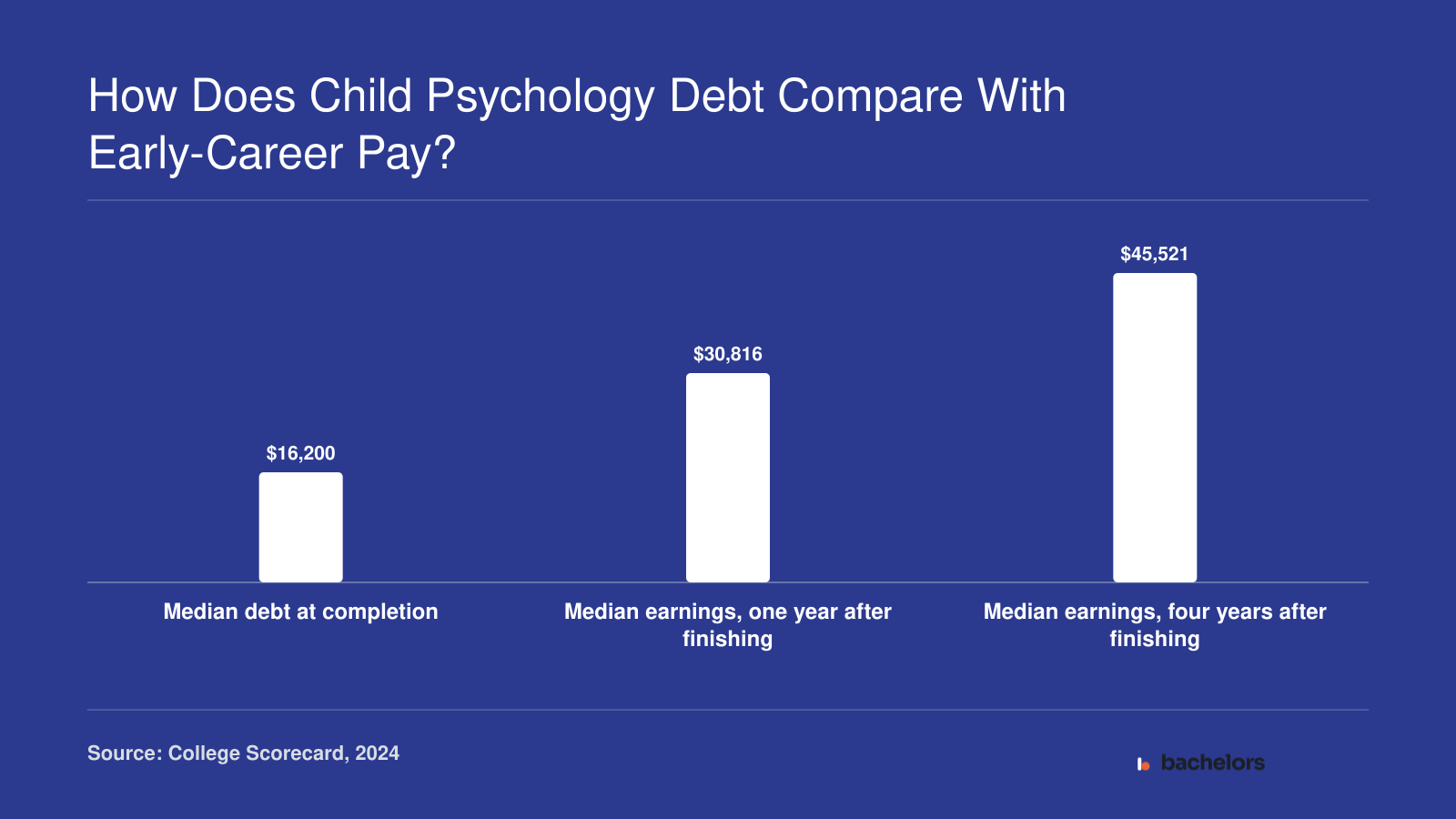
Among the high-ROI schools here, the University of North Florida is the one where the federal data publishes both debt and earnings for its child psychology bachelor's graduates. Graduates finished with a median of $16,200 in debt and earned a median of $30,816 one year after finishing, rising to $45,521 four years after finishing. These schools are ordered by an institution-wide proxy, not each program's own return: median earnings 10 years after entry for all of a school's students divided by the median debt of all its graduates (about 3.6 at North Florida), so read the ranking as a campus-level signal.
What a Child Psychology Major Covers, and How It Differs From Child Development
Major titles vary from one campus to the next, so the name on the diploma tells you less than the course list does. Catalogs use "major," "concentration," and "emphasis" for similar content, and no single national curriculum exists.
Typical Core Coursework
Most programs build around a similar set of courses, though titles and sequencing vary:
- Developmental psychology: how children grow cognitively, socially, and emotionally.
- Abnormal child psychology: behavioral and emotional disorders in childhood.
- Research methods and statistics: the backbone of the degree. Eastern Washington University, for example, requires Psychological Statistics and Tests and Measurements.1
- Cognition and learning: memory, language, and how children acquire skills.
- Family systems: how households, peers, and schools shape behavior.
- Assessment basics: an introduction to testing and observation tools.
How It Differs From Neighboring Majors
Child development is the more applied cousin. Missouri Western State University houses its B.S. in Child Development in Business, Professional Studies, and Education, and pairs PSY courses with EDU courses aimed at working with children and families.2 Developmental psychology is usually research-oriented and spans more of life. The University of Minnesota's B.A. runs through its Institute of Child Development and covers prenatal to maturity3, while the University of San Diego folds developmental psychology into a broad B.A. in Psychology with a life span scope.4 General psychology, as at Boston College, is the widest option, with child courses typically sitting among the electives.5
Where Fieldwork Fits
Internships and field placements usually appear in the junior or senior year, in schools, clinics, and childcare or social service agencies. Requirements differ widely. Minnesota lists a one-semester field study, and Eastern Washington requires 4 credits of field study, while other programs offer placements only as electives.
The Practical Takeaway
Graduate admissions committees care more about research experience and a solid core of psychology courses than the exact major title. George Mason University notes that its developmental psychology concentration can prepare students for graduate study6 in areas such as school psychology or clinical child psychology. Compare course lists, ask about lab opportunities, and treat the label as secondary.
Related Articles
Online vs. Campus Child Psychology Degrees: Fieldwork, Pace, and Transfer Credit
The schools ranked here come in online, campus, and mixed formats, and the format shapes your schedule, your credit transfer options, and the hands-on experience you leave with. Online programs offer flexibility, while campus programs make research labs and faculty mentoring easier to reach. That research access matters most if you plan to apply to graduate school later.
| What to compare | Online format | On-campus format |
|---|---|---|
| Pacing | Asynchronous. Southern New Hampshire University lists no set class times and 24/7 classroom access. Liberty University lists no set login times. | Scheduled meetings at fixed days and times, with in-person attendance expected. |
| Term length | Often shorter terms. Liberty offers 8-week courses with eight start dates per year. | Usually semester-based, with fall and spring start points. |
| Transfer credit | Often generous. Liberty accepts up to 75% of the degree in transfer. SNHU's online bachelor's programs total 120 credits. | Varies by school. Check each registrar's cap and residency rules before you apply. |
| Fieldwork and practicum | Usually arranged locally. Liberty notes that certain practicums, internships, or field experiences may be excluded. Its child life track offers PSYC 499 Internship with field shadowing, but the source does not say it is required. | Placements are often set up through campus partners such as schools, clinics, and child care centers, with supervision from faculty. |
| Research labs and mentoring | Limited lab access. Mentoring happens by email, video, or discussion boards. | Direct access to faculty labs, research assistant roles, and in-person mentoring. Graduate programs often look for this experience. |
| Cost considerations | No relocation or housing costs, and you can keep working. Compare per-credit pricing and fees. | Housing, transportation, and campus fees add to the bill, so compare net price rather than sticker price. |
Questions to Ask Yourself
Are you aiming for a PhD, PsyD, or school psychology specialist degree?
Do you need an online format, and can you arrange your own field placement?
How many community college or prior credits do you have, and will this school take them?
Would a general psychology major with a child development minor open more doors than a narrowly titled major?
Accredited Child Psychology Degree Programs: Regional vs. APA Approval
Institutional accreditation is a quality review of an entire college or university, carried out by a voluntary, nongovernmental agency that the U.S. Department of Education recognizes. The Department does not accredit schools or individual programs itself. It approves the accrediting agencies. For a bachelor's degree in child psychology, this institution-level approval is the credential that counts.
It matters for three practical reasons. Federal student aid is available only at schools accredited by a recognized agency. Accreditation also shapes whether another college will accept your transfer credits. Finally, graduate admissions offices expect an undergraduate degree from an accredited institution.
Why APA Accreditation Is a Red Flag Here
The American Psychological Association's Commission on Accreditation reviews doctoral programs, internships, and postdoctoral residencies. It does not accredit bachelor's programs. If an undergraduate program advertises "APA accreditation," treat that as a warning sign and ask the school what it actually means. No bachelor's degree needs APA approval to be legitimate.
How to Verify a School
- Department of Education: Search the school in the Database of Accredited Postsecondary Institutions and Programs (DAPIP) and confirm its accreditor is recognized.
- CHEA directory: The Council for Higher Education Accreditation lists institutions and recognized accrediting organizations, which gives you a second check.
Other Quality Checks
Accreditation sets a floor, not a ranking. To compare accredited options, look at:
- Faculty research: Are professors actively publishing on child and adolescent development?
- Undergraduate research: Can you join a lab or complete a thesis before graduating?
- Internship partnerships: Does the school place students in schools, clinics, or child welfare agencies?
What Licensed Psychologists Earn After Graduate Training
A bachelor's degree in child psychology is the first step toward licensure. BLS figures for May 2025 show clinical and counseling psychologists earned a median of $100,580 and school psychologists $95,990.
Child Psychology programs by state
Child Psychology Degree Questions, Answered
These answers cover the questions students ask most often when comparing a bachelor's degree in child psychology. Details such as licensure, transfer limits, and certification rules can vary by state and school, so confirm specifics with each program.
What is the best college for child psychology?
Can you get a bachelor's degree in child psychology online?
What jobs can I get with only a bachelor's in child psychology?
How long does it take to become a child psychologist?
Is a bachelor's in child psychology worth the tuition?
Can I transfer community college credits into a child psychology bachelor's program?
Do I need a child psychology major to get into a clinical or school psychology graduate program?
Can I work as a Registered Behavior Technician with a child psychology degree?
Compare Child Psychology programs on the data that matters
Explore more Psychology majors or browse every field of study.
All Psychology programs Browse every field of study