Best Psychology Schools in Rhode Island
Compare 9 accredited General Psychology programs in Rhode Island, with net price after aid, graduation rates, earnings and debt from IPEDS and the U.S. College Scorecard.
A bachelor's degree in psychology in Rhode Island can cost a resident $16,942 a year in tuition and fees at the University of Rhode Island, or $63,550 at Providence College. Schools award it as a Bachelor of Science (B.S.) or Bachelor of Arts (B.A.) in Psychology, and the label matters less than the price gap.
Campus programs dominate, with one online option at Johnson & Wales University, and cost, graduation rate and earnings sit side by side for each school. A low sticker price means little if few students finish.
Earnings for psychology graduates here cluster much closer together than tuition does, so debt often decides which program pays off.
Key Points
- Providence College psychology graduates earn a $69,424 median five years out.
- University of Rhode Island tuition: $16,942 in-state, $37,146 out-of-state.
- Johnson & Wales University offers a fully online B.S. in Psychology.
Best Schools for a Bachelor's Degree in Psychology in Rhode Island
The schools below appear in the order our editors placed them for Rhode Island psychology bachelor's study. Use the cards to compare degree structure, campus setting, and program focus, along with institution-wide graduation rates that range from 48% to 96% across the group.
University of Rhode Island
#1Kingston, RI · ~$21,000/yr (est.)
Best for: Students wanting B.A. and B.S. options
The University of Rhode Island is the state's flagship public campus and the only Rhode Island school in this group to award both a B.A. and a B.S. in Psychology. The B.A. leaves room for internships and a broader liberal arts mix, while the B.S. adds a stronger math and research methods core and requires hands-on research. The university reports an institution-wide graduation rate of 73%, and its traditional residential setting supports full-time campus study.
- B.A. and B.S. degree options
- Flexible B.A. curriculum with room for other disciplines
- Internships and research apprenticeships
- Math and research methods emphasis in the B.S.
- Hands-on research experience required
- Prepares for psychology careers and advanced graduate study
Rhode Island College
#2Providence, RI · $9,000/yr (est. net price)
Best for: Transfer students using statewide admission agreements
Rhode Island College is a public institution with a psychology B.A. that builds around research methods, statistics, and broad coverage of brain and cognitive science, human development, and health and well-being. The department offers minors in psychology and behavioral neuroscience, and eligible students can pursue an accelerated B.A.-to-M.A. path. The college reports an institution-wide graduation rate of 48%, and statewide transfer agreements give community college students a clear route into the major.
- Accelerated B.A.-to-M.A. option
- Minors in psychology and behavioral neuroscience
- Free tuition for eligible Rhode Island students in junior and senior years
- Northeast Neighbors tuition discount
- Coursework in research methods, statistics, personality, social, developmental, and experimental psychology
- Covers brain and cognitive sciences, human development, and health and well-being
Bryant University
#3Smithfield, RI · ~$41,000/yr (est.)
Best for: Business-minded majors adding psychology
Bryant University awards a Bachelor of Science with a major in Psychology through its College of Health and Behavioral Sciences. The 120-credit degree requires a capstone, a business administration minor, and coursework across five foundational perspectives, which gives the program an applied, business-adjacent feel. The university reports an institution-wide graduation rate of 80%, and the required internship or senior research seminar adds a professional component.
- 120 total credit hours
- 36 credits minimum for the major
- Capstone required
- Business administration minor required
- Coursework across five foundational perspectives
- Three courses must be at the 400 level
- Internship requires at least 120 supervised hours
- Study at Oxford's Hertford College
Providence College
#4Providence, RI · ~$49,000/yr (est.)
Providence College offers a Bachelor of Arts in General Psychology built around research methods and three breadth areas: brain, mind, and behavior; clinical and applied psychology; and sociocultural and developmental processes. Advanced seminars and a laboratory course round out a curriculum that emphasizes critical thinking and close faculty mentorship. The college reports an institution-wide graduation rate of 86%, and a neuroscience certificate is available for added depth.
- 35 total credit hours
- 11 total courses
- Breadth areas: brain, mind, behavior; clinical and applied; sociocultural
- Advanced seminars and laboratory courses
- Foundations in methods and statistics
- Neuroscience certificate available through 2027
Salve Regina University
#5Newport, RI · ~$37,000/yr (est.)
Salve Regina University offers a campus-based Psychology B.A. that follows APA guidelines and covers human development, social psychology, cognitive processes, and related topics. Students can pursue independent research, fieldwork, and an accelerated bachelor's-to-master's program in Behavior Analysis, with early course planning recommended. The university reports an institution-wide graduation rate of 77%.
- APA guideline curriculum
- Independent research opportunities
- Fieldwork experiences available
- Accelerated bachelor's/master's in Behavior Analysis
- 3.30 GPA requirement for accelerated program
- 150 total credits for accelerated program
- Capstone course required
- Study abroad encouraged
Roger Williams University
#6Bristol, RI · ~$38,000/yr (est.)
Roger Williams University offers a psychology bachelor's degree with an empirical approach to human behavior, covering cognitive, social, developmental, and abnormal psychology with attention to human diversity. The department has 13 full-time PhD faculty and encourages undergraduates to join faculty research projects. The university reports an institution-wide graduation rate of 69%, and psychology is available as both a major and a minor.
- 13 full-time PhD faculty
- Undergraduate research opportunities
- Psychology major and minor offered
- Focus on human diversity
- Students involved in faculty research
- Coursework in cognitive, social, developmental, and abnormal psychology
- Empirical approach to theories and research
Brown University
#7Providence, RI · $25,000 – $30,000/yr (est.)
Brown University offers a psychology concentration with a strong scientific foundation in statistics, research methods, and five core areas of psychology. Students complete 12 courses, including laboratory work and a capstone, and the Sc.B. option adds five STEM courses for a deeper science focus. The university reports an institution-wide graduation rate of 96%, and an optional honors program supports faculty-mentored research.
- 12 total courses
- Capstone required
- Statistics and research methods training
- Five core areas including cognitive, social, developmental, and clinical psychology
- Sc.B. option adds five STEM courses
- Honors research program available
- Flexible electives across departments
Johnson & Wales University
#8Providence, RI · ~$20,000/yr (est.)
Johnson & Wales University awards an online Bachelor of Science in Psychology through its College of Arts & Sciences. The program covers abnormal and developmental psychology, neuropsychology and psychopharmacology, research methods and ethics, and electives in areas such as criminology and substance use disorders. Students complete an internship, directed experiential education, or undergraduate research experience, and courses run in 7- or 15-week terms.
- $495 per credit for online undergraduate tuition in 2026-27
- Fully online option
- 7- or 15-week course lengths
- Career Catalyst Scholarship: 20% tuition savings
- Transfer credit evaluations within 48 hours
- Internship, research, or experiential learning options
- Courses in abnormal and developmental psychology, neuropsychology and psychopharmacology
- Four-year completion for full-time students starting from the beginning
Cost & outcomes by school
Federal data for the highest-earning General Psychology programs, independent of the ranking above. Earnings are this field's bachelor's graduates four years after completing where the Scorecard reports them, else the school's undergraduate median.
| School | Net price / yr | Grad rate | Earnings | Debt | Grads/yr | Format |
|---|---|---|---|---|---|---|
| Brown University RI | $25,184 | 96% | $93,487 | $11,428 | — | Campus |
| Bryant University RI | $41,219 | 80% | $90,008 | $26,849 | 17 | Campus |
| Providence College RI | $48,523 | 86% | $63,746 | $27,000 | 113 | Campus |
| Salve Regina University RI | $36,967 | 77% | $61,121 | $27,000 | 62 | Campus |
| Roger Williams University RI | $37,999 | 69% | $57,212 | $27,000 | 68 | Campus |
| University of Rhode Island RI | $21,440 | 73% | $56,571 | $20,500 | 280 | Campus |
| Rhode Island College RI | $9,478 | 48% | $52,758 | $19,500 | 116 | Campus |
| Johnson & Wales University RI | $31,027 | 55% | $43,418 | $26,000 | 45 | Campus |
| Johnson & Wales University RI | $20,252 | — | $43,418 | $26,000 | 23 | Online |
Sources: U.S. Department of Education. Net price, graduation rate, earnings and debt: College Scorecard (earnings and debt for this field's bachelor's graduates where reported, else school-wide); graduates: IPEDS. A dash means no figure is reported.
Cost, debt & payoff
Median earnings of this field's bachelor's graduates (4 yrs after completing, else the school's undergraduate median) vs. their median federal loan debt · U.S. College Scorecard
Across these programs the median graduate earns about $57,212 and finishes with roughly $26,000 in debt — a ratio that clears a common rule of thumb (keep debt below first-year salary). Net price and debt vary widely school to school, so check the per-school figures in the table above before you shortlist.
Cheapest Rhode Island Schools for a Psychology Bachelor's Degree
Average net price is what full-time students actually paid after grants and scholarships, based on 2024 federal IPEDS and College Scorecard data, so your own bill will rise or fall with your family income and the aid you receive. Public schools lead on cost: Rhode Island College's average net price of $9,478 is less than half of any private school's in this group, and the University of Rhode Island comes in at $21,440. Private schools carry higher sticker prices, but aid narrows the gap sharply at Brown University, where tuition and fees of $71,412 drop to an average net price of $25,184. For a budget-conscious student, the biggest takeaway is the spread: Rhode Island College costs about $27,500 less per year on average than Salve Regina University, the most expensive option here.
| School | City | Sector | Average Net Price (After Aid) | In-State Tuition and Fees | Out-of-State Tuition and Fees | Graduation Rate |
|---|---|---|---|---|---|---|
| Rhode Island College | Providence | Public | $9,478 | $11,300 | $27,299 | 48% |
| Johnson & Wales University (online B.S.) | Providence | Private nonprofit | $20,252 | $13,365 | $13,365 | N/A |
| University of Rhode Island | Kingston | Public | $21,440 | $16,942 | $37,146 | 73% |
| Brown University | Providence | Private nonprofit | $25,184 | $71,412 | $71,412 | 96% |
| Salve Regina University | Newport | Private nonprofit | $36,967 | $50,100 | $50,100 | 77% |
B.A. vs. B.S. in Psychology at Rhode Island Schools
The real difference between a B.A. and a B.S. in psychology is breadth versus scientific rigor, and the University of Rhode Island shows that split more clearly than any other school here.
How the two degrees typically differ
A B.A. usually pairs psychology with liberal-arts breadth and often language study, leaving room for a second major or minor. A B.S. adds more math, natural science and research methods, aimed at lab work, data analysis and graduate or professional study.
URI's B.A. and B.S. side by side
Both URI degrees require 120 credits, general education and a 2.00 GPA.1 B.A. majors take at least 32 psychology credits (the 2026-2027 curriculum sheet lists 35 to 60 in the major). They start with PSY 113, PSY 200 and two of PSY 232, 235 or 254, then complete 30 upper-level credits for catalog years 2024 and later. Experiential learning can be research, a community placement, teaching assistance or a similar placement.
The B.S. is more prescriptive. The 2025-2026 sheet lists 41 major credits, two math courses (options run from MTH 107 to MTH 215), BIO 101/103 or BIO 110/103, and a writing course (WRT 104, 106 or 332). Required psychology work includes statistics (STA 307/308) and research methods. Students also complete two research-intensive courses totaling 6 credits with an average grade of at least C, chosen from options such as PSY 361, 384, 425 or 471. The experiential requirement is specifically research in PSY 496.1 URI positions the B.S. for graduate and professional preparation, medical school included.
Other schools here
Bryant and Johnson & Wales list their programs as a Bachelor of Science in psychology. Salve Regina lists a Bachelor of Arts with a behavior analysis concentration. Brown offers an Sc.B. option with STEM courses alongside its standard psychology concentration. Rhode Island College, Providence College and Roger Williams each list one psychology program with no separate B.A./B.S. split, so confirm details in the current catalog.
Rule of thumb
Choose the B.S. for research or science-heavy paths, and the B.A. for flexibility and double majors.
Rhode Island Psychology Bachelor's Graduates With the Highest Earnings
The University of Rhode Island has in-state tuition of $16,942 and the lowest median debt in this table ($20,500), and its graduates earn $52,822 five years after finishing, close to the figures for Salve Regina University and Roger Williams University. The takeaway: a higher price does not guarantee a proportionally higher paycheck, so compare five-year earnings against what you expect to borrow.
| School | Median earnings 1 year after finishing | Median earnings 5 years after finishing | Median program debt | Share earning above poverty line | Share employed 1 year after finishing |
|---|---|---|---|---|---|
| Providence College | $37,863 | $69,424 | $27,000 | 97% | 91% |
| Brown University | N/A | $63,062 | N/A | N/A | N/A |
| Salve Regina University | $35,096 | $53,926 | $27,000 | 92% | 91% |
| Roger Williams University | $32,289 | $53,224 | $27,000 | 90% | 98% |
| University of Rhode Island | $37,414 | $52,822 | $20,500 | 88% | 95% |
Related Articles
Online and Hybrid Psychology Bachelor's Options at Rhode Island Schools
Johnson & Wales University is the one school here that lists its psychology bachelor's as an online program. Its B.S. in Psychology, based in Providence, is described as a fully online option with 7- or 15-week courses, a published rate of $495 per credit, and transfer credit evaluations within 48 hours.
Campus-based programs
Every other school here lists a campus-based psychology program: the University of Rhode Island, Rhode Island College, Bryant University, Providence College, Salve Regina University, Roger Williams University and Brown University. URI's Bachelor of Arts and Bachelor of Science in Psychology are both listed as on-campus, 120-credit degrees for 2026-2027, and we could not verify an online or hybrid version of either.1
URI's undergraduate majors page also mentions an online Bachelor of Interdisciplinary Studies pathway for students with 45 or more college credits. That is a different degree, not a psychology major, so do not treat it as an online route into psychology.
We found no verified hybrid or degree-completion psychology track at the other campus-based schools. That reflects what their program pages show, so call admissions if you need flexibility.
What to ask before you assume
Online does not always mean the same thing at every school. Before you apply, ask:
- Residency: Whether out-of-state students can enroll, and whether any state-based aid or tuition rules apply to you.
- In-person requirements: Whether internships, labs, research or capstone work must be done on campus or can be completed near home.
- Tuition: Whether online tuition differs from campus tuition, and which fees apply to each.
- Transfer credit: How many credits count toward the psychology major, since that decides how much of the degree you still have to take.
Admissions Requirements for Rhode Island Psychology Bachelor's Programs
Test-optional admission has changed how students apply to Rhode Island colleges, but transfer credit is still the less visible hurdle into a psychology bachelor's program.
What Rhode Island College publishes
Rhode Island College gives transfer applicants a clear benchmark: 24 or more earned college credits in a diversified program require at least a 2.00 GPA.1 Initial admission is test-optional, and SAT or ACT scores are encouraged when they support the application.1 RIC accepts up to 90 regionally accredited college credits, generally for comparable courses completed with a C or better, and it maintains transfer and articulation agreements with the Community College of Rhode Island.1
The Joint Admission Program with CCRI can guarantee admission for students who enroll before completing 30 credits, earn the prescribed associate degree within five years of initial CCRI matriculation, hold at least a 2.4 cumulative GPA, and meet RIC's nonacademic requirements.
How selective the programs are
Acceptance rates and Pell Grant shares show the range. Brown University admits 5.4% of applicants, and 40.9% of its students receive Pell Grants. Providence College admits 50.9% with a 26.6% Pell share; Bryant University 65.5% and 28.2%; Salve Regina University 68.2% and 31.6%; University of Rhode Island 72.2% and 41.4%; Roger Williams University 87.7% and 27.5%; Rhode Island College 91.8% and 64.3%; Johnson & Wales University 91.0% and 61.7%. Those figures describe each incoming class overall, not the psychology department alone. We found no published policy to quote on first-year GPA cutoffs and test rules at the other schools, so confirm the current rule with each admissions office.
A transfer-credit tip for CCRI students
CCRI runs open admissions and does not require SAT scores, though it encourages them for placement.2 Its total transferred credits, including prior-learning credit, may not exceed 75% of the credits required for a degree, and program courses generally need a C- or better.3 Students planning a psychology bachelor's degree should ask both RIC and CCRI for a written credit evaluation before enrolling in upper-level psychology courses, then confirm that each comparable course meets the receiving school's grade rule. Bring the course syllabus, not just the transcript.
Cost of a Psychology Bachelor's Degree in Rhode Island
What you actually pay for a psychology bachelor's degree in Rhode Island is the price after aid, not the number on a tuition page. The two can sit far apart.
Sticker Price vs. Net Price
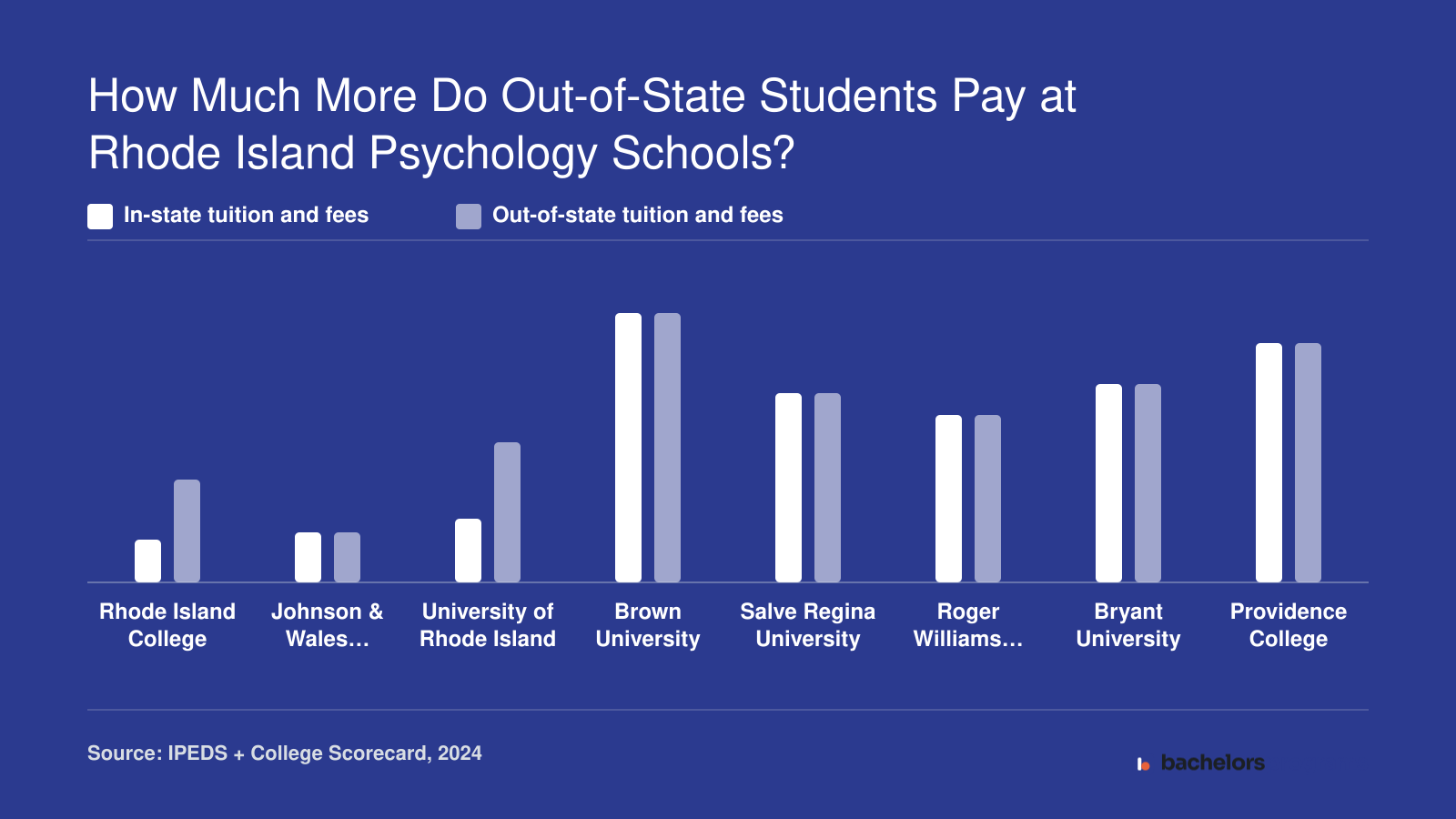
The public schools split their rates by residency. Rhode Island College lists $11,300 in tuition and fees for in-state students and $27,299 for out-of-state students. The University of Rhode Island lists $16,942 in-state and $37,146 out-of-state. Providence College ($63,550), Bryant University ($52,677) and Salve Regina University ($50,100) charge the same published rate to everyone.
Net price, the average a student pays after grants and scholarships, is a different number. Brown University's published price is above $71,000, yet its average net price is about $25,184, below URI's out-of-state sticker price. Rhode Island College averages $9,478 and URI $21,440. These are averages across aid recipients, so your own figure depends on family income and the aid you receive.
Rhode Island Aid Programs
RI Promise is a last-dollar award for the state's community college. It covers tuition and mandatory fees for up to two years after federal and other aid is applied.1 Students must enroll continuously full-time and keep a 2.5 GPA.1 Eligibility began with the high school class of 2017, and funding depends on annual state appropriation, so confirm current rules before you plan around it.
Rhode Island College advertises free tuition for eligible Rhode Island students through its Hope Scholarship. Check the school's financial aid office for current eligibility, award amounts and deadlines. The Rhode Island Office of the Postsecondary Commissioner oversees state grants and scholarships and can confirm this year's programs.
Residency rules matter too. A nonresident who attended an approved Rhode Island high school for three or more consecutive years and graduated from it may qualify for in-state tuition after filing an affidavit.2 Rhode Island College also charges in-state rates plus 50% to students from listed Massachusetts communities within 20 miles of Providence.3
Practical Ways to Lower the Bill
- File the FAFSA early: State and institutional aid can run out, so submit it as soon as it opens.
- Verify residency: Read the state residency policy before enrolling, since the in-state gap at URI exceeds $20,000 a year.
- Start at community college: RI Promise can cover the first two years, and you then transfer into a psychology bachelor's program. Confirm credit transfer first.
- Compare net price calculators: Run each school's calculator rather than judging by sticker price.
How Much More Do Out-of-State Students Pay at Rhode Island Psychology Schools?
These are published tuition and fees before any financial aid. The University of Rhode Island has the widest residency gap: out-of-state students pay $37,146, compared with $16,942 for Rhode Island residents, a difference of $20,204. Rhode Island College follows at $11,300 in-state versus $27,299 out-of-state, while private schools such as Brown, Providence College, Bryant and Johnson & Wales charge a single rate regardless of where you live.
Psychology Careers and Licensure in Rhode Island With a Bachelor's Degree
What can you actually do in Rhode Island with a bachelor's degree in psychology? Mostly people-focused and analysis-focused jobs outside licensed clinical practice.
Realistic Bachelor's-Level Roles
- Human resources specialist: The national median was $75,940 per year ($36.51 per hour) in May 2025, according to the Bureau of Labor Statistics. The latest Rhode Island figure in the sources I reviewed is older: $74,340 in May 2019.2
- Market research analyst or marketing specialist: Rhode Island's May 2023 median was $77,760, across about 3,240 jobs in the state.1
- Social and human service assistant or case manager: These are common entry points for psychology majors. Check the Rhode Island Department of Labor and Training for current local wages, since I could not confirm a state figure.
- Behavioral technician: Usually an entry-level role in clinics, schools or home-based programs. Pay varies by employer and certification, so confirm it in current postings.
These medians cover workers at every experience level, and the HR and market research figures come from different years and geographies. Treat them as rough guides, not promises.
How This Lines Up With Program Earnings
The Scorecard earnings in the table above measure graduates soon after completion, so they generally sit below occupational medians that include experienced workers. A gap between the two is normal. The better question is whether a school's graduates are moving into roles like these.
What the Bachelor's Alone Does Not License
A bachelor's degree in psychology does not qualify you to practice as a psychologist, a licensed mental health counselor (LMHC) or a school psychologist in Rhode Island. Nationally, psychologists need an advanced degree, supervised experience and an examination, and school psychologists typically need a master's degree in school psychology.3 LMHC licensure also requires graduate-level training and supervised practice. Confirm current Rhode Island requirements with the state Department of Health before planning that path, because rules and exceptions can change.
A Practical Next Step
Build experience while you are still enrolled. Look for:
- Internships in human services agencies, HR offices or marketing teams.
- Research assistantships with psychology faculty, which build data skills that market research employers value.
- A psychology club or honor society, which can lead to mentors and local contacts.
Start in your sophomore year, so you have two or three experiences to show by graduation.
Compare General Psychology programs on the data that matters
Explore more Psychology majors or browse every field of study.
All Psychology programs Browse every field of study