Best Health Psychology Degree Programs
Compare 17 accredited Health Psychology programs at 16 colleges, with net price after aid, graduation rates, earnings and debt from IPEDS and the U.S. College Scorecard.

Sticker tuition for a health psychology bachelor's degree runs from $4,800 a year at Brigham Young University-Idaho to $48,550 at Emmanuel College, a tenfold spread within a single field.
Health psychology examines how stress, behavior, and thinking shape physical health. At the undergraduate level, it points toward health education, wellness programming, and research support roles.
The programs here are ranked on College Scorecard cost, graduation, earnings, and debt data. Titles vary, though. Some schools offer a standalone major, others a concentration inside general psychology, and that structural difference often matters more than what the degree is called.
Key Points
- Net price runs from $8,221 at BYU-Idaho to $33,817 at Walden University.
- UC San Diego graduates report a $63,237 median five years out.
- Treat a health psychology bachelor's as a launch point for graduate school.
The 10 Best Health Psychology Bachelor's Programs for 2027
The five programs at the top of this list each name health psychology on the degree itself, as a standalone major, an emphasis, or a concentration, and each pairs that focus with a defined set of health-focused courses rather than a single elective. What separates them from the five that follow is the depth of science and research around the health coursework, from research labs and a senior thesis at UC San Diego to a biopsychology core at Thomas Jefferson. The second half is not weaker on relevance: it holds an adult-degree concentration built for working students, a Boston program with hospital internships, and several low-cost public options.
University of California-San Diego
#1La Jolla, CA · $10,000 – $15,000/yr (est.)
Best for: Research-minded students in biological science
UC San Diego is a large public research university whose psychology department works alongside a medical school, a neuroscience program, and the Salk Institute, and undergraduates are expected to take part in research. That matters here because the Bachelor of Science in Human Health Psychology is built as a science degree, with natural science prerequisites, research lab courses, and a required senior research paper. Federal field-of-study data for psychology completers at the school put median earnings at $26,953 one year after finishing. Students entering in fall 2026 or later should confirm the current psychology major structure, since the human health psychology requirements published for earlier cohorts have been replaced.
- 2.0 GPA minimum for the major
- Capstone and senior research paper required
- Coursework in addiction and impulsive behavior
- Research lab courses built into the degree
- Maximum of three transfer courses accepted
- Natural science and programming prerequisites
Brigham Young University-Idaho
#2Rexburg, ID · ~$8,000/yr (est.)
Best for: Value-seeking students at a faith-based campus
BYU-Idaho is a private religious university in Rexburg with very accessible admissions and one of the lowest published net prices on this list, which makes it a common first stop for students who want a psychology degree without heavy debt. The psychology major offers a health psychology emphasis that connects mental and physical well-being, with coursework in health behavior and illness prevention. Coursework integrates faith-based learning with scientific inquiry, and graduates move into health care support roles, wellness coaching, or graduate study in clinical health psychology.
- Health psychology emphasis inside the psychology BS
- Explores how psychological factors affect physical health
- Coursework covers health behavior and illness prevention
- Prepares for wellness coaching or clinical health study
- Faith-based learning paired with scientific inquiry
George Mason University
#3Fairfax, VA · $15,000 – $20,000/yr (est.)
Best for: Psychology majors adding a health focus
George Mason is a large public university in Northern Virginia with completion rates near 68 percent and a published net price well below the private options on this list. Its psychology department offers eight concentration options, and health psychology is a compact 12-credit addition that fits inside the standard psychology major instead of replacing it. Students take a required Science of Well-Being course plus approved electives, and honors students can substitute a health-focused thesis for one concentration course.
- 12-credit concentration inside the psychology major
- Required course in the Science of Well-Being
- Electives include Lifespan Development and Clinical Psychology
- One of eight concentration options in psychology
- Honors thesis on a health topic can replace a course
Texas Woman's University
#4Denton, TX · ~$12,000/yr (est.)
Texas Woman's University is a public university in Denton with a deep history in health professions education and a published net price near $12,000, one of the lower figures on this list. The Bachelor of Science in Psychology with a health psychology concentration is aimed squarely at health care settings, and it is one of the more demanding versions here, with a 3.0 GPA minimum and specific prerequisite courses. Required coursework includes Health Psychology, Psychology of Stress, a behavior therapy lab, and bioethics, with attention to addiction and health disparities.
- 3.0 GPA minimum for the concentration
- Required Health Psychology and Psychology of Stress courses
- Behavior therapy lab experience
- Bioethics course required
- Covers addiction, stress and health disparities
- Built for careers in health care settings
Thomas Jefferson University
#5Philadelphia, PA · ~$29,000/yr (est.)
Thomas Jefferson University is a health sciences focused private university in Philadelphia, and its undergraduate psychology offerings reflect that: the biopsychology BS combines psychology with biology, chemistry, and anatomy and physiology. Health psychology is one of three concentrations inside that degree, so students take real science alongside health behavior coursework. Federal field-of-study data for psychology completers at the school put median earnings at $43,964 one year after finishing.
- Health psychology track inside a biopsychology BS
- Required Health Psychology and Positive Psychology courses
- Electives include bioethics and health and wellness coaching
- 120 to 130 credits over four years
- Independent research project in senior year
- Internships in research, legal and educational settings
University of Missouri-St Louis
#6Saint Louis, MO · $15,000 – $20,000/yr (est.)
The University of Missouri-St. Louis is a public university with an unusually flexible calendar: psychology courses run in 4-, 8-, 12- and 16-week terms, which suits students who need to move faster or slower than a standard semester. The BS in psychological sciences offers a health and pre-health psychology concentration as one of four advanced subfields, and all majors take a course on psychology careers. Students can add the Honors College certificate without extra classes and join Psi Chi or the Psychology Club.
- Optional health and pre-health psychology concentration
- One of four advanced subfields in the major
- 4-, 8-, 12- and 16-week course terms
- Required course on psychology careers
- Honors College certificate with no extra classes
- Psi Chi and Psychology Club on campus
University of Northwestern-St Paul
#7Saint Paul, MN · ~$28,000/yr (est.)
University of Northwestern-St Paul runs its psychology degree as an adult undergraduate program, with a fully online or blended format and a 22 to 26 month completion timeline. That makes it the most direct fit here for working adults who need to keep a job while finishing a bachelor's degree. The health psychology concentration carries 16 credits of its own, including stress and pain management courses, and faculty are practicing clinicians.
- 16 credits of health psychology coursework
- Courses in health psychology, stress and pain management
- 125 credits, typically finished in 22 to 26 months
- Fully online or blended course format
- Capstone integrating psychology and theology
- Faculty are practicing clinicians
Emmanuel College
#8Boston, MA · ~$27,000/yr (est.)
Emmanuel College is a small private college in Boston, and its psychology program leans on that geography: students complete internships at Boston Children's Hospital, Brigham and Women's, Massachusetts General, and McLean Hospital. The BA in Psychology carries a concentration in Counseling and Health Psychology, with coursework in health psychology, psychopathology, and counseling theory, plus a two-semester senior capstone. The program reports that all of its Class of 2024 counseling and health psychology graduates were employed within a year, and federal field-of-study data put median earnings for psychology completers at $41,522 one year after finishing.
- Concentration in Counseling and Health Psychology
- Required coursework in health psychology and psychopathology
- Counseling Theories and Techniques required
- Internships at Boston Children's and Brigham and Women's
- Two-semester capstone in senior year
- Every student completes an internship
Texas A&M University-Kingsville
#9Kingsville, TX · ~$12,000/yr (est.)
Texas A&M University-Kingsville is a public university in South Texas with a high admit rate and a published net price near $12,000, making it one of the more affordable routes to a health-focused psychology degree on this list. Its BA in psychology with a health psychology concentration is unusually broad in subject matter: courses touch substance abuse, folk medicine, neuropsychology, psychopharmacology, and counseling skills. A statistics and experimental psychology core keeps the research fundamentals in place.
- 120 total credit hours
- Coursework in substance abuse and folk medicine
- Neuropsychology and psychopharmacology options
- Counseling skills training included
- Cross-cultural psychology option available
- Statistics and experimental psychology in the core
Eastern Washington University
#10Cheney, WA · ~$14,000/yr (est.)
Eastern Washington University is a public university in Cheney, Washington, and it takes the most direct approach on this list: health psychology is the degree itself, not a concentration inside a general psychology major. The BS is a 180-credit quarter-based program with a required health psychology elective, a Focus Experience elective, and a senior capstone. Transfer credit, Advanced Placement, and Running Start can all shorten the published four-year plan.
- Standalone BS in Health Psychology
- 180 credits on a quarter calendar
- Health Psychology elective required
- Focus Experience elective included
- PSYC 490 Senior Capstone required
- Transfer and Running Start credit can alter the plan
Cost & outcomes by school
Federal data for the highest-earning Health Psychology programs, independent of the ranking above. Earnings are this field's bachelor's graduates four years after completing where the Scorecard reports them, else the school's undergraduate median.
| School | Net price / yr | Grad rate | Earnings | Debt | Grads/yr | Format |
|---|---|---|---|---|---|---|
| Massachusetts College of Pharmacy and Health Sciences MA | $39,545 | 62% | $125,557 | $27,000 | 18 | Campus |
| University of Illinois Urbana-Champaign IL | $14,355 | 85% | $81,054 | $19,500 | — | Campus |
| George Mason University VA | $17,915 | 68% | $76,343 | $19,500 | — | Campus |
| University of California-Merced CA | $11,983 | 69% | $64,368 | $16,144 | — | Campus |
| Emmanuel College MA | $26,706 | 68% | $62,013 | $27,000 | 28 | Campus |
| Eastern Washington University WA | $13,886 | 44% | $57,897 | $19,500 | 60 | Campus |
| Texas Woman's University TX | $11,963 | 49% | $56,544 | $19,218 | — | Campus |
| Thomas Jefferson University PA | $28,928 | 69% | $56,119 | $27,750 | 10 | Campus |
| University of California-San Diego CA | $12,470 | 86% | $56,000 | $15,000 | 279 | Campus |
| Brigham Young University-Idaho ID | $8,221 | 56% | $53,406 | $13,969 | — | Campus |
| University of Missouri-St Louis MO | $15,071 | 57% | $53,037 | $20,000 | 5 | Campus |
| Texas A&M University-Kingsville TX | $12,090 | 42% | $51,450 | $22,934 | — | Campus |
Sources: U.S. Department of Education. Net price, graduation rate, earnings and debt: College Scorecard (earnings and debt for this field's bachelor's graduates where reported, else school-wide); graduates: IPEDS. A dash means no figure is reported.
Cost, debt & payoff
Median earnings of this field's bachelor's graduates (4 yrs after completing, else the school's undergraduate median) vs. their median federal loan debt · U.S. College Scorecard
Across these programs the median graduate earns about $56,119 and finishes with roughly $21,325 in debt — a ratio that clears a common rule of thumb (keep debt below first-year salary). Net price and debt vary widely school to school, so check the per-school figures in the table above before you shortlist.
Inside Our Scoring: Price, Completion, and Graduate Outcomes
Schools earned their place here by reporting their numbers. Schools that publish nothing about cost, completion, or what graduates go on to do did not make the cut, no matter how appealing the course catalog looked.
What Went Into the Score
- Average net price after aid: What students pay after grant and scholarship aid, not the sticker tuition figure.
- Institution-wide graduation rate: A proxy for whether students who enroll tend to finish.
- Program completions: How many psychology degrees the school awards each year, which signals whether the department is large enough to sustain electives and faculty depth.
- Earnings and debt: Federal College Scorecard figures for graduate pay and typical borrowing, used wherever they are published.
Where the Numbers Stop Short
Be careful with how far these figures stretch. The graduation rate and net price are campus-wide averages across every major rather than health psychology specifically, so a strong institutional rate does not guarantee a strong psychology department. Earnings data is thinner still: some schools have no published figure for their graduates at all, and where it exists it reflects the whole institution or broad field rather than this one track.
Who Was Eligible
Both campus and fully online formats competed on the same terms. Schools that offer health psychology as a concentration inside a psychology major were judged alongside those with a standalone major, since the coursework and career paths overlap heavily.
What a Bachelor's Degree in Health Psychology Covers
What classes do you actually take in a bachelor's degree in health psychology? The answer depends heavily on whether the school offers a standalone major or a concentration layered onto a general psychology degree, but the course lists are broadly similar across catalogs.
The core course load
Expect a foundation in general psychology, lifespan or child and adolescent development, abnormal psychology, and learning and behavior, followed by health-specific coursework. UMass Lowell's health psychology pathway for students entering in fall 2026 includes Health Psychology, Abnormal Psychology, Child and Adolescent Development, Learning and Behavior, Research Methods, and Research Statistics.1 Eastern Washington University's Bachelor of Science builds around a 5-credit Health Psychology course, 5 credits of research methods, 5 credits of psychological statistics, and a 3-credit course on the science of stress and coping.2 Methods and statistics are not optional here; they are what let you read clinical literature and run a senior project.
Concentration versus full major
A concentration is a focused add-on, typically somewhere in the range of 12 to 18 credits of health-themed electives on top of the standard psychology core. George Mason's health psychology concentration, available within the B.A. or B.S., totals 12 credits: the required 3-credit Science of Well Being course plus 9 credits chosen from a short approved list. A dedicated major like Eastern Washington's is considerably broader, pulling in health, statistics, and communication coursework (CMST 210 or CMST 420, for instance). There is no national credit standard, so read the catalog before assuming.
Applied work and smart minor pairings
Applied requirements vary just as much. Eastern Washington requires an 8-credit Focus Experience filled through internship, independent study, or research credits (PSYC 495 Internship is one route)2, while Mason's concentration page lists no separate placement. If your program leaves it optional, take it anyway: supervised hours in a clinic, health department, or research lab produce the references and experience graduate admissions committees look for.
Students aiming at nursing, physician assistant, or public health graduate programs commonly pair the degree with a minor in public health, nutrition, or biology to cover prerequisite science coursework the psychology core will not.
Health Psychology vs. General Psychology vs. Public Health Majors
All three majors can lead to health-related work, but they start from different questions. Choose health psychology if you want to study how stress, behavior, and emotion affect physical health. Choose general psychology if you want the broadest foundation in research and mental processes, and public health if you want to work on community-level health programs and settle on a career path through internships.
| Factor | Health Psychology | General Psychology | Public Health |
|---|---|---|---|
| Main focus | How psychological and behavioral factors shape health | Broad study of mind and behavior with a strong research foundation | Health of communities and populations |
| Typical courses | Health psychology, stress and coping, health behavior, physiological psychology, aging | Psychopathology, biological, cognitive, developmental, and social psychology | Lower- and upper-division public health coursework |
| Entry-level jobs | Research assistant, project coordinator, health coach, public health program evaluator, workplace well-being strategist | Roles in health care, education, research, business, government, and marketing | Health education and promotion, health services, health-related research |
| Common work settings | Hospitals, health-care systems, community organizations, nonprofits, health technology and wellness programs | Health care, education, business, government, and research | Companies, hospitals, community health agencies, nonprofits |
| Practical experience | Varies by school | Varies by school; research skills are emphasized | Internships built into the curriculum at many schools |
| Graduate pathways | Clinical psychology, behavioral medicine, integrated primary care psychology, research; clinical roles require an advanced degree plus licensure | Graduate study in psychology and related fields, often with GRE preparation | Graduate school or direct full-time job search, both standard |
| Best fit | Students drawn to the mind-body link and possibly clinical or research careers | Students who want flexibility or are still deciding on a specialty | Students who want program-focused, community-facing health work |
Related Articles
Health Psychology Degree Cost: Net Price, Tuition, and Debt
The price that matters is the one after grants and scholarships, not the sticker figure. Among the schools on this page, average annual net price runs from $8,221 at Brigham Young University-Idaho to $33,817 at Walden University. Treat those figures as averages for students who receive aid, not a quote you are guaranteed to see. Your own price depends on family income, residency, and the aid package each school builds for you.
Public vs. Private: Where the Gap Shows
Public universities are usually the cheapest route for in-state students, but residency changes the math fast:
- UC San Diego: $16,758 in-state vs. $50,958 out-of-state, a $34,200 premium. Average net price is $12,470.
- George Mason University: $14,220 in-state vs. $38,688 out-of-state, adding $24,468. Net price is $17,915.
- Texas Woman's University: $8,640 in-state vs. $18,480 out-of-state, a $9,840 difference. Net price is $11,963.
Private schools typically charge one rate regardless of where you live, and their sticker prices fall sharply after aid. Emmanuel College lists $48,550 in tuition and fees but averages a $26,706 net price. Thomas Jefferson University drops from $47,505 to $28,928.
Debt and Monthly Payments
Median debt for psychology graduates at the program level varies widely, and so does the monthly bill on a standard 10-year repayment plan:
- UC San Diego: $15,000 median debt, about $159 a month.
- Faulkner University: $25,875 median debt, about $274 a month.
- Emmanuel College: $27,000 median debt, about $286 a month.
That spread is meaningful on an entry-level salary. A difference of more than $120 a month adds up to over $14,000 across a decade of repayment.
Compare Net Price, Not Sticker Price
A private school's published tuition can look out of reach, yet its average net price may land well below a public university's out-of-state tuition. Before ruling any program in or out, run each school's net price calculator with your own household numbers, then compare the estimates side by side.
Online, Hybrid, or on Campus: Where Health Psychology Fits
Flexibility is the draw of online study, but a health psychology major leans on hands-on experience that distance learning can thin out. The data shows how that plays out: nearly all of the ranked programs are campus-based, and the University of Northwestern-St Paul is the one hybrid option, with a fully online route noted in its program details. George Mason University is classed as campus in our data, yet its psychology page also describes a 100% online BA or BS with an optional Health Psychology concentration.1 Confirm which format you would be enrolling in before you apply.
When a General Psychology Degree Is Enough
An online psychology bachelor's with health electives is a reasonable substitute if you need to keep working, live far from a campus, or want a broad base before choosing a direction. The core coursework in research methods, statistics, and biological psychology is largely the same. What you give up is the formal major label, which matters less than the courses on your transcript and the experience you can document.
Trade-Offs to Weigh
- Lab research: Research labs usually run in person, so online students may have to find opportunities on their own.
- Internships: You will need to arrange placements in your own community, since a program's local hospital and clinic ties will not travel with you.
- Mentoring: Graduate school letters of recommendation depend on faculty who know your work, and that takes deliberate effort at a distance.
Online Options Outside the Ranked List
Official pages point to a few more programs worth a look, though each is an alternative to verify rather than a recommendation:
- CUNY School of Professional Studies: A fully online BA in Psychology with a Health Psychology track.
- Naropa University: An online BA in Psychology with a Psychology of Health and Healing concentration.
- Southern Illinois University Carbondale: A 100% online BA in Psychology that includes health psychology coursework, though not as a named concentration.
The pages we reviewed do not establish accreditation for these online programs or whether they enroll students in every state. Check both with the school directly.
Graduate Earnings by School: Which Health Psychology Programs Pay Off Most?
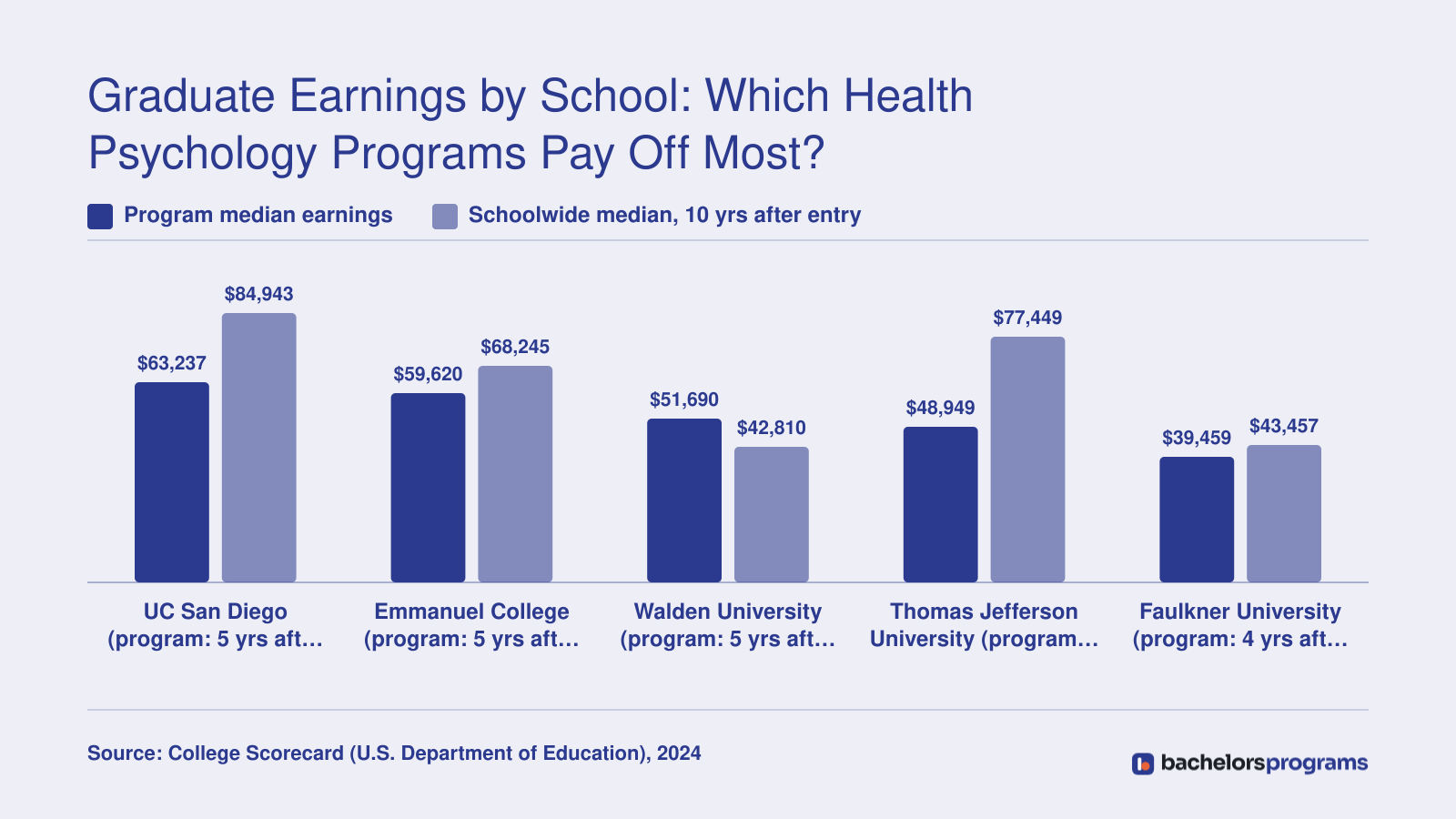
UC San Diego graduates report a program median of $63,237 five years after completion, about $23,800 more than Faulkner University's $39,459 four years after completion. Regional wages (Southern California and Boston versus Alabama) likely explain part of that gap, and so does graduate school: students who go straight into a graduate program often report lower early earnings. The second bar for each school is a schoolwide median for all students 10 years after entry, not a result for this major. Program earnings are not reported for MCPHS, Illinois, or George Mason, so those schools are not charted.
Health Education Specialist Pay at a Glance
Is a Health Psychology Bachelor's Worth It?
Student and graduate discussions on forums like Reddit reach a fairly consistent verdict: a health psychology bachelor's pays off most as a launch point for graduate or professional school, not as a stand-alone credential. Whether it is worth it for you depends largely on whether you have a clear next step in mind.
- You study how behavior, stress, and lifestyle shape physical health, an interdisciplinary blend that general psychology majors rarely get in such depth.
- The coursework builds a strong foundation for graduate study in public health, nursing, physician assistant programs, counseling, or clinical psychology.
- Many programs offer lab work and research methods training, giving you hands-on experience that strengthens graduate school applications.
- Behavior change and prevention skills fit the expanding focus on wellness, health education, and chronic disease prevention across health care settings.
- Pairing the major with a public health minor gives you both behavioral science depth and population-level health knowledge.
- Few job postings carry a "health psychology" title, so graduates often land roles like behavioral coach, ABA technician, or case manager instead.
- Forum posters frequently describe low entry-level pay with a psychology bachelor's, sometimes near minimum wage, with higher earnings taking years to build.
- Clinical, counseling, and licensed psychologist roles require a graduate degree plus supervised hours, so plan for more school if those careers appeal to you.
- Relatively few colleges offer a true health psychology major, and many list it only as a concentration or track within general psychology.
- Entry-level roles can be hard to secure without connections, prior experience, or certifications, a recurring frustration among recent graduates.
Health Psychology programs by state
Health Psychology Degree Questions Students Ask
Which school is the best choice for a bachelor's in health psychology?
How does health psychology differ from clinical psychology at the undergraduate level?
Can a bachelor's in health psychology lead to licensure on its own?
Is a health psychology major good preparation for nursing, PA, or public health graduate programs?
Will graduate schools accept an online health psychology bachelor's?
Compare Health Psychology programs on the data that matters
Explore more Psychology majors or browse every field of study.
All Psychology programs Browse every field of study