Best Data Science Degree Programs in New Jersey
Compare 5 accredited Data Science programs in New Jersey at 4 colleges, with net price after aid, graduation rates, earnings and debt from IPEDS and the U.S. College Scorecard.
A data science bachelor's in New Jersey runs four years and roughly 120 credits, built on calculus, statistics and programming. It is most often awarded as a Bachelor of Science (B.S.) in Data Science, and at the New Jersey Institute of Technology that B.S. forks into a computing option and a statistics option.
Rutgers, Ramapo College of New Jersey and Saint Peter's each build the degree on a different mix of mathematics and applied analytics.
Employers hiring analysts around Newark and Jersey City read the math and programming transcript closely, and a capstone built on real data usually counts for more than the wording on the diploma.
Key Points
- NJIT's 120-credit B.S. splits into computing and statistics options.
- Saint Peter's posts $42,552 tuition but the lowest net price, $12,199.
- New Jersey's need-based Tuition Aid Grant (TAG) can cut costs further.
Best Bachelor's Degree in Data Science Programs in New Jersey, Ranked
For undergraduates who want the most technical preparation available in the state, the New Jersey Institute of Technology is the strongest fit, with a 120-credit B.S. that splits into a computing option and a statistics option. Rutgers and Ramapo follow closely for students who want a broader liberal arts base or an embedded second field, and Saint Peter's is the pick for anyone drawn to artificial intelligence. The schools offering this program report institution-wide graduation rates between 58% and 84%.
New Jersey Institute of Technology
#1Newark, NJ · $20,000 – $38,000/yr (est.)
Best for: Newark commuters seeking hands-on computing rigor
NJIT runs its data science degree out of two colleges, so a student can lean toward software, high performance computing and cloud systems in the Ying Wu College of Computing or toward probability and statistical inference in the Department of Mathematical Sciences. The B.S. requires 120 credits and closes with a two-course capstone, and the program names applications that run from genomics and finance to cybersecurity and journalism. It is the most technically dense option on this list and the closest thing New Jersey offers to an engineering-grade data science degree.
- Computing option sits in the Ying Wu College of Computing
- 120 total credit hours, including Data Science Capstone I and II
- Covers machine learning, statistical inference and probability
- Includes programming, software engineering and cloud computing
- Applications in health, finance, marketing and cybersecurity
- Two concentration options: Computing and Statistics
- Statistics option sits in the Department of Mathematical Sciences
- Co-op work experience elective available
- Electives cover probability, linear algebra and programming
- Applications in health, finance and cybersecurity
- Free electives chosen with advisor guidance
- Capstone required within the 120 credits
Rutgers University
#2New Brunswick, NJ · $24,000/yr (est. net price)
Best for: Stats-focused learners at a large research university
Rutgers awards a Bachelor of Arts in Data Science through its School of Arts and Sciences, which makes it the most flexible option here for students who want room for a second major or a social science focus. Two tracks, Statistics and Human Centered, split the difference between regression methods and data structures on one side and informatics and information visualization on the other. Students get the resources of a large research university in New Brunswick, including expanding work in machine learning and artificial intelligence.
- Two tracks: Statistics and Human Centered
- Statistics track adds Calculus II, data structures and regression methods
- Human Centered track adds IT, informatics and information visualization
- Foundation includes data literacy, statistical inference and linear algebra
- SAS CORE requirements included for all students
- Applied statistical learning built into both tracks
Ramapo College of New Jersey
#3Mahwah, NJ · $15,000 – $20,000/yr (est.)
Best for: Small-college learners pairing data with a minor
Ramapo built its data science major around an embedded disciplinary minor, so every student pairs data work with a second field and usually draws the capstone project from it. The 128-credit program leans on Python, R and applied statistics in a small-college setting in Mahwah, and a 4+1 arrangement lets students finish a master's in one extra year with 30% off graduate tuition. It suits students who want a project-based major without a large lecture-hall environment.
- 128 credit hours with an embedded disciplinary minor
- Capstone usually drawn from the student's minor or second major
- Coursework includes Data Analysis and Visualization and Machine Learning
- Python and R programming emphasized
- 4+1 B.S. to M.S. option saves 30% on graduate tuition
- Sits in the Center for Data, Mathematical & Computational Sciences
Saint Peter's University
#4Jersey City, NJ · ~$12,000/yr (est.)
Saint Peter's pairs data science with artificial intelligence, and the curriculum is unusually explicit about cloud platforms, deep learning and the ethics surrounding them. Students work in Python, R, SQL, TensorFlow, PyTorch and Tableau, and the program builds in preparation for Amazon Web Services, Microsoft Azure and IBM certifications alongside internships and industry partnerships. It is a practical, applied option in Jersey City for students who want AI skills layered on top of analytics.
- Combines data science with artificial intelligence coursework
- Training in Python, R, SQL, TensorFlow, PyTorch and Tableau
- Prepares for AWS, Microsoft Azure and IBM AI certifications
- Covers AI ethics, bias, informed consent and data privacy
- Internships, industry partnerships and capstone challenges
- Cloud computing and deep learning focus
Cost & outcomes by school
Federal data for the highest-earning Data Science programs, independent of the ranking above. Earnings are this field's bachelor's graduates four years after completing where the Scorecard reports them, else the school's undergraduate median.
| School | Net price / yr | Grad rate | Earnings | Debt | Grads/yr | Format |
|---|---|---|---|---|---|---|
| New Jersey Institute of Technology NJ | $16,504 | 73% | $84,276 | $21,000 | 12 | Campus |
| Rutgers University NJ | $24,406 | 84% | $74,479 | $21,500 | 27 | Campus |
| Ramapo College of New Jersey NJ | $18,173 | 70% | $67,541 | $21,000 | 9 | Campus |
| Saint Peter's University NJ | $12,199 | 58% | $57,815 | $20,500 | 11 | Campus |
Sources: U.S. Department of Education. Net price, graduation rate, earnings and debt: College Scorecard (earnings and debt for this field's bachelor's graduates where reported, else school-wide); graduates: IPEDS. A dash means no figure is reported.
Cost, debt & payoff
Median earnings of this field's bachelor's graduates (4 yrs after completing, else the school's undergraduate median) vs. their median federal loan debt · U.S. College Scorecard
Across these programs the median graduate earns about $74,479 and finishes with roughly $21,000 in debt — a ratio that clears a common rule of thumb (keep debt below first-year salary). Net price and debt vary widely school to school, so check the per-school figures in the table above before you shortlist.
How We Ranked New Jersey Bachelor's in Data Science Programs
This ranking weighs what actually shapes your outcomes: what you pay, whether students finish, what graduates earn, and how much debt they carry afterward.
What We Weighed
Net price is what remains after grants and scholarships come off the sticker price, and that is the figure you actually finance. Graduation rate shows how often students who start actually finish. Program-level earnings show what graduates of a given data science program report, and debt shows how much of that paycheck is already spoken for. Selectivity rounds things out, because a program that admits broadly tends to support students differently than one that admits narrowly.
Where the Numbers Come From
Earnings and debt are program-level figures drawn from federal College Scorecard data, measured in the years after completion rather than at graduation. Graduation rate and net price are institution-wide averages, so treat them as context for the school overall rather than a promise about the data science major itself.
This ranking is independent. No school listed here sponsored it, reviewed it, or paid for its position. Where a program's marketing tells a brighter story than the federal numbers, we used the federal numbers.
Online and Hybrid Data Science Bachelor's Options at New Jersey Schools
Campus Delivery Is the Norm
NJIT lists its B.S. in Data Science as an on-campus program in Newark, requiring 120 credits through either a Computing option or a Statistics option. Rutgers in New Brunswick offers data science as a Bachelor of Arts major in its School of Arts and Sciences, with Statistics and Human Centered tracks1, and its program listing describes no online or hybrid version. Ramapo College of New Jersey in Mahwah and Saint Peter's University in Jersey City also offer data science bachelor's programs (Saint Peter's pairs the field with artificial intelligence). Confirm their delivery formats directly with each admissions office.
No official program page we reviewed establishes a fully online or hybrid bachelor's degree in data science at any school ranked here.2 Individual courses may still run online or in the evening, so ask each department.
Who Each Format Suits
- Traditional residential students: Campus programs fit students who want labs, faculty office hours, research projects and easy access to internship recruiting.
- Working adults: Plan around class schedules. Ask whether part-time enrollment or evening sections are available before you apply.
- Transfer students: Commuting to a campus program is often the realistic path. Urban campuses in Newark and Jersey City may be easier to reach by public transit than suburban ones.
Online Tuition and Out-of-State Students
Neither NJIT nor Rutgers publishes a separate online tuition rate for its data science bachelor's, which fits their campus-based delivery. Students outside New Jersey should not count on finishing one of these degrees remotely. No out-of-state online pathway from a school on this page is established. Plan to relocate or commute, and budget for campus costs and out-of-state tuition where it applies.
Related Articles
Admissions: GPA, Test Policy, Math Prerequisites and Transfer Credit
Admission to a bachelor's degree in data science in New Jersey usually runs through general university admission rather than a separate program screen. Use this checklist to confirm each requirement with the school before you apply.
- GPA expectationsNJIT's B.S. in Data Science catalog lists no special requirements for admission to the major, and matriculated students can declare it under NJIT's standard policies. We could not confirm a program-specific minimum GPA at NJIT, Rutgers, Ramapo or Saint Peter's, so check each school's freshman and transfer admissions pages for current expectations.
- SAT/ACT policyTesting policies change from cycle to cycle. Confirm whether NJIT, Rutgers, Ramapo and Saint Peter's require, accept or waive SAT/ACT scores for the 2026–27 application year directly with each admissions office. We could not verify a current published policy tied to these data science programs.
- Math prerequisitesNJIT's 120-credit curriculum builds on Calculus I, Introduction to Probability Theory, Linear Algebra, Statistical Methods I and Regression Analysis. Students who finish precalculus, and ideally calculus, in high school are better positioned to start that sequence on schedule. Ask the other schools which math course you need to place into first.
- Transfer creditNJ Transfer offers course-by-course transferability evaluations of first- and second-year coursework at participating institutions. It shows how community college classes are likely to carry over, but it does not guarantee admission to a specific major. We could not confirm a data-science-specific community college agreement at any school here. Ask each school about credit caps, minimum grades and residency rules before you enroll.
Accreditation: What to Check Before You Enroll
Regional accreditation from the Middle States Commission on Higher Education (MSCHE) is the baseline for any bachelor's degree in data science in New Jersey. It makes a school's students eligible for federal financial aid, and it is what most colleges check when deciding whether to accept transfer credits. Check it for New Jersey Institute of Technology, Rutgers University, Ramapo College of New Jersey, and Saint Peter's University before you apply anywhere.
Programmatic Accreditation
Data science has no single required programmatic accreditor. ABET accredits specific computing and engineering programs, but it does not currently have a dedicated data science credential that employers expect. An ABET listing on a related program, such as computer science, does not carry over to a separate data science degree. We could not confirm ABET accreditation for the B.S. in Data Science at NJIT or for the data science programs at the other schools here. If it matters to you, ask the department directly.
How to Verify in Five Minutes
- MSCHE directory: Search the school's name on the Middle States website and confirm its status is accredited.
- School website: Look for the accreditation page, usually in the footer or the About section, and check that the language matches the MSCHE listing.
- ABET search: If a program claims ABET accreditation, look it up on ABET's accredited program search by program name and campus.
- Admissions office: Ask in writing if anything is unclear.
What a Data Science Bachelor's Costs in New Jersey
The cost of a data science bachelor's has two parts: the published tuition and fees a school charges for a year, and the net price students actually pay once grants and scholarships come off the bill. In New Jersey, those two numbers can point in opposite directions.
Published Tuition and Fees
At the public schools below, New Jersey residents pay far less than out-of-state students. Saint Peter's, a private university, charges everyone the same rate.
- Ramapo College of New Jersey: $16,777 in-state, $27,708 out-of-state
- Rutgers University: $17,929 in-state, $37,441 out-of-state
- New Jersey Institute of Technology: $19,974 in-state, $37,664 out-of-state
- Saint Peter's University: $42,552 for all students
The sticker-price spread is wide. For a New Jersey resident, Saint Peter's lists $25,775 more per year than Ramapo. Ramapo's flat rate covers 12 to 18 credits, and its trustees approve new rates each year, usually in late June, so confirm the current schedule before you build a budget.
Net Price Tells a Different Story
Net price is the average a student pays after grant aid. It is calculated across all undergraduates at a school, not data science majors alone, and your own figure will depend on family income and the aid you receive.
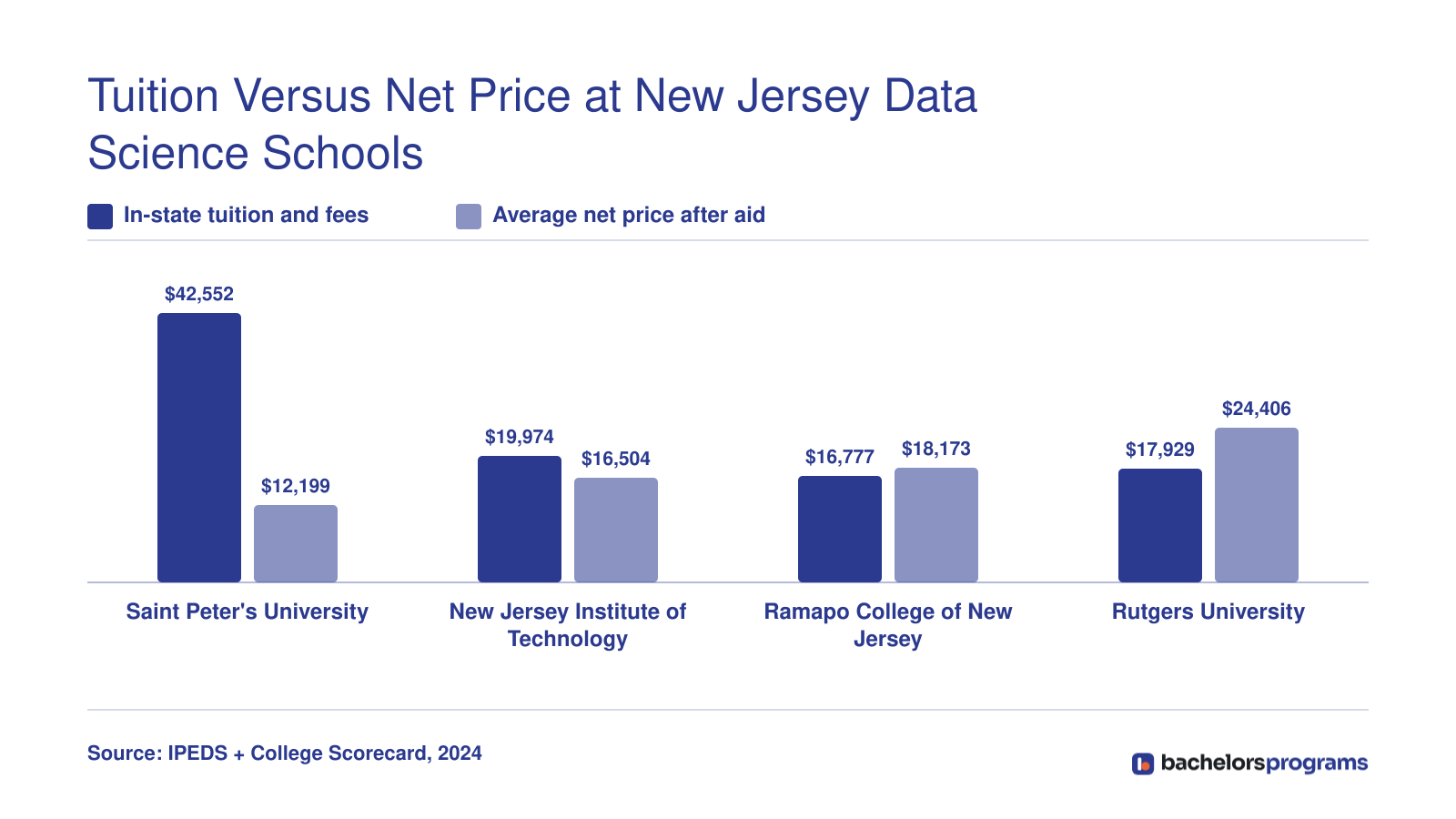
After aid, the order changes. Saint Peter's has the lowest average net price here at $12,199, followed by NJIT at $16,504, Ramapo at $18,173 and Rutgers at $24,406. Large institutional grants can make a private school cheaper in practice than a public one, so file the FAFSA early and compare actual award letters rather than published rates.
What Students Typically Borrow
Median federal loan debt at graduation is strikingly similar across these schools: $20,500 at Saint Peter's, $21,000 at NJIT and Ramapo, and $21,500 at Rutgers. These figures are school-wide rather than specific to the data science major, but they show that a typical borrower leaves with between $20,500 and $21,500 in federal loans regardless of campus. That consistency makes net price, not borrowing, the bigger variable when you compare offers.
Tuition Versus Net Price at New Jersey Data Science Schools
Sticker price and what families actually pay can point in opposite directions. Saint Peter's University posts the highest tuition of the schools ranked here at $42,552, yet its average net price after grant aid is the lowest at $12,199. Net price is an institution-wide average that also folds in housing, books and other living costs, which is why it can top tuition at public schools like Ramapo and Rutgers. Your own cost will depend on your aid package.
New Jersey Grants and Scholarships That Cut the Price
Which New Jersey aid programs can lower the cost of a bachelor's degree in data science? The main ones split between need-based and merit-based awards.
Need-Based Aid
- Tuition Aid Grant (TAG): A need-based grant from the New Jersey Higher Education Student Assistance Authority (HESAA).1 Award amounts vary by student and school type, so check HESAA for your figure.
- Educational Opportunity Fund (EOF): A need-based program for students from economically and educationally disadvantaged backgrounds. Eligibility and awards run through HESAA and the school's EOF office, so confirm the current rules with them.
- Garden State Guarantee (GSG): A need-based grant for third- and fourth-year students at New Jersey public four-year institutions. You must attend full time (at least 12 credits a semester) and be working toward a first bachelor's. It covers up to four semesters or 128 credits, whichever comes first.2 NJIT, Rutgers and Ramapo are public; Saint Peter's is private.
Merit-Based Aid
- NJ STARS: For New Jersey high school graduates ranking in the top 15.0% of their class who enroll at their local community college. It can fully cover community college tuition.3
- NJ STARS II: For NJ STARS students who finish an associate degree and transfer to a participating New Jersey bachelor's-granting school. It pays $2,500 per academic year for up to four semesters.
School Scholarships and Deadlines
Check the financial aid pages at NJIT, Rutgers, Ramapo and Saint Peter's for data science or STEM awards, since we could not confirm specific named scholarships.
File the FAFSA (or the NJ Alternative Financial Aid Application, if you are eligible) every year. For 2026-27, HESAA set September 15, 2026 for new TAG applicants and February 15, 2027 for spring-only applicants.4 Check HESAA for the 2027-28 dates, since late applications are not extended.
Data Science Bachelor's in New Jersey: Common Questions
These answers cover the questions prospective students ask most about a B.S. in data science at New Jersey schools. Details vary by school, so confirm specifics on each program's own page before you apply.
What math background do you need for a data science major?
Is a data science major better than computer science or statistics for a New Jersey career?
Can community college students in New Jersey transfer into a data science bachelor's?
Can you earn a bachelor's degree in data science online from a New Jersey school?
Compare Data Science programs on the data that matters
Explore more Science & Engineering majors or browse every field of study.
All Science & Engineering programs Browse every field of study