Best Electrical Engineering Degree Programs
Compare 500+ accredited Electrical Engineering programs at 470+ colleges, with net price after aid, graduation rates, earnings and debt from IPEDS and the U.S. College Scorecard.

What does a bachelor's degree in electrical engineering cost once aid is applied, and does the paycheck justify it? Across these schools, average net price runs from $6,128 at Princeton University to $20,111 at MIT. Most of these programs award a Bachelor of Science (B.S.) in Electrical Engineering.
This is an undergraduate ranking of U.S. schools, not a graduate or peer-reputation list. Schools are compared on cost after aid, graduation rates, and program-level earnings and debt from College Scorecard.
Price is only half the constraint. Several of these schools admit fewer than one in ten applicants.
Key Points
- Princeton's average net price after aid, $6,128, undercuts some public flagships.
- Princeton former students earn roughly $10.70 per dollar of median debt.
- ABET accredits individual degree programs, so verify your specific electrical engineering major.
Best Schools for a Bachelor's Degree in Electrical Engineering
The ten schools below split into two camps. Public flagships can land in-state students at a net price in the low five figures or below, while private universities charge considerably more after aid but post institution-wide graduation rates in the low to mid 90s. Graduation rates here describe the whole institution, not the electrical engineering department alone, and program-level earnings appear only where the school publicly reports them for recent graduates.
University of California-Berkeley
#1Berkeley, CA · ~$13,000/yr (est.)
Best for: Students wanting CS and EE combined
Berkeley folds electrical engineering into the Electrical Engineering and Computer Sciences major, so undergraduates study circuits, signals and systems alongside computer science in a single degree. Honors students can add a faculty adviser, undergraduate research and a transcript notation, and a five-year route adds a master's in one extra year. Recent investment includes a chip-design education fund backed by an NVIDIA hardware executive, and Berkeley engineers collaborate with Lawrence Berkeley National Laboratory on quantum networking.
- Combines computer science and electrical engineering in one major
- Honors track with faculty adviser and undergraduate research
- Five-year BS/MS option adds one year for the master's
- Applicants apply to a specific major in the College of Engineering
- No switching in from other colleges after admission
- More math and science coursework than the CS bachelor's
- Accredited by ACS WASC
Princeton University
#2Princeton, NJ · ~$6,000/yr (est.)
Best for: Research-bound students eyeing graduate school
Princeton's Electrical and Computer Engineering department blends EE with computer science, materials science, energy, physics, biology and public policy, with work spanning photonic technologies, autonomous vehicles, encrypted networks, quantum computers and solar cells. Cohorts are small and the department holds an open house in its undergraduate lab each semester. Graduates move to Google, Intel, Microsoft and startups, continue to top graduate programs, or head into finance, law and medicine.
- Combines CS, materials science, energy, physics and biology
- Focus on electronic and photonic technologies
- Semester open house held in the undergraduate lab, F110
- Graduates work at Google, Intel, Microsoft or startups
- Some graduates continue to top graduate schools
- Open to careers in business, finance, government and law
Georgia Institute of Technology
#3Atlanta, GA · ~$12,000/yr (est.)
Best for: Learners wanting many specialization choices
Georgia Tech awards a Bachelor of Science in Electrical Engineering built around engineering analysis and design, with eleven concentration options stretching from analog electronics and bioengineering to optics and photonics, microsystems, electrical energy and telecommunications. It is a large campus program in Atlanta, with one of the bigger EE graduating cohorts among the schools listed here. Course descriptions and the full catalog are published term by term so students can map a four-year sequence.
- 11 concentration options
- Engineering analysis and design focus
- Study areas from bioengineering to photonics and optics
- Includes an electronics packaging coursework area
University of Florida
#4Gainesville, FL · ~$7,000/yr (est.)
The Herbert Wertheim College of Engineering awards an ABET-accredited Bachelor of Science in Electrical Engineering that requires 128 credits and a two-course capstone design sequence. Three elective tracks let students lean toward electronic devices and circuits, electromagnetics, power and photonics, or computers, communications, systems and controls. Admission runs through critical-tracking courses with a 2.5 GPA and C grades in calculus, physics and chemistry, and the degree is built to prepare students for professional licensure.
- ABET accredited B.S. in Electrical Engineering
- 128 total credit hours, including a two-course capstone
- Three specialization areas: circuits, power and photonics, controls
- 2.5 GPA minimum in critical-tracking courses
- C or better in calculus, physics and general chemistry
- 10 credits of EE breadth and 6 credits of EE depth electives
- 18 credits of EE technical electives
- Combination degree options and eight-semester model plan
University of California-Los Angeles
#5Los Angeles, CA · $13,000/yr (est. net price)
UCLA offers a standalone Electrical Engineering BS, listed separately from computer engineering in the 2026 General Catalog, with roughly 140 bachelor's completions in the most recent year. The department reported 2026 student recognition in integrated sensors and semiconductor technology, including a student paper award at the IEEE BiCMOS and Compound Semiconductor ICs symposium, plus a 2026 SEMI Award for North America that reflects close semiconductor industry ties. Undergraduates get a large research university's labs and faculty in Los Angeles.
- Standalone Electrical Engineering BS, separate from computer engineering
- Published in the 2026 UCLA General Catalog
Stanford University
#6Stanford, CA · $10,000 – $15,000/yr (est.)
Stanford's Bachelor of Science in Electrical Engineering emphasizes designing experimental projects and communicating findings, and peer advisers help undergraduates plan their class choices. The program prepares graduates for government and corporate roles or for graduate and professional study. Program requirements are documented in the EE undergraduate handbook, and the department sits at the center of the Bay Area's semiconductor and systems industry.
- Design and communicate experimental projects
- Prepares for graduate or professional school
- Careers in government agencies and the corporate sector
- Peer advisers help with class choices
- Full details in the EE undergraduate handbook
Massachusetts Institute of Technology
#7Cambridge, MA · ~$20,000/yr (est.)
MIT's Course 6-5 leads to a Bachelor of Science in Electrical Engineering with Computing, spanning analog circuit design, computer engineering, quantum engineering and communications. Students build a foundation of five subjects in mathematics, programming and algorithms, then add three core system design subjects and an integrative system design laboratory. Four subjects from application tracks and a communication-intensive subject complete the degree, and departmental research reaches sensors, energy transducers and new physical substrates for computation.
- Designated Course 6-5 within EECS
- Includes an integrative system design laboratory
- Covers analog circuit design through quantum engineering
- Five foundation subjects in math, programming and algorithms
- Three core system design subjects required
- Four subjects drawn from application tracks
- One communication-intensive subject required
Purdue University
#8West Lafayette, IN · ~$15,000/yr (est.)
Purdue's Bachelor of Science in Electrical Engineering offers nine concentrations, including artificial intelligence and machine learning, electric power and energy systems, microelectronics and semiconductors, quantum technology, and RF and optical engineering. Students must hold a 2.000 GPA in ECE courses and complete at least 32 upper-level ECE credits in West Lafayette, with catalog requirements listed for each term from Fall 2021 through Fall 2026. A corporate-partner program runs a discipline-specific career event each year, and Purdue is part of a semiconductor workforce initiative with the University of Illinois.
- ABET accredited B.S. in Electrical Engineering
- 9 concentration options, including power, quantum and RF
- 2.000 GPA minimum in ECE major-area courses
- At least 32 upper-level ECE credits at West Lafayette
- Separate B.S. in Computer Engineering also offered
- Requirements vary by catalog term, Fall 2021 to Fall 2026
- ECE minors and certifications open to non-ECE students
California Institute of Technology
#9Pasadena, CA · ~$16,000/yr (est.)
Caltech's Bachelor of Science in Electrical Engineering divides into devices, meaning hardware development, and systems, which covers processing and analyzing information. Optional tracks run through circuits and electronics, computer engineering, intelligent systems and medical engineering. Coursework covers electromagnetic theory, probability models, signal processing, embedded systems and advanced electronics, plus 72 units of advanced electives and a senior capstone or research thesis.
- Two branches: devices and systems
- Four optional tracks: circuits, computer engineering, intelligent systems, medical engineering
- 72 units of advanced electives
- Senior capstone project or research thesis
- More than twenty EE faculty teach in the program
- Small class sizes and research-grade lab equipment
University of California-San Diego
#10La Jolla, CA · $10,000 – $15,000/yr (est.)
UC San Diego's B.S. in Electrical Engineering requires 68 lower-division units and then one of eight approved depth sequences, from communication systems and computer system design to photonics, power engineering and machine learning and controls. Each depth totals 68 units and combines breadth courses, depth courses, technical electives, two upper-division professional electives and a design course. Students may propose a custom depth with department approval, and major courses must be letter graded at C- or better.
- Eight approved depth sequences, from photonics to power engineering
- 68 lower-division units required before the depth
- Each depth totals 68 units with breadth and depth courses
- Two upper-division professional electives required
- Design course chosen from ECE-111, 115, 140B, 190 or 191
- Major courses must be letter graded C- or better
- Custom depth possible with department approval
Cost & outcomes by school
Federal data for the highest-earning Electrical Engineering programs, independent of the ranking above. Earnings are this field's bachelor's graduates four years after completing where the Scorecard reports them, else the school's undergraduate median.
| School | Net price / yr | Grad rate | Earnings | Debt | Grads/yr | Format |
|---|---|---|---|---|---|---|
| Carnegie Mellon University PA | $31,944 | 94% | $250,168 | $22,224 | 247 | Campus |
| University of California-Berkeley CA | $13,481 | 93% | $200,543 | $13,674 | 516 | Campus |
| Massachusetts Institute of Technology MA | $20,111 | 96% | $161,118 | $10,967 | 76 | Campus |
| Cornell University NY | $28,690 | 95% | $147,241 | $14,725 | 95 | Campus |
| The University of Texas at Austin TX | $19,857 | 89% | $146,003 | $20,480 | 365 | Campus |
| Columbia University in the City of New York NY | $21,590 | 96% | $143,332 | $21,500 | 28 | Campus |
| The Cooper Union for the Advancement of Science and Art NY | $13,269 | 81% | $139,068 | $15,000 | 33 | Campus |
| Rice University TX | $13,370 | 95% | $136,656 | $11,000 | 4 | Campus |
| Franklin W Olin College of Engineering MA | $25,171 | 96% | $129,455 | $19,500 | 30 | Campus |
| California Institute of Technology CA | $16,075 | 94% | $128,566 | — | 12 | Campus |
| University of California-Los Angeles CA | $12,548 | 93% | $126,209 | $16,979 | 124 | Campus |
| California Polytechnic State University-San Luis Obispo CA | $16,665 | 86% | $125,240 | $23,475 | 139 | Campus |
Sources: U.S. Department of Education. Net price, graduation rate, earnings and debt: College Scorecard (earnings and debt for this field's bachelor's graduates where reported, else school-wide); graduates: IPEDS. A dash means no figure is reported.
Cost, debt & payoff
Median earnings of this field's bachelor's graduates (4 yrs after completing, else the school's undergraduate median) vs. their median federal loan debt · U.S. College Scorecard
Across these programs the median graduate earns about $90,088 and finishes with roughly $22,595 in debt — a ratio that clears a common rule of thumb (keep debt below first-year salary). Net price and debt vary widely school to school, so check the per-school figures in the table above before you shortlist.
How We Ranked These Electrical Engineering Programs
The figures behind this list come from two federal sources: the College Scorecard and IPEDS, the Integrated Postsecondary Education Data System. Both release on their own schedules, so every number below reflects the latest snapshot each had published at the time of writing.
What the Ranking Draws On
Each program is weighed on the same set of undergraduate measures:
- Cost: average net price after federal, state and institutional aid, not the published sticker tuition.
- Completion: institution-wide graduation and retention rates.
- Outcomes: program-level median earnings and median federal debt for graduates.
- Selectivity: admission rates and the academic profile of incoming students.
No single measure decides a school's position, and the ranking does not publish numeric weights.
Why This Is Not a U.S. News List
U.S. News engineering rankings lean heavily on peer reputation surveys. This list is built only from undergraduate cost and outcome data, which is the perspective a prospective bachelor's degree student actually needs.
Where the Numbers Stop
Graduation rates and net price describe the whole institution, not the electrical engineering department alone. Some programs also carry no published earnings figure, because too few graduates were tracked for the data to be released.
What Electrical Engineering Schools Really Cost After Aid
Net Price Across the Lowest-Cost Schools
Among the least expensive schools here, average net price runs from $6,128 at Princeton University to $13,807 at Stanford University. Public in-state net prices sit in a similar band: $6,541 at the University of Florida, $11,297 at Florida State University, $12,116 at Georgia Tech, and $13,481 at UC Berkeley. Private schools look very different on paper, yet Rice University's net price is $13,370 and Stanford's is $13,807.
Why Sticker Price and Net Price Differ
Published tuition is the starting point, not the bill. Princeton lists tuition and fees of $62,688, but its average net price is $6,128 because grant aid covers most of the gap. The University of Florida runs the other way. In-state tuition is $6,381, yet the average net price is $6,541, since net price also counts housing, food and books before subtracting grants. Out-of-state students at Florida pay a listed $28,659 in tuition, so residency matters as much as sector.
What Graduates Borrow
Program-level federal debt is modest at the public schools where it is reported:
- University of Florida: $20,650 median debt, about $219 a month over 10 years.
- Georgia Tech: $22,250 median debt, about $236 a month.
- UC Berkeley: $13,674 median debt, about $145 a month.
Debt figures are not reported for every program, so Princeton, Rice and Stanford are left out here.
So, How Much Does an EE Degree Cost by School?
For the schools above, an average year costs roughly $6,000 to $14,000 after aid, whether public or private. Treat that as an average, not a personal quote. Your own price depends on family income, residency and the aid you qualify for, so check the calculator every school publishes before you rule anyone in or out.
Best Value Electrical Engineering Degree Programs: Highest Return for the Cost
The earnings-to-debt ratio divides a school's median earnings for former students 10 years after they first enrolled by the median debt its graduates carry, so Princeton's ratio of 10.7 means a typical former student earns about $10.70 a year for every $1 borrowed. These figures come from U.S. Department of Education IPEDS and College Scorecard data (2024) and describe the whole institution across all majors, not electrical engineering alone. Stanford also reports a program-level median of $187,527 for its electrical engineering graduates five years after completion, and Caltech posts the highest school-wide earnings in this snapshot, though its median graduate debt is not reported, so no ratio can be calculated for it.
| School | Location | Average Annual Net Price | School-Wide Median Earnings (10 Years After Entry) | Median Graduate Debt | Earnings-to-Debt Ratio | EE Program Median Earnings (5 Years After Completion) |
|---|---|---|---|---|---|---|
| California Institute of Technology (Caltech) | Pasadena, CA | $16,075 | $128,566 | Not reported | N/A | N/A |
| Princeton University | Princeton, NJ | $6,128 | $110,066 | $10,320 | 10.7 | N/A |
| Stanford University | Stanford, CA | $13,807 | $124,080 | $12,000 | 10.3 | $187,527 |
Related Articles
Is Your Electrical Engineering Program ABET-Accredited?
ABET's Engineering Accreditation Commission (EAC) accredits specific degree programs, not an entire university or engineering department.1 A school can hold EAC accreditation for its bachelor's electrical engineering program while related majors, such as electrical engineering technology, sit under the separate Engineering Technology Accreditation Commission. That distinction matters because the EAC credential is the standard route to the Fundamentals of Engineering exam and, later, the PE license.
Check the Record, Not the Reputation
Princeton, Florida and Purdue each list ABET accreditation for their electrical engineering programs. Treat those statements as a starting point. ABET's search lists 419 institutions with an accredited electrical engineering program, but that total does not tell you which specific degree at a given campus is covered.2 Search the Accredited Programs database by institution or by program name, then confirm the exact campus, bachelor's degree level, and formal program title.3 Read the accreditation dates and status. If a program appears only when you enable the historical-programs option, treat it as historical until the dates show otherwise.
Why Employers Ask
Federal agencies and defense contractors often require an ABET-accredited engineering degree for engineering positions. That requirement can follow graduates into hiring, security clearance reviews, and promotion. It also shapes licensure: state licensing boards typically expect an EAC-accredited bachelor's degree before accepting PE applicants.
Match the Exact Program
ABET assigns programs to commissions by their literal names. EAC programs must include "engineering" in the title, and the 2026-2027 EAC criteria cover titles with electrical, electronic, computer, communication, or telecommunications modifiers.4 Check the specific campus and delivery format too; ABET applies the same criteria to on-site, online, and blended instruction, but only the program listed in the record is covered.5 Do not assume every electrical engineering option at a university is covered because one record appears.
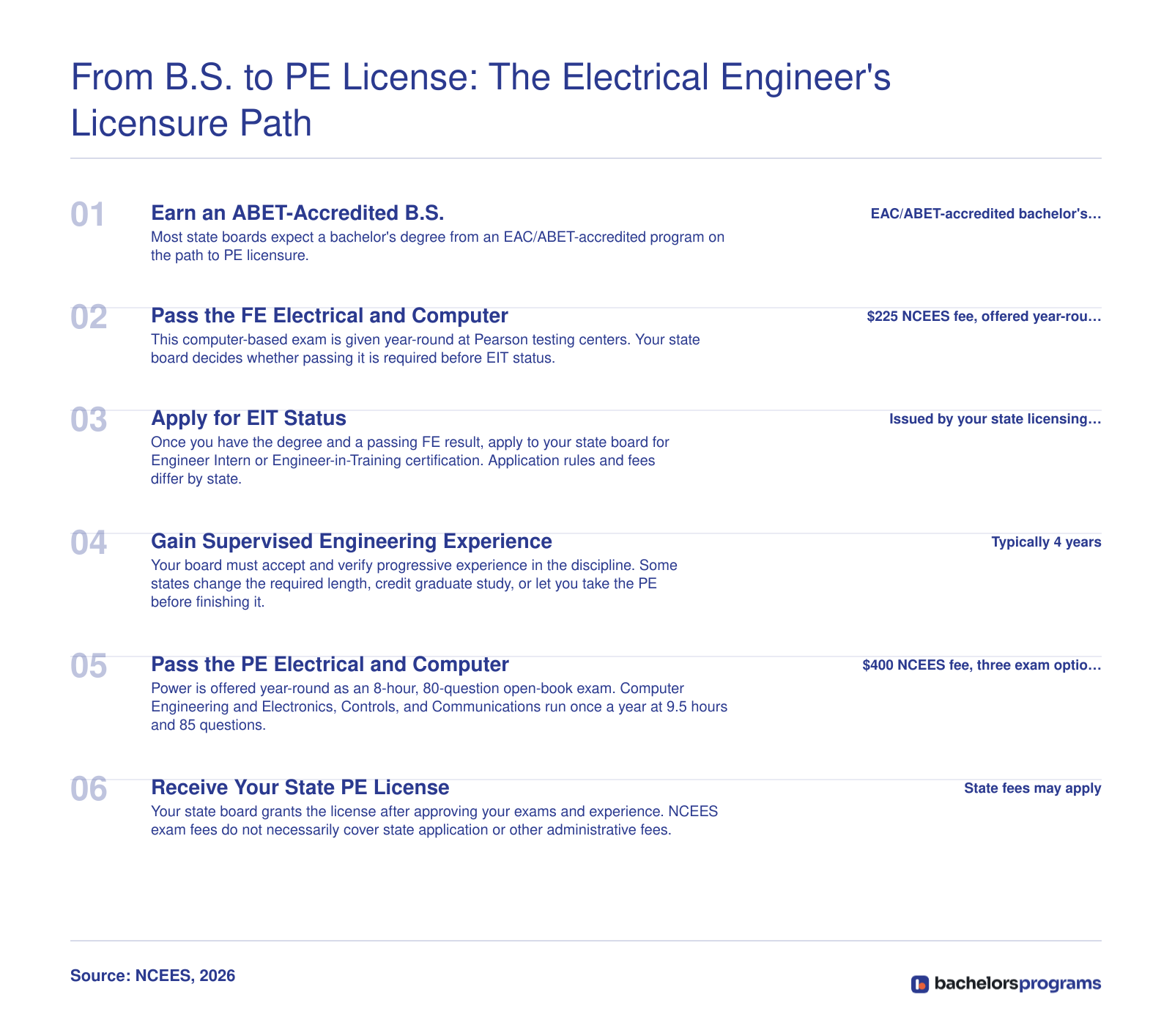
From B.S. to PE License: The Electrical Engineer's Licensure Path
A bachelor's degree in electrical engineering is the first step toward the Professional Engineer (PE) license, which matters most in power, utilities, and public-sector work. Licensure rules vary by state, so confirm each requirement with your state licensing board before you plan your timeline.
Electrical Engineering Specializations and Where to Study Them
A specialization is the cluster of upper-division courses, labs, and electives you choose in your junior and senior years. The core curriculum stays similar everywhere (circuits, electromagnetics, signals, control theory), but the back half of the degree is where you commit to a technical area. Several schools here publish their concentration options openly: Georgia Tech lists eleven study areas ranging from bioengineering to photonics, Purdue offers nine, UC San Diego eight, and Caltech four across its device and systems branches.
Semiconductors and microelectronics
Federal CHIPS Act funding has pushed domestic chip manufacturing into a hiring cycle, and departments have responded. Purdue says it launched the nation's first comprehensive semiconductor degrees program in May 2022, and its electrical engineering track sits at No. 10 in the 2027 undergraduate rankings.1 Northeastern names semiconductors and microelectronics as a formal focus area. At Pitt, semiconductor devices is a required junior-year course rather than an elective.2 Georgia Tech's electronics packaging coursework area covers the assembly side of the same industry.
Power, grid modernization, and renewables
Grid buildout and renewable interconnection work drive steady demand here. Pitt's Electric Power concentration covers generation and distribution, smart grid, and renewables, with hands-on work in an Eaton-sponsored Electric Power Systems Lab.2 Purdue's curriculum includes power generation and transmission. Northeastern lists power and energy systems among its focus areas.
Robotics, AI, and embedded systems
Northeastern's ECE department spans AI and Physical AI alongside robotics and autonomous systems. MIT's Course 6-5 degree moves from analog circuit design through quantum engineering and requires an integrative system design lab. Berkeley's EECS degree deliberately blends computing with electrical engineering and carries more math and science than its computer science alternative.
Co-op and combined-degree options
Paid industry experience is a Northeastern strength: the university has built its program around co-op since 1909 and ranked first for co-ops and internships in 2026.3 Pitt runs paid full-time alternating co-op placements. Berkeley advertises a five-year option that adds a master's in one extra year, and Florida notes combination degrees are available.
Electrical Engineering vs. Computer Engineering vs. Electronic Systems Engineering Technology
These three bachelor's degrees overlap in coursework but lead to different kinds of work and different licensure timelines. Electrical and computer engineering are accredited by ABET's Engineering Accreditation Commission (EAC), while electronic systems engineering technology falls under the Engineering Technology Accreditation Commission (ETAC). Many top electrical engineering departments are combined electrical and computer engineering (ECE) departments, so readers searching for the best computer engineering schools will often find that the schools ranked here offer both degrees.
| Factor | Electrical Engineering (B.S.) | Computer Engineering (B.S.) | Electronic Systems Engineering Technology (B.S.) |
|---|---|---|---|
| ABET accrediting commission | EAC (engineering) | EAC (engineering) | ETAC (engineering technology) |
| Math and theory depth | Calculus, probability and statistics, plus differential equations, linear algebra, complex variables, and discrete math; theory and foundational analysis | Same advanced math core, applied to systems that combine hardware and software | Algebra and trigonometry level or above; applied rather than theory-heavy |
| Curriculum emphasis | Conceptual design, analysis of electrical and electronic devices, research orientation | Design of devices and systems with both hardware and software components | Building, testing, operating, and maintaining systems; analog and digital electronics, microcontrollers, programming |
| Typical job titles | Electrical design engineer, electrical R&D engineer | Computer engineer, hardware engineer, embedded-systems engineer | Roles in construction, manufacturing, product design, testing, technical services and sales |
| FE and PE eligibility | FE exam, then PE after 4 years of progressive experience; eligible in all states and territories | FE exam, then PE after 4 years of progressive experience; eligible in all states and territories | FE exam, then PE, but the NCEES path cited calls for 8 years of experience; some state boards require extra experience, and eligibility is not universal |
| Best fit | Students who want design, research, or a PE license with the broadest options | Students drawn to processors, embedded systems, and firmware | Students who prefer hands-on, applied work and are comfortable with a longer licensure path |
Median Pay for Electrical Engineers
A bachelor's degree in electrical engineering leads into one of the better-paid engineering occupations in the United States.
Electrical Engineering programs by state
Compare Electrical Engineering programs on the data that matters
Explore more Science & Engineering majors or browse every field of study.
All Science & Engineering programs Browse every field of study