Best Anthropology Degree Programs
Compare 540+ accredited Anthropology programs at 490+ colleges, with net price after aid, graduation rates, earnings and debt from IPEDS and the U.S. College Scorecard.

A bachelor's degree in anthropology leads to work in museums, cultural resource management firms, public health agencies, and research organizations. Schools award it as a Bachelor of Arts (B.A.) or a Bachelor of Science (B.S.) in Anthropology, and the title matters less than the coursework behind it.
The catch is that the major is broad. Archaeology, biological, cultural, and linguistic tracks lead to different jobs, and some of the strongest roles, such as professional archaeologist or curator, often ask for graduate training beyond the bachelor's.
The programs here vary widely in price and in how much fieldwork they build in, so weigh both against the career you actually want.
Key Points
- Most programs teach cultural, biological, archaeology, and linguistic anthropology first.
- Strong archaeology programs typically run a summer field school, so ask early.
- Market research analysts earn the highest median pay among anthropology-related jobs.
Best Anthropology Schools for a Bachelor's Degree: Our Top 10
The ten schools below all award a bachelor's degree in anthropology, and we included every delivery format: traditional campus programs, online options, and schools that run both. Each card lists what a prospective major actually compares: net price after aid, institution-wide graduation and admission rates, program-level earnings where the data is published, and median debt after finishing. Earnings figures are for anthropology graduates specifically and always name the time window.
University of California-Los Angeles
#1Los Angeles, CA · $13,000/yr (est. net price)
Best for: Research-minded majors seeking funded fieldwork
UCLA is the largest anthropology program in this group by completions, and its department runs the Lemelson Undergraduate Honors Program, which funds original student research and pairs majors with faculty mentors. The anthropology BA sits in a large public research university with a 20-to-1 student-faculty ratio and a 93% institution-wide graduation rate. It is the strongest combination of program scale and published outcomes on this list.
- Anthropology BA listed in the UCLA General Catalog for 2026
- Includes the Lemelson Undergraduate Honors Program
- Honors program funds original undergraduate research
- Faculty mentoring and research presentation support
Princeton University
#2Princeton, NJ · ~$6,000/yr (est.)
Best for: Thesis writers drawn to medical or legal anthropology
Princeton awards an A.B. in Anthropology with three tracks: Sociocultural Anthropology, Medical Anthropology, and Law, Politics, and Economics. Majors take nine departmental courses, including two core courses in ethnographic method, and every student writes a junior paper and senior thesis plus a senior departmental exam. The default track is sociocultural, and the department offers competitive funding for summer field research.
- A.B. in Anthropology on the transcript
- 3 tracks: sociocultural, medical, law and politics
- 9 departmental courses required
- Two core courses in ethnographic method
- Junior paper and senior thesis required
- Senior departmental exam required
- Study abroad neither required nor expected
- Competitive summer field research funding
University of California-Berkeley
#3Berkeley, CA · ~$13,000/yr (est.)
Best for: California transfers planning an honors thesis
UC Berkeley offers anthropology as a Bachelor of Arts in the College of Letters and Science, with an honors thesis path for majors who hold a 3.5 overall and 3.65 major GPA. Majors clear three prerequisite courses before declaring and must declare by the end of the first semester of junior year. The department also runs a coursework-based fifth-year master's aimed at cultural resource management work.
- Bachelor of Arts in anthropology
- Three prerequisite courses before declaring
- Declare by junior year, transfers in first semester
- 2.0 GPA minimum in major courses
- Honors thesis needs 3.5 overall, 3.65 major GPA
- Honors courses count as major electives
- Fifth-year master's in cultural resource management
Stanford University
#4Stanford, CA · $10,000 – $15,000/yr (est.)
Stanford's anthropology BA requires 65 units inside a 180-unit university minimum, built around a theory course, a methods course, and 20 units in an emphasis. Students choose from Cultural and Social Anthropology, Environmental Anthropology, Medical Anthropology, or a self-designed emphasis, with up to 15 petitioned units from related fields. A capstone or senior paper is required, and honors candidates conduct original research with a 3.4 major GPA.
- Bachelor of Arts in anthropology
- 4 emphasis options, including self-designed
- 65 units in the major, 180-unit university minimum
- Theory course and methods course required
- Capstone or senior paper required
- Honors needs 3.4 major GPA, 3.0 overall
- Up to 15 petitioned units from related areas
University of California-Davis
#5Davis, CA · $10,000 – $15,000/yr (est.)
UC Davis is unusual in awarding anthropology as both a Bachelor of Arts and a Bachelor of Science, letting students pick between a biological and human origins track and two cultural tracks. Coursework spans archaeology, ethnography, linguistics, human biology, and ecology, and the department names cultural resources specialist, archaeologist, and collections manager among career outcomes. An anthropology club and a dedicated department advisor support majors.
- Offers both a Bachelor of Arts and a Bachelor of Science
- 3 tracks: human origins, evolutionary, cultural
- Coursework in archaeology, linguistics, human biology
- Prepares students for health professions
- Archaeology students consult an adviser on track
- Anthropology Club and department advisor available
Harvard University
#6Cambridge, MA · $15,000 – $20,000/yr (est.)
Harvard organizes undergraduate anthropology into two programs, Archaeology and Social Anthropology, and awards the A.B. through Harvard College. The subject is taught as a global, comparative, and holistic study of the human condition, covering how behavior evolved and how language, culture, and society shape experience across time and space. Admission is highly selective and the institution-wide graduation rate is 98%.
- A.B. in Anthropology
- 2 programs: Archaeology and Social Anthropology
- Global, comparative, holistic approach
- Covers human behavior evolution
- Language, culture, and society coursework
University of California-Irvine
#7Irvine, CA · $14,000/yr (est. net price)
UC Irvine's anthropology BA runs 13 courses and 50 units, opening with an introduction to sociocultural anthropology plus one course in biological anthropology, archaeology, or language and culture. Required upper-division work includes an ethnography and methods course and a dedicated anthropology careers course, followed by six electives. A three-quarter honors program admits majors at a 3.3 overall and 3.5 major GPA and produces a 40 to 80 page thesis.
- 13 courses, 50 units in the major
- Ethnography and Anthropological Methods required
- Anthropology Careers course required
- Majors writing seminar required
- Three-quarter honors thesis, 40 to 80 pages
- Honors needs 3.3 overall, 3.5 major GPA
- UCEAP study abroad fulfills major requirements
- Minor available in Medical Anthropology
University of California-Santa Barbara
#8Santa Barbara, CA · $15,000 – $20,000/yr (est.)
UC Santa Barbara awards a BA in anthropology with emphases in Archaeology, Biological Anthropology, and Cultural Anthropology, and students can also complete the degree without an emphasis. Majors may declare after finishing two anthropology courses with a 2.0 GPA, and all major courses must be letter-graded. The department also offers an anthropology minor and points students toward graduate study, secondary education, and social work.
- Bachelor of Arts in anthropology
- 3 emphases: archaeology, biological, cultural
- BA without an emphasis also available
- Declare after two anthropology courses
- 2.0 GPA minimum, all major courses letter-graded
- Anthropology minor available
- Archaeology emphasis within the anthropology BA
- Same 2.0 GPA minimum and letter-grade rule
- Prepares for graduate study in anthropology
- Anthropology minor also available
- Cultural anthropology emphasis within the BA
- Declare after two anthropology courses
- Anthropology research internships offered
- Prepares for secondary education or social work
University of North Carolina at Chapel Hill
#9Chapel Hill, NC · ~$12,000/yr (est.)
UNC Chapel Hill keeps its anthropology BA lean at 27 credit hours: one course each in biological anthropology, archaeology, and sociocultural anthropology, a theory course in the junior year, a capstone seminar, and four additional anthropology courses. Honors candidates need a 3.3 GPA plus the two-course thesis sequence, and the department also awards a prize for the best honors thesis. A separate medical anthropology major is offered alongside the standard BA.
- 27 credit hours in the major
- Capstone seminar ANTH 490 required
- Theory course taken junior year
- Six-credit cap on field-oriented coursework
- Honors thesis requires 3.3 GPA
- Study abroad credit applies to the major
- Internships and independent study available
- Separate Medical Anthropology major offered
University of California-San Diego
#10La Jolla, CA · $10,000 – $15,000/yr (est.)
UC San Diego lists anthropology degrees across several concentrations, with coursework in archaeology, biological, social, cultural, and linguistic anthropology. Students build applied skills in genetic lab techniques, GIS, and archaeological field methods, with regional focus on Latin America, Asia, and Oceania, and can join field schools or study abroad in the Mediterranean and Middle East. A senior thesis program and an undergraduate instructional apprentice program are available, and the degree can lead to a California teaching credential.
- Archaeology concentration within the anthropology BA
- Applied skills: genetic lab, GIS, field techniques
- Regional focus on Latin America, Asia, Oceania
- Archaeological field schools available
- Senior thesis program offered
- Biological anthropology concentration
- Courses across all anthropology subfields
- Archaeological field schools offered
- Senior thesis program available
- Global Concentration option available
- Sociocultural anthropology concentration
- C- or better required in all courses
- Senior thesis program available
- Undergraduate internship and apprentice program
- California teaching credential pathway
Cost & outcomes by school
Federal data for the highest-earning Anthropology programs, independent of the ranking above. Earnings are this field's bachelor's graduates four years after completing where the Scorecard reports them, else the school's undergraduate median.
| School | Net price / yr | Grad rate | Earnings | Debt | Grads/yr | Format |
|---|---|---|---|---|---|---|
| Massachusetts Institute of Technology MA | $20,111 | 96% | $143,372 | $14,768 | — | Campus |
| Stanford University CA | $13,807 | 92% | $124,080 | $12,000 | 10 | Campus |
| Carnegie Mellon University PA | $31,944 | 94% | $114,862 | $21,750 | — | Campus |
| University of Pennsylvania PA | $28,699 | 97% | $111,371 | $15,715 | 15 | Campus |
| Princeton University NJ | $6,128 | 98% | $110,066 | $10,320 | 49 | Campus |
| Cornell University NY | $28,690 | 95% | $104,043 | $14,000 | 15 | Campus |
| Georgetown University DC | $40,815 | 95% | $103,494 | $15,500 | 13 | Campus |
| Harvard University MA | $19,066 | 98% | $101,817 | $14,000 | 19 | Campus |
| Yale University CT | $23,777 | 96% | $100,533 | $12,975 | 11 | Campus |
| University of Notre Dame IN | $26,780 | 95% | $99,980 | $19,000 | 22 | Campus |
| Washington and Lee University VA | $23,781 | 94% | $94,810 | $19,500 | — | Campus |
| Brown University RI | $25,184 | 96% | $93,487 | $11,428 | 16 | Campus |
Sources: U.S. Department of Education. Net price, graduation rate, earnings and debt: College Scorecard (earnings and debt for this field's bachelor's graduates where reported, else school-wide); graduates: IPEDS. A dash means no figure is reported.
Cost, debt & payoff
Median earnings of this field's bachelor's graduates (4 yrs after completing, else the school's undergraduate median) vs. their median federal loan debt · U.S. College Scorecard
Across these programs the median graduate earns about $54,610 and finishes with roughly $21,507 in debt — a ratio that clears a common rule of thumb (keep debt below first-year salary). Net price and debt vary widely school to school, so check the per-school figures in the table above before you shortlist.
How We Ranked Bachelor's Degree in Anthropology Programs
The lowest net price in this ranking rarely belongs to the school with the strongest early-career earnings, and the most famous name on the page is seldom the least expensive one. Ranking anthropology programs means deciding how much each of those gaps should count, then applying the same standard to every school.
The sources behind the numbers
Two federal sources do the work. The U.S. Department of Education's College Scorecard supplies institution-level figures and, where a school reports them, earnings and debt specific to its anthropology graduates. IPEDS completions data shows how many anthropology credentials each school awards, which keeps a small department from being judged the same as a large one.
What the factors measure
- Affordability: average net price after grant and scholarship aid, plus median federal debt at completion. Lower is better on both.
- Completion: graduation and retention rates, which describe whether students who enroll actually finish. Higher is better.
- Outcomes: median earnings a few years past graduation for anthropology graduates, where the school publishes them. Higher is better.
No hidden percentage weights tilt these factors. Each one points in the same direction for every program, so a cheaper school with comparable completion and earnings naturally moves up.
Where the method has limits
Graduation rates and longer-run earnings describe the whole institution, not the anthropology department alone. Net price averages what aided students paid, so your own financial aid offer will differ. A few smaller programs publish no earnings at all, so those schools are weighed on cost, completion rates, and how many anthropology degrees they award.
What a Bachelor's Degree in Anthropology Covers: B.A. vs. B.S.
The B.A. and the B.S. cover much the same subject matter; what changes is the coursework required around the core.
The Four-Field Core
Most U.S. programs build the major around four subfields: cultural (sociocultural) anthropology, biological anthropology, archaeology, and linguistic anthropology. You take foundation courses in each, then add methods, theory, and electives, often finishing with a senior capstone. The University of Minnesota requires the four-subfield core and a capstone for both degrees1, and Tulane's B.S. asks for at least one course in each subfield.4 Major requirements commonly land between 30 and 40 credits. Rice and the University of Kansas set 30-credit minimums, UCCS requires 36, and Penn State's B.A. calls for 37.2
How the B.A. and B.S. Differ
There is no national template, so read each school's catalog. The general pattern:
- B.A.: Broader liberal arts coursework with a cultural and theoretical lean, plus a foreign language at many schools. Minnesota asks for four semesters of a second language1, while Penn State's requirement runs from 0 to 12 credits depending on proficiency.2 Some quantitative work is still common, such as Maryland's required quantitative-skills course.5
- B.S.: More math, statistics, and natural science. Tulane's B.S. requires Calculus I plus a statistics course4, and Minnesota's B.S. adds 18 to 24 credits of quantitative or natural science coursework.1
How Long It Takes
Either degree typically totals about 120 semester credits, or four years of full-time study. Penn State and Rice both set 120 as the total.3 Transfer credit and summer field school credit can shorten the timeline, while missed prerequisites or a long language sequence can extend it. Kansas advises finishing general education and language requirements by the end of fall of junior year to stay on pace.6
Which Option Fits Your Goals
The B.S. suits students headed toward forensic anthropology, biological research, or pre-health tracks, where lab and statistics coursework carries weight. The B.A. fits museum, nonprofit, policy, or law-school paths, where writing, language skills, and cultural analysis matter most.
Anthropology Specializations: Archaeology, Biological, Cultural, and Linguistic
Most bachelor's programs teach all four subfields before asking you to focus on one. The strongest archaeology programs typically run a summer field school, so check that when comparing the best colleges for anthropology and archeology. Federal labor data groups all four subfields into one occupation, "Anthropologists and Archeologists," which reports a median of $70,770 per year (May 2025) and typically asks for a master's degree. Entry-level jobs for bachelor's graduates are therefore often in related roles, and the examples below are general rather than tied to any single school.
| Subfield | What You Study | Typical Coursework | Hands-On Component | Best-Fit Track | Common Entry-Level Jobs |
|---|---|---|---|---|---|
| Archaeology | Material evidence from past cultures, recovered and analyzed systematically | Method and theory, North American or world prehistory, lab analysis, GIS | Summer field school with excavation, survey, and artifact cataloging | B.S. for science-heavy paths; B.A. also common | Field technician, cultural resource management assistant, museum or collections aide |
| Biological (Physical) Anthropology | Human evolution, primates, and human biological variation | Human evolution, primatology, osteology, genetics, forensic methods | Lab work with skeletal collections; some programs offer fossil or primate research | B.S. is usually the stronger fit | Lab assistant, research assistant, forensic or health-related support roles |
| Cultural Anthropology | How societies organize life, and the social effects of human issues over time | Ethnographic methods, kinship, globalization, medical or economic anthropology | Ethnography: interviews, participant observation, and fieldwork projects | B.A. is typical | Community outreach, nonprofit program support, market or user research assistant |
| Linguistic Anthropology | How languages develop and what they reveal about history and culture | Language and culture, sociolinguistics, phonetics, language documentation | Recording and transcribing speech, plus language-documentation projects | B.A. is typical; B.S. if computational work is emphasized | Language program support, research assistant, content or localization roles |
| Applied or Cross-Subfield Study | Using anthropological methods to address practical problems | Research design, statistics, data analysis, ethics | Internships, capstone projects, community-based research | Either track; add a minor to fit your goal | Policy aide, human services coordinator, program or research assistant |
Cost, Net Price, and Student Debt Compared
The three schools below have the lowest average net prices among the schools ranked here, according to 2024 U.S. Department of Education data from IPEDS and the College Scorecard. Net price is what students pay on average after grants and scholarships, not the sticker price. The two public universities come out cheapest because in-state tuition starts low: Texas A&M University-Central Texas averages $1,300 and the University of Florida $4,815. Princeton University cuts a $62,688 sticker price to an average of $6,128 with aid, but it admits under 5 percent of applicants. A high Pell grant share means a school enrolls many lower-income students. At the University of Florida, anthropology graduates finish with a median federal debt of $14,491, about $154 a month on a 10-year repayment plan.
| School | Location | Sector | In-State Tuition and Fees | Out-of-State Tuition and Fees | Average Net Price | Pell Grant Share | Program Median Federal Debt | Est. 10-Year Monthly Payment |
|---|---|---|---|---|---|---|---|---|
| Texas A&M University-Central Texas | Killeen, TX | Public | $7,363 | $17,154 | $1,300 | 82% | N/A | N/A |
| University of Florida | Gainesville, FL | Public | $3,876 | $16,579 | $4,815 | 67% | $14,491 | $154 |
| Princeton University | Princeton, NJ | Private nonprofit | $62,688 | $62,688 | $6,128 | 81% | N/A | N/A |
Related Articles
What Anthropology Graduates Earn Soon After Finishing
Program-level earnings show what anthropology bachelor's graduates earn in their first years of work, not what a university's graduates earn across all majors.
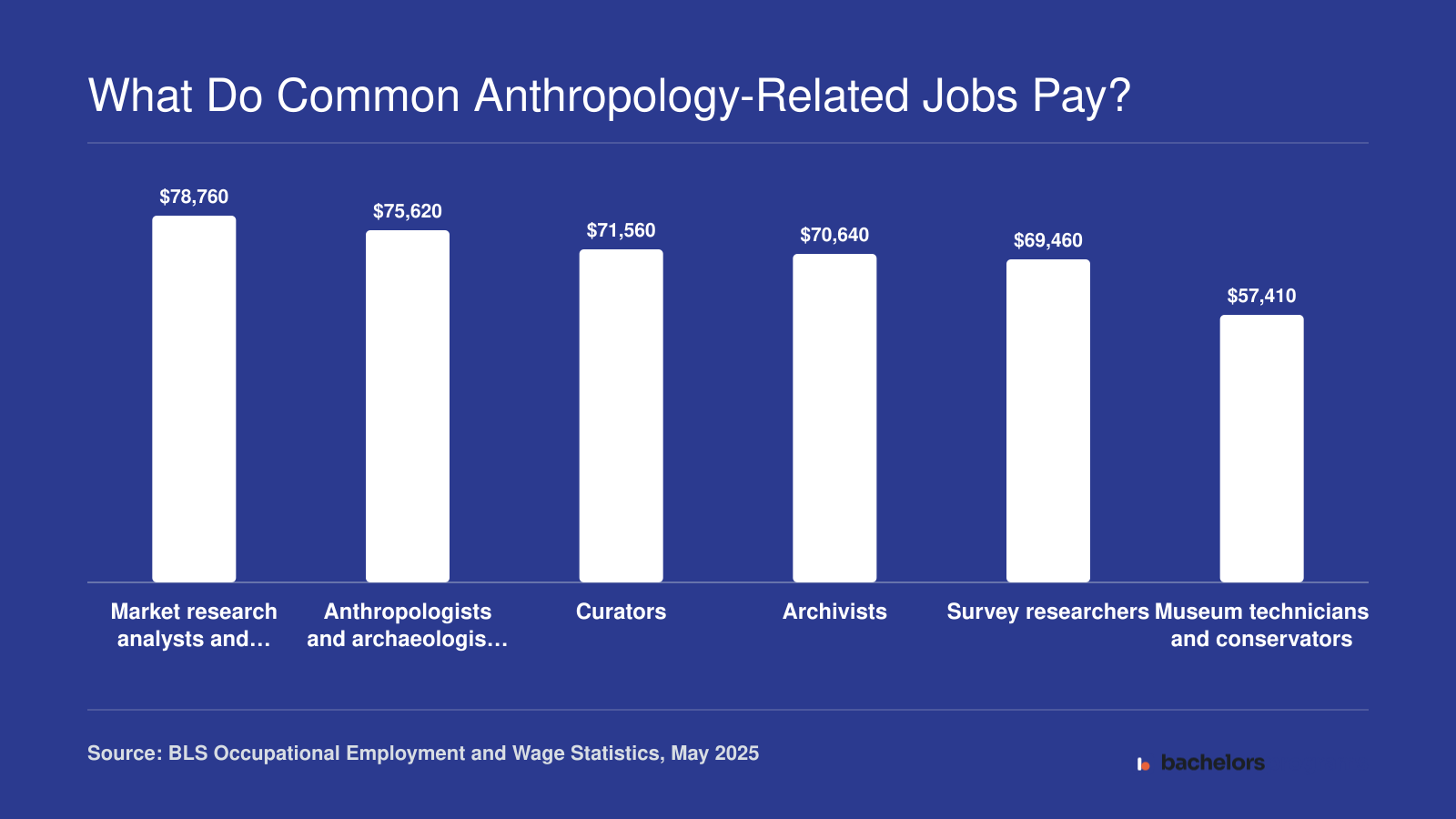
What Do Common Anthropology-Related Jobs Pay?
Market research analysts and marketing specialists earn the highest median wage among these occupations, and museum technicians and conservators earn the lowest. Market research and museum technician roles are commonly entered with a bachelor's degree, while anthropologists and archaeologists, curators, archivists, and survey researchers typically need a master's degree. BLS publications show slightly different medians for anthropologists and archaeologists; this chart uses the occupational wage release figure.
Questions to Ask Yourself
Are you more curious about cultures and human variation over time, or about modern institutions and survey data?
Does your interest center on ancient sites and material remains?
Are you leaning toward medicine or genetics?
How to Choose an Anthropology Degree Program
The schools ranked here differ in focus, cost and format. Work through these checks before you apply or declare.
- Confirm institutional accreditationNo separate programmatic accreditor exists for undergraduate anthropology. A program counts as accredited when its college holds institutional accreditation from an agency recognized by the U.S. Department of Education. The Department does not accredit programs itself. It publishes the list of recognized agencies. Accreditation matters for federal aid and transfer credit, but it does not guarantee department quality or a job.
- Ask about archaeology field schoolsIf archaeology interests you, ask whether the department runs a field school and whether it meets Register of Professional Archaeologists (RPA) field school standards. RPA certification reviews the field school's training, not the degree. It matters most if you plan on cultural resource management or archaeology graduate study.
- Review faculty and research accessCheck faculty expertise across cultural, archaeological, biological and linguistic anthropology. Look for labs, museum collections and research projects that undergraduates can join.
- Compare net price and debtUse the cost table above to weigh net price after aid and typical borrowing for each program, not just the sticker price.
- Match the format to the fieldworkDecide between campus, online or hybrid study. If you study online, ask how field and lab requirements are completed.
- Weigh neighboring majorsBefore declaring, compare anthropology with sociology, archaeology, human biology and geography to see which best fits your goals.
Anthropology programs by state
Compare Anthropology programs on the data that matters
Explore more Science & Engineering majors or browse every field of study.
All Science & Engineering programs Browse every field of study