Best Biochemistry Degree Programs
Compare 930+ accredited Biochemistry programs at 900+ colleges, with net price after aid, graduation rates, earnings and debt from IPEDS and the U.S. College Scorecard.

A bachelor's degree in biochemistry is a four-year undergraduate major that applies chemistry to living systems: proteins, enzymes, metabolism, and the molecules behind disease. Schools award it as a Bachelor of Science (B.S.) or Bachelor of Arts (B.A.) in Biochemistry, often at about 120 credit hours with organic chemistry, physics, and extended lab work.
Every program listed is a bachelor's program, not graduate study. That matters because the major works as a launchpad. Yale reports that three quarters of its majors go on to PhD or MD programs, so the degree often pays off most after the first job.
Key Points
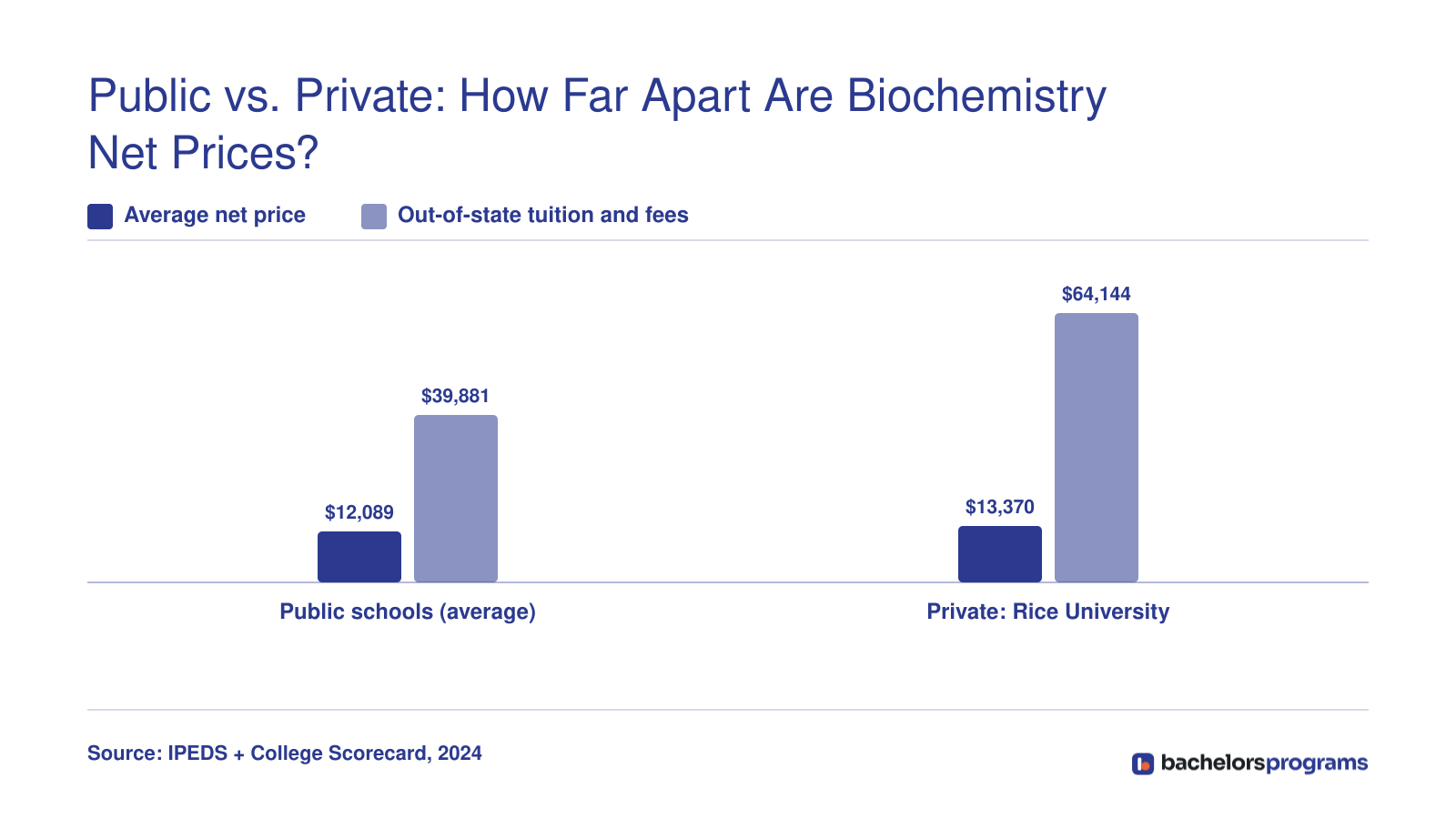
- Ranked public schools average $12,089 net per year, near Rice's $13,370.
- Plan on four full-time years and roughly 120 credit hours; online options are rare.
- A biochemistry degree's biggest career payoff usually comes after graduate school.
Top 10 Schools for a Bachelor's Degree in Biochemistry
The ten programs below pair rigorous chemistry and biology coursework with substantial laboratory time, and several build a senior thesis or capstone into the degree. Each entry also notes the average net price after aid at that school and the share of its students who finish.
California Institute of Technology
#1Pasadena, CA · ~$16,000/yr (est.)
Best for: Aspiring researchers wanting a thesis-driven track
Caltech is a small Pasadena institute where undergraduates get into research early, and its chemistry option carries a biochemistry track with four required laboratory courses and a three-term senior thesis. Schools offering this program graduate 94% of students, and the average net price after aid comes to about $16,075. Instruction is on campus, and the institute admits a very small, highly selective class.
- Diploma reads Chemistry (Biochemistry)
- 486 total units required for Institute graduation
- Four required laboratory courses
- At least 36 units of advanced biology or chemistry electives
- Three-term senior thesis in biochemistry required
- Up to 27 units each of Ch 80 and Ch 82 can count toward the degree
University of Florida
#2Gainesville, FL · ~$7,000/yr (est.)
Best for: Florida residents seeking a large public research campus
The University of Florida brings a 120-credit biochemistry major, split into two concentration options, to a large public research campus in Gainesville. Undergraduates can join faculty labs, and the UFTeach minor adds Florida teacher certification. Schools offering this program graduate 91% of students, and the average net price after aid is about $6,541. Instruction is on campus.
- 120 total credits; the major totals 62 to 69 credits
- Two concentration options
- Exit exam: DUCK, 30 of 60 to pass
- Minimum grade of C within two attempts
- 15 major core credits must be taken at UF
- Undergraduate research can lead to publications
- UFTeach minor adds Florida teacher certification
- Listed among the top five nationally in chemistry PhD production
University of California-Los Angeles
#3Los Angeles, CA · $13,000/yr (est. net price)
Best for: Pre-med students seeking funded undergraduate lab research
UCLA awards a Bachelor of Science in Biochemistry and backs it with a deep research infrastructure: 32 undergraduates received funded 2026 research fellowships, and a new first-year course helps incoming majors build academic skills early. Schools offering this program graduate 93% of students. Graduates earn a median $73,506 four years after finishing, and the average net price after aid is about $12,548. Instruction is on campus.
- Bachelor of Science in Biochemistry
- New Chemistry and Biochemistry 1 course for first-year majors
- 32 undergraduates received funded 2026 research fellowships
- Median earnings of $73,506 four years after finishing
- Coursework catalog published annually in PDF and HTML
University of Chicago
#4Chicago, IL · ~$15,000/yr (est.)
The University of Chicago's Biological Chemistry major joins the Department of Chemistry with the Department of Biochemistry and Molecular Biology, and honors students write a research thesis and defend it in an oral presentation. A chemistry placement test is required even for students holding AP credit. Schools offering this program graduate 96% of students, and the average net price after aid is about $14,860. Instruction is on campus.
- Joint major across Chemistry and Biochemistry and Molecular Biology
- Chemistry Placement Test required, even with AP Chemistry credit
- AP Chemistry score of 5 earns credit for CHEM 11100
- No credit for IB Chemistry
- Honors requires a research thesis, oral presentation, and 3.0 GPA
- Joint BS/MS in Chemistry available
- Undergraduate research can count for course credit
University of Washington-Seattle Campus
#5Seattle, WA · ~$14,000/yr (est.)
The University of Washington's Seattle campus offers a 193-credit Bachelor of Science in Biochemistry with regular and honors sequences in mathematics, physics, and chemistry, plus three required biochemistry courses and a laboratory. Up to 9 credits of advanced undergraduate research can count toward science electives, and a petition may substitute research for the lab. Schools offering this program graduate 85% of students, and the average net price after aid is about $14,091. Instruction is on campus.
- 193 total credits for the Bachelor of Science
- Minimum 2.50 cumulative major and overall GPA
- Required courses include BIOC 440, 441, and 442
- Up to 9 credits of advanced undergraduate research count as electives
- Regular or honors sequences in math, physics, and chemistry
- Research petition may replace the biochemistry laboratory
Yale University
#6New Haven, CT · ~$24,000/yr (est.)
Yale offers both a Bachelor of Arts and a Bachelor of Science in Molecular Biophysics and Biochemistry, with six concentrations including Biochemistry, Biophysics and Structural Biology, and Chemical Biology. A one-credit senior essay is required either way, and the department reports that three quarters of graduates enter PhD, MD, or MD/PhD programs. Schools offering this program graduate 96% of students, and the average net price after aid is about $23,777. Instruction is on campus.
- B.A. requires 9.5 course credits; B.S. requires 12.5
- One-credit senior essay required for both degrees
- Six concentrations, including Biochemistry and Chemical Biology
- Biochemistry concentration adds genetics and advanced chemical biology
- Three quarters of graduates enter PhD, MD, or MD/PhD programs
- Simultaneous B.S./M.S. option available
University of California-Berkeley
#7Berkeley, CA · ~$13,000/yr (est.)
UC Berkeley houses biochemistry inside its Molecular and Cell Biology major, where the Biochemistry, Biophysics and Structural Biology emphasis offers two tracks built on core courses, a genetics course, a lab, and electives. The College of Chemistry supports an active biochemistry research community with faculty work in the field. Schools offering this program graduate 93% of students, and the average net price after aid is about $13,481. Instruction is on campus.
- Bachelor of Arts with an emphasis in Biochemistry, Biophysics and Structural Biology
- Two tracks within the emphasis
- Each track requires core courses, genetics, a lab, and electives
- Lower-division prep includes general and organic chemistry, biology, and physics
- Six emphases available within the major
- Seven-course breadth requirement
University of Georgia
#8Athens, GA · ~$14,000/yr (est.)
The University of Georgia awards a Bachelor of Science in Biochemistry and Molecular Biology that requires two semesters of laboratory research, often an independent project in a faculty member's lab. Required coursework runs 36 to 38 hours, students add 12 hours of major electives, and Double Dawgs pathways link the degree to several master's programs. Schools offering this program graduate 90% of students, and the average net price after aid is about $13,936. Instruction is on campus.
- 120 credits, with 36 to 38 hours of required major courses
- Two semesters of laboratory research required
- 12 hours of major electives
- Double Dawgs BS/MS pathways in several fields
- Coursework includes Physical Biochemistry and Human Biochemistry and Disease
- Biochemistry Undergraduate Student Association (BUSA)
The University of Texas at Austin
#9Austin, TX · ~$20,000/yr (est.)
UT Austin's 120-hour Bachelor of Science in Biochemistry places 81 hours in the major and finishes with a capstone chosen from research, honors research, biotechnology, or a supervised literature review. Students need at least 21 upper-division hours and 12 upper-division chemistry hours taken in residence. Schools offering this program graduate 89% of students, and the average net price after aid is about $19,857. Instruction is on campus.
- 120 semester hours, with 81 hours in the major
- Capstone options include research, honors research, and biotechnology
- At least 21 upper-division hours required
- 12 upper-division chemistry hours must be in residence
- Minimum grade of C- in each required math and science course
- 2.00 GPA required in math and science courses
- Advising required every semester
Georgia Institute of Technology
#10Atlanta, GA · ~$12,000/yr (est.)
Georgia Tech's 122-credit Bachelor of Science in Biochemistry includes biophysical chemistry, quantitative chemical analysis, two biochemistry laboratories, and a chemistry seminar. Up to 12 credits of undergraduate research count toward the degree, though pass-fail and VIP courses apply only as free electives. Schools offering this program graduate 94% of students, and the average net price after aid is about $12,116. Instruction is on campus.
- 122 total credits
- Two biochemistry laboratories plus a chemistry seminar
- Up to 12 credits of CHEM 4699 research counts toward the degree
- Pass-fail and VIP courses count only as free electives
- Biology electives include immunology, microbiology, and drug design
- Quantitative Chemical Analysis and Biophysical Chemistry required
Cost & outcomes by school
Federal data for the highest-earning Biochemistry programs, independent of the ranking above. Earnings are this field's bachelor's graduates four years after completing where the Scorecard reports them, else the school's undergraduate median.
| School | Net price / yr | Grad rate | Earnings | Debt | Grads/yr | Format |
|---|---|---|---|---|---|---|
| California Institute of Technology CA | $16,075 | 94% | $128,566 | — | — | Campus |
| Carnegie Mellon University PA | $31,944 | 94% | $114,862 | $21,750 | 3 | Campus |
| University of Pennsylvania PA | $28,699 | 97% | $111,371 | $15,715 | 51 | Campus |
| Claremont McKenna College CA | $28,849 | 91% | $104,736 | $13,500 | 4 | Campus |
| Cornell University NY | $28,690 | 95% | $104,043 | $14,000 | — | Campus |
| Georgetown University DC | $40,815 | 95% | $103,494 | $15,500 | 13 | Campus |
| Columbia University in the City of New York NY | $21,590 | 96% | $102,491 | $21,500 | 27 | Campus |
| Yale University CT | $23,777 | 96% | $100,533 | $12,975 | 40 | Campus |
| University of Notre Dame IN | $26,780 | 95% | $99,980 | $17,103 | 23 | Campus |
| Duke University NC | $29,612 | 97% | $97,800 | $13,000 | 1 | Campus |
| Dartmouth College NH | $29,519 | 96% | $97,434 | $17,500 | — | Campus |
| Washington and Lee University VA | $23,781 | 94% | $94,810 | $19,500 | 17 | Campus |
Sources: U.S. Department of Education. Net price, graduation rate, earnings and debt: College Scorecard (earnings and debt for this field's bachelor's graduates where reported, else school-wide); graduates: IPEDS. A dash means no figure is reported.
Cost, debt & payoff
Median earnings of this field's bachelor's graduates (4 yrs after completing, else the school's undergraduate median) vs. their median federal loan debt · U.S. College Scorecard
Across these programs the median graduate earns about $57,912 and finishes with roughly $23,250 in debt — a ratio that clears a common rule of thumb (keep debt below first-year salary). Net price and debt vary widely school to school, so check the per-school figures in the table above before you shortlist.
How We Ranked These Biochemistry Schools
A fair biochemistry ranking compares like with like, and that means bachelor's programs only. Graduate programs are excluded, unlike competitor lists that blend undergraduate and graduate offerings and muddy the numbers a prospective student actually needs.
The figures come from College Scorecard and IPEDS: net price, graduation rate, program-level earnings, debt, and admissions selectivity.
Why ASBMB accreditation matters
The American Society for Biochemistry and Molecular Biology (ASBMB) runs a national, independent, outcomes-based review of undergraduate programs.1 It accredits the program, not the whole institution.1 Applicants must offer a B.A. and/or B.S., show a well-rounded curriculum, and document at least 400 laboratory hours (as of the 2022 cycle), along with support for student research.3 ASBMB reports accrediting 120 programs since 2013.5 Its "Schools with ASBMB-Accredited Programs" page lists current schools by state with a primary contact.
Accreditation also makes a program eligible to administer the ASBMB certification exam:
- Who can sit for it: Juniors and seniors in accredited programs, with one attempt each, so ASBMB recommends the final year.4
- Format: Electronic, 12 mostly free-response questions in 60 minutes.4
- Results: Proficient or advanced proficiency, which lets you compare yourself nationally regardless of school prestige.2
Programs are invited, not required, to offer it, and some make it optional.4 In 2026, 911 exams were given at 87 accredited programs.4 Ask any school you consider whether it administers the exam.
Limits of the data
Graduation rates are school-wide, so they describe the university, not its biochemistry majors specifically. Some programs also lack published earnings, and where that is the case we leave the figure out rather than estimate it. Treat the rankings as a starting point, then confirm accreditation status directly with ASBMB and the school.
What a Biochemistry Degree Costs: Net Price, Debt, and Monthly Payments
Published tuition is a poor guide to what a biochemistry degree costs. The gap between sticker price and net price varies widely by school, and it shifts depending on where you live.
Sticker Price vs. Net Price
In-state tuition is lowest at the University of Florida ($6,381) and Florida State ($6,517). It climbs to $8,994 at UNC Chapel Hill and $18,848 at the University of Michigan. Out-of-state rates run much higher: $28,659 at Florida, $41,203 at UNC, and $63,081 at Michigan. Rice University, a private school, lists tuition of $61,247 for everyone.
Net price is the average a student pays after grants and scholarships. It tells a different story. Florida averages $6,541, Florida State $11,297, UCLA $12,548, Berkeley $13,481, and the University of Washington $14,091. Rice averages $13,370, which falls inside the range of the public schools despite a sticker price several times higher.
Treat these as averages. A student from a lower-income family may pay far less, and one who gets little aid may pay more.
Debt and Monthly Payments
Where program-level federal debt is published, the medians for biochemistry graduates are modest:
- Rice: $7,500 median debt, about $80 a month over 10 years.
- UCLA: $14,753 median debt, about $156 a month.
- Washington: $14,014 median debt, about $149 a month.
- Michigan: $17,095 median debt, about $181 a month.
- Florida State: $17,625 median debt, about $187 a month.
- Georgia: $20,750 median debt, about $220 a month.
- Georgia Tech: $24,250 median debt, about $257 a month.
Programs with no figure listed here simply have no published program-level number.
A Practical Tip
Run the net price calculator on every school's financial aid page before you rule anything out. Each takes about 15 minutes and uses your family's finances to estimate your own cost. For many students, the result lands well below the published tuition, and it can change which school ends up cheapest.
Public vs. Private: How Far Apart Are Biochemistry Net Prices?
Public universities make up most of the schools ranked here. Their average net price of $12,089 a year is close to the $13,370 net price at Rice University, the private option on this list. Published prices tell a different story: out-of-state tuition and fees average $39,881 at the public schools, while Rice lists $64,144 for every student. That puts the gap between sticker price and net price at about $50,800 at Rice, compared with roughly $27,800 at the publics. The sticker-to-net gap is often widest at private schools, so run a private program through its net price calculator before ruling it out.
Related Articles
Earnings and Return on Investment by Biochemistry Program
Biochemistry has become one of the most graduate-school-bound undergraduate majors, which makes early paychecks a misleading yardstick. Program-level numbers show how wide the spread is, so every figure below carries its time window.
Median Earnings, One Year and Five Years Out
- UC Davis: $42,266 one year after completion, $87,815 five years after.
- UCLA: $35,210 one year after completion, $76,967 five years after.
- BYU: $31,225 one year after completion, $66,498 five years after.
- Brown: $43,637 one year after completion. A five-year figure is not reported.
- Rice: $67,158 five years after completion. A one-year figure is not reported.
Why Early Pay Can Look Low
About 84 percent of Brown's biochemistry graduates were working one year out, compared with roughly 93 percent at UC Davis and BYU and 91 percent at UCLA. A lower share working often means more graduates went straight into medical school or a PhD track. Their earnings are not yet in the median, so a modest one-year number does not always signal a weak outcome.
What the ROI Ratio Does and Does Not Tell You
Brown (8.18), Rice (8.16) and Yale (7.75) post the strongest return-on-investment ratios among the schools here. That ratio is a rough proxy. It is built from institution-wide earnings and debt, not from biochemistry graduates alone. Treat it as a tiebreaker for schools you already like, not a promise about your own paycheck.
Compare Like With Like
Do not set one program's one-year earnings against another's five-year earnings. Rice's $67,158 at five years says nothing about how it stacks up against Brown's $43,637 at one year. Match the window first, then compare. Small graduating classes, such as Brown's 29 completions, can also swing a median from year to year.
What Can You Do With a Biochemistry Degree?
A bachelor's degree in biochemistry gets you into the lab quickly, but its biggest payoff usually comes after further study. Knowing where the degree stops and where graduate training starts helps you plan realistically.
Entry-Level Roles Open With a Bachelor's
Graduates commonly start in hands-on science jobs such as:
- Laboratory or biochemical technician: Running experiments, preparing samples, and maintaining equipment for a research team.
- Quality control analyst: Testing materials and products in pharmaceutical, food, or biotech settings to confirm they meet standards.
- Research associate: Supporting biotech and pharma scientists with assays, data collection, and documentation.
The closest federal benchmark is biological technicians, for which the Bureau of Labor Statistics lists a bachelor's degree as the typical entry requirement.1 That occupation had a median annual wage of $57,510 in May 2025, with employment projected to grow 7% from 2025 to 2035.1 These jobs are a solid start, but they are not the top of the pay scale.
The Biochemist Title Usually Requires a Ph.D.
In BLS terms, "biochemist" is a research occupation, and independent research and development work generally calls for a doctorate.3 BLS lists a doctoral or professional degree as the typical entry credential for biochemists and biophysicists.2 Some bachelor's and master's holders do qualify for entry-level positions, and many Ph.D. holders begin in temporary postdoctoral research roles.3
The reward for that extra training is substantial. Biochemists and biophysicists earned a median of $127,410 a year in May 2025, and BLS projects 12% employment growth from 2025 to 2035.2 Both figures sit well above the technician numbers.
Pre-Med and Other Graduate Paths
Biochemistry is a natural pre-med major because its coursework in metabolism, molecular biology, and organic chemistry overlaps heavily with the science content on the MCAT. You can major in biochemistry and still complete the usual medical school prerequisites without much extra planning. Admission depends on your GPA, test score, clinical experience, and overall application, not on the name of your major.
Medicine is only one route. Biochemistry graduates also move on to:
- Ph.D. programs: The standard path to leading independent research in academia or industry.
- Pharmacy school: A fit for students drawn to drug action and metabolism.
- Dental school: Biochemistry coursework covers much of the science foundation these programs expect.
- Patent law: Law school plus a strong science background can lead to work protecting biotech and pharmaceutical inventions.
The Takeaway
Treat the bachelor's degree as a strong start, not a finish line. It qualifies you for technician and associate roles right away, and it builds the base for the doctoral, medical, pharmacy, and legal credentials where earning power rises most. If you plan to stop at four years, aim for programs that offer undergraduate research and industry internships, since those experiences carry the most weight in entry-level hiring.
Biochemist Median Pay Nationally
A bachelor's degree in biochemistry is the starting point for a research career, and the national pay figure shows where that path can lead.
How Long a Biochemistry Degree Takes, and Whether You Can Study Online
Fully online biochemistry degrees remain the exception, even as many other science majors have moved partly or wholly off campus.
How Long It Takes
Expect about four years of full-time study and roughly 120 credit hours. The University of Florida, the University of Georgia, and UT Austin list 120 credits, Georgia Tech lists 122, and Gannon's ACS-certified curriculum requires at least 125.2 Totals vary by school, so check the catalog for the program you are considering.
Ways to Finish Sooner
- AP/IB credit: Policies differ widely. The University of Chicago, for example, awards credit for a 5 on AP Chemistry but none for IB Chemistry.
- Summer terms: Knocking out general chemistry, calculus, or physics over the summer can open room for upper-level courses.
- Community college transfer: Arriving with organic chemistry finished helps most, though the receiving school decides what counts.
- Combined degrees: Yale offers a simultaneous B.S./M.S. option, Chicago a joint B.S./M.S. in Chemistry, and Georgia offers Double Dawgs pathways. Ask how these affect your bachelor's timeline.
Studying Online
Labs are the obstacle. Organic chemistry and biochemistry labs depend on specialized equipment and supervised instruction, which is why few schools offer the major remotely.
Arizona State University is the clearest verified example. It offers an online B.A., an online B.S., and an online B.S. with a medicinal chemistry concentration, each requiring 120 credits.1 Many physics and general chemistry labs can be completed at home with lab kits, but organic chemistry and biochemistry labs must be done in person at the Tempe campus.1 ASU also says some courses may be completed at an approved accredited institution near you, though equivalency is not guaranteed.
Outside ASU, we could not confirm another school with clearly documented online or hybrid lab arrangements. Every school ranked here lists on-campus delivery, so plan on in-person labs unless a program tells you otherwise in writing.
Questions to Ask Yourself
Do you want a B.S. with physical chemistry and calculus-based physics, or a B.A. with more flexibility?
Can you join a faculty research lab by sophomore year?
Does the school have a pre-health advising office that tracks medical school acceptance rates?
Is the major standalone biochemistry or combined with molecular biology?
Biochemistry programs by state
Compare Biochemistry programs on the data that matters
Explore more Science & Engineering majors or browse every field of study.
All Science & Engineering programs Browse every field of study