Best Chemistry Degree Programs
Compare 1,200+ accredited Chemistry programs at 1,050+ colleges, with net price after aid, graduation rates, earnings and debt from IPEDS and the U.S. College Scorecard.
A chemistry bachelor's degree often costs far less than its sticker price, and how much less varies widely from one school to the next. Schools award it as a Bachelor of Science (B.S.) or Bachelor of Arts (B.A.) in Chemistry.
Among the schools ranked here, average net price after aid runs from $6,128 at Princeton to $20,111 at MIT, even though both list tuition and fees above $62,000. The University of Florida sits near the low end at $6,541.
Price is only one variable. Research access, required lab hours and ACS approval vary just as much between departments, and those differences shape what a graduate can do on day one.
Key Points
- Princeton's $62,688 tuition averages just $6,128 after grants and scholarships.
- UC San Diego and UC Davis report the highest chemistry graduate earnings.
- The American Chemical Society reports 699 approved chemistry programs nationwide.
Best Chemistry Schools at a Glance: Top 10 Bachelor's Programs
Below are ten chemistry departments ordered on a blend of cost after aid, student outcomes and completion data. Each card carries net price, institution-wide graduation rate, delivery format, city and state, plus chemistry-specific earnings wherever the federal data reports them.
University of Florida
#1Gainesville, FL · ~$7,000/yr (est.)
Best for: Florida residents seeking public-university value
Florida's flagship public university awards an ACS-approved bachelor's degree in chemistry with Standard Chemistry and Biochemistry tracks, and students at this school graduate at 91%. Net price after aid comes to about $6,541, the lowest on this list, and chemistry graduates earn a median of $56,179 four years after finishing. Required courses run every fall and spring, and undergraduates are encouraged to join faculty research groups.
- 120 total credit hours; major coursework runs 59 to 64 credits
- 25 to 30 foundation credits in general chemistry, calculus and physics
- 34 credits of organic, analytical, inorganic and physical chemistry with labs
- Exit exam (DUCK) requires a score of at least 30 out of 60
- Minimum grade of C in required courses, within two attempts
- At least 15 major core credits must be taken at UF
- ACS-approved program with an ACS-certified degree option
- UFTeach option pairs the degree with a science teaching minor
- 120 total credit hours; the biochemistry major runs 62 to 69 credits
- Track built around a biological focus rather than standard chemistry
- Undergraduate research with faculty encouraged
- Required courses offered every fall and spring
- Ranked in the top five nationally for PhD production
University of California-Berkeley
#2Berkeley, CA · ~$13,000/yr (est.)
Best for: Aspiring materials chemists eyeing research careers
Berkeley's College of Chemistry awards a B.S. in Chemistry built on inorganic, organic and physical chemistry, with added work in analytical, nuclear and biophysical chemistry and chemical biology. Students at this school graduate at 93%, and chemistry graduates report a median of $82,386 four years after finishing, the highest figure in this top 10. Net price after aid is about $13,481.
- 120 units required for graduation
- Materials Chemistry concentration available
- Coursework in inorganic, organic and physical chemistry
- Specialized courses in analytical, nuclear and biophysical chemistry
- Lab work in synthesis, spectroscopy and physical chemical measurement
- Undergraduates can join a research group
- Prepares students for careers as professional chemists
Princeton University
#3Princeton, NJ · ~$6,000/yr (est.)
Best for: Independent researchers who want a senior thesis
Princeton awards the A.B. in chemistry through a department that requires eight courses, four semesters of independent work and a senior thesis defended before a faculty panel. Students at this school graduate at 98%, and net price after aid is about $10,320. A track leading to American Chemical Society certification adds analytical chemistry and biochemistry, and juniors may spend spring abroad.
- Eight departmental courses required for the major
- Three 300- or 400-level courses in organic, physical and inorganic chemistry
- One term of experimental laboratory instruction
- Four semesters of independent work, CHM 397 through CHM 498-499
- Senior thesis plus oral presentation to three or four faculty
- Four cognates from molecular biology, engineering, geoscience and others
- ACS certification track adds analytical chemistry and biochemistry
- Study abroad in junior spring can cut one cognate per semester
University of North Carolina at Chapel Hill
#4Chapel Hill, NC · ~$12,000/yr (est.)
UNC-Chapel Hill's B.S. in Chemistry moves students through organic, inorganic, physical, analytical and biological chemistry, with biochemistry and polymer tracks for specialization. Students at this school graduate at 91%, and chemistry graduates earn a median of $64,981 four years after finishing. Net price after aid is about $11,655, and majors meet a departmental advisor before registering beyond the fourth term.
- Four-year major spanning organic, inorganic, physical and analytical chemistry
- Biochemistry and polymer tracks available
- Majors meet a departmental advisor before the fifth term
- Undergraduate research and study abroad opportunities
- Graduates most often enter chemical manufacturing, food and pharmaceutical work
University of California-Los Angeles
#5Los Angeles, CA · $13,000/yr (est. net price)
UCLA's Department of Chemistry and Biochemistry awards B.S. degrees in chemistry, biochemistry and general chemistry to a department of nearly 1,200 undergraduates. Students at this school graduate at 93%, chemistry graduates earn a median of $72,220 four years after finishing, and net price after aid is about $12,548. Teaching and research occupy buildings stocked with eight X-ray diffractometers, eight high-field NMR spectrometers and seven mass spectrometers.
- Separate majors in chemistry, biochemistry and general chemistry
- 45 full-time professors plus 10 research-active emeriti
- Department enrolls nearly 1,200 undergraduates
- Facilities include eight high-field NMR spectrometers from 200 to 600 MHz
- Eight X-ray diffractometers and seven mass spectrometers
- Chemistry library holds over 62,000 volumes and 700 journals
- Faculty hold three Nobel Prizes in Chemistry
University of California-Irvine
#6Irvine, CA · $14,000/yr (est. net price)
UC Irvine's Chemistry, B.S. pairs a three-quarter general chemistry sequence and a full year of organic chemistry with advanced analytical and physical chemistry coursework. Students at this school graduate at 87%, chemistry graduates earn a median of $74,810 four years after finishing, and net price after aid is about $14,251. Seven optional concentrations run from Chemical Biology and Medicinal Chemistry to Nuclear and Radiochemistry.
- Three-quarter general chemistry lecture and lab sequence
- Full year of organic chemistry with laboratories
- Three-quarter physical chemistry sequence, CHEM 132A through 132C
- At least five upper-division electives, two lectures and two labs
- Seven optional concentrations, including Medicinal and Environmental Chemistry
- Optional ACS-certified degree requires undergraduate research and a thesis
- Honors admission requires a 3.3 GPA
University of Michigan
#7Ann Arbor, MI · $18,000 – $61,000/yr (est.)
Michigan's LSA chemistry programs lead to a Bachelor of Science, with a specialized B.S. in Chemistry at 124 credits and a leaner Chemical Science major at 120. Students at this school graduate at 93%, chemistry graduates earn a median of $65,591 four years after finishing, and net price after aid is about $13,138. Honors requires a 3.4 GPA plus a thesis built on undergraduate research, and a teaching certificate in chemistry is available through the School of Education.
- Specialized B.S. in Chemistry runs 124 credits
- Chemical Science major requires 24 major credits and 120 total
- Major GPA of 2.0 required, with a C- recommended in core courses
- Honors needs a 3.4 overall and major GPA plus a research thesis
- Teaching certificate in Chemistry offered through the School of Education
- Joint program with the College of Engineering
University of Chicago
#8Chicago, IL · ~$15,000/yr (est.)
The University of Chicago offers both a B.A. and a B.S. in Chemistry through the College, and the B.S. can add one of five tracks: Physical, Organic, Inorganic, Materials or Chemical Biology. Students at this school graduate at 96%, and net price after aid is about $14,860. Honors requires a 3.0 GPA, a research paper and an oral presentation, and a five-course chemistry minor is available.
- At least eight chemistry courses beyond the general education requirement
- Leaves room for double majors and interdisciplinary work
- Five-course chemistry minor available
- Chemistry Placement Test required for first-year and transfer students
- ACS-accredited B.S. typically requires twelve chemistry courses
- Five tracks: Physical, Organic, Inorganic, Materials and Chemical Biology
- Joint B.S./M.S. in Chemistry and Biological Chemistry offered
- Honors requires a 3.0 GPA, a research paper and an oral presentation
University of California-San Diego
#9La Jolla, CA · $10,000 – $15,000/yr (est.)
UC San Diego's Chemistry BS requires 122 to 126 units and carries automatic American Chemical Society certification for every major. Students at this school graduate at 86%, chemistry graduates earn a median of $77,249 four years after finishing, and net price after aid is about $12,470. Five advanced laboratory courses and three quarters of physical chemistry anchor the upper division.
- 122 to 126 units, split between 66 lower-division and 56 to 60 upper-division
- Automatic American Chemical Society certification for chemistry majors
- Three quarters of physical chemistry and two quarters of inorganic chemistry
- Five advanced laboratory courses required
- At least 48 upper-division chemistry units completed in residence
- No more than one D allowed in upper-division major coursework
- Honors track requires a 3.2 overall GPA
- Separate BS options in Environmental Chemistry and Molecular Synthesis
Massachusetts Institute of Technology
#10Cambridge, MA · ~$20,000/yr (est.)
MIT awards a Bachelor of Science in Chemistry built on the General Institute Requirements, required lecture subjects and the URIECA laboratory modules. Students at this school graduate at 96%, and net price after aid is about $20,111, the highest on this list. The ChemFlex option lets students substitute a 36-unit approved focus area such as Chemical Physics, Computational Chemistry or Materials Chemistry.
- ACS-certified degree built on the General Institute Requirements
- Required subjects include inorganic, biological and organic chemistry
- Thermodynamics I and II, kinetics, spectroscopy and electronic structure
- At least three of twelve URIECA laboratory modules
- 5.39 research subject can replace part of the lab requirement
- ChemFlex option substitutes a 36-unit approved elective focus area
- Sample focus areas: Chemical Physics, Computational Chemistry, Energy, Science Policy
Cost & outcomes by school
Federal data for the highest-earning Chemistry programs, independent of the ranking above. Earnings are this field's bachelor's graduates four years after completing where the Scorecard reports them, else the school's undergraduate median.
| School | Net price / yr | Grad rate | Earnings | Debt | Grads/yr | Format |
|---|---|---|---|---|---|---|
| Massachusetts Institute of Technology MA | $20,111 | 96% | $143,372 | $14,768 | 19 | Campus |
| Harvey Mudd College CA | $35,924 | 92% | $138,687 | $25,000 | 9 | Campus |
| California Institute of Technology CA | $16,075 | 94% | $128,566 | — | 2 | Campus |
| Stanford University CA | $13,807 | 92% | $124,080 | $12,000 | 11 | Campus |
| Carnegie Mellon University PA | $31,944 | 94% | $114,862 | $21,750 | 28 | Campus |
| University of Pennsylvania PA | $28,699 | 97% | $111,371 | $15,715 | 32 | Campus |
| Princeton University NJ | $6,128 | 98% | $110,066 | $10,320 | 24 | Campus |
| Georgetown University DC | $40,815 | 95% | $103,494 | $15,500 | 7 | Campus |
| Georgia Institute of Technology GA | $12,116 | 94% | $102,772 | $21,672 | 32 | Campus |
| Columbia University in the City of New York NY | $21,590 | 96% | $102,491 | $21,500 | 13 | Campus |
| Harvard University MA | $19,066 | 98% | $101,817 | $14,000 | 52 | Campus |
| Yale University CT | $23,777 | 96% | $100,533 | $12,975 | 13 | Campus |
Sources: U.S. Department of Education. Net price, graduation rate, earnings and debt: College Scorecard (earnings and debt for this field's bachelor's graduates where reported, else school-wide); graduates: IPEDS. A dash means no figure is reported.
Cost, debt & payoff
Median earnings of this field's bachelor's graduates (4 yrs after completing, else the school's undergraduate median) vs. their median federal loan debt · U.S. College Scorecard
Across these programs the median graduate earns about $57,514 and finishes with roughly $23,250 in debt — a ratio that clears a common rule of thumb (keep debt below first-year salary). Net price and debt vary widely school to school, so check the per-school figures in the table above before you shortlist.
How We Ranked Chemistry Degree Programs
We rank chemistry degree programs on published numbers rather than reputation: what a bachelor's degree in chemistry costs at each school, what graduates earn, and how many students finish. Every figure traces back to federal data or to the schools themselves, so you can check the work yourself.
The Data Behind the Rankings
Outcomes come from College Scorecard's program-level records for chemistry bachelor's completers, which report earnings and debt for a single program rather than an entire university. Price, graduation and retention figures come from institution-level records, because that is the level at which schools report them.
What We Weigh
- Affordability: average net price, meaning tuition and fees minus grant aid for first-year students who receive federal aid.
- Outcomes: median earnings for chemistry graduates a few years after completion, plus the debt those completers carry.
- Student success: graduation and retention rates for the institution.
- Selectivity context: admit rate and incoming class profile, used to frame a school rather than to reward exclusivity for its own sake.
What These Numbers Cannot Tell You
Net price is an average, not a quote. Your aid offer may look very different, and out-of-state or transfer students often pay more. Graduation rates describe the whole university, not the chemistry department. Some programs do not publish earnings for their graduates, and where that figure is missing we weigh price and completion instead of guessing. The result is a list you can compare line by line, with the same measures applied to every school.
Is a Bachelor's Degree in Chemistry Right for You? B.S. vs. B.A. Explained
Both versions of a bachelor's degree in chemistry cover the core sequence of general, organic, analytical, inorganic and physical chemistry. The difference is how much math, physics and advanced lab work each one adds, and how much room it leaves for other interests. In general, the B.S. suits lab, industry and graduate school goals, while the B.A. suits pre-health, teaching, policy, patent and science-writing paths. Requirements vary by school, so check each program's catalog before you decide.
| Factor | B.S. in Chemistry | B.A. in Chemistry |
|---|---|---|
| Math and physics depth | Usually calculus through multivariable or differential equations, plus a full calculus-based physics sequence | Usually calculus and a more limited physics requirement, sometimes algebra-based |
| Upper-level lab hours | More advanced lab courses, such as instrumental analysis and advanced physical or inorganic lab | Fewer required advanced labs, with a lighter upper-level lab load |
| Elective room for a minor or double major | Limited, because the major requirements take up much of the schedule | More open, which makes a minor or double major easier to fit in |
| Fit for pre-med or pre-pharmacy | Works well, but leaves less space for the extra biology and prerequisites these tracks need | Often a comfortable fit, since electives can cover health-school prerequisites |
| Fit for industry or Ph.D. paths | Stronger preparation for bench scientist, quality control and technical support roles, and for doctoral study | Can lead to these paths, often with added research or coursework |
| Link to ACS-certified tracks | Typically the degree that follows the American Chemical Society certified curriculum | Usually not the certified track, though this varies by school |
| Best suited for | Lab work, industry careers and graduate school | Pre-health, teaching, policy, patent work and science writing |
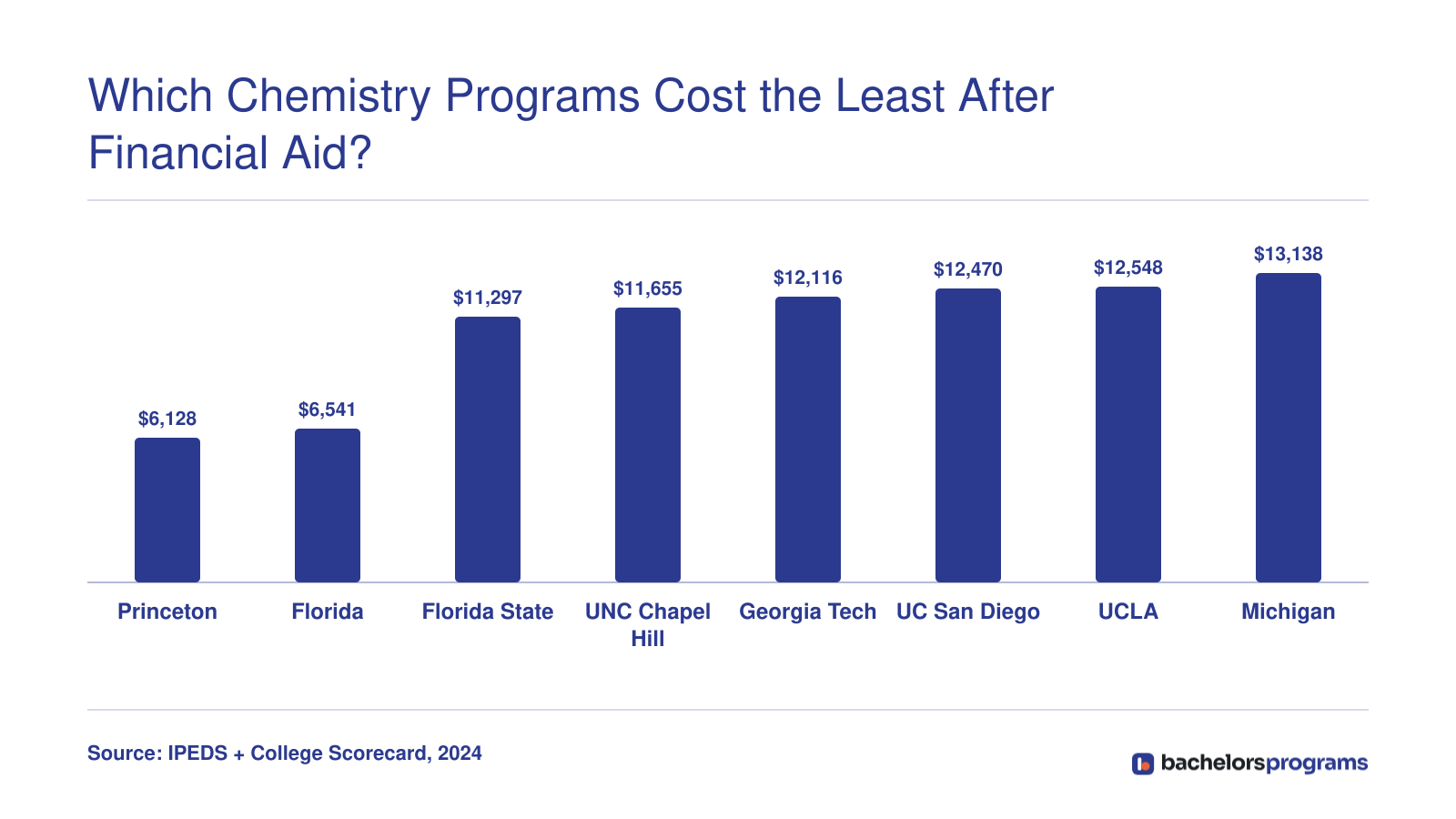
Which Chemistry Programs Cost the Least After Financial Aid?
These affordable chemistry degree programs post the lowest average net prices after grants and scholarships among the schools ranked here. Princeton, the lone private university in the group, lists $62,688 in tuition and fees but averages just $6,128 after aid, while public flagships such as the University of Florida ($6,541 net) start with much lower in-state tuition and add housing and other costs of attendance to reach their net price. Net price is an average across all aided students, so your own cost will rise or fall with your family's income.
Related Articles
Chemistry Degree Salary and Debt by School
Low debt and strong early earnings are two different kinds of value, and the clearest picture comes from reading them side by side. Among the chemistry programs here, the highest reported earnings belong to UC San Diego, UC Davis, UC Santa Barbara, and the University of Maryland, each measured five years after completion. The figures below are chemistry-completer outcomes, not institution-wide averages, so they describe the major rather than the whole campus.
Highest-Earning Chemistry Programs
- UC San Diego: $83,272 median earnings five years after completion, $15,500 median federal debt, and an estimated $170 monthly payment over 10 years.
- UC Davis: $81,776 median earnings five years after completion, $13,000 median federal debt, and an estimated $138 monthly payment over 10 years.
- UC Santa Barbara: $79,458 median earnings five years after completion, $13,993 median federal debt, and an estimated $168 monthly payment over 10 years.
- University of Maryland: $78,447 median earnings five years after completion, $19,000 median federal debt, and an estimated $177 monthly payment over 10 years.
Why First-Year Pay Looks Lower
One year after completion, median earnings at these schools range from $42,204 at UC Davis to $47,197 at UC Santa Barbara. That is well below the five-year figures, and the gap is not a red flag by itself. A meaningful number of chemistry graduates enter graduate or professional school, so their first-year earnings may reflect part-time work, stipends, or no salary at all while they study. The five-year number captures graduates who have had time to move into industry, teaching, or research roles.
The Value Test
Debt changes the comparison. A program with a lower net price and manageable monthly payments can be the better choice even if its earnings figure sits a few thousand dollars below a more expensive school's. Run the numbers together: median earnings at the five-year mark, median federal debt, and the 10-year payment. A low-debt program with solid earnings often beats a high-sticker-price option, and a strong first-year salary is less meaningful if it comes with debt that takes a decade to clear. A high sticker price alone does not disqualify a program, and a low one does not guarantee a good return. Treat first-year pay as a starting point, not a verdict.
ACS-Approved Chemistry Programs Among Our Top Schools
ACS approval is a quality review by the American Chemical Society, the national professional body for chemists. It confirms that a college's chemistry department meets the society's guidelines for curriculum, faculty and laboratory training. ACS reported 699 approved programs in 2025.1 Approval applies to the department, while certification applies to you: students who complete the department's certified track graduate with an ACS-certified bachelor's degree.
What the Certified Track Requires
- Foundation courses: Five courses spanning analytical chemistry, biochemistry, inorganic, organic and physical chemistry.2
- In-depth courses: At least four advanced courses totaling at least 12 semester credits.3
- Lab work: At least 350 hours of in-person lab beyond introductory chemistry, though ACS normally expects about 400.5 At least 220 hours must come from chemistry courses, research or related labs can supply up to 130, and no more than 25% can be computational.4
- Research: ACS expects an undergraduate research experience.5
Where Our Top Schools Stand
Program materials at the University of Florida, Princeton, UC Irvine, the University of Chicago, UC San Diego and MIT reference ACS approval or an ACS certification track. UC San Diego certifies its chemistry majors automatically, while UF and UC Irvine treat certification as an option you choose. For UC Berkeley, UNC Chapel Hill, UCLA and the University of Michigan, confirm status in the ACS directory before assuming either way.
Why It Matters and How to Check
An ACS-certified degree tells graduate admissions committees and industry employers that you have logged substantial hands-on lab time and advanced coursework. If you plan to work as a chemist or pursue a chemistry Ph.D., the certified track is worth choosing. Medical schools do not require it; they focus on prerequisite coursework.
To verify any school, open the ACS Approved Programs Directory on the American Chemical Society website and search by school name or state. Then ask the department two questions: how you enroll in the certified track, and whether research hours count toward the lab requirement.
Undergraduate Research and Concentrations: Forensic, Environmental and Medicinal Chemistry
Two chemistry bachelor's degrees can look identical on paper and still differ in one decisive way: whether research is built into the degree or left as an optional extra.
Research Built Into the Curriculum
Princeton lists a thesis and four semesters of independent research among its chemistry requirements. South Florida offers research as a credit-bearing course, CHM 4970, worth 1 to 3 credits and capped with a short paper or poster.1 Stanford runs a 10-week summer program for its own undergraduates that ends in a report and poster2, while Penn State's chemistry department, with 36 research faculty and more than 200 graduate students, steers students toward NSF-funded summer placements.3 Read those as examples of structure rather than proof that every major at each school must complete a thesis.
Finding a Paid Summer Lab
NSF REU sites pay undergraduates to work in a host lab over the summer, and students apply to the sites directly, not to NSF.4 The REU directory on nsf.gov lets you filter by chemistry and by state.4 Listings usually open in November and December, with deadlines running from January to March.4 Participants must be U.S. citizens, nationals or permanent residents4; cohorts typically run about 10 students, with most coming from outside the host school.5 Arkansas's chemistry REU advertises a $7,000 award and prefers 60 completed credit hours and a 3.0 GPA.6 Rising juniors and seniors are the usual audience, though some sites start students sooner.7
Concentrations and Where They Lead
- Forensic chemistry: crime labs and toxicology units
- Environmental chemistry: regulatory agencies, water and soil testing
- Medicinal and pharmaceutical: drug discovery and development
- Materials chemistry: Berkeley lists it as a named concentration
- Chemistry education: pairs with teaching certification, as at Michigan
Then ask admissions two questions: what share of chemistry majors conduct research, and how early you can join a lab.
Questions to Ask Yourself
Do you need an ACS-certified degree, or would a B.A. with pre-med coursework serve you better?
Can you join a faculty research lab as a sophomore, or only as a senior?
Would a forensic or medicinal concentration narrow your options too early?
Can you realistically attend in-person labs, or do you need a hybrid format?
What Chemical Technicians Earn
Chemical technician roles are a common way into lab work, so their pay is a useful baseline for weighing a bachelor's degree in chemistry.
Chemistry programs by state
Compare Chemistry programs on the data that matters
Explore more Science & Engineering majors or browse every field of study.
All Science & Engineering programs Browse every field of study