Best Data Science Degree Programs in New York
Compare 13 accredited Data Science programs in New York, with net price after aid, graduation rates, earnings and debt from IPEDS and the U.S. College Scorecard.

Data science has moved from a graduate specialty to a standard undergraduate major, and New York schools now teach it under labels like Data Science & AI, Data Science and Machine Learning, and Actuarial and Data Science. A bachelor's degree in data science, most often a Bachelor of Science (B.S.), pairs statistics and programming with a domain focus.
The practical tension is cost against reputation. Columbia and NYU carry national name recognition, while CUNY Lehman College and SUNY Brockport charge far less in-state.
The programs here are based at New York schools, and the focus stays on bachelor's-level work, where program design and employer ties vary widely from school to school.
Key Points
- CUNY Lehman ($7,410) and SUNY Brockport ($8,752) post the lowest in-state tuition.
- Columbia's $71,845 sticker price falls to a $21,590 average net price.
- Data science bachelor's programs at these New York schools favor campus study.
Best Bachelor's in Data Science Programs in New York
These are the ten strongest bachelor's degree programs in data science offered by New York colleges and universities, led by schools that get students to the finish line and keep the net price after aid within reach. Each card below gives the city, the format, any concentration options, and the institution-wide graduation rate, which describes the whole school rather than the major alone. The methodology note at the end of the page explains what carried the most weight.
Columbia University in the City of New York
#1New York, NY · ~$22,000/yr (est.)
Best for: Research-driven statistics and computing students
Columbia runs its data science major jointly through the Computer Science and Statistics departments, and the university's Data Science Institute connects undergraduates to sponsored research, startups, and New York City employers through its Industry Catalyst Network. The institute reaches across 17 schools and 69 departments, so projects and electives can extend into public health, journalism, and engineering. About 96% of Columbia undergraduates finish their degrees, the highest completion rate among the schools listed here. The major is math-forward, with a statistics sequence that runs through probability, inference, and regression.
- 18 total courses split between statistics and computer science
- Joint major run by the Computer Science and Statistics departments
- Honors Mathematics A and B satisfies the mathematics requirement
- Statistics sequence covers probability, inference, and linear regression
- Statistical machine learning or a machine learning alternative required
- Two statistics electives and three computer science electives
- Pass/D/Fail grades and D grades do not count toward the major
- 124 points of credit for the B.A., with advising from both departments
Stony Brook University
#2Stony Brook, NY · ~$19,000/yr (est.)
Best for: Cost-conscious students wanting a math-heavy core
Stony Brook is a public research university on Long Island, and its data science major is a joint effort between Applied Mathematics and Statistics and Computer Science. The program launched for fall 2025 and connects to the university's AI Innovation Institute, giving undergraduates a route into research early. Roughly 76% of Stony Brook students graduate. The curriculum carries noticeably more mathematics than a business analytics degree, and majors can apply to an accelerated bachelor's-to-master's path in data science.
- 58 credits minimum, jointly taught by Applied Math and Computer Science
- 12-credit specialization in Business, Computer Science, or Applied Math
- 3.00 GPA plus B- or better in CSE 114, CSE 214, and one math course
- Two admission cycles: January 5 for spring, June 5 for fall
- 9 credits of upper-division data science technical electives
- C or better required in every course counted toward the major
- Accelerated BS/MS in Data Science open to majors
- Cannot be combined with a Computer Science double major
New York University
#3New York, NY · ~$37,000/yr (est.)
Best for: City students pairing data with a minor
NYU houses its data science bachelor's degree in the College of Arts and Science, where majors take fourteen data science courses and pair them with a minor in another field. That structure turns the degree into applied statistics and machine learning aimed at a subject the student picks, from economics to biology. About 88% of NYU students graduate, and the Greenwich Village location puts internships and part-time industry work within reach. Students begin the data science sequence no later than the spring of sophomore year.
- 128 credits total, including 14 four-credit data science courses
- Pairs the major with a 16-credit minor in another field
- C or better in Principles of Data Science I required to declare
- Coursework spans statistical modeling, machine learning, and causal inference
- Start the data science sequence by spring of sophomore year
- No honors track currently offered
- AP credit accepted for computer science and calculus
SUNY Brockport
#4Brockport, NY · ~$16,000/yr (est.)
SUNY Brockport folds actuarial science and data science into one 120-credit major, so preparation for the Society of Actuaries exams sits alongside R and Python coursework. Any undergraduate can declare the major, and the department builds in an internship or a 400-level mathematics elective. About 55% of Brockport students graduate. The required mathematics sequence runs from Calculus I through real analysis, probability and statistics, and time series, which suits students who want a quantitative rather than a business-facing degree.
- 120 credits total, with 48 credits in the major
- Open to any undergraduate, with no separate admission step
- 2.0 GPA in major courses and C or better in four core math courses
- Coursework prepares students for initial Society of Actuaries exams
- R programming plus Python or object-oriented problem solving
- Internship or a 400-level math course fills the elective requirement
- 15 major credits must be completed at Brockport
- Math sequence runs through real analysis, time series, and probability
Clarkson University
#5Potsdam, NY · ~$30,000/yr (est.)
Clarkson is a private university in Potsdam with an engineering and technology identity, and its data science degree devotes 35 credits to mathematics and statistics. A required professional experience can be met with a co-op or internship, and undergraduates can join faculty research as early as their first year. About 75% of Clarkson students graduate. Twenty-four free electives leave enough room for a minor or a second major alongside the data science core.
- 120 credits, including 35 credits in mathematics and statistics
- 24 free electives, enough for a minor or a second major
- Professional experience requirement, met by a co-op or internship
- Undergraduates can join faculty research in the first year
- Application electives add depth in a chosen domain
- More than 200 student-run clubs and organizations
St Lawrence University
#6Canton, NY · ~$29,000/yr (est.)
St. Lawrence is a small liberal arts university in Canton where data science sits inside the Math, Computer Science, and Statistics Department. Paid summer research with a faculty mentor, off-campus study in more than 20 countries, and a student quantitative club give majors options well beyond the classroom. About 79% of St. Lawrence students graduate. The department also supports a high-performance computing machine and four computer labs that stay open to all students on weekdays.
- Offered as a major and as a minor
- Minor requires seven units: six core courses and one elective
- Paid summer research with a faculty mentor through the University Fellowship
- Off-campus study in more than 20 countries
- Four computer labs open to all students on weekdays
- Q-Club shares research and internship experiences
- Weekly Problem of the Week with points and prizes
Canisius University
#7Buffalo, NY · ~$18,000/yr (est.)
Canisius is a private Jesuit university in Buffalo whose data science degree requires a minor or second major, so graduates leave with a second field attached to the technical core. Sport Data Analytics electives feed a 4+1 path toward a graduate certificate, and students compete in an annual 48-hour analytics sprint using Python, R, and machine learning. About 66% of Canisius students graduate. The coursework balances mathematics and computer science with business intelligence.
- Requires a minor or second major in a complementary field
- Sport Data Analytics electives apply toward a 4+1 graduate certificate
- Annual 48-hour analytics sprint using Python, R, and machine learning
- Students placed first and second in the 2025 Olympiad
- Coursework spans mathematics, computer science, and business intelligence
- Complementary minors include economics, finance, and digital media arts
Siena University
#8Loudonville, NY · ~$34,000/yr (est.)
Siena is a private university in Loudonville, outside Albany, with a data science bachelor's degree split into a standard track and an applied track that adds 18 credits in a chosen subject area. Classes hold 20 students or fewer, the first course assumes no programming experience, and the curriculum was built with input from Amazon, Facebook, Uber, and Verizon. About 75% of Siena students graduate. Students also compete in an annual weekend DataFest.
- Two tracks: Data Science and Applied Data Science
- Applied track adds 18 credits in marketing, health studies, politics, or sports
- Classes capped at 20 students or fewer
- First course teaches Python with no prior experience required
- Incoming data science students receive a free Raspberry Pi
- Curriculum built with input from Amazon, Facebook, Uber, and Verizon
- Annual weekend DataFest competition
Manhattanville University
#9Purchase, NY · ~$21,000/yr (est.)
Manhattanville, in Purchase in Westchester County, awards both a Bachelor of Arts and a Bachelor of Science in data science, and both degrees close with a senior research project that produces working software. Majors meet weekly in a Data Lab that takes on projects from outside organizations, and that work counts as internship credit with a faculty mentor attached. About 58% of Manhattanville students graduate. The BA leaves room for a second major in economics, psychology, or finance, while the BS adds calculus, probability, algorithms, and database design.
- Both a Bachelor of Arts and a Bachelor of Science are offered
- At least 120 credits, ending in a Senior Evaluation research project
- The BA leaves room for a second major in economics, psychology, or finance
- The BS adds calculus, probability, algorithms, and database design
- Weekly Data Lab projects with outside organizations count as internship credit
- A faculty mentor is assigned to each Data Lab team
- Instruction covers computational methods, data structures, and machine learning
CUNY Lehman College
#10Bronx, NY · $3,100/yr (est. net price)
Lehman College is a CUNY senior college in the Bronx, and its Data Science and AI degree runs from data collection and cleaning through machine learning with four concentrations. Students apply the methods to earth science, sociology, business, and mathematics, and the department lists internships, independent study, and scholarships. About 51% of Lehman students graduate. The program also prepares students for master's or doctoral work in artificial intelligence, statistics, or operations research.
- B.S. in Data Science and AI through the Computer Science Department
- Four concentrations: AI, Data Analytics, Data Science Theory, Spatial Data Science
- Curriculum runs from data collection and cleaning to machine learning
- Methods applied to earth science, sociology, business, and mathematics
- Internships, independent study, and scholarships listed by the department
- Prepares students for master's or doctoral study in AI or statistics
Cost & outcomes by school
Federal data for the highest-earning Data Science programs, independent of the ranking above. Earnings are this field's bachelor's graduates four years after completing where the Scorecard reports them, else the school's undergraduate median.
| School | Net price / yr | Grad rate | Earnings | Debt | Grads/yr | Format |
|---|---|---|---|---|---|---|
| Columbia University in the City of New York NY | $21,590 | 96% | $102,491 | $21,500 | 8 | Campus |
| SUNY Maritime College NY | $22,367 | 64% | $95,951 | $23,250 | — | Campus |
| Clarkson University NY | $30,305 | 75% | $89,696 | $26,000 | 6 | Campus |
| New York University NY | $37,050 | 88% | $82,509 | $20,500 | 164 | Campus |
| Siena University NY | $33,733 | 75% | $76,079 | $26,561 | 16 | Campus |
| Stony Brook University NY | $18,784 | 76% | $74,502 | $18,228 | — | Campus |
| St Lawrence University NY | $28,651 | 79% | $67,258 | $27,000 | 15 | Campus |
| Canisius University NY | $17,940 | 66% | $60,681 | $24,250 | 2 | Campus |
| Manhattanville University NY | $20,991 | 58% | $58,832 | $25,000 | 3 | Campus |
| CUNY Lehman College NY | $3,148 | 51% | $58,013 | $10,950 | — | Campus |
| St Bonaventure University NY | $27,074 | 67% | $57,214 | $26,000 | — | Campus |
| Roberts Wesleyan University NY | $23,130 | 67% | $55,031 | $23,750 | — | Hybrid |
Sources: U.S. Department of Education. Net price, graduation rate, earnings and debt: College Scorecard (earnings and debt for this field's bachelor's graduates where reported, else school-wide); graduates: IPEDS. A dash means no figure is reported.
Cost, debt & payoff
Median earnings of this field's bachelor's graduates (4 yrs after completing, else the school's undergraduate median) vs. their median federal loan debt · U.S. College Scorecard
Across these programs the median graduate earns about $67,258 and finishes with roughly $23,750 in debt — a ratio that clears a common rule of thumb (keep debt below first-year salary). Net price and debt vary widely school to school, so check the per-school figures in the table above before you shortlist.
Most Affordable Data Science Bachelor's Programs in New York
Average net price is what full-time students actually paid per year after grants and scholarships, based on 2024 IPEDS and College Scorecard data, so your own cost will depend on family income and the aid you qualify for. Public CUNY and SUNY campuses post much lower in-state tuition, but generous institutional aid at private schools can narrow the gap: Canisius University's net price comes in below Stony Brook University's. At $3,148 a year, CUNY Lehman College costs $17,843 less than the fifth-cheapest option, Manhattanville University, at $20,991.
| Affordability Rank | School | Location | Type | Program | In-State Tuition and Fees | Average Net Price | Graduation Rate |
|---|---|---|---|---|---|---|---|
| 1 | CUNY Lehman College | Bronx, NY | Public | Data Science & AI | $7,410 | $3,148 | 51% |
| 2 | SUNY Brockport | Brockport, NY | Public | Actuarial and Data Science Major | $8,752 | $16,353 | 55% |
| 3 | Canisius University | Buffalo, NY | Private nonprofit | Data Science | $34,500 | $17,940 | 66% |
| 4 | Stony Brook University | Stony Brook, NY | Public | Data Science, BS | $10,931 | $18,784 | 76% |
| 5 | Manhattanville University | Purchase, NY | Private nonprofit | Data Science | $44,604 | $20,991 | 58% |
Online and Hybrid Bachelor's Degree Options at New York Schools
Flexibility and campus access pull in opposite directions for data science students in New York, and the programs here lean toward campus access.
Campus, Online, or Both
Columbia University, Stony Brook University, New York University, SUNY Brockport, Clarkson University, St Lawrence University, Canisius University, Siena University, Manhattanville University and CUNY Lehman College are all listed as campus-based programs. None is flagged as online or hybrid. None of these listings supports a fully online bachelor's degree in data science, so plan on attending in person.
SUNY Maritime College's Data Science and Machine Learning program (with a Logistics and Transportation concentration) does not state an online or hybrid format on its program page.1 Roberts Wesleyan University and St Bonaventure University are in our directory of New York programs, but we have no delivery-mode details for them. Confirm directly with each school before assuming either way.
How Online and Hybrid Formats Typically Work
Where online courses exist, they usually run one of two ways. Asynchronous classes let you complete lectures and assignments on your own schedule within weekly deadlines. Synchronous classes meet live at set times. Hybrid programs mix online coursework with required days on campus, often for labs, exams or capstone presentations. Because these schools publish no such arrangement, we can't say what an on-campus requirement would look like. Ask admissions about it directly.
Residency and Eligibility
None of the program pages we reviewed lists a residency rule or special eligibility limit tied to a remote format. That is partly because no remote format is described. Tuition is a separate matter: in-state and out-of-state rates still apply at the public schools here, such as Stony Brook, SUNY Brockport and CUNY Lehman College.
Related Articles
Admissions: GPA, Test Policy, and Transfer Credit for New York Data Science Programs
Getting into a bachelor's data science program comes down to three things: the grades a school expects, whether it wants SAT or ACT scores, and how many college credits it will accept from another college. Stony Brook University and New York University publish the clearest details. For every other school ranked here, confirm current standards with its admissions office before applying.
Stony Brook University
- GPA: Transfer applicants typically arrive with a cumulative GPA of 2.8 or higher on a 4.0 scale.1
- SAT/ACT: Optional. Applicants may submit official scores but are not required to.1
- Transfer credit: Transfer admits have typically completed at least 24 college credits.1
- Major requirements: Admission to the university is not the same as entry into the Data Science B.S. The major lists object-oriented programming, data structures, and either Calculus III or Foundations of Computer Science. It also asks for a 3.0+ GPA, B grades or better in those prerequisite courses, and no more than one course retake.2
New York University
- GPA: No policy published.
- SAT/ACT: No policy published.
- Transfer credit: Current NYU students transferring internally who will have 64 or more credits by their start term must email College of Arts and Science advising to request consideration.3 In the joint Mathematics and Data Science major, transfer credit can cover no more than six of the nine required math courses and nine courses across the full major.4
- Prerequisites: The College of Arts and Science states it has no required prerequisites for its programs, though courses tied to your intended major may get closer review.3
Math and Programming You Should Expect
Data science sits on calculus, statistics, and programming. If you lack a computer science background, plan for introductory coding courses and a calculus sequence early in the degree. Stony Brook's major requirements show how this works in practice: you take programming and data structures in college, then earn the grades needed to declare the major. A strong high school math record, including statistics if your school offers it, gives you a head start.
Do You Need a Computer Science Background?
No. NYU's arts and science college says plainly that it has no required prerequisites, and Stony Brook builds its programming requirements into the first years of college coursework rather than demanding them at application. What matters more is solid math preparation and the willingness to learn to code once you arrive. If you are transferring in, focus on earning strong grades in calculus and any programming classes, since those are the courses data science departments look at most closely.
What a Bachelor's Degree in Data Science Costs in New York
Public and private campuses in New York sit in very different price brackets, though the gap narrows once aid is counted. Annual in-state tuition and fees run from about $7,410 at CUNY Lehman College to $10,931 at Stony Brook University, with SUNY Brockport at $8,752. Private options start near $34,500 at Canisius University and reach $44,604 at Manhattanville University, $65,900 at St Lawrence University and $71,845 at Columbia University.
Net Price Versus Sticker Price
Net price is the average cost after grants for students who receive aid. It is a typical figure, not a quote for you. Lehman averages $3,148. Stony Brook averages $18,784 and Brockport $16,353. Among privates, Canisius averages $17,940, Manhattanville $20,991, Columbia $21,590 and St Lawrence $28,651. Aid narrows the public-private gap considerably, though public campuses still tend to cost less.
SUNY and CUNY In-State Tuition
SUNY lists state-operated resident undergraduate tuition at $7,070 for 2026-27, plus typical student fees of $1,830.5 CUNY sets its own resident rate. In-state pricing generally depends on New York residency, so check each campus's residency rules before assuming you qualify.
TAP and the Excelsior Scholarship
- TAP: 2026-27 awards run from $1,000 to $5,665 a year.1 Dependent undergraduates generally need New York net taxable income of $125,000 or less. Independent single students without tax dependents face a $30,000 limit, and independent married students without tax dependents a $60,000 limit. Expect to need 12 months of state residency and at least 12 credits per semester.
- Excelsior: The household federal AGI cap is $125,000.2 It is for full-time students at SUNY or CUNY four-year colleges who have lived in New York for 12 months and complete 30 credits a year. It covers remaining tuition up to the SUNY resident rate, after TAP, Pell and certain other aid.3 CUNY states up to $5,500 or actual tuition, whichever is less. Recipients must live and work in New York for as many years as they received the award, or it converts to a loan. The 2026-27 application period has closed, so confirm future dates with HESC.4
Where to Check Your Real Cost
Use each school's net price calculator, file the FAFSA and the TAP application, and check current awards on the New York State HESC site.
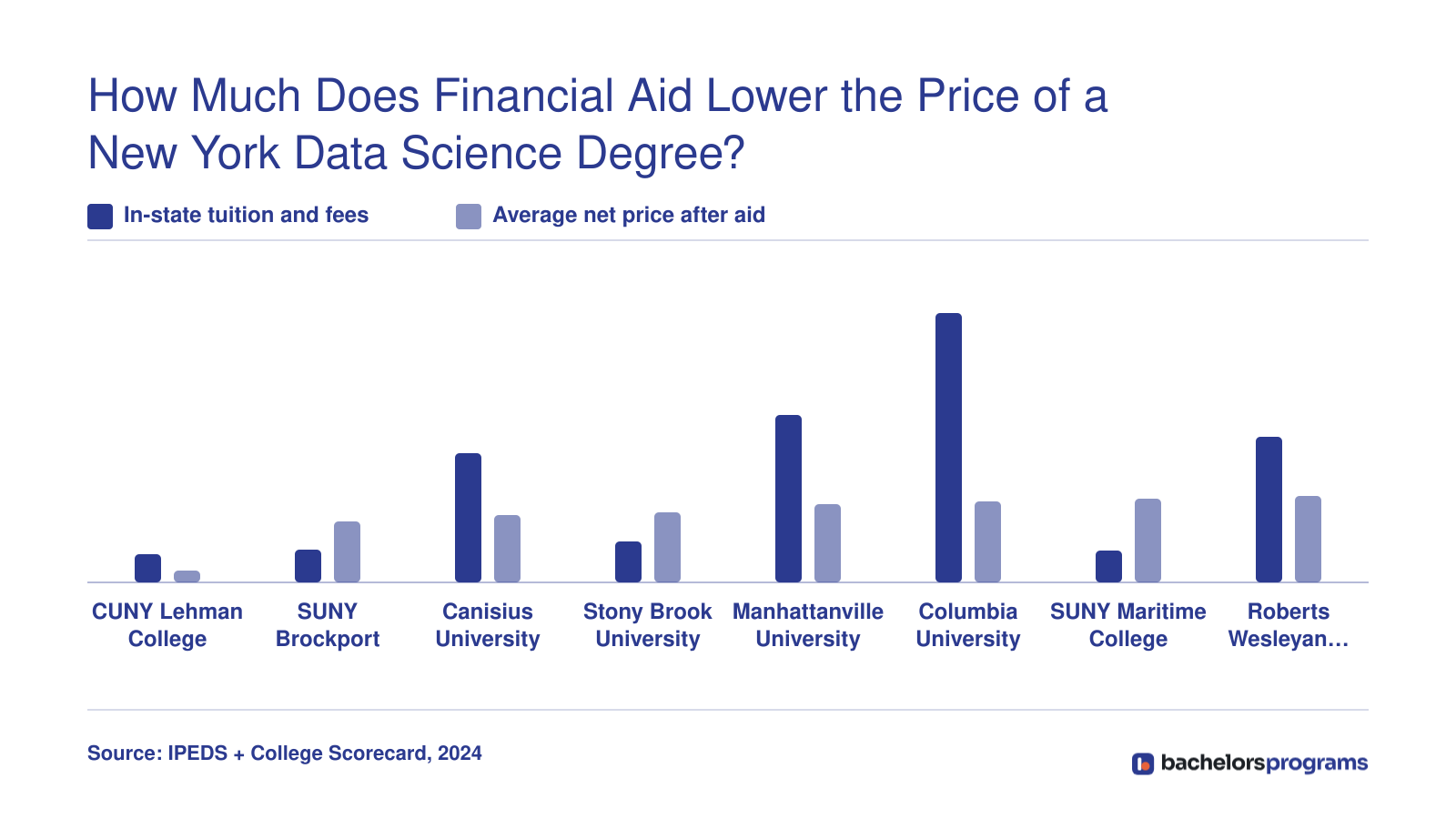
How Much Does Financial Aid Lower the Price of a New York Data Science Degree?
Private schools post the highest sticker prices, but grant aid closes much of the gap. Columbia's $71,845 in tuition and fees drops to a $21,590 average net price, and Manhattanville's $44,604 falls to $20,991. Net price covers housing, books, and other costs after grants, so at SUNY campuses it can run higher than tuition alone, while CUNY Lehman College stays lowest on both measures at $7,410 tuition and a $3,148 net price.
Data Science Careers and Salaries in New York
New York pays data professionals well, but the headline wages describe workers at every experience level, not new bachelor's graduates. Keep that gap in mind as you read the numbers below.
Roles and Hiring Sectors
A bachelor's degree in data science typically leads to these entry points:
- Data analyst: cleaning, querying, and reporting on business data.
- Business intelligence analyst: building dashboards and metrics for decision-makers.
- Junior data scientist: modeling and experimentation, often on a team with senior staff.
- Machine learning or analytics roles: usually reached after a first job or with strong project work.
Finance, media, healthcare, and technology are the sectors most often associated with the New York market. The BLS data used here does not rank specific employers or industries for the state, so check current job postings for the companies hiring now.
What BLS Wages Show
The BLS figures cited here are from May 2023. New York State had about 16,390 data scientists, and their mean annual wage was $134,830.1 In the New York-Newark-Jersey City metro, which also covers parts of New Jersey and Pennsylvania, the median hourly wage was $64.21 (roughly $133,500 a year at full-time hours) and the mean annual wage was $141,460.2 Nationally, the median annual wage was $108,020.3 The state's location quotient of 1.38 means data scientists are more concentrated here than in the typical U.S. state.1
Related roles pay in a similar range. Operations research analysts in New York averaged $111,860, and statisticians averaged $140,860.1
Why These Numbers Differ From Graduate Earnings
The College Scorecard earnings shown earlier track graduates of a specific school a few years after they finish. BLS wages cover everyone in an occupation, including senior and experienced staff, and the metro figures extend beyond New York State. Expect Scorecard-style figures to sit below BLS averages, especially in your first job.
Licensure
New York issues no state license for data scientists or analysts. Employers judge candidates on skills, projects, and internships instead.
How We Ranked These Schools and What Accreditation Means
The ranking compares bachelor's degree programs in data science using four public measures: whether the school offers the program, net price, graduation rate, and program-level outcomes reported through the College Scorecard.
Limits of the Data
Treat the numbers as a starting point, not a verdict. Graduation rate and net price describe the whole institution, not the data science program alone. Earnings figures also use different time windows after graduation, so a number from one school is not always a clean match for another. Where a figure is not reported for a program, we leave it out rather than estimate it. Check each school's own pages for current prices and outcomes before you apply.
Middle States Accreditation
New York colleges are generally accredited by the Middle States Commission on Higher Education (MSCHE), which is recognized by the U.S. Secretary of Education and the Council for Higher Education Accreditation.3 For example, MSCHE lists New York University as accredited since 1921, with its most recent reaffirmation on June 27, 2024, and bachelor's degrees within its approved scope.1
This matters for two practical reasons. Federal financial aid is available only at institutions accredited by a recognized agency, and other colleges are far more likely to accept transfer credit from an accredited school. Verify each school's current status on the MSCHE site, since statuses and review schedules change.
Specialized Accreditation
MSCHE accredits institutions, not individual programs, so it cannot confirm that a specific data science degree has been reviewed.2 ABET accredits computing programs, and some New York schools hold it for computer science4, but our research did not establish that ABET routinely accredits standalone data science bachelor's programs. If a school claims program-level accreditation, ask for the accrediting body and confirm it in that body's official listing.
Common Questions About Data Science Bachelor's Programs in New York
What is the best data science program in New York?
Can you get a bachelor's degree in data science online in New York?
Do you need a computer science background to study data science?
Are there accredited data science degree programs in New York?
Compare Data Science programs on the data that matters
Explore more Science & Engineering majors or browse every field of study.
All Science & Engineering programs Browse every field of study