Best Public Health Schools in West Virginia
Compare 5 accredited Public Health programs in West Virginia, with net price after aid, graduation rates, earnings and debt from IPEDS and the U.S. College Scorecard.

Which West Virginia schools offer a bachelor's degree in public health, and is any of it CEPH accredited? West Virginia University's Public Health Sciences program is, and it sits alongside campus, hybrid, and fully online options elsewhere in the state.
The common credential is the Bachelor of Science (B.S.) in Public Health, though Strayer University-West Virginia delivers its public health coursework as a concentration within a health services administration degree. Published tuition runs from $8,400 a year at American Public University System to $10,104 at WVU for in-state students, while the University of Charleston lists $33,800 before aid.
Health education and county health department roles rarely hinge on school name, so accreditation, format, and price matter more than reputation.
Key Points
- West Virginia University's School of Public Health has been CEPH-accredited since 1997.
- Public and online options charge roughly $8,400 to $10,100 in yearly tuition.
- For online study, American Public University System offers a fully remote B.S.
Best Public Health Schools in West Virginia: Ranked Bachelor's Programs
Five West Virginia institutions currently award a bachelor's degree in public health or a closely related health degree, and they split cleanly between campus programs and fully online ones. The entries below run from a statewide research university with an accredited school of public health to online options built for working adults. Each profile covers what the school is known for and what the degree actually requires.
American Public University System
#1Charles Town, WV · $5,000 – $10,000/yr (est.)
Best for: Working adults wanting monthly online starts
American Public University System is based in Charles Town and delivers its public health bachelor's degree entirely online, with monthly start dates and a pace designed for adults who are already working. The program holds CEPH accreditation and offers four concentrations, ranging from emergency and disaster management to public health informatics. Students can transfer up to 90 credits, and course materials are included at no extra cost.
- CEPH-accredited online Bachelor of Science in Public Health
- Four concentrations: emergency management, nutrition, informatics, general
- 120 total credits; up to 90 transfer credits accepted
- Monthly starts, no entrance exam, no application fee
- Coursework includes epidemiology, health economics, and health policy
- Senior capstone opens after 105 completed credits
- Faculty include practicing public health professionals and first responders
- Courses run 8 to 16 weeks with textbooks included
West Virginia University
#2Morgantown, WV · ~$16,000/yr (est.)
Best for: Future epidemiologists wanting field placements
West Virginia University in Morgantown is home to the state's only CEPH-accredited school of public health, which gives undergraduates access to faculty research and agency partnerships across West Virginia. Public health sciences majors complete a required field placement with organizations such as WVU Medicine, the state Bureau for Public Health, and county health departments. An accelerated bachelor's-to-MPH pathway and Honors College options let strong students move faster, and the program reports that 93% of graduates are working in the field or continuing their education.
- CEPH-accredited, the only accredited public health school in West Virginia
- Required applied field placement with state and local health partners
- Two career preparation courses built into the curriculum
- Accelerated BS/MPH option and Honors College tracks available
- Coursework in epidemiology, biostatistics, health policy, environmental health
- 93% of graduates employed in the field or continuing education
- Small classes with dedicated academic advising
Fairmont State University
#3Fairmont, WV · ~$9,000/yr (est.)
Best for: Rural students needing flexible class formats
Fairmont State University pairs its public health major with a Community Health Promotion concentration and a HyFlex teaching model that lets students attend on campus, join live online, or complete the coursework remotely. In 2026 the university partnered with the West Virginia Primary Care Association on stackable micro-credentials for community health center workers statewide, starting with a cohort of 33 participants. The degree prepares graduates for the Certified Health Education Specialist credential, with projects built around a real community's health needs.
- Community Health Promotion concentration
- CHEP courses taught in HyFlex: on campus, virtual, or online
- Fully online option with synchronous and asynchronous coursework
- Prepares students for the Certified Health Education Specialist exam
- 2.0 GPA required for current students to declare the major
- Student projects address real community health needs
- Public Health minor requires 18 to 19 credit hours, including CHEP 1100 and CHEP 3000
University of Charleston
#4Charleston, WV · $20,000 – $25,000/yr (est.)
The University of Charleston runs its public health major in seat in the state capital, with a health science core that pulls in psychology, exercise science, and communication coursework. Students typically finish in three to four years and close with a final-semester internship that can be arranged in any location with approval. The curriculum maps to the national health education credentialing framework, and graduates are prepared to sit for the Certified Health Education Specialist exam.
- In-seat program in Charleston, completable in 3 to 4 years
- Interdisciplinary core spanning natural sciences, psychology, exercise science, communication
- Freshman applicants need a 2.5 high school GPA; transfers need a 2.0 college GPA
- C or better required in major courses; 2.2 cumulative GPA to remain in good standing
- Final-semester internship can be completed in any location with approval
- Aligns with the NCHEC Seven Areas of Responsibility; prepares for the CHES exam
Strayer University-West Virginia
#5Scott Depot, WV · ~$14,000/yr (est.)
Strayer University's West Virginia location in Scott Depot supports an online Bachelor of Science in Health Services Administration with a public health concentration, aimed at students who want management and population health coursework in a single degree. The 40-course program runs entirely online and accepts up to 28 transferred classes. Academic coaching and a large network of employer tuition assistance partners round out the support structure for working students.
- Public Health concentration within the health services administration degree
- 100% online format across 40 total courses
- Transfer up to 28 classes toward the degree
- Coursework in epidemiology, biostatistics, disease prevention, emergency management
- No-cost general education options can lower the total cost
- One-on-one academic coaches and career planning support
- More than 500 employer tuition assistance partners
Cost & outcomes by school
Federal data for the highest-earning Public Health programs, independent of the ranking above. Earnings are this field's bachelor's graduates four years after completing where the Scorecard reports them, else the school's undergraduate median.
| School | Net price / yr | Grad rate | Earnings | Debt | Grads/yr | Format |
|---|---|---|---|---|---|---|
| West Virginia University WV | $15,634 | 65% | $64,888 | $22,045 | 23 | Campus |
| American Public University System WV | $9,597 | 57% | $59,240 | $30,640 | 75 | Online |
| University of Charleston WV | $22,107 | 46% | $55,774 | $19,500 | 5 | Campus |
| Fairmont State University WV | $9,032 | 44% | $46,857 | $21,000 | 2 | Hybrid |
| Strayer University-West Virginia WV | — | — | $40,092 | $40,621 | — | Online |
Sources: U.S. Department of Education. Net price, graduation rate, earnings and debt: College Scorecard (earnings and debt for this field's bachelor's graduates where reported, else school-wide); graduates: IPEDS. A dash means no figure is reported.
Cost, debt & payoff
Median earnings of this field's bachelor's graduates (4 yrs after completing, else the school's undergraduate median) vs. their median federal loan debt · U.S. College Scorecard
Across these programs the median graduate earns about $55,774 and finishes with roughly $22,045 in debt — a ratio that clears a common rule of thumb (keep debt below first-year salary). Net price and debt vary widely school to school, so check the per-school figures in the table above before you shortlist.
How We Ranked Bachelor's in Public Health Programs in West Virginia
Every position on this list traces back to federal College Scorecard data, the public dataset the U.S. Department of Education publishes on individual colleges and programs. Nothing here is based on reputation, marketing materials, or a survey sent to admissions offices.
What the Data Covers
Four measures do most of the work:
- Earnings: what graduates of a given program earn after finishing, reported by field of study rather than by the whole institution
- Median debt: the typical federal loan balance carried by graduates of that program
- Completions: how many students actually finish the credential
- Net price: average yearly cost after grants and scholarships are subtracted
Two Numbers That Are Broader Than They Look
Graduation rate and net price are institution-wide averages. They describe the whole university, not the public health department inside it, and a large university's averages can look very different from what a public health major experiences. Read them as context for the school, not as a verdict on the major.
Earnings figures also need a clock attached. Wherever a salary appears here, it comes with the window it was measured over, so you know whether it reflects graduates a few years into their careers or a decade past the degree.
Who Made the List
Only bachelor's programs at West Virginia schools qualified, whether students attend on campus or complete the degree online. Graduate certificates, master's degrees, and programs offered solely at the associate level were set aside.
The federal numbers tell you what happened to past graduates. They cannot tell you what a curriculum covers or where students intern, so confirm those details with each school directly.
CEPH Accreditation and Your Bachelor's Degree in Public Health
Is WVU the Only CEPH-Accredited School in West Virginia?
Yes, based on the Council on Education for Public Health (CEPH) directory. West Virginia University's School of Public Health has been accredited since October 14, 1997, and its current term runs through December 31, 2027.1 The directory identifies no other West Virginia institution with CEPH accreditation.1
What CEPH Accreditation Covers at the Bachelor's Level
CEPH sorts accredited units into schools of public health, public health programs, and standalone baccalaureate programs. WVU is accredited as a school, not as a standalone bachelor's program.2 CEPH's criteria say that when a bachelor's degree sits inside a unit that also offers graduate study, school or program criteria apply rather than the standalone baccalaureate criteria. So WVU's B.S. in Public Health Sciences is tied to the school's accreditation, but the directory does not list that degree title separately. Confirm with the school that your specific degree falls under the accredited unit.
Accreditation signals that a program meets national standards for curriculum and outcomes. It can help if you plan to pursue graduate study in public health later, and some employers may value it. A bachelor's degree from a non-CEPH program is still legitimate, and it does not automatically limit your options.
The Other Ranked Schools
American Public University System, Fairmont State University, University of Charleston, and Strayer University-West Virginia do not appear in the CEPH directory for West Virginia. Their baseline credential is regional accreditation, which governs credit transfer, federal financial aid eligibility, and general recognition of the degree. Strayer's program is in health services administration rather than public health, so it follows a different academic path.
How to Check a Program's Status
Before you apply, search the CEPH accredited-programs directory by school name. Look at three things:
- Category: school, program, or standalone baccalaureate.
- Status: accredited, and the term end date.
- Scope: whether your degree is named or sits within the listed unit.
If the scope is unclear, email the admissions office and ask in writing.
Admission Requirements: GPA, Test Policy, and Transfer Credit
Admission to a public health bachelor's program in West Virginia is mostly a university-level decision, with a second gate waiting inside the major. West Virginia University shows how that two-step structure works, and it is the pattern to look for at the other schools on this list.
GPA: two thresholds, not one
At WVU, students transferring from another institution need a 2.0 GPA and must be in good academic standing to enter the Bachelor of Science in Public Health. First-time students are admitted under WVU's general university requirements rather than a program-specific cutoff. Once you are enrolled in the major, the bar rises: the program requires a 2.5 cumulative GPA. That climb from 2.0 to 2.5 is the detail applicants tend to miss, because the admission standard and the standard for staying in the major are not the same number.
WVU's B.S. in Public Health, Health Services Administration page follows the same shape, directing internal and external transfer applicants to the program's transfer guidelines and stating no numeric GPA on the page itself. American Public University System, Fairmont State University, the University of Charleston, and Strayer University-West Virginia set their own admission requirements, so confirm the current thresholds with the admissions office at the campus you are considering before you apply.
Test scores
WVU's School of Public Health program pages do not publish a SAT or ACT policy. None of those pages states whether scores are required, optional, or ignored, so the university's general admissions standards govern first-time applicants. Ask the admissions office directly for the current test policy; a rule that is unstated on a program page is not the same as a rule that does not exist.
Transfer credit
For transfer students, WVU's stated requirement is good academic standing with a 2.0 GPA. The program pages do not publish a separate transfer-credit acceptance rule or a maximum number of credits that will carry over from another college. Before you commit, request a written credit evaluation that tells you how many credits transfer, which ones count toward the public health major, and how many semesters you will need to finish the degree.
Online and Hybrid Bachelor's Options at West Virginia Schools
Online delivery is now standard for public health credentials, though West Virginia's flagship still teaches its bachelor's degree on campus. Some West Virginia schools deliver the public health degree online, while others here remain campus-based.
Delivery Format by School
- American Public University System (Charles Town): The Bachelor of Science in Public Health is online.
- Fairmont State University: The Public Health program is listed as hybrid. It offers a HyFlex model (campus, virtual or online) with synchronous and asynchronous options, plus a fully online route.
- Strayer University-West Virginia (Scott Depot): The program is a Bachelor of Science in Health Services Administration with a public health concentration, delivered 100% online. It is not a standalone public health major.
- West Virginia University: The B.S. in Public Health Sciences is in person at the Morgantown campus. No online version appears on the program page.
- University of Charleston: The Public Health program is campus-based. We could not confirm an online option.
Practical Differences to Weigh
Hands-on requirements matter even in flexible formats. WVU requires an applied field placement, and University of Charleston students complete a final internship that can be done at any location. APUS requires a senior capstone, and students must finish 105 credit hours before starting it.
Schedules differ too. APUS courses run 8 to 16 weeks with rolling starts. Fairmont State's mix of live and self-paced sessions lets you choose how often you attend. The other programs' pages say nothing about fixed cohorts, so ask admissions how course sequencing works.
Tuition is the other question. APUS lists $360 per credit and Strayer lists $1,555 per credit, both as advertised program rates. WVU's rates depend on residency: $492 per credit hour for residents and $1,435 for nonresidents in 2026-2027. Because WVU's program is not online, there is no separate online rate. We could not confirm whether Fairmont State charges online students the same tuition as campus students, so check its current tuition page before you commit.
Cost of a Bachelor's Degree in Public Health in West Virginia
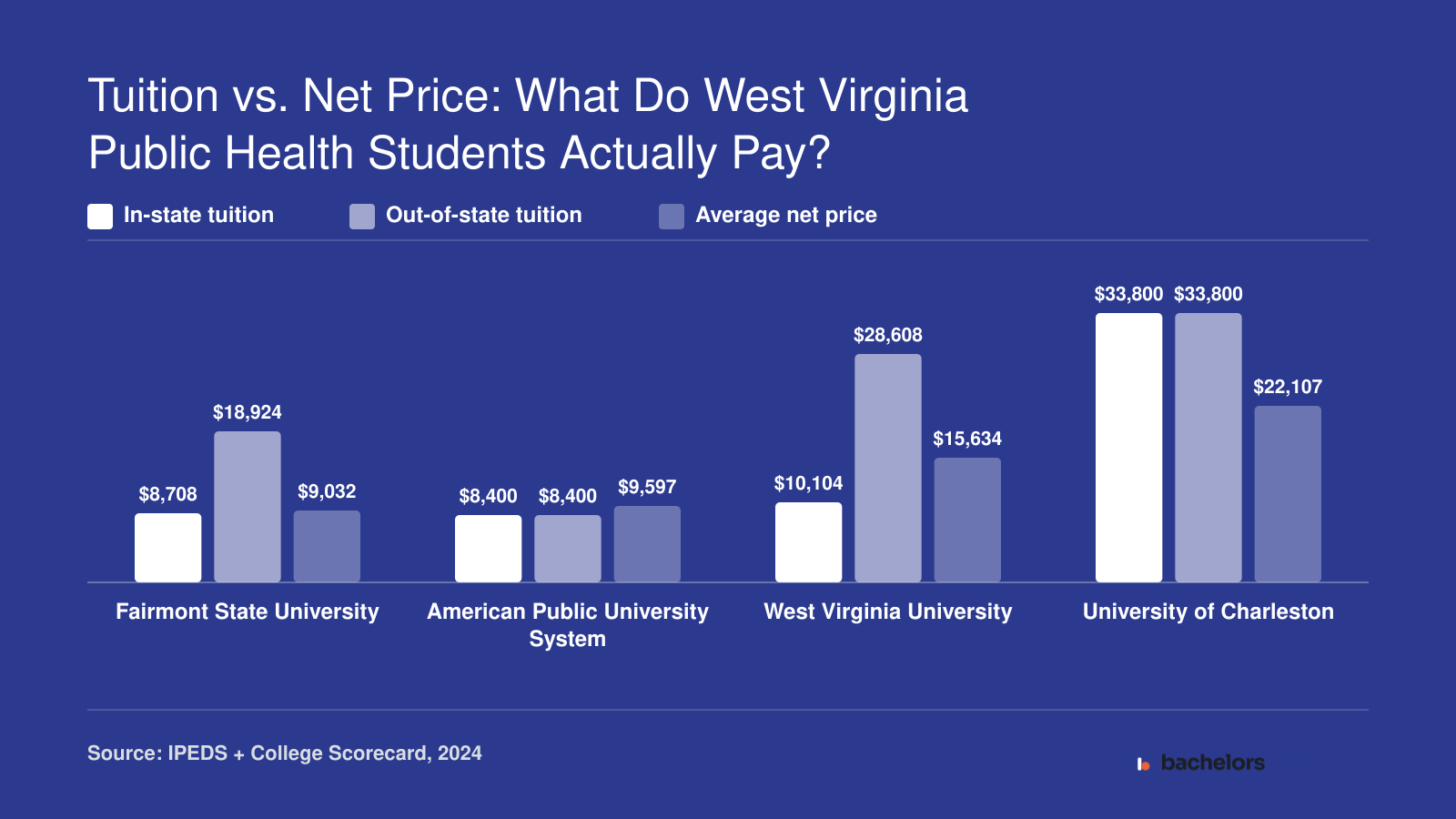
At the public and online options here, published tuition runs roughly $8,400 to $10,100 a year, and average net price after aid falls between about $9,000 and $15,600. The University of Charleston, a private school, is the outlier at $33,800 in published tuition and about $22,100 in net price.
In-State vs. Out-of-State, Sticker vs. Net
Residency matters most at the public campuses. Fairmont State University lists $8,708 in-state and $18,924 out-of-state, with an average net price of $9,032. West Virginia University lists $10,104 in-state and $28,608 out-of-state, with a net price of $15,634. American Public University System charges $8,400 regardless of residency, with a net price of $9,597, which makes it the same cost for out-of-state online students.
Net price is an approximate institution-wide average across all students who receive aid, not a quote for the public health major. Your own figure depends on income, aid eligibility and enrollment pace.
State Aid: PROMISE and the Higher Education Grant
- PROMISE Scholarship: A merit-based award for West Virginia residents who graduate from high school in the state and meet minimum GPA and test-score standards. It is meant for students who attend an eligible West Virginia college, and it carries ongoing academic requirements to keep.
- West Virginia Higher Education Grant: A need-based award for residents attending eligible in-state schools. Eligibility rests on the financial information in your FAFSA, so lower family contribution generally means a stronger case.
Award amounts and cutoffs are reset periodically, so confirm current figures through the College Foundation of West Virginia before you budget around either program.
What Graduates Borrow
Program-level federal data shows median loan debt of $22,045 for West Virginia University's public health graduates and $30,640 for American Public University System's. These figures reflect completers of each school's own program, not every student who enrolls, and they don't cover the other schools here.
The Practical Step
File the FAFSA as early as you can. State grants have deadlines, and awards can run out for late filers. Filing early also puts you in line for federal aid and institutional scholarships, and it gives you time to compare each school's actual offer before you commit.
Tuition vs. Net Price: What Do West Virginia Public Health Students Actually Pay?
Sticker price and net price can tell very different stories. The University of Charleston shows the widest gap: $33,800 in tuition and fees against a $22,107 average net price, about $11,700 less. Net price is an institution-wide average after grants and scholarships that also counts living costs, so it is not a quote for any one student and can run above tuition at lower-cost schools.
Related Articles
Public Health Careers and Licensure in West Virginia
A bachelor's degree in public health in West Virginia leads most directly to three kinds of work: health education, community health outreach, and staff roles in state and county health departments.
Common Roles and Employers
Graduates typically start in one of three roles:
- Health educators: design and deliver prevention programs.
- Community health workers: connect residents with care and services.
- Program staff: support the work of public agencies.
The largest public employer is the Bureau for Public Health, which operates statewide within the West Virginia Department of Health. County and regional local health departments make up the rest of the state's public health network and hire for outreach, education, and program support. School program pages point to a wider field as well. Fairmont State University cites jobs in nonprofit, government, healthcare, and business settings. The University of Charleston names state and local health departments and corporate wellness programs.
What Public Health Jobs Pay
National BLS figures are the clearest wage benchmark for these occupations, since the latest state tables do not establish a West Virginia-specific figure for either one. As of May 2025, the BLS reports:
- Health education specialists: median $64,070 a year ($30.80 an hour).1 A bachelor's degree is the typical entry requirement.
- Community health workers: median $51,850 a year ($24.93 an hour).2 A high school diploma is the typical entry point.
Program-level earnings show how graduates of specific schools fare. West Virginia University public health sciences graduates earned a median of $37,256 one year after finishing and $64,888 four years out. American Public University System public health graduates earned a median of $47,100 after one year and $63,490 after five years.
Licensure and the CHES Credential
Entry-level public health jobs generally do not require a state license. The credential many employers recognize is the optional Certified Health Education Specialist (CHES), issued by the National Commission for Health Education Credentialing (NCHEC). To qualify, you need a bachelor's degree or higher from an accredited institution. You also need either a major in health education or at least 25 semester credits (37 quarter hours) of qualifying coursework with a C or better.3 Meeting those academic standards only makes you eligible to sit for the CHES exam. Certification also requires passing the exam and keeping up with continuing education.4 Fairmont State and the University of Charleston both describe their programs as preparing students for CHES.
Graduates aiming for epidemiology, leadership, or research roles often continue to graduate study, and WVU offers an accelerated BS/MPH option for students who plan that path early.
Choosing the Right West Virginia Public Health School for You
The best fit depends on your budget, your starting point, and where you want to go after graduation. Here is how the schools line up by student type.
In-State, Budget-Focused Students
Start with the public universities, West Virginia University in Morgantown and Fairmont State University in Fairmont. In-state tuition at a public school is usually the lowest sticker price, but compare the net price each school reports, since aid can narrow the gap with private options like University of Charleston.
Transfer Students
Fairmont State and University of Charleston are worth a close look if you are bringing credits from another college. Check each school's transfer policy for how public health and general education credits are applied. Where a page publishes no policy, ask admissions directly before you commit.
Online Learners
American Public University System, based in Charles Town, offers a Bachelor of Science in Public Health in an online format, which suits working adults who need flexibility. Strayer University-West Virginia offers a Bachelor of Science in Health Services Administration instead. It leans toward healthcare management, so choose it only if that is your goal.
Students Planning Graduate Study
West Virginia University's Public Health Sciences, BS is the natural starting point if you expect to continue into graduate school. Whichever school you pick, ask about CEPH accreditation status and about advising for graduate admission.
Your Next Step
Before you apply, confirm the following on each school's own pages:
- Admissions: GPA expectations, test policy, and transfer credit rules.
- Cost: Current tuition and the net price after aid.
- Format: Whether the courses you need run on campus, online, or both.
Then file the FAFSA early and check the deadlines for West Virginia state aid, such as the Higher Education Grant Program and the PROMISE Scholarship. Early applications give you the best chance at limited funds.
Compare Public Health programs on the data that matters
Explore more Healthcare majors or browse every field of study.
All Healthcare programs Browse every field of study