Best Forensic Science Schools in West Virginia
Compare 8 accredited Forensic Science programs in West Virginia at 6 colleges, with net price after aid, graduation rates, earnings and debt from IPEDS and the U.S. College Scorecard.
In West Virginia, the main tradeoff is lab-science depth versus criminal justice flexibility. A bachelor's degree in forensic science, usually awarded as a Bachelor of Science (B.S.) in Forensic Science, prepares students for crime laboratory work. Criminal justice degrees with forensic options lean toward investigation and evidence handling.
The state has a strong forensic pipeline. West Virginia University's nationally known program in Morgantown holds FEPAC accreditation through 2030, and the FBI's Criminal Justice Information Services Division operates in Clarksburg.
Online routes, such as American Public University System's digital forensics track, add scheduling flexibility. Bench analyst positions, however, still expect substantial chemistry and biology coursework completed in a physical laboratory.
Key Points
- WVU's forensic science B.S. holds FEPAC accreditation through February 2030.
- WVU forensic science graduates earned a $44,255 median one year out.
- West Virginia requires no state license for forensic scientists or CSIs.
Best Forensic Science Schools in West Virginia: Our Ranked Bachelor's Programs
Six West Virginia institutions currently offer a bachelor's degree in forensic science or a criminal justice degree with a dedicated forensic concentration, and they differ sharply in scope. One is a full forensic science department with three accredited majors and a working crime lab partnership; the others range from a small liberal arts program with a hands-on crime house to a fully online digital forensics track. The list below runs from the most complete forensic science offering in the state to the most affordable regional options.
West Virginia University
#1Morgantown, WV · ~$16,000/yr (est.)
Best for: Students wanting a full forensic science major
West Virginia University runs the state's most developed forensic science operation, with a Department of Forensic and Investigative Science that awards a Bachelor of Science across three majors. Students train on professional fingerprint identification and bloodstain pattern software, and the department's ties to the West Virginia State Police Crime Laboratory, the WVU College of Law, and the FBI's Criminal Justice Information Services Division put real casework and federal instruction inside the undergraduate experience. It is also the only program in this ranking that carries forensic-specific programmatic accreditation.
- One of three forensic majors sharing a common science foundation
- Accredited by the Forensic Education Programs Accreditation Commission
- Students can change focus during the first two years
- Forensic Living-Learning Community open to majors
- Access to more than 800 vetted forensic internship sites
- Prepares graduates for forensic drug chemist and toxicologist roles
- Scholarships available to declared majors
- Training on the largest crime scene training complex in the country
- Internships with law enforcement agencies
- 120 total credit hours, including 91 in the major
- Required 3-credit internship and a capstone course
- Direct admission with a 3.75 high school GPA or qualifying math scores
- Students must hold a 2.5 GPA in major courses
- Adviser meeting required every semester
American Public University System
#2Charles Town, WV · $5,000 – $10,000/yr (est.)
Best for: Working adults seeking an online digital forensics degree
American Public University System, based in Charles Town, delivers its forensic coursework entirely online, which makes it the practical choice for working adults, military members, and anyone outside commuting distance of Morgantown or Fairmont. The forensic focus here is digital: the Bachelor of Science in Criminal Justice with a Digital Forensics concentration builds around computer forensics, cybercrime, network intrusions, and the handling of digital evidence in court. Instructors include people who hold senior positions in government agencies and criminal justice organizations.
- 120 semester hours, including 27 in the concentration
- Capstone in digital forensics required
- Coursework in computer forensics, cybercrime and network intrusions
- Covers hard drive and operating system forensics
- Legal and ethical issues in forensics covered
- 30 semester hours of open electives
Fairmont State University
#3Fairmont, WV · ~$9,000/yr (est.)
Best for: Hands-on learners who prefer small cohorts
Fairmont State University keeps its forensic science major deliberately small, averaging about five graduates a year, and the curriculum sits squarely in the natural sciences: biology, chemistry, physics, and math, with laboratory training in spectroscopy, wet chemical analysis, microscopy, and molecular methods. A capstone course asks students to pull those skills together to solve a real problem, and students get hands-on scene experience through the program's Crime House. A forensic and investigative science minor is available for students majoring in another field.
- Capstone requires solving a real problem with combined lab skills
- Lab training in spectroscopy, microscopy and molecular methods
- Crime House provides hands-on scene experience
- Program averages about five graduates per year
- Forensic and Investigative Science minor available
- Prepares students for graduate and professional school
Shepherd University
#4Shepherdstown, WV · $9,000 – $19,000/yr (est.)
Shepherd University approaches forensics through criminal justice rather than the sciences, offering a Bachelor of Arts with a Forensics concentration inside a department that also covers law enforcement administration. Majors finish an internship or a scientific research project as part of a senior thesis capstone, and courses run face to face, online asynchronously, live streamed, or in a Hyflex format where students choose how to attend each session. It suits students aiming at investigative and justice system roles more than at bench science.
- Two concentrations: Law Enforcement Administration and Forensics
- Senior thesis capstone built on an internship or research
- Hyflex courses let students choose how they attend
- Cooperative learning can earn course credit
- Coursework covers justice system structure and social science
West Virginia State University
#5Institute, WV · $11,000/yr (est. net price)
West Virginia State University awards a Bachelor of Science in Criminal Justice with a Forensic Science Option, and it is unusual among criminal justice programs for the amount of hard science it requires. Students take general and organic chemistry, analytical chemistry, biology, anatomy and physiology, genetics, and college algebra alongside Introduction to Forensic Science and an Advanced Forensic Science Lab. All majors must earn at least a C in required courses, and a senior seminar closes the degree.
- 120 to 121 credit hours, with 40 in the major
- Includes Introduction to Forensic Science and an advanced lab
- Requires organic chemistry, analytical chemistry and genetics
- C or better required in all major courses
- Senior seminar required
Bluefield State University
#6Bluefield, WV · $11,000 – $18,000/yr (est.)
Bluefield State University offers a Bachelor of Science in Criminal Justice with a Forensic Procedure and Evidence concentration, a 29-credit forensic block inside a 120-credit degree. Coursework covers forensic investigation, firearms and tool marks, forensic photography, microbiology, genetics, pharmacology, chemistry, and victimology. The university is the most transfer-friendly option on this list, accepting up to 72 credits from regionally accredited community colleges and admitting associate degree holders at junior status, and it publishes a recommended eight-semester plan while noting that completion may take longer.
- 29-credit forensic concentration inside a 120-credit degree
- Coursework in firearms and tool marks and forensic photography
- Includes microbiology with lab, genetics and chemistry
- Up to 72 credits transfer from regionally accredited colleges
- Associate degree holders may enter at junior status
- Eight-semester plan published, though completion may take longer
Cost & outcomes by school
Federal data for the highest-earning Forensic Science programs, independent of the ranking above. Earnings are this field's bachelor's graduates four years after completing where the Scorecard reports them, else the school's undergraduate median.
| School | Net price / yr | Grad rate | Earnings | Debt | Grads/yr | Format |
|---|---|---|---|---|---|---|
| West Virginia University WV | $15,634 | 65% | $62,455 | $24,121 | 103 | Campus |
| American Public University System WV | $9,597 | 57% | $57,237 | $32,062 | 46 | Online |
| Shepherd University WV | $11,363 | 51% | $49,358 | $21,600 | — | Hybrid |
| Fairmont State University WV | $9,032 | 44% | $46,857 | $21,000 | 9 | Campus |
| West Virginia State University WV | $11,139 | 39% | $40,492 | $23,338 | — | Campus |
| Bluefield State University WV | $13,684 | 37% | $38,217 | $18,250 | — | Campus |
Sources: U.S. Department of Education. Net price, graduation rate, earnings and debt: College Scorecard (earnings and debt for this field's bachelor's graduates where reported, else school-wide); graduates: IPEDS. A dash means no figure is reported.
Cost, debt & payoff
Median earnings of this field's bachelor's graduates (4 yrs after completing, else the school's undergraduate median) vs. their median federal loan debt · U.S. College Scorecard
Across these programs the median graduate earns about $53,298 and finishes with roughly $23,730 in debt — a ratio that clears a common rule of thumb (keep debt below first-year salary). Net price and debt vary widely school to school, so check the per-school figures in the table above before you shortlist.
How We Ranked West Virginia Bachelor's Programs in Forensic Science
The ranking weighs a short list of things a prospective student can actually check, and separates numbers that describe the whole institution from numbers that describe the forensic program itself.
What Goes Into the Order
- Net price after aid: the average price students actually pay once grants and scholarships are applied, not the published sticker price.
- Graduation rate: how many first-time students finish at that school within a standard window.
- Program-level earnings: what graduates of the program went on to earn, where the school or federal data reports it.
- Completions: how many students actually finished the program, which shows it runs in practice and not only on paper.
- Accreditation: whether the program itself carries FEPAC recognition, and whether the institution holds regional accreditation with a forensic-relevant curriculum behind it.
Where the Numbers Come From, and Where They Stop
Net price and graduation rate are calculated for the entire institution. They tell you how a school treats students overall, but they are not measured for the forensic science major alone. A strong institutional rate is an encouraging sign, not a promise about your own program.
Program-level earnings and completions are uneven in the same way. Some schools publish them for a specific major; others report only at the department or campus level. Where a figure is not reported, no estimate is substituted. The order reflects only what a school actually discloses, so a program is never penalized for silence, and never credited for it either. A school that publishes little can still rank well on the strength of its accreditation, price, and completion record.
Which West Virginia Bachelor's Programs in Forensic Science Are FEPAC-Accredited?
West Virginia University's B.S. in Forensic and Investigative Science at Morgantown holds FEPAC accreditation through February 16, 2030, following re-accreditation on February 16, 2025.1 Among the bachelor's programs here, it is the only one with the Forensic Science Education Programs Accreditation Commission's approval.
WVU Morgantown: The Accredited Program
The Morgantown degree offers three undergraduate focus areas:
- Forensic Biology: the lab-science route for students drawn to biological evidence.
- Forensic Chemistry: centered on analyzing chemical and trace materials.
- Forensic Examination: the track for students interested in evidence examination work.
WVU's own program page does not describe Forensic Biology as an FBI DNA analyst qualifying sequence. If that job is your goal, compare the course list against the FBI's published coursework requirements before you commit.
WVU's Beckley Program Is Separate
West Virginia University also offers a B.S. in Forensic Investigation at its Beckley campus. The university catalog states that Morgantown's FEPAC accreditation does not encompass this program. Its focus is investigation rather than laboratory analysis, so it suits students aiming at investigative roles more than crime lab bench work. The two degrees sound alike but are accredited differently, so read program names closely.
Fairmont State and the Other Schools Here
Fairmont State University offers a Forensic Science bachelor's program, but the accreditation information we reviewed documents only institutional accreditation from the Higher Learning Commission.2 We found no FEPAC listing for it. The same goes for the forensic-related options at American Public University System, Shepherd University, West Virginia State University and Bluefield State University, which are built around criminal justice or digital forensics rather than a FEPAC-reviewed science curriculum.
Lack of FEPAC accreditation is not a disqualifier for every career. Investigative, digital and many entry-level roles do not require it. Some crime laboratories do prefer or require a degree from an accredited science program, so confirm employer expectations with the schools and agencies you are targeting. Check the current FEPAC list before applying, since statuses are updated periodically.1
Can You Earn a Bachelor's Degree in Forensic Science Online in West Virginia?
Online delivery has changed criminal justice education far faster than the bench sciences, and forensic science sits between the two.
The Short Answer
None of the laboratory-science programs here publishes a fully online route to a forensic science bachelor's degree. West Virginia University's three Morgantown majors (Forensic Biology, Forensic Chemistry, and Forensic Examiner) and WVU Tech's Chemical Forensics degree in Beckley are campus programs, each requiring 120 or more credit hours, and neither campus lists an online or evening version of those majors. Fairmont State's forensic science major, West Virginia State's forensic science option inside criminal justice, and Bluefield State's forensic procedure and evidence degree are likewise built around seated coursework and lab time.
The one fully online option in this group is American Public University System, based in Charles Town, which awards a bachelor's degree in criminal justice with a digital forensics concentration. That is a criminal justice credential with forensic coursework, not a laboratory science degree.
Where Hybrid Fits
Shepherd University's criminal justice program, with a forensics concentration, runs in a hybrid format that lets students choose among face-to-face, live-stream, and online asynchronous attendance. The flexibility is real, but the core is criminal justice rather than chemistry and biology labs.
Why Labs Limit Online Delivery
Forensic science runs on instrument time, wet-lab technique, chain-of-custody practice, and mock scene work. Accredited programs have to document those facilities, and a video demonstration cannot stand in for pipetting.
If you need flexibility, build your chemistry and biology prerequisites at a community college and transfer into a campus program, or take the hybrid criminal justice route and plan on graduate study.
Admission Requirements for a Bachelor's Degree in Forensic Science in West Virginia
West Virginia University sets the most clearly defined admission bar for a forensic science bachelor's on this list, and that bar centers on math.
West Virginia University: Direct Admission Pathways
First-time freshmen applying to WVU's Forensic Biology, Forensic Chemistry or Forensic Examiner B.S. must meet the university's first-time freshman requirements, plus direct-admission standards for the major:
- Test score pathway: A 2.5 high school GPA together with an ACT Math score of 22 or an SAT Math score of 540.
- Test-optional pathway: A 3.75 cumulative high school GPA, with no math score required.
- Math placement: An ALEKS score of 45 is recommended. The catalog treats it as a recommendation, not an admission prerequisite.
WVU's forensic pages do not spell out whether the test-optional route covers every applicant category in 2026, so confirm with admissions before you skip the exam. The program pages also list no specific high school course prerequisites and no 2026 application deadline. Check the university's main undergraduate admissions calendar for dates.
Transfer students face a separate gate. Applicants with 24 or more college credits and at least a 2.0 GPA must complete CHEM 115 or higher with a C- before admission to the major.
Fairmont State, Shepherd, WVSU, Bluefield State and APUS
For the forensic science, forensic option and digital forensics programs at Fairmont State University, Shepherd University, West Virginia State University, Bluefield State University and American Public University System, no program-specific minimum GPA or testing policy appears in the materials reviewed. Apply through each school's general undergraduate admissions process, and confirm GPA, testing and deadline rules directly with each admissions office.
Prepare for a Science-Heavy Major
Accessible admission does not mean an easy curriculum. Forensic science coursework leans on chemistry, biology and quantitative skills, and WVU's chemistry requirement for transfers shows how early lab science shapes your path. Take high school chemistry, biology and the highest level of math you can manage. Strong preparation protects your GPA once lab courses begin, which matters at programs that set grade minimums for staying in the major.
Transferring From a West Virginia Community College Into a Forensic Science Bachelor's Program
How the 2+2 Route Works
A completed Associate of Arts or Associate of Science satisfies West Virginia University's General Education Foundations, which makes the 2+2 route a practical way to lower costs before a forensic science bachelor's. You finish general education and introductory science at a community college, then transfer for upper-level forensic coursework. Courses covered by West Virginia's Core Coursework Transfer Agreement generally carry over between public institutions.
What Published Agreements Cover
The confirmed pathway is narrower than many students expect. One eastern panhandle community college publishes a 2021-2022 agreement that moves its A.A.S. in Criminal Justice into WVU's online Bachelor of Applied Science in Criminal Justice, with three added courses: CJ 225, CJ 230 and CS 101. That route leads to a criminal justice degree, not a forensic science degree. We found no published articulation into a forensic science bachelor's at WVU or Fairmont State, and the older agreement's terms may have changed. Confirm every course with a transfer advisor at your target school before you enroll.
Match Your Science Sequence
- Chemistry: WVU's Forensic Chemistry and Forensic Biology tracks are chemistry-heavy, so take the full general chemistry sequence with labs rather than a one-semester survey.
- Biology: Choose majors-level biology with labs over nonmajors options.
- Math: Check the level. In the agreement above, an introductory math course mapped to WVU's MATH 121, so verify that it meets your forensic program's math requirement.
- Tools: Look up each course in the WV Higher Education Course Equivalency Inventory Dashboard, then meet with both your faculty advisor and the receiving school's transfer representative.
Related Articles
What Do Forensic Science Bachelor's Graduates Earn After Finishing?
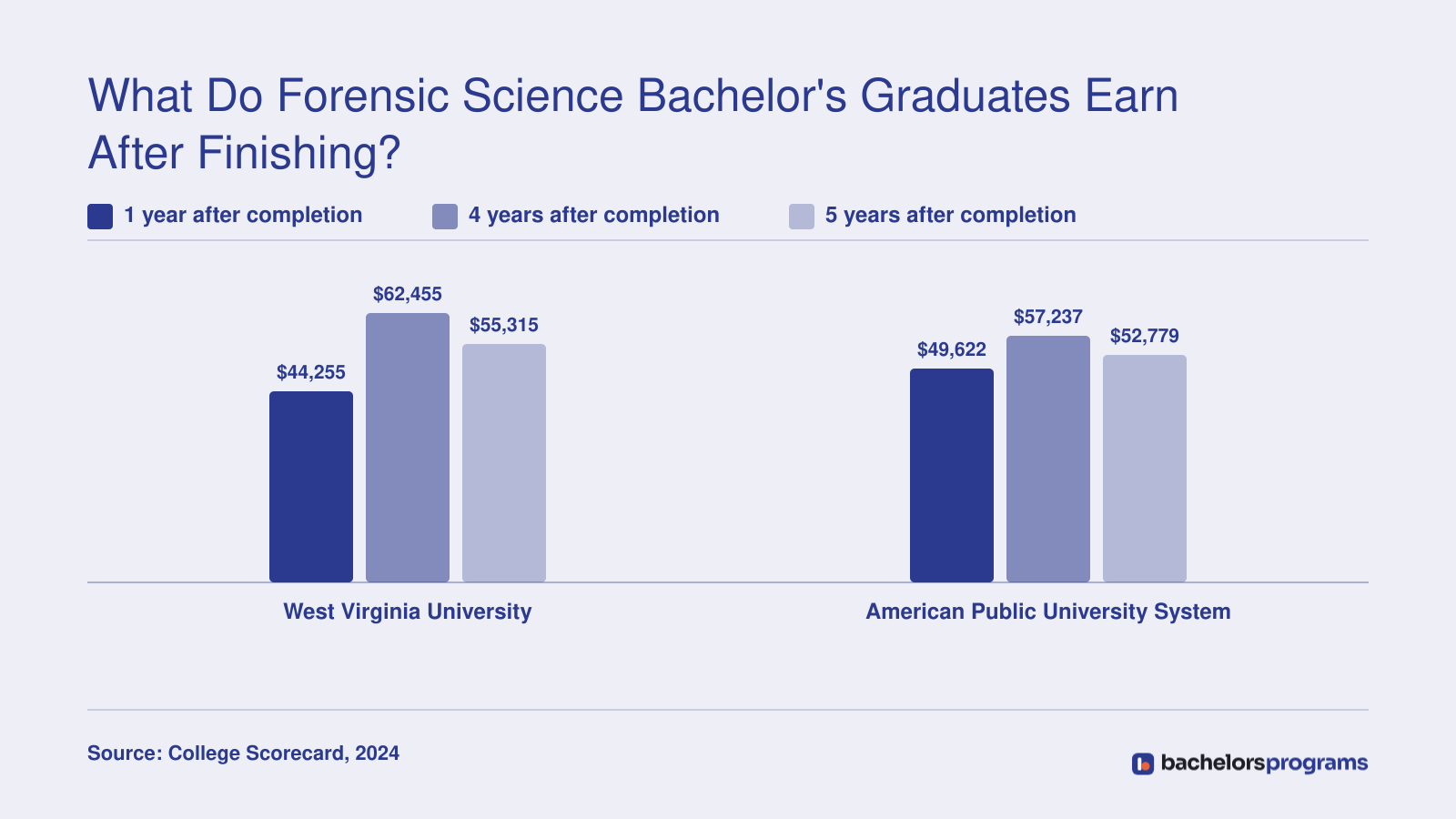
At the program level, West Virginia University's forensic science bachelor's graduates earned a median of $44,255 one year after completing, $62,455 at four years and $55,315 at five years. American Public University System graduates earned $49,622 at one year, $57,237 at four years and $52,779 at five years. Each time window follows a different graduating group, and the other ranked schools have no program-level earnings figure on record.
Forensic Science Careers and Salaries in West Virginia
In West Virginia, a forensic science bachelor's points toward a defined set of entry-level jobs. The most common are forensic science technician, crime scene investigator, laboratory analyst, and evidence technician, with federal and state agencies layering their own titles on top of those.
- Forensic science technician: Runs laboratory tests on evidence and writes reports that investigators and courts rely on.
- Crime scene investigator: Documents, photographs, and collects evidence at scenes, usually for a police department or sheriff's office.
- Laboratory analyst: Works a specialty bench such as DNA, toxicology, or latent prints.
- Evidence technician: Manages chain of custody, storage, and release of physical evidence.
Where the Jobs Are
Two employers anchor the field. The West Virginia State Police Forensic Laboratory runs the state's main crime lab system and hires on two tracks: forensic technicians who handle evidence and support casework, and forensic scientists who analyze it. The published statutory schedule sets salary classifications for both tracks1, while degree, coursework, and background requirements live in individual postings, so read the announcement rather than assuming the statute covers hiring standards. The FBI's Criminal Justice Information Services division in Clarksburg is the other major draw2; West Virginia University's forensic program reports a CJIS agreement that includes FBI instructor-led fingerprint classification training. The bureau publishes its own qualification standards, which vary by position. Graduates also work for local police agencies, coroners and medical examiner offices, and biometrics contractors in north central West Virginia.
What State Lab Roles Pay
The statutory schedule lists annual base salaries of $54,844 for Forensic Technician I, $56,538 for Technician II, and $60,420 for Technician III.1 The scientist track runs from $62,044 at Forensic Scientist I to $76,057 at level VI, stepping through $64,228, $66,332, $68,731, and $72,257.1 Treat these as statutory base pay for state classifications rather than occupation-wide averages, and keep them separate from program-level earnings figures.
The Honest Picture on Openings
West Virginia is a small state, and forensic openings are correspondingly thin. West Virginia University reports that its graduates work mainly as scene investigators and laboratory examiners, with a 90% placement rate, but that figure spans every graduate and every employer, not just forensic jobs in state. Some graduates relocate for lab work. Others take adjacent roles in law enforcement, investigations, or general laboratory science and build forensic experience from there.
West Virginia Forensic Scientist Licensure and Certification at a Glance
Questions to Ask Yourself
Do the lab jobs you want require a FEPAC-accredited degree?
Does your budget depend on in-state aid like the PROMISE Scholarship?
Would you rather study natural science or investigation?
Do you need to study online or near where you already live?
Compare Forensic Science programs on the data that matters
Explore more Criminal Justice & Law majors or browse every field of study.
All Criminal Justice & Law programs Browse every field of study