Best Early Childhood Education Schools in West Virginia
Compare 4 accredited Early Childhood Education programs in West Virginia, with net price after aid, graduation rates, earnings and debt from IPEDS and the U.S. College Scorecard.

In-state tuition and fees run from $4,612 at West Virginia University at Parkersburg to $33,800 at University of Charleston, a spread that shapes most decisions about a bachelor's degree in early childhood education. The common credential is the Bachelor of Science (B.S.) in Early Childhood Education, though program titles vary.
Every school ranked below is based in West Virginia and offers its program on campus, online or both; each is compared on net price, admissions, delivery format and state licensure route.
Licensure is the sharper dividing line. West Virginia University at Parkersburg's Child Development degree is non-licensing, so anyone aiming to teach public pre-K under state Policy 5202 should confirm a program's certification route first.
Key Points
- In-state tuition spans $4,612 (WVU Parkersburg) to $33,800 (University of Charleston).
- West Virginia sets a 2.5 overall college GPA for teacher preparation.
- Initial PreK-K licenses follow West Virginia Board of Education Policy 5202.
Best Bachelor's in Early Childhood Education Schools in West Virginia
Four West Virginia colleges currently offer a bachelor's degree in early childhood education or a closely related child development field, and they split cleanly into two groups: a large research university and a private capital-city campus that teach largely in person, and two public options built for working adults who need to finish online. Two of the four charge in-state tuition to every enrolled student regardless of where they live, which matters a great deal in a state where most early childhood professionals are already employed while they study. Below, each school is described by what it actually offers a prospective early childhood major.
West Virginia University
#1Morgantown, WV · ~$16,000/yr (est.)
Best for: Family studies majors seeking a research university
West Virginia University is the state's largest research university, and its Morgantown campus pairs a broad professional catalog with a Bachelor of Science in Child Development and Family Studies that runs both on campus and fully online. The program spans development from birth through age eight and includes field experiences, internships and a capstone, with coursework in developmental assessment, trauma and resiliency, and family dynamics. First-time freshmen who meet university requirements are admitted directly, while transfer students need at least a 2.0 cumulative university GPA.
- 120 total credit hours, including 51 major hours and a 15-credit minor
- Offered on campus in Morgantown or fully online
- Focus on development from birth through age eight
- Field experiences and internships in child and family settings
- Capstone course (CAHS 489) required
- Coursework covers developmental assessment and trauma and resiliency
- First-time freshmen meeting university requirements admitted directly
- Transfer students need a 2.0 cumulative university GPA
Concord University
#2Athens, WV · $10,000/yr (est. net price)
Best for: Working early childhood staff needing flexible completion
Concord University is a small public campus in Athens, in the southern part of the state, with a long record of serving rural Appalachian students. Its early childhood offering is a Regents Bachelor of Arts in Early Childhood Development delivered entirely online and built for adults who already work in early childhood settings. Because it accepts CDA and CDS credentials for credit and charges in-state tuition to every student regardless of residency, it is one of the more accessible routes to a bachelor's degree in this field.
- Fully online, 60 credit hours over two years of continuous enrollment
- In-state tuition for all students regardless of residency
- Credit accepted for CDA and CDS certificates
- Applicants must be at least four years past high school graduation
- Enter with 60 general education and elective credits
- 20-hour field observation tied to your own work setting
- Courses include Child Development, Language and Literacy, Challenging Behavior I and II
- Capstone required
University of Charleston
#3Charleston, WV · $20,000 – $25,000/yr (est.)
Best for: Traditional students wanting in-person field experience
The University of Charleston is a private institution on the Kanawha River in the state capital, known for small classes and a career-focused approach. Its education program includes an Elementary Studies and Child Development area of study taught in seat over four years, with field experience beginning in the freshman year. The program holds AAQEP accreditation and lets students add a double major, a minor or dual certifications.
- Four-year program taught in seat in Charleston
- 2.5 high school GPA for freshman direct entry; 2.0 college GPA for transfers
- Field experience begins in the freshman year
- Education program holds AAQEP accreditation, received June 2024
- Rotational semester schedule for education program courses
- Small classes; double majors, minors and dual certifications available
West Virginia University at Parkersburg
#4Parkersburg, WV · $1,800/yr (est. net price)
West Virginia University at Parkersburg is a public regional campus in the Ohio Valley that has built its child development offerings around a career ladder for people already working in the field. The Bachelor of Applied Science in Child Development is a 120-credit degree completed entirely online, and every online student pays in-state tuition no matter where they live. The degree is non-licensing and does not lead to public school certification, so it suits readers aiming at center leadership and family support roles rather than classroom teaching licensure.
- 120-credit Bachelor of Applied Science completed entirely online
- In-state tuition for all online students regardless of residency
- Career ladder: 30-credit certificate, 60-credit AAS, then two more years
- Transfer credit for CDA, ACDS and WVIT credentials
- 2.0 GPA and a C or better in all CDEV and EDUC coursework
- Background check and no-conviction statement required
- Non-licensing degree; does not lead to public school certification
- Prepares childcare center directors and family support specialists
Cost & outcomes by school
Federal data for the highest-earning Early Childhood Education programs, independent of the ranking above. Earnings are this field's bachelor's graduates four years after completing where the Scorecard reports them, else the school's undergraduate median.
| School | Net price / yr | Grad rate | Earnings | Debt | Grads/yr | Format |
|---|---|---|---|---|---|---|
| University of Charleston WV | $22,107 | 46% | $55,774 | $19,500 | 2 | Campus |
| West Virginia University WV | $15,634 | 65% | $51,537 | $24,121 | 97 | Online or campus |
| Concord University WV | $9,966 | 39% | $44,168 | $18,721 | 35 | Online |
| West Virginia University at Parkersburg WV | $1,807 | 9% | $39,681 | $12,570 | 23 | Online |
Sources: U.S. Department of Education. Net price, graduation rate, earnings and debt: College Scorecard (earnings and debt for this field's bachelor's graduates where reported, else school-wide); graduates: IPEDS. A dash means no figure is reported.
Cost, debt & payoff
Median earnings of this field's bachelor's graduates (4 yrs after completing, else the school's undergraduate median) vs. their median federal loan debt · U.S. College Scorecard
Across these programs the median graduate earns about $47,853 and finishes with roughly $19,111 in debt — a ratio that clears a common rule of thumb (keep debt below first-year salary). Net price and debt vary widely school to school, so check the per-school figures in the table above before you shortlist.
How We Ranked West Virginia Early Childhood Education Schools
What makes one West Virginia early childhood education bachelor's program a better bet than another?
The order below rests on a short list of measures you can check yourself. Cost comes first in practice: the average net price students pay after grant aid carries more weight than published sticker tuition, since the two can differ by thousands of dollars. Graduation rates follow, then program-level earnings and typical graduate debt where a school reports them, then how many students complete the program, and finally whether it is offered on campus, online or both.
What the numbers cover
Both measures are institution-wide averages. They describe the whole college, not the early childhood major, so read them as context rather than a promise about your own outcome.
The list includes only West Virginia bachelor's programs that publish the measures above, so it stays short by design. A school's absence usually reflects unpublished data, not a weak program.
How to use it
Treat the order as a shortlist, not a verdict. Call each admissions office to confirm the credential awarded, the field placement requirements and the current transfer credit policy before you apply.
Online and Hybrid Bachelor's Options at West Virginia Schools
Online coursework buys flexibility, but in West Virginia it does not remove the classroom hours. The real question is how far you will have to travel for them, and how often.
Which Schools Offer Which Format
- West Virginia University: offers its Child Development and Family Studies B.S. both online and on campus. Field experiences and internships are built in either way.
- Concord University: delivers the R.B.A. in Early Childhood Development in a hybrid format, pairing WVROCKS courses with Concord courses. It requires 120 credits and 36 residence credit hours, at least 12 taken at Concord and 24 at other West Virginia state colleges.1
- West Virginia University at Parkersburg: offers Child Development with a fully online option and in-state tuition for all online students.
- University of Charleston: campus-based, with field experience beginning in the freshman year.
How Placements Work
Online students at these schools still complete supervised hours in person, typically arranged with a site near where they live rather than in the college town. Concord's R.B.A. lists 20 clinical hours.1 Where a program leads toward licensure, expect heavier requirements: Concord's licensure-track education programs use a year-long residency with face-to-face clinical work, part of it three full days a week in one classroom for a semester.2 WVU Parkersburg states plainly that its Child Development degree is non-licensing and carries no school certification, so weigh that against your goals before you enroll.
Who Thrives Online
Working paraprofessionals already in a classroom, parents managing a schedule, and students in rural counties far from a campus get the most from these formats, provided they can reach a placement site.
Admission Requirements: GPA, Test Policy and Transfer Credit
Admission to a bachelor's program in early childhood or child development at a West Virginia school usually depends on your overall GPA and, for licensure-track study, the state's teacher-preparation rules: West Virginia sets a 2.5 overall college GPA for teacher-preparation programs and requires Praxis exams for licensure unless an exemption applies, such as a 3.0 cumulative GPA with a conferred bachelor's degree. Requirements for the specific programs below vary, and where a school's early childhood program publishes no GPA, test or transfer policy, the table says so, so confirm details with each admissions office before you apply. The clearest transfer routes run from West Virginia community and technical colleges: both West Virginia University and West Virginia University at Parkersburg have articulation agreements that let students finish an early childhood associate degree first and carry those credits into a bachelor's program, which can lower total cost.
| School | Minimum GPA | Test Policy | Transfer Pathways |
|---|---|---|---|
| West Virginia University | 2.0 overall GPA for entry to the online Child Development and Family Studies major | No policy published | Articulation agreement with a West Virginia community and technical college: graduates of its early childhood associate degree can transfer credits toward the B.S. in Child Development and Family Studies |
| Concord University | No policy published | No policy published | No policy published |
| University of Charleston | No policy published | No policy published | No policy published |
| West Virginia University at Parkersburg | No policy published | No policy published | Articulation agreement lets students who complete an early childhood associate degree at a partner West Virginia community and technical college continue toward a bachelor's degree in the same field |
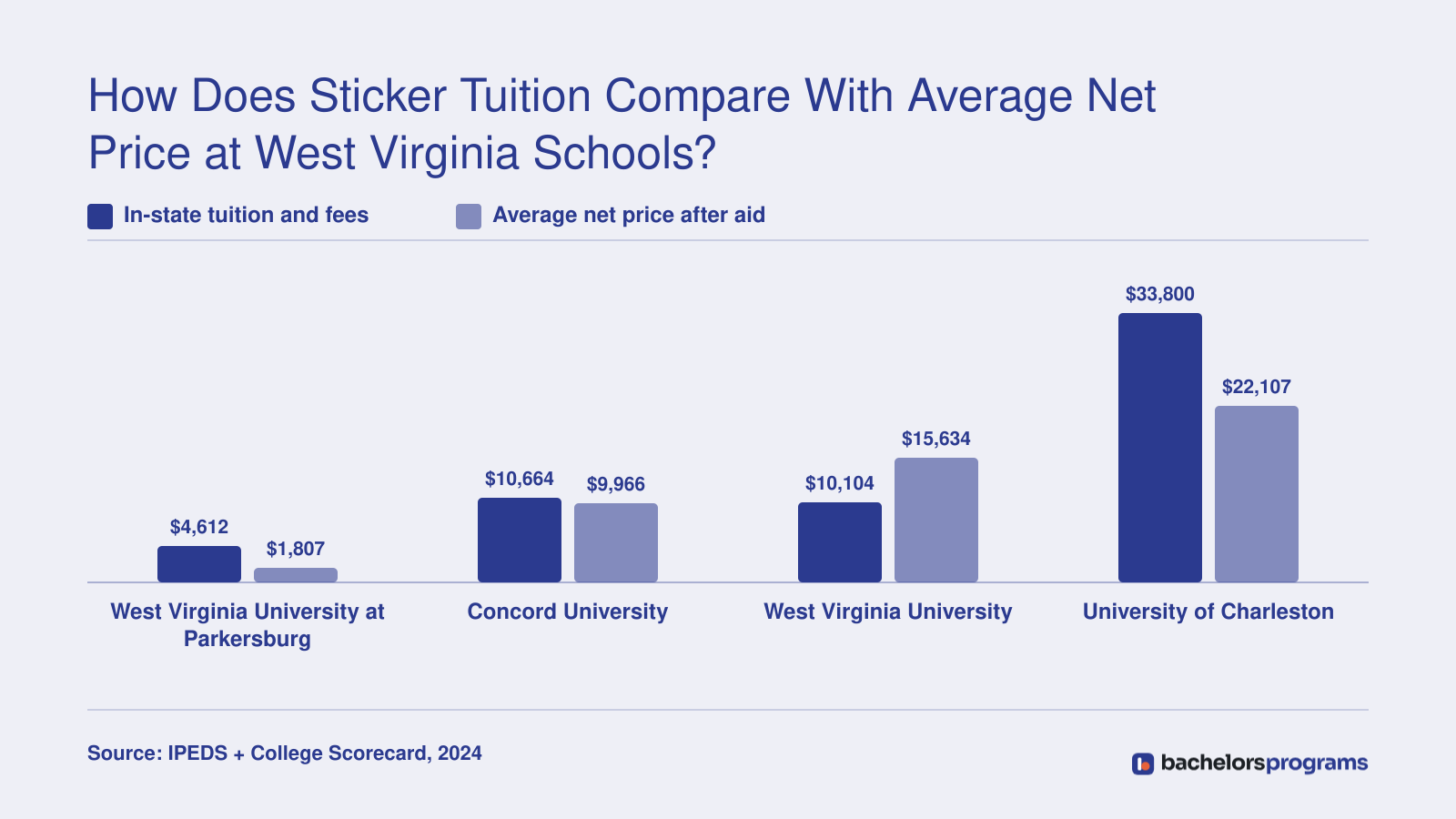
How Does Sticker Tuition Compare With Average Net Price at West Virginia Schools?
Published in-state tuition and fees range from $4,612 at West Virginia University at Parkersburg to $33,800 at University of Charleston, but the average net price after grants and scholarships changes the picture. Net price is the full cost of attendance, including housing, books and fees, minus grant aid, which is why West Virginia University's $15,634 average sits above its $10,104 tuition. Each net price shown is an institution-wide average for first-time, full-time students receiving federal aid, so your own cost will vary with family income, housing choices and the aid you qualify for.
Related Articles
What Program Graduates Earn After Finishing
Program-level federal data shows what graduates of these specific bachelor's programs earn, not campus-wide averages.
West Virginia Pre-K Teacher Licensing at a Glance
Frequently Asked Questions
These answers cover the questions West Virginia students ask most often about pre-K, licensure, online study, financial aid and transfer credit. Rules change, so confirm details with the West Virginia Department of Education and each school's admissions or financial aid office.
Is pre-K mandatory in WV?
What certification do you need to teach Pre-K in West Virginia?
Can you earn a bachelor's degree in early childhood education online in West Virginia?
Does the Hope Scholarship pay for college in West Virginia?
Can a community college associate degree count toward a bachelor's in early childhood education?
Compare Early Childhood Education programs on the data that matters
Explore more Education & Teaching majors or browse every field of study.
All Education & Teaching programs Browse every field of study