Best Criminology Schools in Florida
Compare 12 accredited Criminology programs in Florida, with net price after aid, graduation rates, earnings and debt from IPEDS and the U.S. College Scorecard.

Florida certifies law enforcement officers through the state's Criminal Justice Standards and Training Commission, and a four-year degree is not required to enter an academy. A bachelor's degree in criminology, a B.S. or a B.A., is therefore a choice about career range, not a license.
The programs below span campus, online and hybrid formats at schools across Florida. Cost, earnings, the split between criminology and criminal justice, and the state's certification rules all shape which one fits.
The real tension is value. The degree widens options in analyst, probation and court roles, but price and early pay vary sharply from school to school.
Key Points
- University of Florida has the lowest net price among public options.
- University of Miami's $62,616 tuition drops to a $37,244 average net price.
- Florida certifies officers, not criminologists, so the degree alone grants no license.
Best Bachelor's Degree in Criminology Schools in Florida: Our Ranked List
Florida's criminology bachelor's degrees run from large public research universities in Tampa, Gainesville and Orlando to small private colleges in Lakeland, Miami and Saint Augustine. All ten schools below award a bachelor's degree in criminology or a closely named variant, and several let you complete the degree fully online. Each entry notes the credential offered, how coursework and internships are structured, and where graduates tend to land.
University of South Florida
#1Tampa, FL · ~$10,000/yr (est.)
Best for: Tampa students seeking agency internships
The University of South Florida is a large public research university in Tampa whose criminology department places interns at close to 100 agencies, with up to 9 elective credits available for the placement. Students can follow a two-year or a four-year plan, join the Criminology Club and Alpha Phi Sigma, and work in labs such as the Center for Justice Research & Policy and the C.I.B.R. Lab. The degree feeds into law enforcement, corrections, courts, juvenile justice and cybercrime roles across the Tampa Bay area.
- Coursework covers crime theory, research methods and the U.S. justice system
- Internships worth up to 9 elective credits at close to 100 agencies
- Two-year and four-year plans of study available
- Research centers include the Center for Justice Research & Policy and C.I.B.R. Lab
- Criminology Club and Alpha Phi Sigma honor society open to majors
- Average salary rises from about $42,900 at year one to about $90,800 at year ten
University of Florida
#2Gainesville, FL · ~$4,800/yr (est.)
Best for: Independent learners wanting a fully online path
The University of Florida is the state's flagship public university in Gainesville, and its criminology major can be finished on campus or entirely online. The 120-credit degree requires 34 credits of criminology coursework, at least 22 of them taken at UF, plus a statistics course and a department exit exam. Online students take all classes at a distance, and many graduates go on to law school or graduate study.
- 120-credit Bachelor of Arts, on campus in Gainesville or fully online
- 34 credits of criminology coursework plus 3 credits of statistics
- At least 22 of the 34 criminology credits must be taken at UF
- Up to 12 transfer credits accepted toward the major
- Grade of C required in major courses; department exit exam to graduate
- Up to 9 credits of approved interdisciplinary electives
- Online students take all coursework at a distance
Ana G. Mendez University
#3Orlando, FL · ~$20,000/yr (est.)
Best for: Working adults returning to college
Ana G. Mendez University is a private institution in Orlando that delivers its Bachelor of Science in Criminology fully online through the Liberal Arts Division. The curriculum takes a humanistic, interdisciplinary view of crime, tracing legal, social, political, historical and psychological influences on criminality and on how society responds. Career paths named by the program include marshal, public security and administrative roles in government agencies.
- Fully online Bachelor of Science in Criminology
- Coursework covers causes of criminality and how society responds to it
- Humanistic, interdisciplinary approach to crime and justice
- Examines legal, social, political, historical and psychological influences
- Prepares students for marshal, public security and government roles
- Sits in the Liberal Arts Division under Criminal Justice and Security
University of Miami
#4Coral Gables, FL · $37,000/yr (est. net price)
The University of Miami is a private research university in Coral Gables whose criminology degree is built on sociology, with required statistics and social research methods courses. Majors must earn at least a C- in departmental courses, hold a 2.0 GPA in them and complete 16 credits in residency, so transfer credit is limited. Graduates move into juvenile probation, pretrial services, crime analysis and federal agencies such as the DEA, and the major is a common route to law school.
- 120-credit Bachelor of Arts in Criminology built on sociology coursework
- 12 credits of sociology electives plus statistics and research methods
- At least 16 credits must be completed in residency at Miami
- C- minimum in departmental courses and a 2.0 GPA in those courses
- No more than 15 credits may transfer in from other institutions
- Prepares students for crime analysis, pretrial services and federal agencies
Florida Southern College
#5Lakeland, FL · $29,000/yr (est. net price)
Florida Southern College is a private college in Lakeland that awards both a Bachelor of Arts and a Bachelor of Science in Criminology, each 124 credit hours. Every major completes a supervised internship, with recent placements at the Polk County Sheriff's Office, the State Attorney's Office and the U.S. Department of Justice, plus a capstone research paper. The college reports that 100% of its Class of 2025 graduates reported employment or graduate school within six months.
- Bachelor of Arts and Bachelor of Science tracks, 124 credit hours each
- 56 hours of core coursework plus 8 hours of major electives
- Supervised internship at a local, state or federal criminal justice site
- Capstone senior research paper through Seminar in Criminology
- Interns placed with the Polk County Sheriff's Office and U.S. Department of Justice
- Electives include crime scene investigation and juvenile delinquency
- Campus chapter of the Alpha Phi Sigma honor society
The University of Tampa
#6Tampa, FL · ~$36,000/yr (est.)
The University of Tampa awards a Bachelor of Science in Criminology and Criminal Justice, with coursework in criminological theory, victimology, policing, corrections and white collar crime. The standout feature is a Tampa Police Department partnership that lets qualified seniors spend their final semester at the TPD Police Academy, earn 12 to 16 credits and be paid $30 an hour while the scholarship covers academy costs. Internships in courts, corrections, juvenile justice and victim services are also available.
- Bachelor of Science in Criminology and Criminal Justice in Tampa
- Qualified seniors may spend their final semester at the Tampa Police Academy
- Academy practicum earns 12 to 16 UTampa credits at $30 an hour
- Scholarship covers academy tuition, uniforms, equipment and books
- Minimum 2.8 GPA and senior standing to apply to the academy route
- Internships in courts, corrections, juvenile justice and victim services
Flagler College
#7Saint Augustine, FL · ~$31,000/yr (est.)
Flagler College is a small private college in Saint Augustine where criminology sits in the Behavioral Sciences department, with a matching minor and a published Four-Year Career Plan. Coursework covers the causes of crime, evidence, psychology, corrections and justice systems alongside the college's Core Curriculum, and the department lists five faculty including a Director of Criminology. Alumni have gone on to law school and to a doctoral program at the University of Florida.
- Criminology major and matching minor in the Behavioral Sciences department
- Coursework covers causes of crime, evidence, psychology and corrections
- Published Four-Year Career Plan for criminology majors
- Department lists five faculty, including a Director of Criminology
- Alumni have entered law school and a University of Florida doctoral program
Barry University
#8Miami, FL · $20,000 – $25,000/yr (est.)
Barry University is a private Catholic university in Miami that awards a Bachelor of Science in Criminology through its Department of Sociology and Criminology. Every major is assigned a faculty advisor, and the program builds in internships, research and service-learning, with a 3 Year Accelerated Program for students who want to finish sooner. Graduates work as police officers, corrections officers, forensic science technicians, probation officers and fraud investigators.
- Bachelor of Science in Criminology through Sociology and Criminology
- 3 Year Accelerated Program, about 18 credits per semester plus summers
- Every major is assigned a departmental faculty advisor
- Internships, research and service-learning built into the program
- Merit scholarships reach $17,000; most students receive financial aid
- Rolling admissions applications accepted year round
Florida State University
#9Tallahassee, FL · ~$11,000/yr (est.)
Florida State University's College of Criminology and Criminal Justice offers a Bachelor of Science in Criminology that can be completed fully online, and the Tallahassee location puts students near state government and agency employers. The degree requires 60 credit hours and includes an internship that can run full time at 40 hours a week for 15 credits, satisfying the minor requirement or standing in for a second major. Online students can keep their current job while they finish.
- Online Bachelor of Science from the College of Criminology and Criminal Justice
- 60 credit hours required, with an internship built into the degree
- Full-time internship of 40 hours a week can earn 15 credits
- Internship can satisfy the minor requirement or replace a second major
- Internship eligibility requires 60 completed credits and core coursework
- Tallahassee location puts students near state agencies and the capital
University of Central Florida
#10Orlando, FL · ~$10,000/yr (est.)
The University of Central Florida in Orlando offers a Bachelor of Science in Sociology with a Crime, Law, and Deviance track, a 120-credit degree with 21 credits of track electives and a data analysis capstone. Every student completes an original research project, and the track can be finished fully online, where newly admitted students may see reduced campus-based fees. In-state tuition is $212.28 per credit hour for Florida residents.
- 120 credit hours, including 21 credits of Crime, Law, and Deviance electives
- 4-credit capstone in Data Analysis and an original research project
- Track may be completed fully online with reduced campus-based fees
- In-state tuition $212.28 per credit hour; out-of-state $891.07
- Up to 6 internship credits; crime analysis certificate recommended
- 15 credits of interdisciplinary restrictive electives required
Cost & outcomes by school
Federal data for the highest-earning Criminology programs, independent of the ranking above. Earnings are this field's bachelor's graduates four years after completing where the Scorecard reports them, else the school's undergraduate median.
| School | Net price / yr | Grad rate | Earnings | Debt | Grads/yr | Format |
|---|---|---|---|---|---|---|
| University of Miami FL | $37,244 | 84% | $70,461 | $16,062 | 52 | Campus |
| Florida State University FL | $11,297 | 86% | $61,675 | $18,000 | — | Online |
| The University of Tampa FL | $36,211 | 64% | $60,742 | $23,250 | 178 | Campus |
| University of Central Florida FL | $10,411 | 78% | $58,308 | $18,190 | — | Online |
| University of Florida FL | $6,541 | 91% | $57,953 | $15,224 | 192 | Online or campus |
| University of Florida FL | $4,815 | 85% | $57,953 | $15,224 | 42 | Online or campus |
| University of North Florida FL | $10,154 | 69% | $56,343 | $15,531 | — | Campus |
| University of South Florida FL | $9,812 | 77% | $53,883 | $17,464 | 386 | Online or campus |
| Barry University FL | $22,613 | 38% | $51,180 | $27,000 | 15 | Campus |
| Florida Southern College FL | $28,551 | 71% | $49,829 | $26,000 | 22 | Campus |
| Flagler College FL | $30,525 | 56% | $48,913 | $24,250 | 37 | Campus |
| Ana G. Mendez University FL | $19,775 | — | — | $12,188 | 27 | Online |
Sources: U.S. Department of Education. Net price, graduation rate, earnings and debt: College Scorecard (earnings and debt for this field's bachelor's graduates where reported, else school-wide); graduates: IPEDS. A dash means no figure is reported.
Cost, debt & payoff
Median earnings of this field's bachelor's graduates (4 yrs after completing, else the school's undergraduate median) vs. their median federal loan debt · U.S. College Scorecard
Across these programs the median graduate earns about $57,953 and finishes with roughly $17,732 in debt — a ratio that clears a common rule of thumb (keep debt below first-year salary). Net price and debt vary widely school to school, so check the per-school figures in the table above before you shortlist.
5 Lowest-Cost Bachelor's in Criminology Programs in Florida
These Florida public universities are sorted by average annual net price, which is what students pay after grants and scholarships, using 2024 IPEDS and College Scorecard data from the U.S. Department of Education. The University of Florida has the lowest net price, at $4,815 a year, and also the lowest in-state tuition and fees, at $3,876. Every school below keeps in-state tuition under $6,500 a year.
| School | City | Program | Format | In-State Tuition & Fees | Average Net Price (After Aid) | Graduation Rate |
|---|---|---|---|---|---|---|
| University of Florida | Gainesville | Criminology | Campus and online | $3,876 | $4,815 | 85% |
| University of South Florida | Tampa | Bachelor of Arts in Criminology | Campus and online | $6,410 | $9,812 | 77% |
| University of North Florida | Jacksonville | Criminal Justice | Campus | $6,389 | $10,154 | 69% |
| University of Central Florida | Orlando | Sociology: Crime, Law, and Deviance Track (B.S.) | Online | $6,368 | $10,411 | 78% |
| Florida State University | Tallahassee | Criminology (B.S.) | Online | $5,656 | $11,297 | 86% |
5 Highest-Earning Bachelor's in Criminology Programs in Florida
Earnings one year after graduation are shown alongside so you can compare early starting pay with longer-term growth.
| School | City | Degree | Format | Median Earnings 1 Year After Graduation | Median Earnings 5 Years After Graduation | In-State Tuition and Fees | Average Net Price |
|---|---|---|---|---|---|---|---|
| University of Miami | Coral Gables | B.A. in Criminology | Campus | $29,670 | $67,998 | $62,616 | $37,244 |
| University of Florida | Gainesville | Criminology | Campus and online | $35,096 | $61,030 | $3,876 | $4,815 |
| University of South Florida | Tampa | Bachelor of Arts in Criminology | Campus and online | $37,108 | $51,831 | $6,410 | $9,812 |
| Florida Southern College | Lakeland | Criminology | Campus | $39,713 | $51,091 | $44,040 | $28,551 |
| The University of Tampa | Tampa | Bachelor of Science in Criminology and Criminal Justice | Campus | $34,137 | $50,753 | $34,408 | $36,211 |
How We Ranked Florida Criminology Schools
This ranking compares bachelor's degree programs in criminology at Florida schools using public federal data rather than school marketing. Five inputs drive it: College Scorecard outcomes, net price, graduation rates, selectivity, and program completions.
What each measure tells you
- Outcomes: Scorecard earnings show what graduates make at a set point after finishing. Every earnings figure in this ranking names its window.
- Net price: the average cost after grants and scholarships, usually lower than the sticker price.
- Graduation rate: the share of an entering class that finishes, a signal of student support and persistence.
- Selectivity: how competitive admission is. It shows who gets in, not how well a school teaches.
- Completions: how many bachelor's degrees a program awards, a rough gauge of size and demand.
Where the data falls short
Graduation rate and net price describe whole institutions. They describe the whole school, not the criminology program, so your experience as a criminology major may differ from the figure shown. Earnings work the same way: when a number covers an entire institution or a broader field, we say so and never present it as a program's own result. Program names also vary, from Criminology to Criminal Justice to a sociology track, so completions are not always a like-for-like comparison.
Scope
Only bachelor's programs are ranked, and the figures reflect the Scorecard's latest snapshot year, so they will shift as new data is released. No school paid for placement.
Criminology vs. Criminal Justice Bachelor's Degrees in Florida
Criminology asks why crime happens. Criminal justice asks what the system does about crime after it happens. That single split explains most of the difference between the two degrees, and it is the first thing to settle before you compare Florida programs.
Which Florida Schools Award a Criminology Degree
At the schools on this list, the criminology title is the more common one. The University of Florida, the University of South Florida, the University of Miami, Flagler College and Florida State University all award a degree titled simply Criminology, and Florida Southern College offers it as both a Bachelor of Arts and a Bachelor of Science. Barry University awards a B.S. in Criminology, and Ana G. Mendez University titles its program Science in Criminology.
A few titles blend the two fields. The University of Tampa awards a Bachelor of Science in Criminology and Criminal Justice, which carries coursework in both. The University of Central Florida takes a different route altogether, awarding a B.S. in Sociology with a Crime, Law, and Deviance track1, and the University of North Florida awards a criminal justice degree.
What the Difference Means After Graduation
Criminology leans on theory, research methods and statistics, which suits crime analysis, policy research, program evaluation and graduate study in criminology or sociology. Criminal justice leans operational, pointing toward policing, courts, corrections and the certification paths those jobs require. Blended programs such as Tampa's let you build a resume that reads either way.
A Rule of Thumb
If you want to study crime, choose criminology. If you want to work inside the system that responds to it, choose criminal justice. When the required courses overlap heavily, as they do in many of these programs, the titles are close to interchangeable, and the internship, the elective choices and the local agency connections matter more than the words on the diploma.
Online, Hybrid and Campus Bachelor's in Criminology Options at Florida Schools
Flexibility is the real tradeoff in Florida: a fully online degree fits around a full-time job, but it leaves you building contacts without a campus career office down the hall. At the schools here that publish delivery details, the split is clear.
Fully Online Bachelor's in Criminology
Florida State University's B.S. in Criminology is fully online, built for students who work or live away from Tallahassee, and it requires no campus visits. FSU advertises competitive online tuition rates for the program and does not publish a separate online surcharge for it. Online students are advised through the College rather than a campus walk-in office, so scheduling happens by email and phone.
Florida State's Bachelor's Internship Program is the piece online students should plan around: it can replace a minor, and placements run with affiliated state and federal agencies and private employers. Internships are not available in every state, so confirm your location early. Eligibility requires the criminology major, at least 60 credits, and a C or better in the core courses.
UF Online and Campus Options
The University of Florida lists its B.A. in Criminology through UF Online, a fully online route. UF publishes a tuition and fees section but does not break out whether online students pay a separate surcharge, and separate online advising or internship placement support is not spelled out.
What to Ask Before You Choose
Not every Florida program here publishes its format. Before applying, ask three questions: is the degree fully online, hybrid or campus, what fees sit outside tuition, and how are internships placed for students who never come to campus. Those answers matter more than the delivery label itself. Online works well when you are disciplined and already near agencies you want to work for; campus still wins if you need structured internship placement and in-person networking.
Whichever route you pick, verify advising access and internship placement support in writing before you enroll.
Admissions for a Bachelor's in Criminology in Florida: GPA, Test Policy and Transfer Credit
What GPA and test scores do you need to get into a criminology program in Florida? The answer depends on the school: Florida criminology programs range from highly selective to nearly open-door.
Selectivity and GPA
Scorecard admission rates show the spread. The University of Miami admits about 18.9 percent of applicants and Florida State University about 24.2 percent. The University of Tampa (40.3 percent), the University of Central Florida (40.1 percent) and the University of South Florida (43.2 percent) sit in the middle. The University of Florida record shows 61.3 percent, Florida Southern College 64.4 percent, Barry University 77.2 percent and Flagler College 80.8 percent. Ana G. Mendez University reports no rate in our data.
Published GPA figures are mostly program-level, not entry cutoffs. The University of Florida's criminology major asks for a 2.8 cumulative GPA by 60 credit hours and a 2.75 across at least nine foundation hours. Miami lists a 2.0 minimum for the degree. Tampa's 2.8 applies to its police academy scholarship, not general admission. Barry notes rolling admissions. Florida Southern lists SAT and ACT among its application materials, but we could not confirm whether it is test-optional. For the other schools, confirm GPA and test rules on the admissions page before you apply.
Florida College System AA Transfers
USF is the clearest case. An Associate in Arts from a Florida public state or community college is recommended, not required. It satisfies general education and gives junior-level standing, though USF does not state a cap on transferable credits.
The University of Florida is stricter about the major itself. It accepts only first- or second-year courses in introductory criminology, criminal justice, criminal law, criminal procedure and law enforcement toward the 34 major credits. Transfer work in the discipline is capped at 12 credits, no more than 6 of them from 1000- and 2000-level courses. Other lower-level courses may still count toward the 120 credits needed to graduate. Some community college criminal justice courses may be treated as vocational and excluded from the major. Whether an AA satisfies general education or guarantees junior entry at UF is not established, so ask an advisor. Miami accepts up to 15 transfer credits.
Where to Start
- Community college AA: A good fit if you want lower early costs and plan to enter USF, where the AA is recommended. Choose courses with your target school's transfer rules in hand.
- Direct freshman entry: Better for the more selective campuses, or if you want a full four-year experience, internships and honor societies from the first year.
- Online program: Worth a look if you are working. Florida State, Ana G. Mendez, UCF and the University of Florida all offer online routes.
Whichever path you choose, request a written credit evaluation from your target school before you enroll anywhere.
Cost of a Bachelor's in Criminology in Florida: Tuition, Net Price and Financial Aid
Public universities and private colleges in Florida price the same degree very differently, and the sticker price rarely tells the whole story.
Published Tuition vs. Net Price
Among the public schools here, in-state tuition and fees run from about $3,876 a year at the University of Florida to roughly $6,400 at the University of South Florida and the University of Central Florida. Net price, the average cost after grants and scholarships, is higher: about $4,815 at UF, $9,812 at USF and $10,411 at UCF. UF's 2026-27 rate is $214.54 per credit hour including applicable fees, or $2,574.48 for a 12-credit semester.1 That total is UF's own and should not be applied to other schools. UCF lists its online in-state rate at $212.28 per credit.
Private colleges start far higher. Barry University lists $34,350 and Florida Southern College $44,040, but average net prices come in lower, at about $22,613 and $28,551. Net price at some private schools sits close to the published price, so check each school's figure.
Florida Aid to Know About
- Bright Futures: For 2026-27, Florida Academic Scholars cover 100% of tuition and applicable fees, and Florida Medallion Scholars cover 75%.2 Covered fees include activity, health, athletic, capital improvement, technology and tuition differential charges.
- Basic eligibility: A Florida high school diploma or equivalent, Florida residency, U.S. citizenship or eligible noncitizen status, and enrollment in a degree program at an eligible Florida institution.2
- Limits: Awards can run up to five years after high school graduation, cover up to 120 semester hours, and currently apply to summer terms.2
- Florida Student Assistance Grant: Need-based aid at public universities, state colleges and other eligible institutions, capped at $2,000 per individual under the 2026 law.3
GPA, test-score and service-hour thresholds for Bright Futures change, so confirm them with the Florida Department of Education and each school's financial aid office.
Finding the Affordable Options
For the lowest cost, start with the lowest-cost table above, where the public universities lead. Treat net price as an average across students, not a personal quote. Both net price and graduation rate cover all undergraduates at the school, not criminology majors alone.
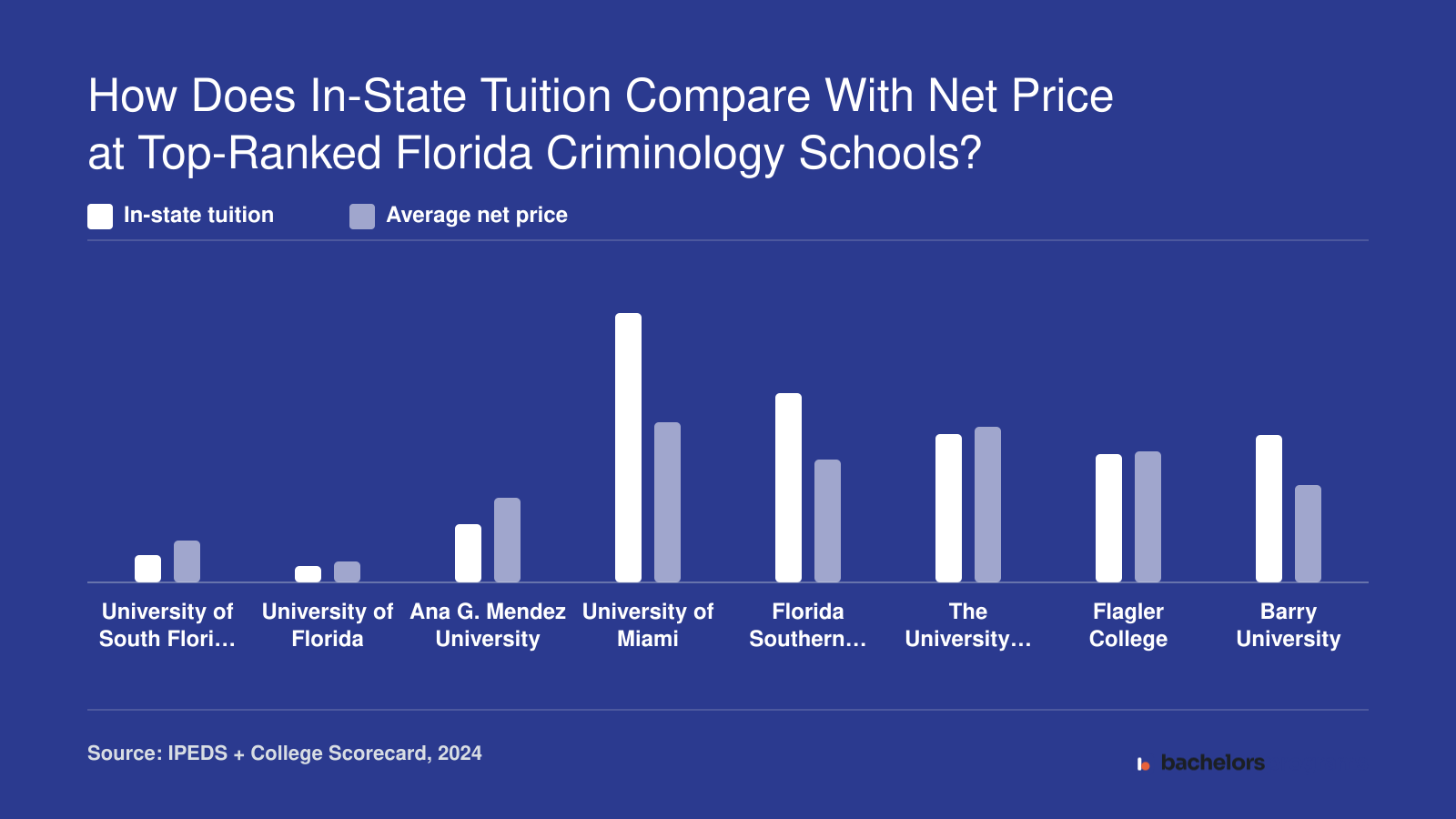
How Does In-State Tuition Compare With Net Price at Top-Ranked Florida Criminology Schools?
The gap between sticker price and net price shows what a degree really costs: at the University of Miami, $62,616 in tuition falls to a $37,244 average net price, and Barry University drops from $34,350 to $22,613. At public schools like the University of Florida and the University of South Florida, net price runs above tuition because it counts housing, food and books after aid, yet still stays under $10,000. Net price is a sector-specific average: public figures reflect in-state aided students, and private figures reflect all aided students.
Florida Law Enforcement and Corrections Certification: What Criminology Graduates Need
A criminology degree does not license you to do anything, and that is the first thing to understand about working in Florida criminal justice. The state certifies officers, not criminologists. Whether the degree matters for certification depends on the job: patrol, corrections, and the analyst or advocacy roles many graduates pursue each answer that question differently.
Criminology Itself Is Not a Licensed Field
No Florida license exists for "criminologist." Regulation attaches to sworn positions, which the Florida Department of Law Enforcement oversees through the Criminal Justice Standards and Training Commission. The commission issues three separate certifications: law enforcement, corrections, and correctional probation.1
What Certification Requires
Under Florida law, applicants must be at least 19 for law enforcement and correctional probation, or 18 for corrections; be a U.S. citizen; hold a high school diploma or GED, except for correctional probation, which requires a bachelor's degree; have no felony conviction and no misdemeanor involving perjury or a false statement; have no dishonorable discharge; and show good moral character.1 Fingerprints, a background investigation with drug testing, and a medical exam follow, verified by the employing agency.
Applicants pass the Basic Abilities Test for law enforcement or corrections, though not for correctional probation.2 Then comes a basic recruit program at a commission-certified school, and finally the State Officer Certification Examination, which allows three attempts.3 Candidates have four years from the start of basic recruit training to pass and obtain sworn employment.2
Does a Bachelor's Degree Help?
A bachelor's degree is not required for law enforcement or corrections certification. It is required for correctional probation. Crime analyst and victim advocate positions are non-sworn and need no commission certification at all.
The Sequence for a Graduate
The practical order is degree, then Basic Abilities Test, then academy, then the state exam, then agency hire, all inside that four-year window.
Careers and Pay for Florida Criminology Graduates
What can you do with a bachelor's degree in criminology in Florida, and what does it pay? The degree feeds directly into local police departments, sheriff's offices, probation and corrections agencies, forensic labs, and court and analyst roles. Sworn positions still require the state's academy and certification route, so the bachelor's degree in criminology matters most for specialist units, promotion, and supervisory tracks.
Five Common Paths and Their Pay
Figures below are national Bureau of Labor Statistics medians from May 2025, with projections for 2025 to 2035.
- Police officer or detective: median $77,310 a year; 3% projected growth; about 60,100 openings a year.1
- Probation officer or correctional treatment specialist: median $66,270; 3% growth; about 7,900 openings a year. A bachelor's is the typical entry-level credential.2
- Correctional officer: median $58,850; a projected 7% decline, but roughly 30,000 openings a year as people leave the field. A high school diploma is typical entry.3
- Forensic science technician: median $72,060; 13% growth, the strongest of the group; about 2,800 openings a year. A bachelor's is typical.4
- Crime analyst: federal data groups detectives and criminal investigators together, so analyst salaries vary by agency and are best checked with the department itself.
Reading the Earnings Numbers Correctly
Program-level earnings and occupation wages answer different questions. Graduates of the schools ranked here report median earnings of roughly $50,800 to $68,000 five years after finishing, with median debt of about $15,000 to $25,000. Those figures cover every graduate of the program, including people who moved into law, insurance, or federal work. Occupational medians describe one job across the whole country. Use the first to judge the program, the second to judge the career, and check current Florida postings for local starting pay.
Related Articles
Compare Criminology programs on the data that matters
Explore more Criminal Justice & Law majors or browse every field of study.
All Criminal Justice & Law programs Browse every field of study