Best Criminal Justice Schools in Florida
Compare 34 accredited Criminal Justice programs in Florida, with net price after aid, graduation rates, earnings and debt from IPEDS and the U.S. College Scorecard.
A bachelor's degree in criminal justice, most often a Bachelor of Science (B.S.) in Criminal Justice, fits Florida well. The state runs large municipal police departments, county sheriff's offices, a major corrections system, and busy court circuits, and all of them hire.
Tuition is rarely the obstacle at the public universities here, where in-state tuition and fees run from $4,879 to $6,565 a year. The harder questions are what graduates actually earn, whether a program fits a working schedule, and how it connects to hiring.
A degree does not replace Florida's separate officer certification, so internship access to local agencies often matters as much as the diploma.
Key Points
- Indian River State College charges $2,764 in annual in-state tuition and fees.
- Nova Southeastern University graduates post the top four-year earnings figure: $71,972.
- Florida police candidates must be at least 19 and earn CJSTC certification.
Best Criminal Justice Schools in Florida: Our Top 10
Every school below is ranked, and every one of them offers a bachelor's degree in criminal justice or a closely related criminology degree, so you can compare like with like. The net price after aid and graduation rate shown on each card are institution-wide figures for the school, not figures for the criminal justice major, and the price is an approximate figure rather than a quote for the program.
Florida State University
#1Tallahassee, FL · ~$11,000/yr (est.)
Best for: Students seeking a research-driven criminology core
Florida State University's College of Criminology and Criminal Justice is one of the most established criminal justice programs in the state, awarding a BS or BA in Criminology with a criminal justice focus. The degree takes 120 credit hours, including 36 hours of criminology coursework and four core courses passed with a C or higher. Students can complete an optional one-semester, full-time internship, and instruction runs in person in Tallahassee or through online and distance learning open to all FSU students. Eligible students may also take up to 12 graduate credits through a bachelor's-to-master's pathway.
- 120 total credit hours
- 36 hours of criminology coursework
- Four core courses with a C or higher
- Required minor of 12-15 hours
- Optional full-time internship semester
- Fully online option available
- Bachelor's to master's pathway, 12 credits
Strayer University-Florida
#2Tampa, FL · ~$16,000/yr (est.)
Best for: Working adults balancing full-time jobs with coursework
Strayer University runs its Bachelor of Science in Criminal Justice on 11-week courses, a structure built around students who work full time and want to keep earning while they study. Six concentrations let students aim at a specific corner of the field, including digital forensics and cybersecurity, crime and criminal behavior, national security, and probation and parole. The university accepts up to 28 transfer classes and offers no-cost general education courses through Sophia Learning, along with military and employer tuition benefits.
- 6 concentration options
- 40 total courses, each 11 weeks
- 67.5 credits of criminal justice courses
- 18 credits in a required concentration
- Transfer up to 28 classes
- No-cost general education via Sophia Learning
- Employer reimbursement and military benefits
- $1,555 per course
University of Central Florida
#3Orlando, FL · ~$10,000/yr (est.)
Best for: Career changers targeting crime analysis work
The University of Central Florida offers a 120-credit bachelor's degree in criminal justice through its College of Community Innovation and Education, with a 30-credit core and 30 credits of restricted electives. Students choose the Professional Track, which embeds academy training, certifications and a required internship backed by more than 100 community partners, or the Scholar's Track, which requires a 3.2 GPA and adds graduate seminars. UCF is also one of a small number of Florida institutions authorized to deliver the Florida Department of Law Enforcement's crime analysis certificate pathway through academic coursework, a route aimed at crime analysis, intelligence and investigative support careers.
- 120 total credit hours
- 30-credit core plus 30 credits of restricted electives
- Professional Track embeds academy training and internship
- Scholar's Track requires 3.2 GPA and graduate seminars
- Internship network of 100+ community partners
- Six undergraduate certificate options
- Capstone in criminal justice ethics required
- Fully online option available
Florida International University
#4Miami, FL · ~$9,000/yr (est.)
Florida International University awards a Bachelor of Science in Criminal Justice built around police, courts and corrections, with 18 credits of core coursework, 18 credits of criminal justice electives and a senior capstone. Students also complete two Global Learning courses and a second-semester foreign language sequence. The degree is available on campus and through FIU Online, and an internship is encouraged. Full-time criminal justice employees with three years of experience may petition to substitute Ethics in Criminal Justice for a required course.
- 18 credits of core courses
- 18 credits of criminal justice electives
- 24 credits of general electives
- Senior capstone required
- Two Global Learning courses required
- Second-semester foreign language sequence
- Internship encouraged
- Available through FIU Online
Florida Atlantic University
#5Boca Raton, FL · $4,900 – $17,000/yr (est.)
Florida Atlantic University's School of Criminology and Criminal Justice awards a Bachelor of Arts in Criminal Justice with core courses, electives and a foreign language proficiency requirement, offered both on campus and online. Seniors can take up to 12 graduate credits toward the university's Master of Science in Criminology and Criminal Justice. Faculty research and evaluation work with Palm Beach County agencies and local law enforcement gives students a South Florida applied-research connection, particularly in policing, diversion and community safety. Internships, research and community engagement round out the student experience.
- Up to 12 graduate credits as a senior
- Online and on-campus formats
- Foreign language proficiency required
- Internships, research and community engagement
- Research-rich honors experiences
- Combined bachelor's and master's in criminology
University of North Florida
#6Jacksonville, FL · $10,000 – $15,000/yr (est.)
The University of North Florida requires 24 credits in the criminal justice major, covering criminological theory, research methods, juvenile justice, criminal law, law enforcement, courts and corrections, plus 6 credits of major electives. A 6-credit internship is required unless in-service students receive departmental approval to waive it, so most graduates leave with supervised field experience. Students also complete a minor, a foreign language or culture requirement, and at least 120 total hours with 48 upper-level hours. In-service officers can shape their elective choices around their agency work.
- 120 total credit hours
- 24-credit criminal justice core
- 6 credits of major electives
- 6-credit internship required
- In-service internship waiver possible
- Minor required for the major
- 48 upper-level hours required
- Foreign language or culture option
University of West Florida
#7Pensacola, FL · $5,000 – $10,000/yr (est.)
The University of West Florida offers a Bachelor of Arts in Criminal Justice covering criminology, policing, the courts, corrections and the justice system as a whole, with electives in gangs, juvenile justice, cybercrime, drugs, forensic science and homeland security. The degree runs face to face and online, and the online version is designed for full- or part-time working adults. The department awards need-based and merit scholarships each year, and students can pursue internships, research and student organizations. A separate criminal justice minor covers corrections, policing and the courts.
- Fully online option available
- Full-time and part-time study options
- Core study of criminology, policing and courts
- Electives in cybercrime, forensic science, homeland security
- Internships and student organizations
- Department scholarships each year
- Research opportunities for undergraduates
- Small class sizes
Florida Gulf Coast University
#8Fort Myers, FL · ~$13,000/yr (est.)
Florida Gulf Coast University awards a Bachelor of Science in Criminal Justice that covers law enforcement, corrections, the judiciary, juvenile justice, probation and parole, and international justice on top of a liberal arts core. Students take a set of core courses and experiences, then specialize in law enforcement, corrections, legal studies, juvenile justice, international justice, or management in criminal justice. An internship program lets students apply coursework in the field, and students who arrive with an AA or an articulated AS degree from a Florida public college can finish the upper division online. The program is built to serve as a foundation for professional practice or graduate study.
- 6 concentration options
- Upper division online for AA and AS holders
- Articulated AS degrees accepted
- Core courses cover the justice system
- Internship combines theory and practice
- Built on a liberal arts core
- Covers probation, parole and the judiciary
Ana G. Mendez University
#9Orlando, FL · ~$20,000/yr (est.)
Ana G. Mendez University awards a Bachelor of Arts in Criminal Justice through its Liberal Arts Division, taught on site at its Metro Orlando, Tampa Bay and South Florida campuses. The university also runs a separate online Bachelor of Science in Criminology, though the criminal justice bachelor's is an on-site degree. Readers comparing this program should confirm credit totals, cost and admission requirements directly with the university, since those details are not published in its program materials.
- On-site classes only for this degree
- Metro Orlando, Tampa Bay and South Florida campuses
- Housed in the Liberal Arts Division
Florida Agricultural and Mechanical University
#10Tallahassee, FL · $14,000/yr (est. net price)
Florida Agricultural and Mechanical University awards a Bachelor of Criminal Justice through its Department of Sociology and Criminal Justice, delivered online through FAMU Online. Students complete 120 semester hours with a 2.0 GPA, including 30 upper-level criminal justice credits split between 21 core hours and 9 hours in a substantive area such as legal studies, minority and gender studies, juvenile justice or corrections. An 18-credit minor is required and an internship is optional. Graduates move into law enforcement, corrections, probation, loss prevention, forensic science and law, though some of those paths require additional training or graduate study.
- 120 total credit hours
- Fully online through FAMU Online
- 2.0 GPA minimum
- 30 upper-level criminal justice credits
- 21 core hours plus 9 hours in a substantive area
- Four substantive areas including juvenile justice and corrections
- 18-credit minor required
- Optional internship available
Cost & outcomes by school
Federal data for the highest-earning Criminal Justice programs, independent of the ranking above. Earnings are this field's bachelor's graduates four years after completing where the Scorecard reports them, else the school's undergraduate median.
| School | Net price / yr | Grad rate | Earnings | Debt | Grads/yr | Format |
|---|---|---|---|---|---|---|
| Nova Southeastern University FL | $30,371 | 63% | $71,972 | $24,250 | 24 | Online or campus |
| University of Florida FL | $6,541 | 91% | $71,588 | $15,000 | — | Online or campus |
| University of Florida FL | $4,815 | 85% | $71,588 | $15,000 | — | Online or campus |
| Herzing University-Orlando FL | $19,850 | 37% | $69,601 | $19,310 | — | Online |
| Lynn University FL | $44,089 | 52% | $68,824 | $17,250 | 26 | Campus |
| Rasmussen University FL | $21,909 | 42% | $60,483 | $29,236 | 3 | Online |
| Saint Leo University FL | $21,293 | 45% | $60,389 | $25,620 | 111 | Online or campus |
| The University of Tampa FL | $36,211 | 64% | $59,436 | $24,211 | — | Campus |
| DeVry University-Florida FL | $29,477 | 33% | $58,145 | $46,957 | — | Online |
| Florida State University FL | $11,297 | 86% | $57,417 | $18,520 | 585 | Online or campus |
| Barry University FL | $22,613 | 38% | $55,966 | $26,997 | — | Campus |
| Florida International University FL | $9,288 | 74% | $55,830 | $16,829 | 428 | Online or campus |
Sources: U.S. Department of Education. Net price, graduation rate, earnings and debt: College Scorecard (earnings and debt for this field's bachelor's graduates where reported, else school-wide); graduates: IPEDS. A dash means no figure is reported.
Cost, debt & payoff
Median earnings of this field's bachelor's graduates (4 yrs after completing, else the school's undergraduate median) vs. their median federal loan debt · U.S. College Scorecard
Across these programs the median graduate earns about $53,545 and finishes with roughly $23,250 in debt — a ratio that clears a common rule of thumb (keep debt below first-year salary). Net price and debt vary widely school to school, so check the per-school figures in the table above before you shortlist.
Which Florida Criminal Justice Schools Cost the Least?
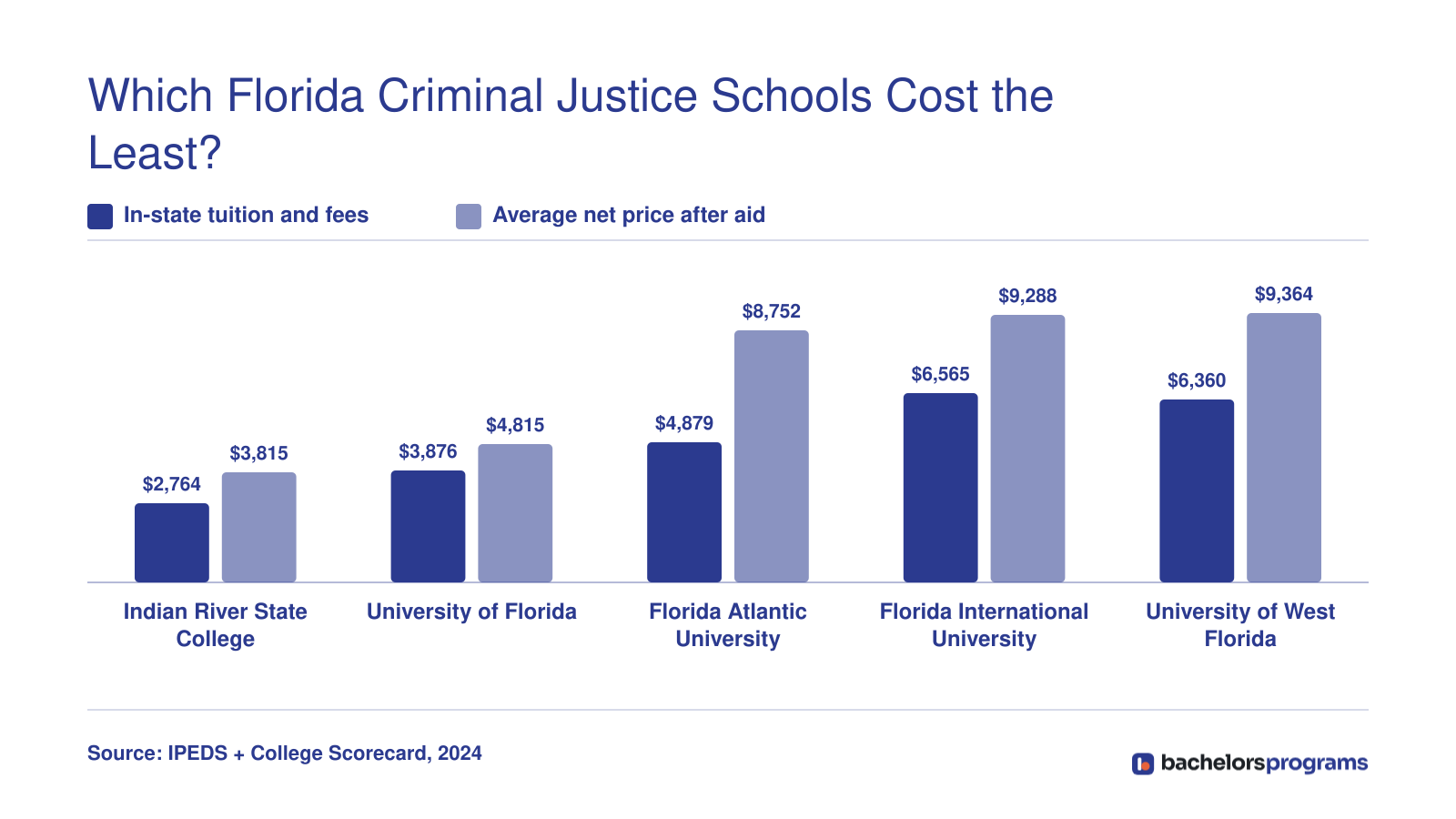
Indian River State College has the lowest prices in this comparison: $2,764 in annual in-state tuition and fees and a $3,815 average net price after aid. At each of these public schools, net price runs higher than tuition. That is because it adds housing, books and other costs before subtracting grants, and it is an average for aided in-state students that shifts with family income. Florida Atlantic University, Florida International University and the University of West Florida also appear in our top 10, while Indian River State College and the University of Florida are in our directory.
Florida Criminal Justice Schools With the Highest Graduate Earnings
Nova Southeastern University, a private school in our directory, reports the highest four-year figure at $71,972. Among the ranked public universities, Florida State University leads at five years ($55,220), with Florida International and Florida Atlantic close behind at a fraction of private tuition.
| School | City | Sector | Median Earnings, 1 Year After Graduation | Median Earnings, 4 Years After Graduation | Median Earnings, 5 Years After Graduation | In-State Tuition and Fees |
|---|---|---|---|---|---|---|
| Nova Southeastern University | Fort Lauderdale | Private nonprofit | N/A | $71,972 | N/A | $38,700 |
| Lynn University | Boca Raton | Private nonprofit | $39,496 | N/A | $59,055 | $44,480 |
| Florida State University | Tallahassee | Public | $34,922 | $57,417 | $55,220 | $5,656 |
| Florida International University | Miami | Public | $36,839 | $55,830 | $55,148 | $6,565 |
| Florida Atlantic University | Boca Raton | Public | $35,647 | $53,545 | $55,057 | $4,879 |
Online and Hybrid Criminal Justice Bachelor's Programs at Florida Schools
An online criminal justice bachelor's degree and a campus-based one lead to the same credential, but they ask different things of your week. At Florida schools, most programs sit in between: one degree, offered in more than one format.
Where the formats fall
Most of the schools ranked here list an online option alongside campus classes. Florida State University, Strayer University-Florida, the University of Central Florida, Florida International University, Florida Atlantic University, the University of West Florida and Florida Gulf Coast University all appear as "both," which means the program is offered in more than one format, not that every student blends the two. Florida Agricultural and Mechanical University lists its Bachelor of Criminal Justice as fully online. The University of North Florida and Ana G. Mendez University list on-campus delivery; at Ana G. Mendez, on-site classes are the only option for this degree.
Who online suits
Flexible coursework suits working officers adding a credential, military members and parents holding down a job, and Florida Gulf Coast notes that its online upper-division track fits shift workers. What rarely moves online is supervised field experience. North Florida requires a six-credit internship, waivable for in-service officers, and Central Florida's professional track places students through a network of community partners. International and Central Florida also require a capstone.
Confirm before you commit
Before you apply, ask two questions: do online students pay the in-state rate, and does the online program admit out-of-state students? Strayer charges the same tuition regardless of residency, while public universities often do not.
Admissions Requirements: GPA, Test Policy, and Transfer Credit
There are two usual routes into a Florida criminal justice bachelor's program: apply as a first-year student, or transfer in after an associate degree. Selectivity varies widely across the schools here, so check where each one sits before you apply.
Selectivity and Access
Florida A&M University admits about 21 percent of applicants and Florida State University about 24 percent. The University of Central Florida admits roughly 40 percent. Florida International University (about 55 percent), University of North Florida (about 53 percent), University of West Florida (about 58 percent), Florida Gulf Coast University (about 63 percent), and Florida Atlantic University (about 66 percent) are more open. Strayer University-Florida and Ana G. Mendez University report no admission rate in our data.
Access to aid points the other way. Pell Grant recipients make up about 86 percent of students at Strayer, 82 percent at FAMU, and 81 percent at FIU. At FSU the share is about 60 percent.
GPA and Test Policy
The program pages for FSU and FAMU list a 2.0 GPA minimum for the major. We did not confirm freshman GPA cutoffs or SAT/ACT policies (required, optional, or not considered) for the other schools, and we will not guess. Check each school's undergraduate admissions page before you apply, since test policies change from year to year.
The Associate-to-Bachelor's Route
Florida's statewide articulation agreement is built for students who finish an Associate in Arts (AA) at a Florida state college.1 It guarantees:
- Admission: a spot at one state university, not every university and not necessarily your first choice.1
- Credit: at least 60 credit hours toward the bachelor's degree.1
- General education: the 36-hour block, once completed at a Florida public institution, is accepted in full elsewhere in the public system.1
Two caveats matter for this field. The equivalent-course guarantee excludes criminal justice skill courses, so academy-style or skills coursework may not count. And if you transfer before finishing your AA, those guarantees do not apply, and you may have to meet freshman admission standards.
Florida law also requires targeted 2+2 pathway agreements between state colleges and state universities.2 These give AA completers guaranteed admission to a partner university and to a degree program there. You must enroll before reaching 30 credit hours.2 We could not confirm a specific criminal justice pathway at Indian River State College or Polk State College, though both offer their own bachelor's in criminal justice. Ask an advisor which agreements cover your target university. FGCU states that its online upper-division program accepts AA/AS holders and articulated AS degrees. Strayer lets you transfer up to 28 classes.
How Long It Takes
A bachelor's degree in criminal justice typically runs about four years of full-time study, or 120 credit hours at FSU, UCF, UNF, and FAMU. Arriving with a 60-credit AA leaves about 60 hours, or roughly two years full time.
Related Articles
Florida Law Enforcement Officer Certification at a Glance
What Florida Police, Corrections, and Probation Officers Earn
These are occupational wages for criminal justice jobs, drawn from U.S. Bureau of Labor Statistics data for May 2025, not earnings reported by graduates of the schools ranked above. Patrol officer figures are Florida-specific, and employment totals marked U.S. are national counts, so read the other rows as a general guide rather than an exact Florida picture. Detectives and criminal investigators earn the highest median wage here, and a bachelor's degree in criminal justice can strengthen a case for promotion into investigative roles, while probation officer positions typically require a bachelor's degree from the start.
| Occupation | Median Annual Wage | 10th Percentile | 90th Percentile | Employment |
|---|---|---|---|---|
| Detectives and criminal investigators | $93,790 | N/A | N/A | N/A |
| Police and sheriff's patrol officers (Florida) | $74,470 | $51,330 | $98,190 | 43,630 |
| Probation officers and correctional treatment specialists | $66,270 | N/A | N/A | 93,700 (U.S.) |
| Correctional officers and jailers | $58,940 | N/A | N/A | 397,800 (U.S.) |
Common Questions About Criminal Justice Degrees in Florida
These short answers pull together the main points on schools, format, cost, timelines, and police certification for anyone weighing a bachelor's degree in criminal justice in Florida.
What is the best college for criminal justice in Florida?
Which Florida schools offer an online bachelor's degree in criminal justice?
How much does a criminal justice degree cost in Florida?
How long does it take to earn a bachelor's degree in criminal justice in Florida?
Do you need a bachelor's degree to become a police officer in Florida?
Compare Criminal Justice programs on the data that matters
Explore more Criminal Justice & Law majors or browse every field of study.
All Criminal Justice & Law programs Browse every field of study