Best Early Childhood Education Schools in Florida
Compare 23 accredited Early Childhood Education programs in Florida at 22 colleges, with net price after aid, graduation rates, earnings and debt from IPEDS and the U.S. College Scorecard.

Florida programs usually award the Bachelor of Science (B.S.) in Early Childhood Education, the four-year credential that covers the state's PreK-3 subject requirements for public school classrooms. Florida schools deliver it two ways: on campus in teacher-preparation cohorts, or online for adults already working in child care.
That split matters more than the diploma name. Average annual net price after aid runs from $1,471 to $5,463 at the lowest-cost options, and only state-approved programs lead cleanly to a Professional Educator's Certificate.
Key Points
- St Petersburg College has the lowest average net price here: $1,471 a year.
- University of Florida holds full CAEP accreditation as of Fall 2024.
- Florida's Professional Certificate with PK-3 coverage requires passing state exams.
Best Early Childhood Education Schools in Florida: Our Top 10
Florida's early childhood bachelor's degrees come in two broad shapes: campus teacher-preparation tracks that lead to PreK-3 certification, and fully online completion degrees built for people already working in child care. The ten schools below are all based in Florida and range from large research universities to state colleges that finish the degree in four semesters. Each entry highlights what the school does distinctively for early childhood majors.
University of Florida
#1Gainesville, FL · ~$7,000/yr (est.)
Best for: Working adults seeking fully online certification
A flagship research university in Gainesville whose early childhood education degree is delivered through UF Online, so students across Florida can complete the teacher preparation sequence without relocating. The program is built around Florida certification from age three through grade three and stacks reading, ESOL and prekindergarten disabilities endorsements onto the core coursework. Classes stay small, and the TEACH Early Childhood Scholarship gives people already working in child care a realistic route to finish the degree.
- 54 total credit hours across a four-year plan
- Meets Florida teacher certification requirements, age 3 to grade 3
- Full-time and part-time options, fall start
- Adds Prekindergarten Disabilities, Reading and ESOL endorsements
- TEACH Early Childhood Scholarship available for early learning staff
- Average class size of 15 to 20 students
Florida International University
#2Miami, FL · ~$9,000/yr (est.)
Best for: Associate degree holders entering online study
Miami's public research university runs two distinct early childhood routes: a fully online development-focused degree for people aiming at child care and early learning settings, and a campus teacher preparation track that leads to Florida certification. The online track pairs every undergraduate with a success coach and starts three times a year, which suits students who are working while they study. Deep ties across Miami-Dade give students many places to observe and work with young children.
- 120 credit hours delivered fully online
- Three start dates per year: fall, spring and summer
- Success coach assigned to every undergraduate
- Open to students with 60 lower-division credits or an associate degree
- Does not lead to teacher certification
- In-state tuition about $236 per credit hour plus fees
- Prekindergarten/Primary concentration, age 3 through grade 3
- Leads to State of Florida teacher certification
- Reading and ESOL endorsements included
- 120 total credit hours with two concentration options
- Coursework spans child development, family studies and assessment
University of Central Florida
#3Orlando, FL · ~$10,000/yr (est.)
Best for: Students exploring Child Life and ABA pathways
One of the largest universities in the country, UCF builds its early childhood degree around a long menu of career pathways rather than a single classroom-teacher outcome. Students can shape the major toward Child Life, applied behavior analysis, exceptional education, human services or nonprofit management, and practicum placements reach into hospital settings. The Orlando location and flexible pathway structure suit students who are not yet certain they want a PreK-3 classroom.
- 120 credit hours ending in a semester-long practicum
- Nine career pathways, including Child Life and Applied Behavior Analysis
- 2.75 overall GPA required, with provisional admission at 2.5
- Hospital-based practicum sites, including Nemours Children's
- 40-hour applied behavior analysis practicum with a supervisor
- Associate in Arts from a Florida institution accepted
University of South Florida
#4Tampa, FL · ~$10,000/yr (est.)
USF's Tampa campus runs a cohort-based early childhood program that is explicitly a state-approved teacher preparation route to PreK-3 certification. Four staged internships and an on-campus preschool lab school give students unusually early and repeated time in front of young children. Graduates leave prepared for classroom teaching as well as director, curriculum and family engagement roles in early learning centers.
- 60 credit hours in a full-time cohort format
- State-approved teacher preparation leading to Florida PreK-3 certification
- ESOL and Reading endorsements included
- Four progressive internships in PreK-3 classrooms
- On-campus Preschool for Creative Learning lab school
- Prepares for teaching, center director and curriculum specialist roles
University of North Florida
#5Jacksonville, FL · $10,000 – $15,000/yr (est.)
Jacksonville's public university offers a fully online, non-licensure early childhood degree built for people already working in the field. Students can often complete the final practicum at their own workplace with advisor approval, and rolling admission allows starts in fall, spring or summer. The T.E.A.C.H. scholarship, which covers up to 90 percent of tuition and books for eligible early childhood employees, makes this one of the more practical routes for working teachers.
- 120 credit hours, fully online and non-licensure
- Rolling admission with fall, spring and summer starts
- Practicum may be completed at your own workplace
- T.E.A.C.H. scholarship covers up to 90 percent of tuition and books
- Level 2 background check with fingerprints before upper-level courses
- Coursework also supports a path toward Florida PreK/Primary certification
Florida Gateway College
#6Lake City, FL · $5,000 – $10,000/yr (est.)
A state college in Lake City that has turned its early childhood bachelor's degree into a short, fully online completion program for students who already hold an associate degree. Full-time students can finish the 120 credits in four semesters, and the program holds accreditation from the early childhood higher education commission through March 2029. Field experiences and an internship span birth to age eight, so graduates are ready for both child care and early classroom roles.
- 120 credit hours; full-time students finish in four semesters
- Entirely online, with full-time and part-time tracks
- Requires a conferred A.A. or A.S. degree and a 2.0 GPA
- Accredited by the early childhood higher education commission through March 2029
- Field experiences and internship cover birth to age 8
- New starts at the beginning of each semester
Miami Dade College
#7Miami, FL · $2,800 – $10,000/yr (est.)
Miami Dade College's state-approved teacher education program is one of the few in Florida that awards certification for both birth to age four and age three to grade three. Three endorsements in ESOL, prekindergarten disabilities and reading are built into the degree, and the program satisfies all Head Start mandates. Clinical experience runs through most courses, and the schedule is shaped for working students.
- State-approved teacher education program
- Florida certification in Birth to Age 4 and Age 3 to Grade 3
- ESOL, Prekindergarten Disabilities and Reading endorsements
- Degree satisfies all Head Start mandates
- Field experience and a Level II background check required
- Built for working students, with extensive clinical hours
Florida Gulf Coast University
#8Fort Myers, FL · ~$13,000/yr (est.)
Florida Gulf Coast University folds reading, ESOL and disability endorsements directly into its PreK-3 early childhood degree rather than treating them as add-ons. Students work in two university early learning centers and complete clinical placements across Lee and Collier county schools. Scholarships of up to $5,000 are available in the junior and senior years, which helps offset the cost of the final clinical semesters.
- PreK-3 concentration with Reading, ESOL and Disability endorsements
- Clinical placements in Lee and Collier county school districts
- Fieldwork at two FGCU Early Learning Centers
- Scholarships up to $5,000 in the junior or senior year
- Internship experiences paired with child development coursework
- Emphasis on family and community partnerships
Saint Johns River State College
#9Palatka, FL · ~$6,000/yr (est.)
A state college in Palatka offering a hybrid early childhood bachelor's degree that blends online coursework with on-campus sessions. The program prepares students for the Florida Teacher Certification Examinations and points them to fee and registration resources, including waivers for military members. Two start dates a year and a 10K Bachelor's Degree option keep the path affordable and predictable.
- Hybrid format combining online and on-campus coursework
- Fall and spring starts, with August 1 and December 1 deadlines
- Program code 7000
- FTCE exam fee and registration resources for students
- 10K Bachelor's Degree option available
- Military certification fee waivers available
Santa Fe College
#10Gainesville, FL · ~$11,000/yr (est.)
Santa Fe College in Gainesville focuses its early childhood bachelor's degree on children from birth through age four, with a curriculum that emphasizes anti-biased teaching practice. Coursework mixes in-person, hybrid and online classes, and every internship happens in Alachua or Bradford County classrooms and centers. Upper-division courses run once a year, so students should map their sequence early.
- Birth through age four focus
- Mix of in-person, hybrid and online classes at the Northwest Campus
- Internships in Alachua or Bradford County
- 2.5 GPA and EDF1005 with a C or better required
- 18 lower-level plus 39 upper-division early childhood credits
- Upper-division courses offered once per year
Cost & outcomes by school
Federal data for the highest-earning Early Childhood Education programs, independent of the ranking above. Earnings are this field's bachelor's graduates four years after completing where the Scorecard reports them, else the school's undergraduate median.
| School | Net price / yr | Grad rate | Earnings | Debt | Grads/yr | Format |
|---|---|---|---|---|---|---|
| Nova Southeastern University FL | $30,371 | 63% | $59,209 | $24,250 | 26 | Online |
| Florida Gulf Coast University FL | $12,568 | 57% | $58,115 | $17,989 | 87 | Campus |
| Barry University FL | $22,613 | 38% | $55,966 | $26,997 | — | Campus |
| Miami Dade College FL | $5,463 | 46% | $55,276 | $9,252 | 37 | Campus |
| Florida International University FL | $9,288 | 74% | $53,854 | $16,100 | 226 | Online |
| University of Florida FL | $6,541 | 91% | $53,079 | $14,757 | 40 | Online |
| St Petersburg College FL | $1,471 | 38% | $52,047 | $19,000 | 42 | Online or campus |
| College of Central Florida FL | $12,088 | 45% | $52,015 | $13,000 | 14 | Campus |
| Northwest Florida State College FL | $4,571 | 39% | $51,900 | $11,750 | 40 | Online or campus |
| University of Central Florida FL | $10,411 | 78% | $51,784 | $18,750 | 449 | Campus |
| University of South Florida FL | $9,812 | 77% | $51,650 | $18,577 | 127 | Campus |
| Saint Johns River State College FL | $6,135 | 49% | $50,390 | $12,500 | 26 | Hybrid |
Sources: U.S. Department of Education. Net price, graduation rate, earnings and debt: College Scorecard (earnings and debt for this field's bachelor's graduates where reported, else school-wide); graduates: IPEDS. A dash means no figure is reported.
Cost, debt & payoff
Median earnings of this field's bachelor's graduates (4 yrs after completing, else the school's undergraduate median) vs. their median federal loan debt · U.S. College Scorecard
Across these programs the median graduate earns about $51,717 and finishes with roughly $16,100 in debt — a ratio that clears a common rule of thumb (keep debt below first-year salary). Net price and debt vary widely school to school, so check the per-school figures in the table above before you shortlist.
Cheapest Bachelor's Degrees in Early Childhood Education in Florida
Among the five lowest-cost options, average annual net price after aid runs from $1,471 at St Petersburg College to $5,463 at Miami Dade College, while in-state tuition and fees stay within a narrow $2,583 to $3,100 band. The table lists both figures side by side, based on 2024 IPEDS and College Scorecard data from the U.S. Department of Education: tuition is the published in-state sticker price, and net price is what students actually paid after grants and scholarships. All five are public Florida colleges, where net price is reported for in-state students receiving aid, and no private institution reaches this lowest-cost group.
| School | City | Program | Format | In-State Tuition and Fees (per year) | Average Net Price After Aid (per year) | What to Know |
|---|---|---|---|---|---|---|
| St Petersburg College | St. Petersburg | Educational Studies and Community Leadership B.S., Early Childhood Education Subplan | Campus and online | $2,682 | $1,471 | Does not lead to teacher certification; preschool specialization for birth to age 4 |
| Florida State College at Jacksonville | Jacksonville | Early Childhood Education (B.S.) | Campus and online | $2,878 | $4,128 | Prepares for the Florida Educator Certificate; ESOL and Reading endorsed |
| Northwest Florida State College | Niceville | Early Childhood Education, Birth through Four | Campus and online | $2,583 | $4,571 | Focus on children ages 0 to 4; career ladder from an A.S. in ECE |
| Florida Gateway College | Lake City | Early Childhood Education, B.S. | Online | $3,100 | $5,364 | Fully online; requires a conferred A.A. or A.S. degree |
| Miami Dade College | Miami | Early Childhood Education Bachelor of Science | Campus | $2,838 | $5,463 | State-approved teacher education program covering Birth to Age 4 and Age 3 to Grade 3 |
Online and Hybrid Bachelor's Options at Florida Schools
Online delivery is now standard in early childhood teacher preparation, but programs still disagree about how much of the degree can happen away from a classroom. At Florida colleges, the answer depends on program type. Several schools here list fully online bachelor's programs, among them UF, FIU, UNF and Florida Gateway. UCF, USF, Miami Dade and FGCU list campus programs, and Saint Johns River State and Santa Fe list hybrid formats that mix online coursework with in-person sessions.
Where Online Students Do Fieldwork
UF Online's Bachelor of Arts in Education in Early Childhood Education is fully online and leads to initial PreK-Grade 3 licensure with PreK Disabilities, ESOL and Reading endorsements. The program includes practicum and internship courses, and student teaching takes place in Florida public schools. Placements are arranged around program objectives and the student's professional goals; an elementary placement outside Alachua County requires department approval. Students arrange transportation and complete background screening and district fees. UNF's online program lists practicum at your current workplace as an option, which helps working students.
Format, Timeline and Certification Checks
UF describes the degree as a four-year program, with a two-year option for students who enter with an associate degree; part-time study or transfer credit can change that timeline. Online study offers scheduling flexibility, but it does not remove the in-person practicum and student-teaching hours. Campus and hybrid programs build those hours into a local schedule, while online students often need a Florida school or early childhood site near them. Before enrolling, confirm whether the online track leads to Florida certification. UF Online's program is designed for initial licensure; FIU's online early childhood development track states that it does not lead to teacher certification.
CAEP Accreditation and Florida-Approved Programs: What to Verify
University of Florida holds Full Accreditation from CAEP at the initial-licensure level as of Fall 2024.1 University of North Florida also has full initial-licensure accreditation, though the effective term is not shown.1 Florida Agricultural and Mechanical University, Florida Gulf Coast University, Florida International University and University of South Florida appear as CAEP-accredited providers, but current 2026 decisions could not be confirmed. For University of Central Florida, Miami Dade College and the other state colleges here, CAEP status could not be confirmed.
Two Different Approvals
CAEP is a national accreditor that reviews an educator preparation provider as a whole, not each individual degree.2 The Florida Department of Education separately approves specific preparation programs, and that approval is what links a degree to state certification. No FDOE approved-program listing was available to check, so state approval for any particular program here is unconfirmed.
Schools describe their own programs. University of South Florida and Miami Dade College call theirs state-approved, and University of Florida says its program meets Florida certification requirements. Treat those as claims to verify. Not every degree leads to licensure: the Florida International University online track says it offers no teacher certification, and University of North Florida describes its degree as non-licensure.
Verify Before You Enroll
- CAEP: Search the school in the CAEP provider search and note the accreditation level and date.
- FDOE: Look for the exact degree title in the state's educator preparation program listings.
- Admissions: Ask in writing whether the program leads to PreK-3 certification.
Completing an approved program is the most direct route to a Florida educator certificate. Without it, you may need extra coursework or exams after graduating.
Related Articles
Admissions: GPA, Test Policy and Transfer Credit
Admission to a bachelor's degree in early childhood education in Florida often happens in two stages: general admission to the school, then entry to the education major. These details come from each school's own program or admissions documents. Confirm them before you apply.
- Minimum GPAThe University of Florida sets a 2.6 GPA minimum. Florida State College at Jacksonville requires a 2.5 GPA on the general-education component. Northwest Florida State College's pathway asks students to keep both their overall and NWFSC GPAs at 2.0 or higher, and it does not publish a separate admission GPA.
- SAT/ACT policyUF is not test-optional. Transfers need a score earned within the last 10 years, either a passing FTCE General Knowledge score or listed minimums such as SAT Reading/Writing 560 and Math 540, or ACT Reading 23, English 22 and Math 22. FSCJ's and NWFSC's program documents state no program-specific test policy.
- A.A. degree and transfer creditUF transfer applicants need an A.A. and at least 60 credits. FSCJ accepts an A.S. in Early Childhood Management/Education or a General Education A.A., with 60 or more transferable credits toward its 120-credit degree.
- Florida College System 2+2 pathwayFSCJ's B.S. is part of Florida's 2+2 Program. UF Online upper-division transfers need an A.A. or bachelor's from a Florida public institution, or a parallel general-education program.
- Education-major entry stepUF's major is limited-access and requires EDF 1005 plus Human Growth and Development or Developmental Psychology, each with a B or better. FSCJ and NWFSC require EDF 1005 with a C or higher. FSCJ also asks for a 350–500-word essay in APA format.
Cost of a Bachelor's Degree in Early Childhood Education in Florida
A Florida bachelor's degree in early childhood education costs less than most families expect, especially for residents who plan their route carefully.
Tuition and Net Price
In-state tuition and fees start at about $2,600 at Saint Johns River State College and reach about $6,600 at Florida International University. Out-of-state rates climb from roughly $9,300 at Saint Johns River State College to about $28,700 at the University of Florida. After grants, average net price for the ranked schools with reported figures runs from about $5,400 at Florida Gateway College to about $9,800 at the University of South Florida, averaging near $7,100. These are institution-wide figures, not program-specific, so treat them as a guide.
State Aid
- Florida Bright Futures: Requires Florida residency, U.S. citizenship or eligible noncitizen status, and enrollment in at least 6 non-remedial credits.1 The 2026-27 application window runs October 1, 2026 to August 31, 2027.1 Four award tiers exist, each with its own GPA and service requirements, so confirm current dollar amounts with your school.
- Florida Student Assistance Grant: Need-based aid for resident undergraduates with no prior bachelor's degree.2 Public institutions require at least 6 credits per term; private schools require 12.
- Teacher scholarships: The University of Florida lists a TEACH Early Childhood Scholarship. Current eligibility and service terms for Florida teacher scholarships and loan forgiveness were not confirmed here, so ask each school's financial aid office whether an early childhood major qualifies.
Debt and Time to Degree
Where program data exists, typical completer debt falls between about $12,500 (Saint Johns River State College) and $18,600 (University of South Florida). These come from small graduating classes, so read them cautiously. The degree usually takes about four years, or 120 credits. With an A.A. transfer, it can take roughly two more years. Florida Gateway College, for example, lists a four-semester program and about $7,000 in total program tuition.
A Practical Money-Saver
Start at a Florida College System school, finish an A.A., then transfer into the bachelor's. Lower-division tuition is the cheapest in the state, and several colleges here award the bachelor's themselves.
Florida Teacher Certification for Prek-3 With a Bachelor's Degree
Professional vs. Temporary Certificates
To teach PreK-3 in a Florida public school, you need the Prekindergarten/Primary (PK-3) coverage on a Florida Educator Certificate.1 The Professional Certificate is the full credential. It generally requires completing the PK-3 subject-area and professional preparation requirements, including passing the required exams or an approved alternative.2 A Temporary Certificate is time-limited. It lets you teach while you finish the Professional requirements, and you then apply to upgrade. Requirements differ by route, prior certificate, degree and exam history, so confirm your own checklist with the Florida Department of Education.
FTCE Exams for PK-3
- General Knowledge: required unless an exemption or alternative pathway applies to you.
- Professional Education Test: $150 under the fee schedule in effect since 2023.3
- PK-3 Subject-Area Examination: $150, with four subtests covering Language Arts and Reading, Social Science, Science and Mathematics.3
Certification application fees are separate from exam fees. Florida charges $75 per subject for an initial application, $75 to upgrade from Temporary to Professional, and $75 per subject to add a coverage or endorsement.4
Endorsements
You can add ESOL and Reading endorsements to a valid Temporary or Professional Certificate, at $75 per subject.4 If you want to work with young children with disabilities, ask the certification office which coverage or endorsement fits your route before you plan coursework.
Birth-to-Five VPK vs. PreK-3 Public Schools
The two tracks have different requirements:
- VPK track: Instructors need at least a Florida Child Care Professional Credential.5 Lead instructors complete 15 hours of training on Florida's Early Learning Standards.6 Emergent literacy courses run 20 hours each (2.0 CEUs).7
- Summer VPK: Instructors need a Temporary or Professional Florida Educator Certificate in any area, plus a degree in a field such as early childhood, preK/primary or elementary education.8
- Public school PK-3: Teachers need the full certification path described above.
A birth-through-four program like Northwest Florida State College's fits the childcare track.
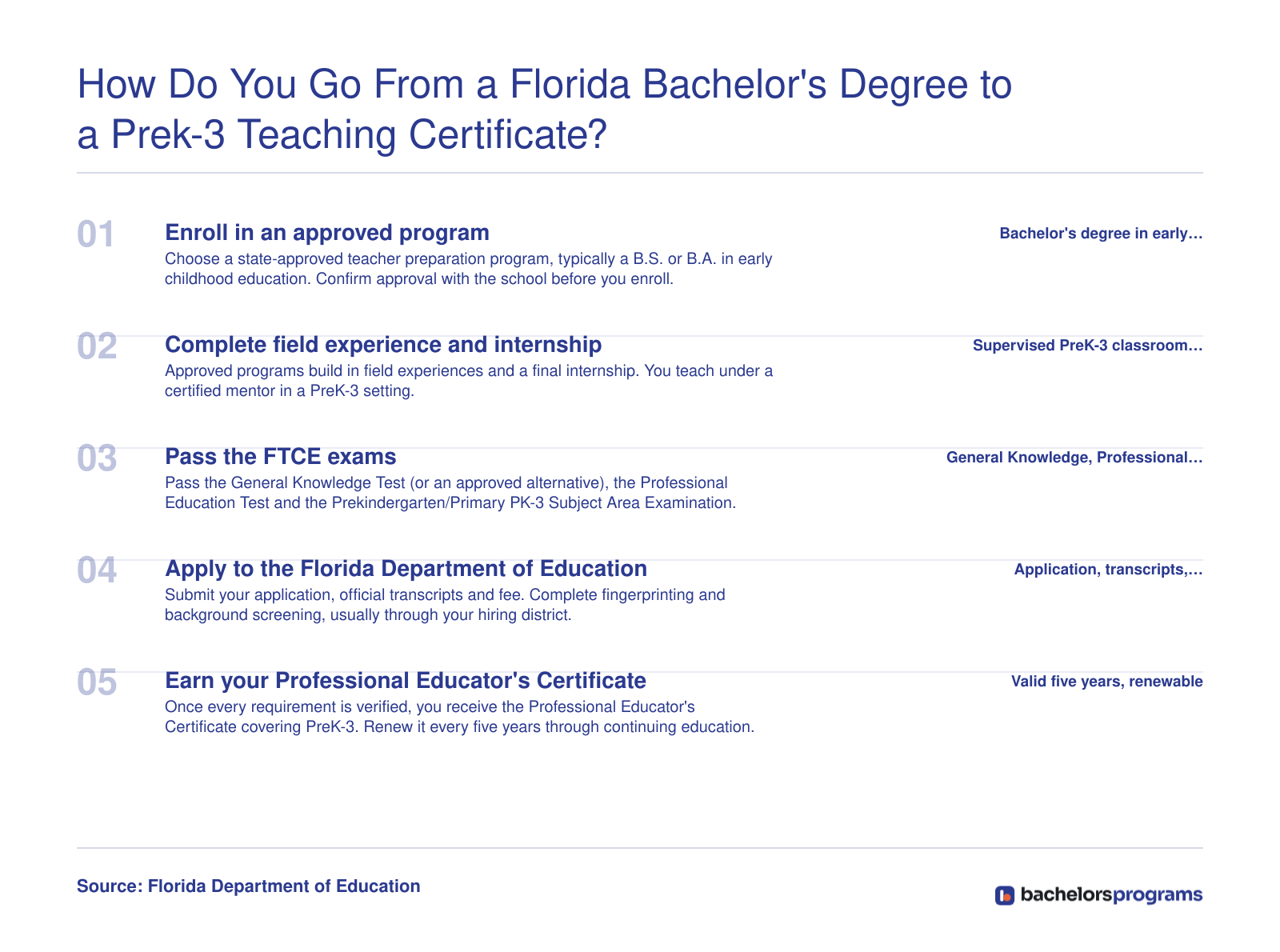
How Do You Go From a Florida Bachelor's Degree to a Prek-3 Teaching Certificate?
Florida's route to a PreK-3 classroom follows a set order: finish an approved program, pass the state exams, then apply for certification. Graduates of state-approved programs who meet every requirement can qualify directly for the Professional Educator's Certificate.
Careers and Salary Outlook for Early Childhood Education Graduates in Florida
Demand for early childhood educators is holding steady rather than surging, and pay depends heavily on the setting: a public school classroom or a childcare center. Wage figures come from the Bureau of Labor Statistics (May 2025), and growth projections cover 2025-2035.
Where a Bachelor's Degree Leads
Graduates typically move into one of these roles:
- PreK-3 public school teacher: Requires a bachelor's degree and Florida certification.
- Preschool teacher: Works in childcare centers, private schools and Head Start-type programs.
- VPK instructor: Teaches in Florida's Voluntary Prekindergarten program, where credential requirements vary by provider.
- Childcare center director: Manages staff, licensing compliance and budgets.
- Early intervention roles: Support infants and toddlers with developmental delays, often with added training or credentials.
Wages and Job Growth
Florida preschool teachers (except special education) earned a median of $35,860 in 2025.1 Nationally, employment for the group is projected to grow 4% from 2025 to 2035.1 A Florida-specific growth rate was not established in the sources reviewed.
Florida preschool and childcare center directors earned a median of $56,750, against $59,300 nationally.4 National employment for directors is projected to decline 3% (about 2,900 jobs), though roughly 5,200 openings a year are still expected from turnover.5
Florida medians for kindergarten and elementary teachers were not established, so national figures stand in: $62,680 for kindergarten and $63,970 for elementary.2 Growth is projected at 0%, but about 99,400 openings a year are expected across the two groups, mostly to replace teachers who leave.3
Reading the Numbers Together
The gap is clear. Public school teaching pays roughly $27,000 to $28,000 more than Florida preschool teaching, using the national figure as a benchmark, and a bachelor's degree is the gateway to that route and to director posts. These occupation-wide wages are separate from the graduate earnings figures for individual schools covered earlier. Those track alumni of specific programs, while these describe every worker in a job category, so do not compare the two directly.
Compare Early Childhood Education programs on the data that matters
Explore more Education & Teaching majors or browse every field of study.
All Education & Teaching programs Browse every field of study